4130 Steel: Chemical Composition, Properties, Hardness, Heat Treatment and Applications
📑 Table of Contents
🧪 2. 4130 Steel Chemical Composition
⚙️ 3. 4130 Steel Properties and Mechanical Performance
🔥 4. 4130 Steel Heat Treatment
🔧 6. Welding and Machining of 4130 Steel
🔄 8. 4130 Steel Equivalent Grades and Comparisons
🛒 9. How to Choose and Buy 4130 Steel
🔍 1. What Is 4130 Steel?
4130 steel is a low-alloy chromium-molybdenum steel widely used for components that need a practical balance of strength, toughness, hardenability, and weldability. The AISI/SAE designation identifies a grade with moderate carbon content and controlled additions of chromium and molybdenum.
Unlike ordinary carbon steel, this alloy can achieve substantially different performance levels through heat treatment. Engineers can use an annealed or normalized condition when machining and fabrication take priority. For higher-strength components, quenching and tempering can produce a harder and stronger structure.
Another important feature is its relatively good weldability compared with many higher-carbon alloy steels. That characteristic makes 4130 attractive for fabricated structures where both mechanical performance and welding processes matter.
International buyers may encounter several designations when sourcing this material. AISI 4130 and UNS G41300 are common references, while EN 25CrMo4 / 1.7218 is often considered a closely related European grade. However, an equivalent designation should never replace a complete specification review.
From a purchasing perspective, the grade name represents only the starting point. Thickness, dimensions, delivery condition, heat treatment, hardness, mechanical properties, inspection requirements, and certification can all affect whether a particular product is suitable.
In practical terms, 4130 is a versatile Cr-Mo alloy steel for applications that require more performance than conventional carbon steel without moving to a higher-alloy material.
🧪 2. 4130 Steel Chemical Composition
The chemical composition of 4130 explains much of its engineering behavior. Carbon contributes to strength and hardenability, while chromium improves hardenability and supports wear resistance. Molybdenum also plays an important role by improving hardenability and helping the steel maintain useful properties after tempering.
Manganese contributes to strength and hardenability as well. Silicon mainly acts as a deoxidizing element and can contribute to the overall strength of the alloy. Meanwhile, phosphorus and sulfur remain controlled residual elements because excessive levels can negatively affect material performance and processing.
| Element | Typical / Specified Range (wt. %) | Engineering Role |
|---|---|---|
| Carbon (C) | 0.28–0.33 | Strength and hardenability |
| Chromium (Cr) | 0.80–1.10 | Hardenability and wear resistance |
| Manganese (Mn) | 0.40–0.60 | Strength and hardenability |
| Molybdenum (Mo) | 0.15–0.25 | Hardenability and tempering response |
| Silicon (Si) | 0.15–0.35 | Deoxidation and strength |
| Phosphorus (P) | ≤0.035 | Controlled residual element |
| Sulfur (S) | ≤0.040 | Controlled residual element |
These figures represent commonly referenced AISI 4130 composition ranges. Exact limits can vary according to the governing product specification, so the material certificate should remain the final reference for a purchase order.
For procurement teams, checking carbon alone is not enough. A small change in alloy chemistry can influence hardenability, welding behavior, heat-treatment response, and final mechanical performance. Therefore, buyers should compare the complete chemical analysis when evaluating different suppliers or potential equivalent grades.
Another useful point concerns the relatively modest carbon level. With approximately 0.28–0.33% carbon, 4130 can reach useful strength while retaining better fabrication characteristics than many higher-carbon alloy steels. That balance is one reason the grade remains popular in engineered structures.
⚙️ 3. 4130 Steel Properties and Mechanical Performance
The mechanical properties of 4130 depend strongly on its delivery condition and heat treatment. Annealed material offers better machinability, while normalized steel provides a useful combination of strength and toughness. A properly quenched-and-tempered condition can deliver considerably higher strength for demanding components.
| Property | Typical Reference Value | Condition / Note |
|---|---|---|
| Density | About 7.85 g/cm³ | Typical value |
| Elastic Modulus | About 205 GPa | Typical reference value |
| Tensile Strength | About 560 MPa | Representative annealed condition |
| Yield Strength | About 360 MPa | Representative annealed condition |
| Elongation | About 28% | Representative annealed condition |
| Normalized Hardness | Around 197 HB | Reference condition |
Normalized material can provide a useful balance for components that require moderate strength without the higher hardness of a quenched-and-tempered condition. Published reference data at approximately 870°C followed by air cooling show tensile strength around 670 MPa and yield strength around 435 MPa for a representative section.
Quenched-and-tempered 4130 can achieve considerably higher mechanical performance. For example, a representative 100 mm section treated by a suitable quenching and tempering process can reach approximately 800 MPa tensile strength, 635 MPa yield strength and 235 HB in a specific published condition.
These figures should not become universal design values. Section thickness, heat-treatment parameters, test location, product specification, and cooling conditions all influence the final result.
For engineering selection, the most useful approach is to specify the required strength, hardness, toughness, dimensions, and delivery condition together. That information allows the supplier to recommend a material condition that actually matches the component rather than relying on the grade name alone.
🔥 4. 4130 Steel Heat Treatment
Heat treatment gives 4130 much of its versatility. By controlling heating, holding, cooling, and tempering, manufacturers can adjust hardness, strength, ductility, and toughness to suit different applications.
For normalizing, a commonly referenced temperature is approximately 870°C, followed by air cooling. This treatment can refine the microstructure and establish a consistent starting condition for subsequent machining or service.
Annealing uses a lower-hardness approach. Published reference data use approximately 865°C, followed by controlled furnace cooling toward approximately 680°C before air cooling. The slower cooling cycle helps reduce hardness and improve machinability.
| Heat Treatment | Reference Temperature | Cooling Method | Typical Objective |
|---|---|---|---|
| Annealing | About 865°C | Controlled furnace cooling | Reduce hardness and improve machinability |
| Normalizing | About 870°C | Air cooling | Refine and stabilize the structure |
| Hardening | Typically around 845–870°C | Selected quenching medium | Increase hardness and strength |
| Tempering | Often around 500–600°C | Controlled cooling | Balance strength and toughness |
Quenching and tempering requires more precise control than normalizing or annealing. A typical production sequence involves heating the steel to an austenitizing temperature, holding long enough for the section to reach the required condition, quenching at a controlled rate, and then tempering at a selected temperature.
Published reference treatments include austenitizing around 855°C followed by water quenching and tempering at approximately 480°C or 540°C. Different tempering temperatures produce different combinations of strength and hardness.
Section size has a major influence on the result. A thick plate cools differently from a small section, so the center may develop a different microstructure from the surface. For that reason, heat-treatment schedules should consider thickness, furnace loading, quenching capacity, required hardness, and mechanical-property targets.
In production, the correct heat-treatment cycle should be established from the applicable material specification and the customer’s required properties rather than copied as one fixed recipe for every thickness.
📏 5. 4130 Steel Hardness
The answer to “how hard is 4130 steel?” depends on the material condition. Annealed, normalized, quenched, and tempered steel can show substantially different hardness values even though they share the same chemical grade.
Representative annealed reference data place hardness in the approximate range of 156–217 HB, depending on the treatment and test condition. A normalized reference condition can reach approximately 197 HB.
After hardening, the surface can reach much higher hardness because the rapid cooling promotes a harder microstructure. Tempering then reduces excessive brittleness while establishing the required balance between strength and toughness.
| Condition | Indicative Hardness | Typical Use Consideration |
|---|---|---|
| Annealed | Approx. 156–217 HB | Machining and fabrication |
| Normalized | Around 197 HB | Balanced strength and toughness |
| Quenched | Can exceed 40 HRC | High hardness before tempering |
| Quenched & Tempered | Depends on tempering cycle | Strength-toughness balance |
Hardness alone, however, should not determine material selection. A component subjected to impact or cyclic loading may need toughness in addition to hardness. Similarly, a machining project may benefit more from a softer delivery condition than from maximum strength.
When purchasing, specify the required hardness range or mechanical-property class whenever the project requires controlled performance. The material certificate should then provide the relevant test results and delivery condition.
🔧 6. Welding and Machining of 4130 Steel
Welding is one of the reasons engineers select 4130 for fabricated structures. Its moderate carbon content gives it better weldability than many higher-carbon alloy steels. Even so, the chromium-molybdenum alloy system requires proper welding procedure control.
Preheating can help reduce the cooling rate and lower the risk of hydrogen-related cracking. The appropriate preheat temperature depends on thickness, carbon equivalent, welding process, joint design, filler metal, and material condition.
Interpass temperature also deserves attention. Excessive heat input can affect the microstructure and mechanical performance, while insufficient control can increase cracking risk. Therefore, qualified welding procedures should define the relevant parameters for critical components.
Post-weld treatment depends on the application and governing specification. Some fabricated parts may require stress relief or additional heat treatment, while other projects can use a qualified welding procedure without a separate post-weld cycle.
Machining behavior changes with hardness as well. Annealed 4130 generally machines more easily than a high-strength quenched-and-tempered condition. For that reason, manufacturers often complete rough machining in a softer condition and perform final heat treatment before finishing operations.
For steel plate processing, dimensional allowance matters too. Heat treatment can cause distortion or dimensional movement, especially in larger sections. Leaving suitable machining allowance gives the workshop room to restore the final dimensions after treatment.
Good results come from coordinating material condition, machining allowance, welding procedure, and heat treatment before production begins.
🏭 7. 4130 Steel Applications
The combination of strength, toughness, hardenability, and weldability gives 4130 a broad range of engineering applications. Designers often select it when a component must withstand mechanical loads while remaining practical to fabricate and machine.
- Aerospace structures: The grade is widely associated with lightweight structural components where strength and weldability are important.
- Motorsport structures: Its strength-to-weight characteristics and fabrication performance make it suitable for selected high-performance assemblies.
- Industrial machinery: Properly heat-treated material can serve in mechanically loaded structural and machine components.
- Oil and gas equipment: The alloy can provide useful strength and toughness for suitable components within the applicable specification.
- Fabricated structures: Weldability combined with moderate alloy content makes it useful for engineered assemblies.
- Mechanical components: Designers can select different delivery and heat-treated conditions according to required strength and hardness.
Application selection should begin with the actual service conditions rather than the material name. Engineers should consider load type, fatigue exposure, impact, operating temperature, section thickness, surface condition, corrosion environment, and fabrication method.
For example, a welded structure may prioritize weldability and toughness, while a highly loaded machined component may place greater emphasis on tensile strength and hardness. The same grade can therefore require different processing routes depending on its final function.
Another consideration is section thickness. Larger sections may develop different properties between the surface and center after heat treatment. Consequently, critical projects should define mechanical testing requirements and acceptance criteria in advance.
🔄 8. 4130 Steel Equivalent Grades and Comparisons
Searches for a 4130 steel equivalent often lead buyers toward European Cr-Mo grades, especially 25CrMo4 / 1.7218. These grades share a broadly similar alloy concept, but the exact chemical and mechanical requirements depend on the applicable standard.
| Designation | System | Relationship | What to Verify |
|---|---|---|---|
| AISI 4130 | AISI / SAE | Primary grade designation | Product standard and condition |
| UNS G41300 | UNS | Material identification | Chemistry and delivery condition |
| 25CrMo4 | EN | Common European comparison | Exact EN product requirements |
| 1.7218 | European material number | Associated with 25CrMo4 | Certificate and mechanical properties |
Similarity does not automatically mean interchangeability. A buyer should compare chemical composition, mechanical properties, heat-treatment condition, product dimensions, inspection requirements, and applicable design standards before approving a substitution.
A useful comparison is 4130 versus 4140. Both belong to the chromium-molybdenum alloy family, yet 4140 normally contains more carbon and offers greater hardness and strength potential. In contrast, 4130 provides a different balance that can be advantageous for welded structures and applications where fabrication remains important.
When evaluating an alternative material, use this sequence: compare chemistry → compare mechanical requirements → check heat treatment → verify dimensions → confirm inspection and certification. That process gives purchasing teams a much safer basis for material substitution.
🛒 9. How to Choose and Buy 4130 Steel
Buying 4130 for an industrial project involves several decisions before the supplier prepares a quotation. The most important step is to define exactly what the finished component requires rather than requesting the grade without additional specifications.
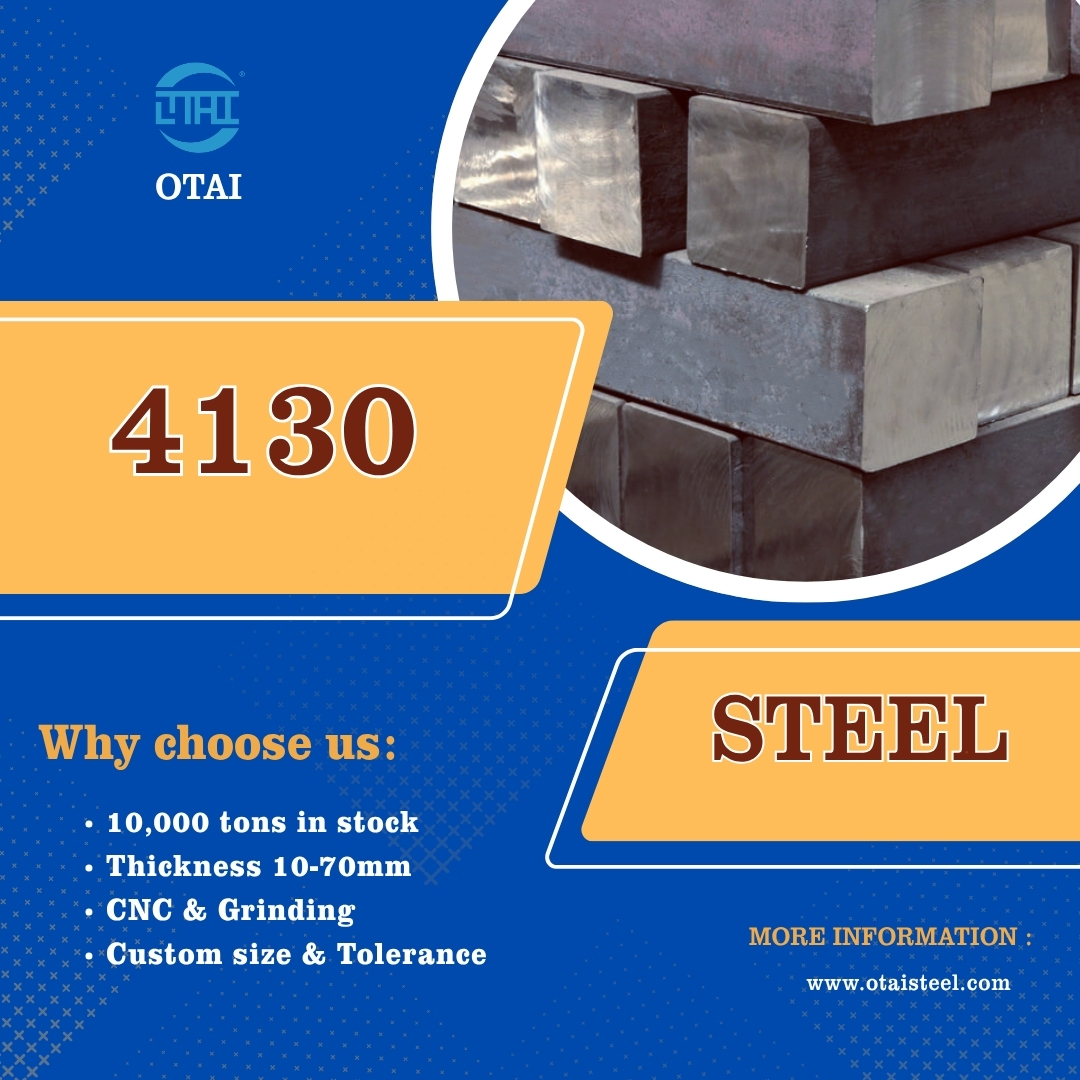
Start with the product form and dimensions. Otai currently keeps 4130 steel plate in thicknesses from 10–70 mm. This stock range can support customers who need plate for machining, fabrication, structural components, and other industrial projects.
Next, define the delivery condition. Annealed material can simplify machining, while normalized or quenched-and-tempered material may better match a specified strength requirement. If the customer has a required hardness range, that value should appear clearly in the inquiry or purchase order.
Material certification is another important point. Buyers may need a mill test certificate showing chemical composition and mechanical properties. Critical applications can also require hardness testing, ultrasonic testing, or inspection by an independent third party.
Dimensional requirements should receive the same attention. Plate thickness, length, width, flatness, cutting tolerance, and machining allowance can all affect the final manufacturing cost. A supplier capable of precision cutting can help reduce unnecessary processing at the customer’s workshop.
| Purchasing Item | Recommended Confirmation |
|---|---|
| Grade | AISI/SAE 4130 or approved equivalent |
| Product Form | Steel plate |
| Thickness | 10–70 mm available from Otai stock |
| Delivery Condition | Annealed, normalized, or specified heat-treated condition |
| Inspection | MTC, hardness, UT, or third-party inspection as required |
| Processing | Cutting, CNC machining, grinding, or heat treatment if required |
| Packaging | Anti-rust protection, straps, or wooden cases according to shipment needs |
For international procurement, supplier communication also matters. A capable 4130 steel supplier should be able to discuss material standards, dimensions, processing, inspection, packaging, and shipping requirements before finalizing the order.
That approach helps prevent a common purchasing problem: receiving material that carries the correct grade designation but does not match the required delivery condition or mechanical specification.
🏢 10. Why Choose Otai?
- 4130 steel plate in stock: Otai supplies 4130 steel plate with thicknesses from 10–70 mm, supporting industrial and project-based requirements.
- 10,000+ tons of stock: Large inventory supports stable material supply and faster order response.
- 20 saw cutting machines: Dedicated cutting equipment supports efficient processing for customer-specific dimensions.
- CNC & grinding: Additional machining services can help customers reduce the number of suppliers involved in a project.
- Custom size and tolerance: Otai can coordinate cutting and processing according to specified dimensional requirements.
- Quality inspection: Material testing, ultrasonic testing, and third-party inspection support are available for applicable orders.
- One-stop service: Cutting, machining, heat treatment, and export packaging can be coordinated through one supplier.
- International experience: Otai has exported steel to 54+ countries since 1999 and serves customers across different industrial markets.
- Export packaging: Anti-rust protection, strap packaging, and wooden box packaging can be arranged according to transportation requirements.
For overseas buyers, a steel supplier needs to do more than provide the material itself. Coordinating stock, cutting, machining, inspection, heat treatment, and packaging can simplify communication and make the purchasing process more efficient.
Otai’s approach is particularly useful when a customer needs a specific plate thickness, custom cutting, inspection documentation, or additional processing before shipment. The goal is to deliver material that fits the customer’s actual production requirements rather than simply supplying a standard steel grade.
❓ 11. FAQ
1. What is 4130 steel?
4130 is a chromium-molybdenum low-alloy steel containing approximately 0.28–0.33% carbon, 0.80–1.10% chromium, and 0.15–0.25% molybdenum. It combines useful strength, toughness, hardenability, and weldability for demanding engineering applications.
2. What is the 4130 steel equivalent?
A commonly referenced European comparison is 25CrMo4 / 1.7218. However, buyers should compare the complete chemical composition, product standard, mechanical properties, delivery condition, and inspection requirements before accepting it as a direct substitute.
3. What is the hardness of 4130 steel?
Hardness varies with condition. Representative annealed and normalized material can fall around 156–197 HB, while hardened and quenched-and-tempered material can achieve substantially higher hardness depending on section size and the selected heat-treatment cycle.
4. What temperature is used for 4130 heat treatment?
A common normalizing reference is approximately 870°C followed by air cooling. Published annealing data use approximately 865°C with controlled furnace cooling. Hardening and tempering temperatures depend on thickness, required hardness, mechanical properties, and the applicable specification.
5. Is 4130 steel good for welding?
Yes. 4130 offers relatively good weldability for an alloy steel, but welding procedures still require control. Preheat, interpass temperature, filler selection, heat input, and any post-weld treatment should follow the requirements of the specific application and welding specification.