4130 Steel Plate: Properties, Heat Treatment, Hardness & Supplier Information
📑 Table of Contents
- 🔍 1. What Is 4130 Steel Plate?
- ⚙️ 2. 4130 Steel Plate Chemical Composition and Classification
- 📊 3. 4130 Steel Plate Mechanical Properties and Datasheet Information
- 🔥 4. 4130 Steel Plate Heat Treatment Process and Temperature
- 📏 5. 4130 Steel Plate Hardness in Different Conditions
- 🔄 6. 4130 Steel Equivalent Grades Comparison
- ⚖️ 7. 4130 vs 4140 Steel Plate: Key Differences
- 🏭 8. 4130 Steel Plate Applications
- 🚢 9. How to Choose a Reliable 4130 Steel Plate Supplier?
- 🏢 10. Otai Special Steel 4130 Steel Plate Supply Capability
- ❓ FAQ About 4130 Steel Plate
🔍 1. What Is 4130 Steel?
4130 steel plate is a chromium-molybdenum alloy steel plate widely used in engineering applications that require high strength, toughness, and good weldability. It is commonly known as AISI 4130, SAE 4130, or 4130 Chromoly steel in international markets.
For buyers searching for a reliable 4130 steel plate supplier, this grade is often selected because it provides an excellent balance between mechanical performance and manufacturing flexibility. Compared with plain carbon steel, 4130 steel offers improved hardenability and strength due to the addition of chromium and molybdenum.
What is 4130 steel plate used for?
4130 steel plate is commonly used for structural and mechanical components where engineers need high strength-to-weight performance, good fatigue resistance, and reliable welding characteristics. Typical applications include aerospace components, motorsport parts, pressure equipment, machinery structures, and industrial components.
The main alloying elements of 4130 steel are chromium and molybdenum. Chromium improves hardenability and wear resistance, while molybdenum increases strength at elevated temperatures and improves toughness after heat treatment.
When purchasing from a 4130 steel plate manufacturer or exporter, customers should confirm the material standard, thickness range, delivery condition, mechanical requirements, and inspection documents before placing an order.
| Item | Description |
|---|---|
| Steel Grade | AISI 4130 / SAE 4130 |
| Steel Type | Chromium-molybdenum alloy steel |
| Main Alloy Elements | Chromium (Cr) and Molybdenum (Mo) |
| Carbon Level | Low-to-medium carbon alloy steel |
| Main Characteristics | High strength, toughness, weldability, and fatigue resistance |
| Common Supply Condition | Hot rolled, normalized, annealed, or heat treated |
4130 steel plate is especially popular among manufacturers that need a material with both strength and fabrication advantages. Its weldability is one of the reasons why many engineers choose it instead of higher carbon alloy steels for welded structures.
However, the final performance of 4130 steel depends on factors such as plate thickness, heat treatment process, manufacturing method, and application requirements. Professional buyers normally review the 4130 steel datasheet and material certificate before confirming the purchase.
⚙️ 2. 4130 Steel Chemical Composition and Classification
The chemical composition of 4130 steel plate determines its strength, hardenability, weldability, and heat treatment response. When reviewing material data, buyers should distinguish between the standard composition range, steel mill Typical Analysis, and the actual chemistry shown on the Material Test Certificate (MTC).
The following table shows the general composition range for AISI 4130 steel according to common specifications. The exact chemistry of supplied material should always be confirmed through the supplier’s MTC.
| Element | Standard Composition Range (wt.%) | Function in Steel |
|---|---|---|
| Carbon (C) | 0.28–0.33% | Provides strength and hardness after heat treatment |
| Silicon (Si) | 0.15–0.35% | Improves deoxidation and contributes to strength |
| Manganese (Mn) | 0.40–0.60% | Improves strength and hardenability |
| Chromium (Cr) | 0.80–1.10% | Improves hardenability and wear resistance |
| Molybdenum (Mo) | 0.15–0.25% | Improves toughness and high-temperature strength |
| Phosphorus (P) | ≤0.035% | Controlled impurity element |
| Sulfur (S) | ≤0.040% | Controlled according to specification |
The combination of chromium and molybdenum gives 4130 steel better performance than many carbon steels. At the same time, its carbon content remains moderate, which helps maintain good weldability when manufacturers follow suitable welding procedures.
Some steel mills may publish a Typical Analysis based on their own production heats. This information can help customers understand normal production characteristics, but it should not be treated as a universal chemical composition for all 4130 steel plates.
For international purchasing, buyers should request:
- 4130 steel plate chemical composition report
- Material Test Certificate (MTC)
- Applicable specification information
- Thickness and tolerance details
- Inspection requirements if necessary
These documents help confirm that the supplied material matches the customer’s technical requirements.
📊 3. 4130 Steel Mechanical Properties and Datasheet Information
The mechanical properties of 4130 steel plate vary according to delivery condition, thickness, and heat treatment process. Therefore, suppliers normally provide mechanical data together with the material condition stated in the datasheet or MTC.
What are the mechanical properties of 4130 steel plate?
4130 steel plate generally provides high tensile strength, good yield strength, and excellent toughness compared with many conventional carbon steels.
| Property | Typical Reference Value |
|---|---|
| Tensile Strength | Approximately 560–850 MPa depending on condition |
| Yield Strength | Approximately 460–700 MPa depending on heat treatment |
| Elongation | Approximately 15–25% |
| Impact Toughness | Depends on testing temperature and delivery condition |
| Hardness | Depends on heat treatment condition |
For engineers selecting 4130 steel plate, mechanical properties are only one part of the evaluation process. They should also consider welding requirements, machining performance, operating environment, and final component design.
A professional 4130 steel plate supplier should provide complete technical information, including:
- Steel grade and standard
- Chemical composition
- Mechanical properties
- Dimensions and tolerance
- Heat treatment condition
- Material certificate
This information allows purchasing teams to compare suppliers accurately and select suitable material for their applications.
🔥 4. 4130 Steel Heat Treatment Process and Temperature
Heat treatment plays an important role in improving the mechanical performance of 4130 steel plate. Through controlled heating, cooling, and tempering processes, manufacturers can adjust the balance between strength, hardness, and toughness according to different application requirements.
How is 4130 steel plate heat treated?
Manufacturers commonly use normalizing, hardening, and tempering processes to achieve the required mechanical properties. The exact parameters depend on plate thickness, furnace conditions, and final performance requirements.
| Heat Treatment Process | Typical Temperature | Purpose |
|---|---|---|
| Normalizing | Approximately 870–900°C | Refines grain structure and improves mechanical consistency |
| Austenitizing / Hardening | Approximately 830–870°C | Creates suitable austenite structure before quenching |
| Quenching | After heating process | Oil quenching is commonly selected to achieve higher hardness |
| Tempering | Approximately 400–650°C | Improves toughness and reduces internal stress |
The holding time depends on plate thickness, furnace loading, and required metallurgical transformation. Therefore, suppliers normally adjust the heat treatment cycle according to actual dimensions instead of applying one fixed processing time for every order.
For critical applications, buyers should confirm whether the supplier can provide heat treatment records, mechanical testing results, and inspection documentation together with the material certificate.
A reliable 4130 steel plate supplier should understand not only the steel grade but also how heat treatment influences final component performance.
📏 5. 4130 Steel Plate Hardness in Different Conditions
Hardness is an important factor when selecting 4130 steel plate for engineering applications. However, hardness values depend on delivery condition, heat treatment process, plate thickness, and testing method.
What hardness can 4130 steel plate reach?
The hardness of 4130 steel plate changes significantly between annealed, normalized, and quenched and tempered conditions.
| Condition | Typical Hardness Reference | Application Characteristics |
|---|---|---|
| Annealed | Approximately 156–217 HB | Better machinability before final processing |
| Normalized | Approximately 200–250 HB | Balanced strength and toughness |
| Quenched and Tempered | Approximately 25–40 HRC | Higher strength mechanical applications |
| Surface Hardened | Depends on surface treatment method | Improved wear resistance at the surface |
Engineers usually select the required hardness according to operating conditions. For example, welded structures may prioritize toughness and weldability, while rotating components may require higher hardness and fatigue resistance.
When requesting a quotation from a 4130 steel plate stockist, customers should specify the required hardness range, delivery condition, and inspection standard to avoid receiving unsuitable material.
🔄 6. 4130 Steel Equivalent Grades Comparison
Because different countries use different steel standards, buyers often compare 4130 steel with similar chromium-molybdenum alloy steels from Europe, China, and other regions.
What is the equivalent grade of 4130 steel?
Common comparable grades include EN 25CrMo4, DIN 1.7218, and China 30CrMo. However, equivalent grades should be confirmed according to chemical composition, mechanical requirements, and applicable standards.
| Standard System | Grade | Region |
|---|---|---|
| AISI / SAE | 4130 | USA |
| EN | 25CrMo4 | Europe |
| DIN | 1.7218 | Germany |
| GB | 30CrMo | China |
Although these grades have similar alloy systems, they may differ in chemical limits, manufacturing specifications, and certification requirements.
For international purchasing, buyers should avoid replacing one grade with another based only on the name. A professional supplier should compare:
- Chemical composition requirements
- Mechanical properties
- Heat treatment condition
- Dimensions and tolerance
- Required certification
This approach helps manufacturers avoid unexpected differences during machining, welding, and final assembly.
⚖️ 7. 4130 vs 4140 Steel : Key Differences
4130 and 4140 steel plate are frequently compared because both belong to chromium-molybdenum alloy steel families. However, differences in carbon content and alloy composition influence their strength, hardenability, and application range.
| Comparison Item | 4130 Steel Plate | 4140 Steel Plate |
|---|---|---|
| Carbon Content | Approximately 0.28–0.33% | Approximately 0.38–0.43% |
| Main Alloy Elements | Chromium + Molybdenum | Higher carbon with Chromium + Molybdenum |
| Strength Level | High strength with good weldability | Higher strength after heat treatment |
| Weldability | Generally easier to weld | Requires more welding consideration |
| Typical Applications | Aerospace parts, welded structures, machinery | Heavy-duty shafts, gears, high-stress components |
Should you choose 4130 or 4140 steel plate?
The choice depends on application requirements. When weldability and balanced mechanical performance are important, many engineers select 4130. When higher strength and hardness are the priority, 4140 may be considered.
Therefore, buyers should evaluate operating conditions, fabrication methods, and final performance requirements instead of selecting material only by price.
🏭 8. 4130 Steel Plate Applications
4130 steel plate is widely used in industries that require high strength, good toughness, and reliable fabrication performance. Its chromium-molybdenum alloy design allows manufacturers to produce components that can withstand repeated loads, impact stress, and demanding operating conditions.
Where is 4130 steel plate used?
Engineers commonly select 4130 steel plate for aerospace structures, motorsport components, pressure-related equipment, machinery parts, and welded structural applications.
| Industry | Typical Components | Why Choose 4130 Steel Plate |
|---|---|---|
| Aerospace | Aircraft components, structural parts, landing gear components | High strength-to-weight ratio and good fatigue resistance |
| Motorsport | Roll cages, chassis components, suspension parts | Good strength with excellent weldability |
| Machinery Manufacturing | Machine frames, shafts, mechanical structures | Balanced strength and toughness after heat treatment |
| Industrial Equipment | Pressure-related components and heavy-duty parts | Reliable mechanical performance |
| Energy Industry | Special structural components | Suitable for demanding service environments |
One important advantage of 4130 steel plate is its combination of strength and weldability. Compared with many higher carbon alloy steels, 4130 provides easier fabrication when manufacturers apply suitable welding procedures and post-weld treatment.
However, engineers should consider the complete working environment before selecting the material. Factors such as temperature, loading condition, corrosion exposure, machining method, and required service life all influence the final material choice.
For this reason, experienced 4130 steel plate suppliers usually help customers evaluate not only the steel grade but also thickness, delivery condition, processing requirements, and inspection needs.
🚢 9. How to Choose a Reliable 4130 Steel Plate Supplier?
Selecting a reliable 4130 steel plate supplier is an important step for manufacturers and distributors purchasing alloy steel internationally. A suitable supplier should provide stable material quality, accurate documentation, flexible processing options, and dependable delivery.
What should buyers check before purchasing 4130 steel plate?
- Stock availability: Confirm whether the supplier maintains regular inventory and can support urgent production requirements.
- Material certification: Request MTC documents showing chemical composition, mechanical properties, and heat treatment condition.
- Dimensions and tolerance: Confirm plate thickness, width, length, and machining allowance requirements before ordering.
- Processing capability: Cutting, machining, and grinding services can reduce additional production steps.
- Quality inspection: For critical applications, buyers may require ultrasonic testing or third-party inspection.
- Export experience: International suppliers should understand export documentation, packaging requirements, and logistics procedures.
When comparing 4130 steel plate price between suppliers, buyers should evaluate the total purchasing value instead of focusing only on the material cost. Factors such as stock availability, processing service, quality stability, and delivery time can significantly influence the final project cost.
A professional 4130 steel plate manufacturer, stockist, or exporter should provide clear technical communication and help customers select suitable material according to application requirements.
Before placing an order, buyers normally prepare the following information:
- Steel grade and applicable standard
- Plate dimensions and quantity
- Delivery condition
- Mechanical property requirements
- Inspection and certification requirements
- Shipping destination
Providing complete purchasing information allows suppliers to prepare accurate quotations and avoid delays caused by specification misunderstandings.
🏢 10. Otai Special Steel Supply Capability
Otai Special Steel is a China-based special steel supplier specializing in alloy steel and tool steel products for global customers. Since 1999, Otai has supplied steel materials to international buyers and provides solutions for manufacturers, distributors, and engineering companies.
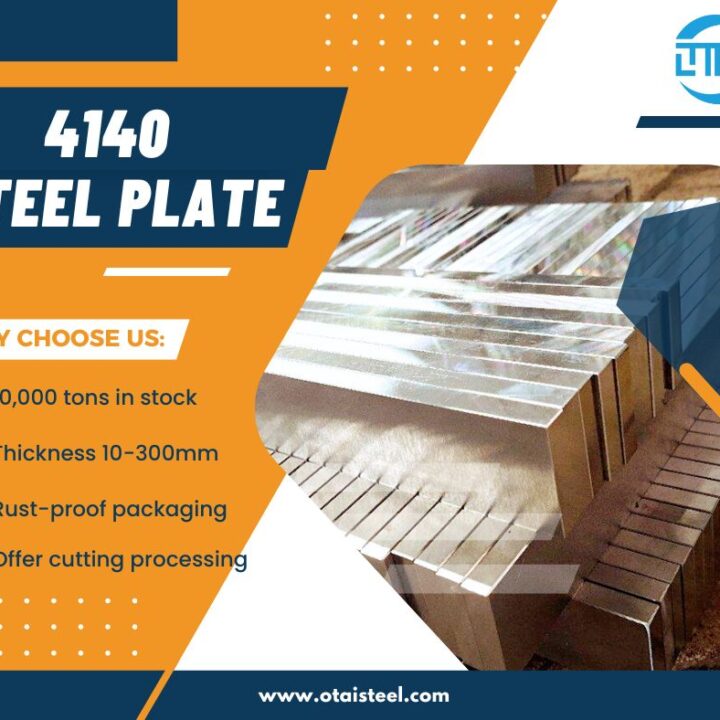
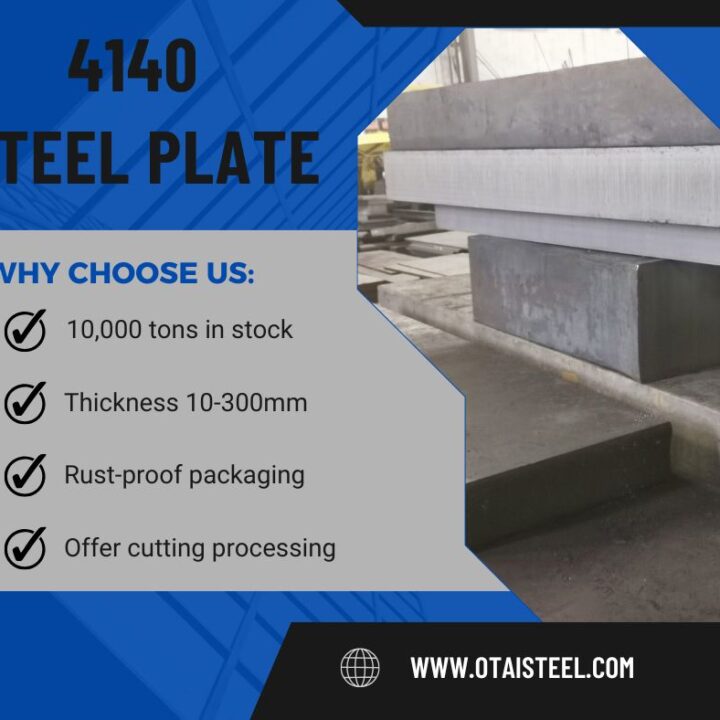
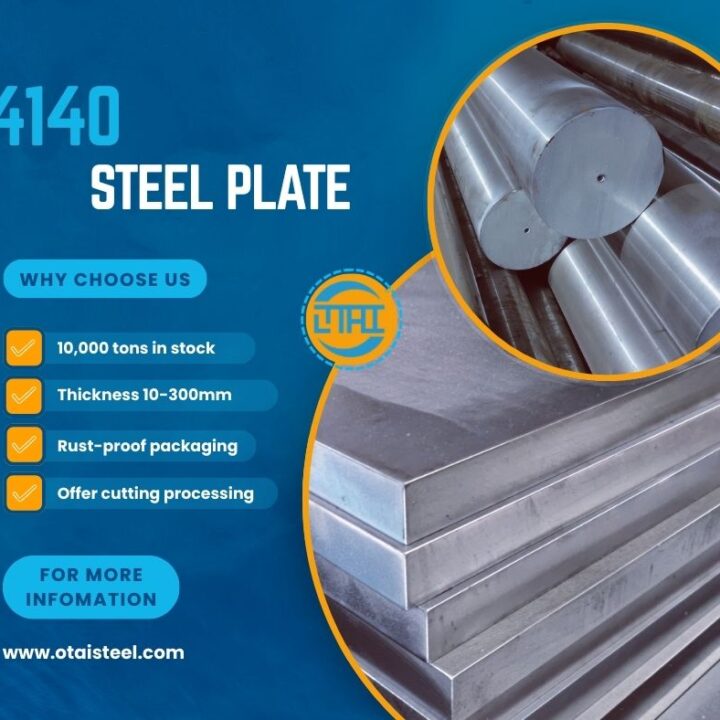
For customers looking for a reliable 4130 steel plate supplier, Otai provides stock availability, customized processing, inspection support, and export services to simplify international purchasing.
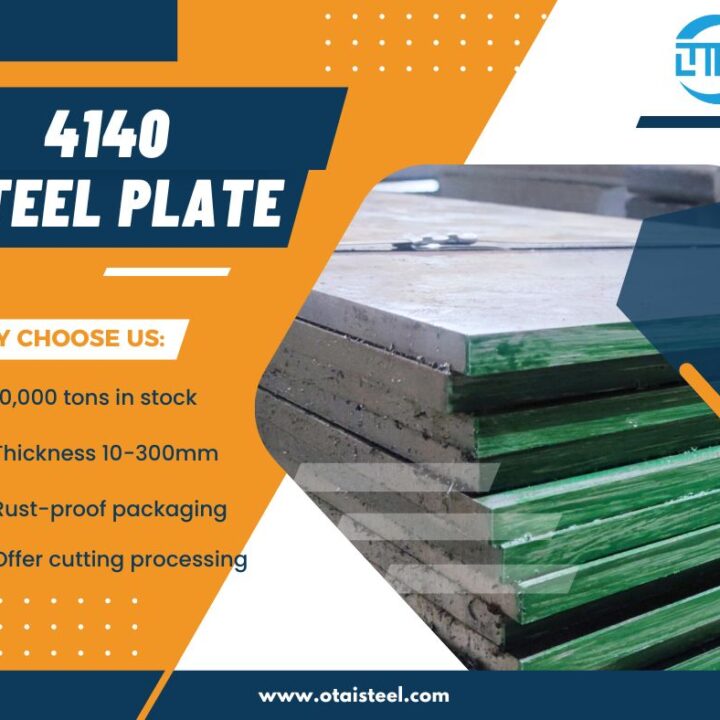
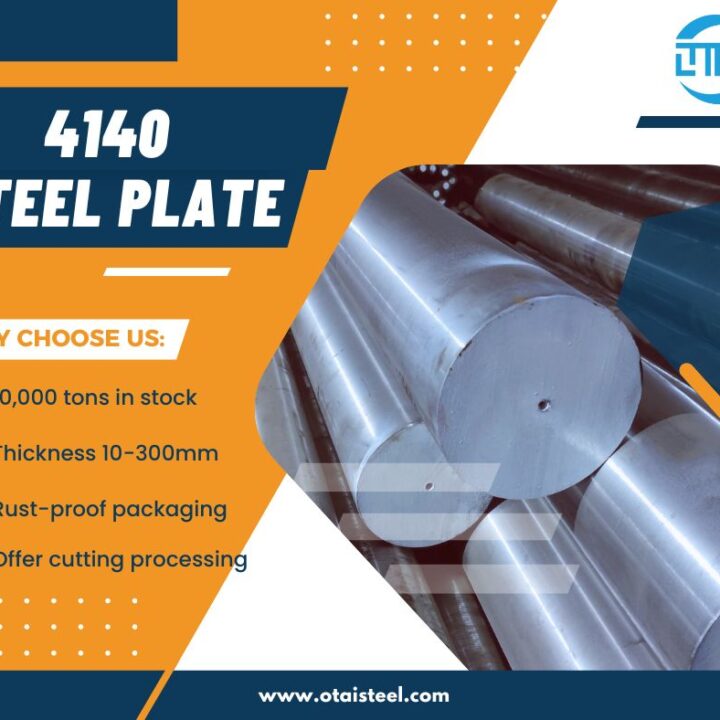
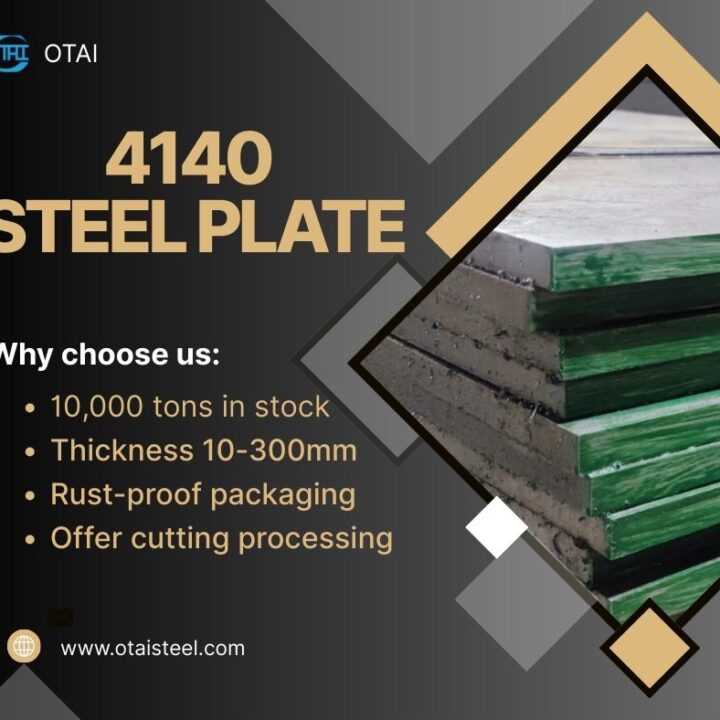
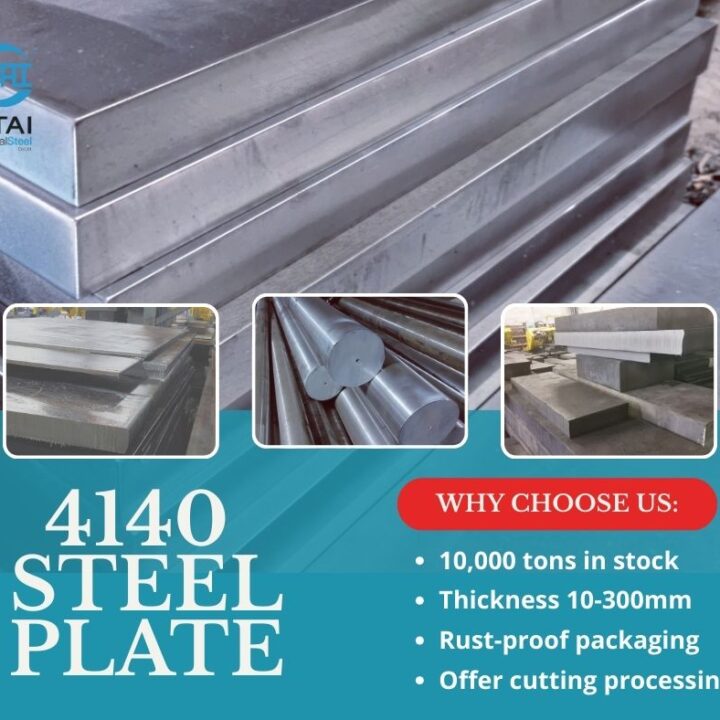
- Large inventory: More than 10,000 tons of steel stock available to support different project requirements.
- 4130 steel plate stock: 4130 steel plate thickness range from 10–70mm in stock.
- Professional cutting capability: Equipped with 20 saw cutting machines for customized size processing.
- Machining support: CNC machining and grinding services are available for customers requiring additional processing.
- Customized solutions: Support custom dimensions, tolerances, and project-based requirements.
- International export experience: Exporting steel products to 54+ countries since 1999.
- Quality support: Provide MTC documents, quality testing, ultrasonic testing options, third-party inspection support, and export anti-rust packaging.
For international steel procurement, reliable supply capability is as important as material quality. Otai helps customers reduce purchasing complexity by combining inventory, processing services, quality documentation, and export experience.
Whether customers require standard 4130 steel plate sizes or customized processing solutions, Otai can support different project requirements with professional steel supply services.
❓ FAQ
1. What is 4130 steel plate?
4130 steel plate is a chromium-molybdenum alloy steel plate under the AISI/SAE standard system. It provides a combination of high strength, toughness, fatigue resistance, and good weldability.
Manufacturers commonly use this material for aerospace parts, motorsport structures, machinery components, and industrial applications requiring reliable mechanical performance.
2. What is the equivalent grade of 4130 steel?
Common comparable grades include EN 25CrMo4, DIN 1.7218, and China 30CrMo. However, buyers should confirm chemical composition, mechanical properties, and certification requirements before replacing one grade with another.
3. What hardness can 4130 steel plate reach?
The hardness of 4130 steel plate depends on delivery condition and heat treatment. Typical hardness ranges include approximately 156–217 HB in annealed condition and around 25–40 HRC after suitable quenching and tempering.
The final hardness value should be confirmed according to actual plate thickness, heat treatment parameters, and testing requirements.
4. Is 4130 steel plate easy to weld?
4130 steel plate generally provides good weldability compared with many higher carbon alloy steels. However, proper welding procedures, preheating, and post-weld treatment may be required depending on thickness and application requirements.
5. How can I buy 4130 steel plate from a supplier?
To purchase 4130 steel plate, buyers should provide the required grade, dimensions, quantity, delivery condition, tolerance, inspection requirements, and destination information.
A professional supplier can then confirm availability, processing options, certification documents, and delivery arrangements.