 16MnCr5 Material Hardness – Understanding Heat-Treated Hardness Values
16MnCr5 material hardness is one of the most important factors engineers consider when selecting steel for gears, shafts, pinions, and other wear-resistant mechanical components. As a low-carbon chromium alloy carburizing steel, 16MnCr5 is specifically designed to achieve a hard surface layer while maintaining a tough and ductile core after heat treatment.
The ability to develop different hardness levels in the surface and core makes 16MnCr5 one of the most widely used case-hardening steels in the automotive, machinery, mining, and power transmission industries. Understanding the hardness characteristics of this steel helps manufacturers optimize component performance, improve wear resistance, and extend service life.
This article explains the 16MnCr5 steel hardness range, the effects of heat treatment, hardness values after carburizing, and how hardness influences practical applications.
📊 Overview of 16MnCr5 Steel
16MnCr5 is a carburizing steel standardized under EN 10084. It contains chromium and manganese, which improve hardenability and enable excellent case-hardening performance.
| Property | Value |
|---|---|
| Steel Grade | 16MnCr5 |
| Material Number | 1.7131 |
| Steel Type | Case Hardening Steel |
| Standard | EN 10084 |
| Main Applications | Gears, shafts, sprockets, bushings |
The relatively low carbon content allows the steel to maintain excellent toughness before carburizing, while chromium improves hardenability during heat treatment.
🔍 16MnCr5 Hardness in Different Conditions
The hardness of 16MnCr5 varies significantly depending on its condition. In the annealed state, the steel remains relatively soft and easy to machine. After carburizing and quenching, the surface hardness increases dramatically.
| Condition | Typical Hardness |
|---|---|
| Annealed | 160–220 HB |
| Normalized | 170–240 HB |
| Quenched and Tempered | 28–40 HRC |
| Carburized and Hardened Surface | 58–62 HRC |
These values demonstrate why 16MnCr5 hardness in HRC is often discussed in relation to heat treatment conditions rather than the raw material state.
🔥 16MnCr5 Hardness After Carburizing
The most common heat treatment for 16MnCr5 is carburizing followed by quenching and tempering. During carburizing, carbon is diffused into the steel surface, increasing carbon content in the outer layer.
This process allows the steel to develop exceptional 16MnCr5 hardness after carburizing while preserving core toughness.
| Heat Treatment Stage | Typical Temperature | Result |
|---|---|---|
| Carburizing | 880–950°C | Carbon enrichment |
| Quenching | 820–860°C | Martensitic transformation |
| Tempering | 150–200°C | Stress relief |
After completion of this cycle, the 16MnCr5 carburized hardness typically reaches 58–62 HRC, making the steel highly resistant to wear and surface fatigue.
⚙️ Surface Hardness vs Core Hardness
One of the biggest advantages of 16MnCr5 is its ability to combine a hard case with a tough core. This dual-property structure is essential for components subjected to repeated loading and impact.
| Property | Typical Value |
|---|---|
| 16MnCr5 Surface Hardness | 58–62 HRC |
| 16MnCr5 Core Hardness | 28–40 HRC |
| Case Depth | 0.5–2.0 mm |
The high 16MnCr5 surface hardness protects against abrasive wear, while the lower 16MnCr5 core hardness prevents brittle fracture during operation.
📈 Factors Affecting Hardness
Several factors influence the final hardness obtained after heat treatment.
- Carburizing temperature
- Carburizing time
- Carbon potential of the furnace atmosphere
- Quenching medium
- Part geometry and section thickness
- Tempering temperature
- Cooling rate
Proper process control is essential to achieve consistent 16MnCr5 heat treatment hardness across production batches.
🏭 Why Hardness Matters in Industrial Applications
The hardness characteristics of 16MnCr5 directly affect component performance and service life. Components with insufficient hardness may wear rapidly, while excessive hardness without adequate toughness can lead to cracking.
| Application | Hardness Benefit |
|---|---|
| Automotive Gears | Excellent wear resistance |
| Gear Shafts | High fatigue strength |
| Sprockets | Extended service life |
| Bushings | Reduced wear |
| Industrial Gearboxes | Long-term reliability |
Because of these benefits, 16MnCr5 gear steel hardness remains a key specification in transmission manufacturing.
🔬 Microstructure and Hardness Relationship
The hardness of 16MnCr5 is closely related to its microstructure. Different heat treatment conditions produce different metallurgical structures, which directly influence hardness, toughness, and wear resistance.
| Microstructure | Typical Hardness | Characteristics |
|---|---|---|
| Ferrite + Pearlite | 160–220 HB | Good machinability |
| Bainite | 25–40 HRC | Good toughness |
| Martensite | 58–62 HRC | Excellent wear resistance |
| Tempered Martensite | 50–60 HRC | Balanced hardness and toughness |
During carburizing and quenching, the surface transforms into high-carbon martensite, which is responsible for the exceptional 16MnCr5 hardness after quenching. Meanwhile, the lower-carbon core remains tougher and more resistant to impact loading.
⚖️ 16MnCr5 Hardness Comparison with Other Case-Hardening Steels
Engineers often compare 16MnCr5 with other carburizing steels when selecting materials for gears and transmission systems.
| Steel Grade | Surface Hardness (HRC) | Typical Application |
|---|---|---|
| 16MnCr5 | 58–62 | Gears and shafts |
| 20MnCr5 | 58–62 | Heavy-duty gears |
| 18CrNiMo7-6 | 58–63 | Wind power gears |
| 8620 Steel | 58–62 | Automotive transmission parts |
This 16MnCr5 hardness comparison shows that the steel achieves hardness levels comparable to many premium carburizing grades while maintaining excellent cost-effectiveness.
🏭 Company Advantages
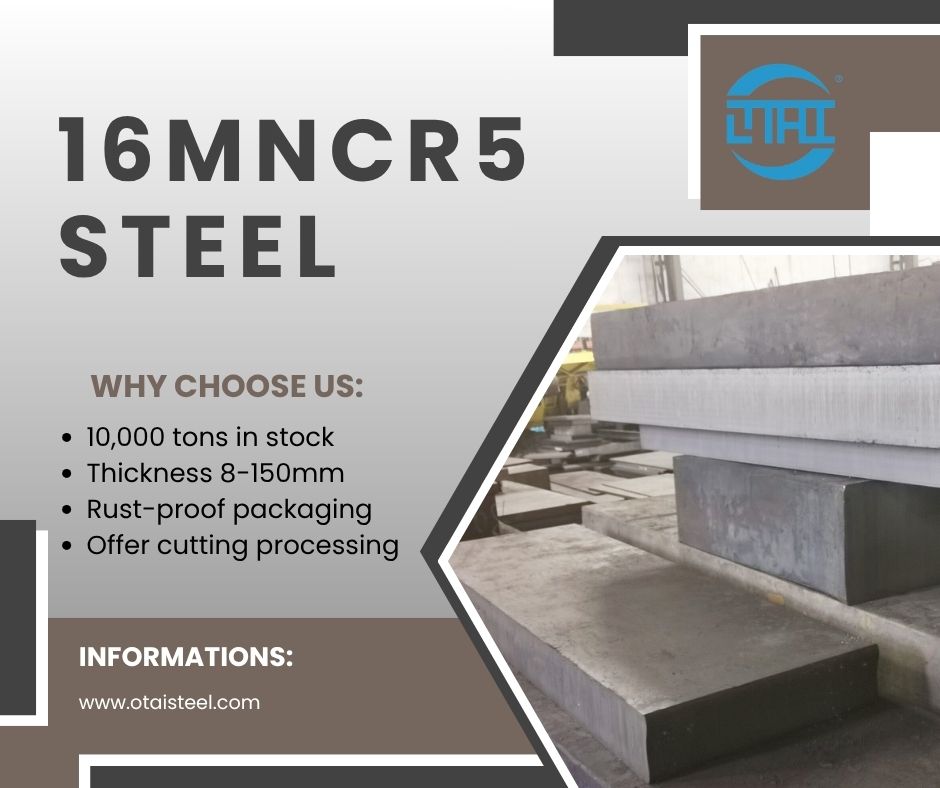
Otai Special Steel is a professional supplier of 16MnCr5 alloy steel products for customers worldwide. We provide reliable material solutions for automotive, machinery, mining, energy, and industrial manufacturing applications.
- More than 10,000 tons of steel inventory available year-round
- 8–150mm thickness 16MnCr5 steel plates available in stock
- Round bars, forged blocks, flat bars, and steel plates available
- Custom cutting according to customer drawings and specifications
- Professional heat treatment support and technical consultation
- Ultrasonic testing (UT) available for internal quality inspection
- Chemical composition verification and mechanical testing reports
- Third-party inspection services including SGS
- Export-standard packaging for worldwide shipment
- Extensive experience supplying international engineering companies
Our team helps customers select the most suitable material condition and heat treatment process to achieve the required hardness and performance.
✅ Conclusion
16MnCr5 material hardness varies significantly depending on heat treatment and material condition. In the annealed state, the steel offers good machinability with hardness typically ranging from 160–220 HB. After quenching and tempering, hardness can reach 28–40 HRC, while carburized surfaces commonly achieve 58–62 HRC.
The combination of high surface hardness and a tough core is what makes 16MnCr5 one of the most widely used case-hardening steels for gears, shafts, pinions, and power transmission components. Proper control of carburizing, quenching, and tempering processes ensures consistent 16MnCr5 mechanical properties and long-term reliability.
For manufacturers seeking excellent wear resistance, fatigue strength, and cost-effective performance, 16MnCr5 remains one of the most reliable engineering steel choices available today.
❓ FAQ
Q1: What is the typical hardness of 16MnCr5 in the annealed condition?
A1: The hardness is typically between 160 and 220 HB, providing good machinability for manufacturing operations.
Q2: What is the surface hardness of carburized 16MnCr5?
A2: The typical 16MnCr5 surface hardness after carburizing and quenching is 58–62 HRC.
Q3: What is the core hardness of 16MnCr5 after heat treatment?
A3: The typical 16MnCr5 core hardness ranges from 28 to 40 HRC, depending on section size and heat treatment parameters.
Q4: Why does 16MnCr5 have different surface and core hardness values?
A4: Carburizing increases the carbon content only at the surface, allowing the outer layer to become very hard while maintaining a tougher core.
Q5: What hardness can 16MnCr5 achieve after quenching?
A5: Depending on carbon content and treatment conditions, 16MnCr5 hardness after quenching can reach approximately 58–62 HRC on the carburized surface.
Q6: Why is 16MnCr5 commonly used for gears?
A6: Its combination of high wear resistance, excellent fatigue strength, and tough core structure makes it ideal for heavily loaded gear systems.