16MnCr5 Steel Mechanical Properties: Strength, Hardness, and Performance in Carburized Components
The 16MnCr5 steel mechanical properties make this alloy one of the most widely used case hardening steels in automotive, industrial machinery, and power transmission systems. Engineers select 16MnCr5 because it delivers an excellent balance of surface hardness, fatigue resistance, impact strength, and wear performance after carburizing and heat treatment.
Modern manufacturers rely on this alloy for components that operate under heavy cyclic loads and continuous surface contact. The steel performs exceptionally well in applications requiring both a wear-resistant surface and a shock-resistant core structure.
Industries commonly use 16MnCr5 steel for:
- Transmission gears
- Pinions
- Drive shafts
- Bearing sleeves
- Gearbox components
- Industrial couplings
- Agricultural machinery parts
🔍 What is 16MnCr5 Steel?
16MnCr5 is a low-carbon chromium-manganese alloy carburizing steel produced according to EN/DIN standards. The steel belongs to the family of case hardening steels, which means engineers typically carburize the surface to create a hard outer layer while maintaining a strong and ductile internal core.
This combination provides excellent mechanical balance for demanding engineering applications involving repeated friction, torque loading, and contact stress.
| Characteristic | Performance |
|---|---|
| Hardenability | Excellent |
| Wear Resistance | Excellent |
| Core Toughness | Very Good |
| Fatigue Resistance | Excellent |
| Machinability | Good |
⚗️ Chemical Composition and Mechanical Performance
The alloy composition directly influences the mechanical behavior of 16MnCr5 steel. Each alloying element contributes to hardenability, toughness, and wear resistance.
| Element | Content (%) | Main Function |
|---|---|---|
| Carbon (C) | 0.14 – 0.19 | Supports carburized hardness |
| Manganese (Mn) | 1.00 – 1.30 | Improves hardenability |
| Chromium (Cr) | 0.80 – 1.10 | Enhances wear resistance |
| Silicon (Si) | 0.17 – 0.37 | Improves strength |
The relatively low carbon content helps maintain good core ductility, while carburizing enriches the surface with carbon to create a hardened martensitic layer after quenching.
🔥 Mechanical Properties in Annealed Condition
Before heat treatment, 16MnCr5 steel offers good machinability and moderate strength. Manufacturers commonly machine gears and shafts in the annealed condition before carburizing.
| Property | Typical Value |
|---|---|
| Tensile Strength | 550 – 800 MPa |
| Yield Strength | 300 – 500 MPa |
| Elongation | 20 – 25% |
| Hardness | 170 – 220 HB |
⚙️ Mechanical Properties After Heat Treatment
After carburizing and quenching, 16MnCr5 develops a hard martensitic surface and a strong ductile core. This structure dramatically improves wear resistance and fatigue performance.
| Property | Typical Value |
|---|---|
| Surface Hardness | 58 – 62 HRC |
| Core Hardness | 30 – 45 HRC |
| Tensile Strength | 800 – 1200 MPa |
| Yield Strength | 550 – 850 MPa |
The carburized surface protects components against severe friction and rolling contact fatigue, while the tough core absorbs shock loading and prevents brittle fracture.
🔬 Microstructure and Mechanical Strength
The microstructure explains why 16MnCr5 performs so effectively in transmission systems and rotating machinery. After carburizing and quenching, the steel develops a dual-structure microstructure that combines a hard outer layer with a shock-resistant core.
| Region | Microstructure | Main Benefit |
|---|---|---|
| Surface Layer | Martensite | High hardness and wear resistance |
| Core | Ferrite/Bainitic Structure | Toughness and shock resistance |
This dual-property structure allows gears and shafts to survive repeated cyclic loading while maintaining dimensional stability under heavy stress conditions.
🚗 Why 16MnCr5 Performs Well in Gear Applications
Gear systems operate under continuous surface pressure, rolling contact stress, and torque fluctuations. Materials used for gears must therefore resist both surface wear and fatigue failure.
16MnCr5 steel performs extremely well because:
- The hardened surface reduces tooth wear
- The tough core absorbs impact loads
- The alloy structure improves fatigue resistance
- The carburized layer delays crack formation
- The steel maintains dimensional stability under stress
These advantages help extend gearbox service life and reduce maintenance costs in industrial machinery and automotive transmission systems.
📊 Heat Treatment Parameters and Performance
Heat treatment strongly affects the final mechanical properties of 16MnCr5 steel. Proper control of carburizing, quenching, and tempering parameters ensures consistent hardness and toughness throughout the component.
| Process | Typical Temperature |
|---|---|
| Carburizing | 880 – 980°C |
| Quenching | 780 – 850°C |
| Tempering | 150 – 200°C |
Proper heat treatment helps achieve:
- Uniform case depth
- Stable hardness distribution
- Reduced distortion
- Improved dimensional stability
- Better fatigue performance
⚖️ Comparison with Other Carburizing Steels
Engineers often compare 16MnCr5 with other carburizing steels used in transmission systems and mechanical power applications.
| Property | 16MnCr5 | SAE 5115 | SCM420 |
|---|---|---|---|
| Surface Hardness | Excellent | Excellent | Excellent |
| Core Toughness | Excellent | Good | Very Good |
| Fatigue Resistance | Excellent | Good | Very Good |
| Hardenability | Excellent | Good | Very Good |
This comparison shows why many manufacturers prefer 16MnCr5 for high-performance gears, shafts, and industrial transmission systems.
🌍 International Equivalent Grades
Several international standards provide steels with similar mechanical performance and carburizing capability to 16MnCr5. These equivalent grades allow manufacturers in different regions to achieve comparable engineering performance.
| Standard | Equivalent Grade |
|---|---|
| AISI / SAE | SAE 5115 |
| JIS | SCM420 |
| GB | 20CrMnTi |
| ISO | 18CrMo4 |
Although these steels offer similar characteristics, slight differences in alloy composition and heat treatment response may influence hardenability and fatigue performance.
🏗️ Industrial Applications of 16MnCr5 Steel
The excellent mechanical properties of 16MnCr5 make it suitable for a wide range of engineering industries. Manufacturers prefer this alloy when components require high wear resistance combined with strong impact toughness.
| Industry | Typical Components |
|---|---|
| Automotive | Transmission gears and shafts |
| Industrial Machinery | Gearboxes and reducers |
| Agricultural Equipment | Drive systems and axles |
| Heavy Equipment | Power transmission components |
In automotive transmission systems, the steel helps reduce wear and extend operational life even under continuous cyclic loading and high rotational stress.
🏭 Company Advantages
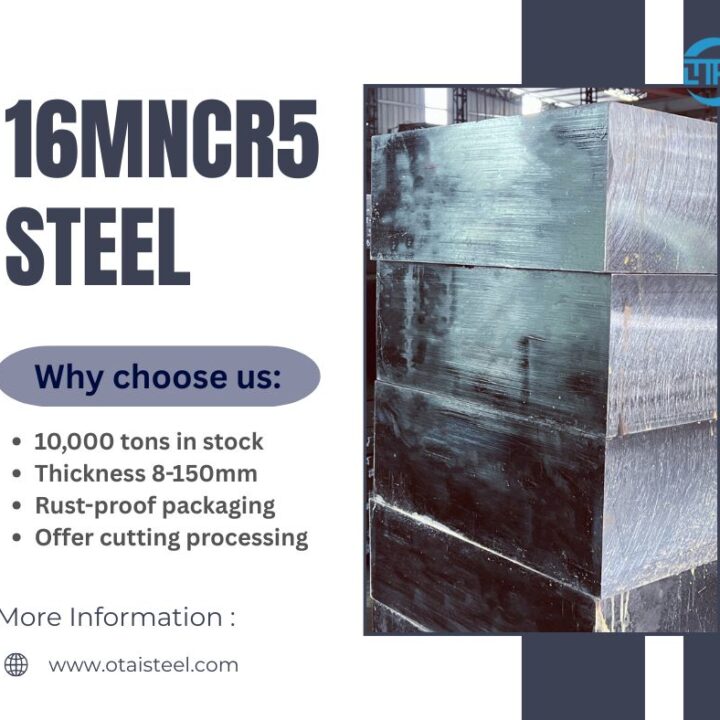
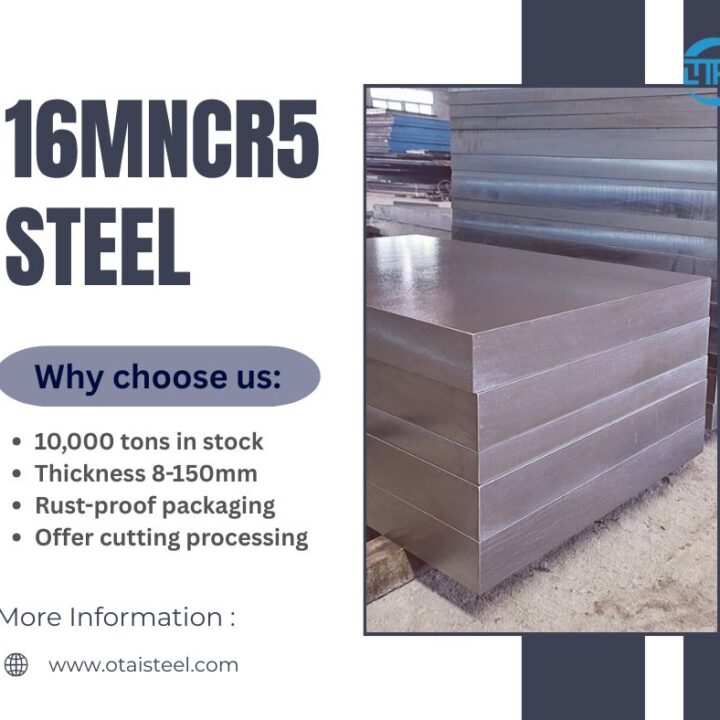
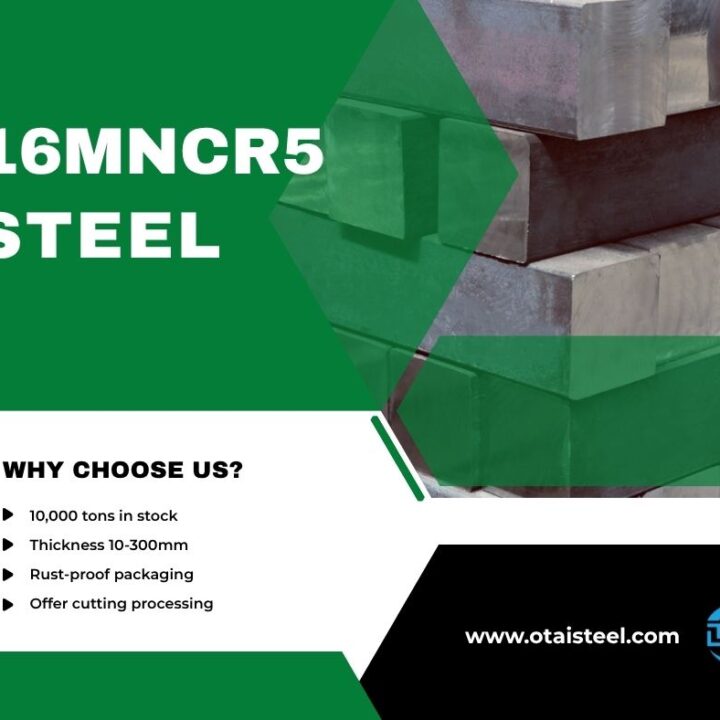
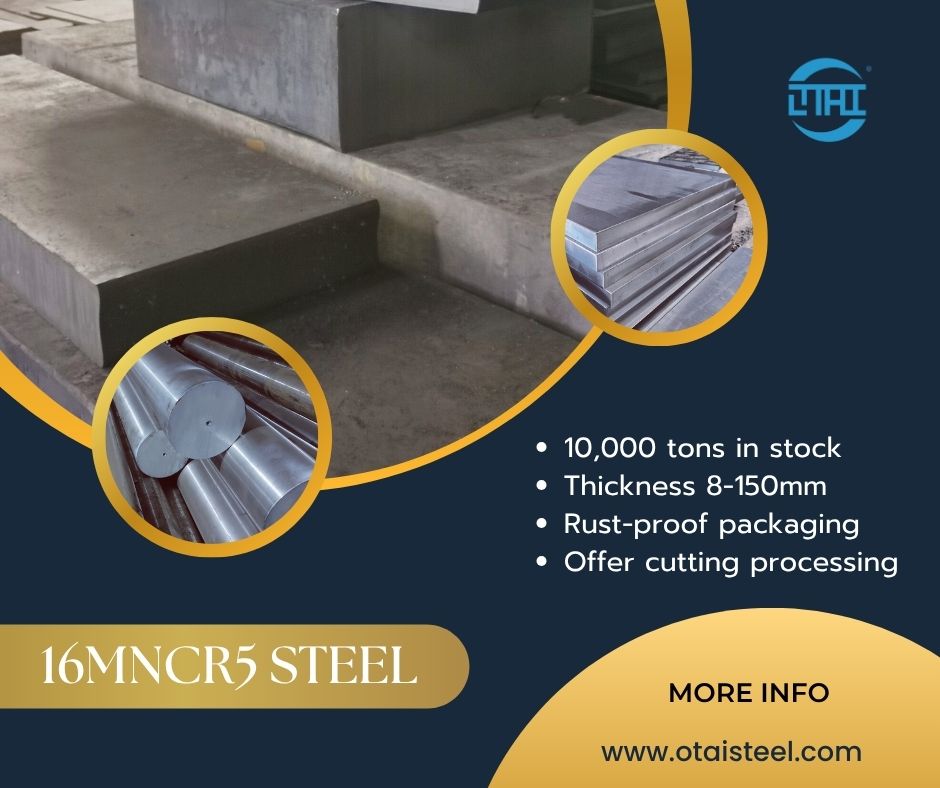
Otai Special Steel supplies premium-quality 16MnCr5 steel materials for demanding engineering and manufacturing applications.
- Large inventory and stable supply
- 8–150mm thickness plates available in stock
- Custom cutting and heat treatment services
- Ultrasonic testing (UT) and chemical composition verification
- Third-party inspection support (SGS)
- Professional export packaging and logistics support
- Technical assistance for material selection and processing
We support customers in automotive, industrial machinery, agricultural equipment, and heavy engineering industries with reliable material quality and fast delivery capability.
❓ FAQ
Q1: What are the main mechanical properties of 16MnCr5 steel?
A1: The steel provides excellent surface hardness, fatigue resistance, wear resistance, and strong core toughness after carburizing and heat treatment.
Q2: What hardness can 16MnCr5 achieve after heat treatment?
A2: Proper carburizing and quenching can achieve approximately 58–62 HRC surface hardness.
Q3: Why is 16MnCr5 widely used for gears?
A3: The steel combines a wear-resistant surface with a tough shock-resistant core, making it ideal for transmission systems and rotating machinery.
Q4: Does heat treatment significantly affect mechanical properties?
A4: Yes. Carburizing and quenching dramatically improve hardness, fatigue resistance, and wear performance.
Q5: Which industries commonly use 16MnCr5 steel?
A5: Automotive, industrial machinery, agricultural equipment, and heavy engineering industries widely use this material for gears, shafts, and power transmission components.