 16MnCr5 Steel Density: Why Material Weight Matters in Engineering Design
The 16MnCr5 steel density is an important physical property for engineers, designers, and manufacturers working with gears, shafts, transmission systems, and carburized mechanical components. Density directly affects:
- Component weight
- Structural calculations
- Rotational inertia
- Material cost estimation
- Machining efficiency
- Equipment performance
As one of the most widely used case hardening steels, 16MnCr5 combines excellent carburizing performance with reliable mechanical properties, making it a preferred material for applications requiring:
- High surface hardness
- Excellent fatigue resistance
- Tough core strength
- Long service life
- Stable dimensional performance
Because of these advantages, manufacturers commonly use 16MnCr5 steel in:
- Automotive gears
- Pinions
- Transmission shafts
- Industrial gearboxes
- Agricultural machinery
- Heavy mechanical systems
Understanding the density of 16MnCr5 helps engineers optimize component design and accurately calculate weight during manufacturing and structural analysis.
🔍 What is the Density of 16MnCr5 Steel?
The standard density of 16MnCr5 steel is approximately:
| Unit | Density Value |
|---|---|
| g/cm³ | 7.85 g/cm³ |
| kg/m³ | 7850 kg/m³ |
| lb/in³ | 0.284 lb/in³ |
These values are typical for low-alloy chromium-manganese steels used in carburizing applications.
Engineering Insight: The density of 16MnCr5 is very similar to many alloy and carbon steels because iron remains the primary element in the composition.
⚗️ Why Density Matters in Mechanical Engineering
Density affects much more than simple material weight. In rotating and high-load systems, it directly influences mechanical behavior and operational efficiency.
Key Engineering Factors Influenced by Density
| Factor | Influence |
|---|---|
| Component Weight | Affects handling and assembly |
| Rotational Inertia | Influences acceleration and energy consumption |
| Structural Load | Impacts bearing and support design |
| Material Cost | Determines raw material usage |
| Transportation Weight | Influences shipping cost |
For gears and shafts operating at high speed, engineers must carefully balance:
- Strength
- Hardness
- Weight
- Fatigue resistance
16MnCr5 provides an excellent balance between these factors.
⚙️ Chemical Composition and Its Influence on Density
The density of 16MnCr5 comes mainly from its iron-based alloy structure.
| Element | Typical Content (%) | Main Function |
|---|---|---|
| Carbon (C) | 0.14 – 0.19 | Supports carburized hardness |
| Silicon (Si) | 0.17 – 0.37 | Improves strength |
| Manganese (Mn) | 1.00 – 1.30 | Enhances hardenability |
| Chromium (Cr) | 0.80 – 1.10 | Improves wear resistance |
| Iron (Fe) | Balance | Main structural element |
Although chromium and manganese slightly influence density, the overall value remains close to standard engineering steels.
📊 Density Comparison with Other Engineering Steels
The following table compares 16MnCr5 with several common alloy steels.
| Steel Grade | Density (g/cm³) | Main Application |
|---|---|---|
| 16MnCr5 | 7.85 | Carburized gears and shafts |
| 4140 Steel | 7.85 | High-strength shafts |
| SCM420 | 7.84 | Precision transmission parts |
| SAE 5115 | 7.85 | Automotive gears |
| 20CrMnTi | 7.83 | Heavy-duty carburized gears |
This comparison shows that most alloy carburizing steels have very similar density values.
🔧 Calculating Weight Using 16MnCr5 Density
Engineers frequently use density to estimate the weight of machined components.
Basic Weight Formula
The general formula is:
\text{Weight} = \text{Volume} \times \text{Density}
For metric calculations:
| Parameter | Unit |
|---|---|
| Volume | m³ |
| Density | kg/m³ |
| Weight | kg |
Example Calculation
Suppose a steel shaft has:
- Volume = 0.002 m³
- Density = 7850 kg/m³
The estimated weight becomes:
0.002 \times 7850 = 15.7\ \text{kg}
This calculation helps engineers estimate:
- Transportation weight
- Machine load capacity
- Rotational inertia
- Production material requirements
⚙️ Influence of Density on Gear Performance
16MnCr5 is widely used for gears because it combines:
- High surface hardness
- Tough core structure
- Moderate material density
- Excellent fatigue resistance
Why Density Matters in Gears
Heavier gears may increase:
- Rotational inertia
- Power consumption
- Bearing load
- Vibration levels
However, adequate density also contributes to:
- Structural rigidity
- Load-bearing capability
- Dimensional stability
16MnCr5 offers a strong balance between strength and manageable weight, making it highly suitable for high-performance transmission systems.
🔥 Heat Treatment and Density Relationship
Heat treatment changes the microstructure of the steel but does not significantly alter overall density.
Typical Heat Treatment Processes
| Process | Main Purpose |
|---|---|
| Carburizing | Increase surface carbon |
| Quenching | Form martensitic surface |
| Tempering | Improve toughness |
Although carburizing modifies the surface composition slightly, the density change remains extremely small and usually does not affect engineering calculations.
🔬 Microstructure of 16MnCr5
The steel develops a dual-structure microstructure after carburizing and quenching.
| Region | Microstructure | Main Benefit |
|---|---|---|
| Surface Layer | Martensite | High wear resistance |
| Core | Tough Ferrite/Bainitic Structure | Shock resistance |
This structure gives gears excellent fatigue performance under repeated cyclic loading.
🚗 Applications Where Density is Important
The density of 16MnCr5 becomes particularly important in rotating or moving mechanical systems.
| Industry | Components |
|---|---|
| Automotive | Transmission gears, synchronizers |
| Industrial Machinery | Gearboxes and reducers |
| Agricultural Equipment | Drive shafts and axles |
| Heavy Equipment | Large transmission assemblies |
🔹 Automotive Transmission Example
Automotive transmission designers carefully consider material density because heavier rotating parts may reduce:
- Fuel efficiency
- Rotational responsiveness
- System efficiency
16MnCr5 helps maintain strong mechanical performance without excessive weight.
⚖️ 16MnCr5 vs Aluminum and Stainless Steel
Engineers often compare steel density with alternative materials.
| Material | Density (g/cm³) | Main Characteristic |
|---|---|---|
| 16MnCr5 Steel | 7.85 | High strength and wear resistance |
| Aluminum Alloy | 2.70 | Lightweight |
| Stainless Steel | 7.75 – 8.00 | Corrosion resistance |
Although aluminum offers lower weight, it cannot match the carburized hardness and fatigue resistance of 16MnCr5 in heavy-load gear applications.
🌐 Equivalent Grades of 16MnCr5
Several international standards offer similar carburizing steels with nearly identical density values.
| Standard | Equivalent Grade |
|---|---|
| AISI / SAE | SAE 5115 |
| JIS | SCM420 |
| GB | 20CrMnTi |
| ISO | 18CrMo4 |
These materials provide similar physical and mechanical performance in gear manufacturing applications.
🏭 Company Advantages
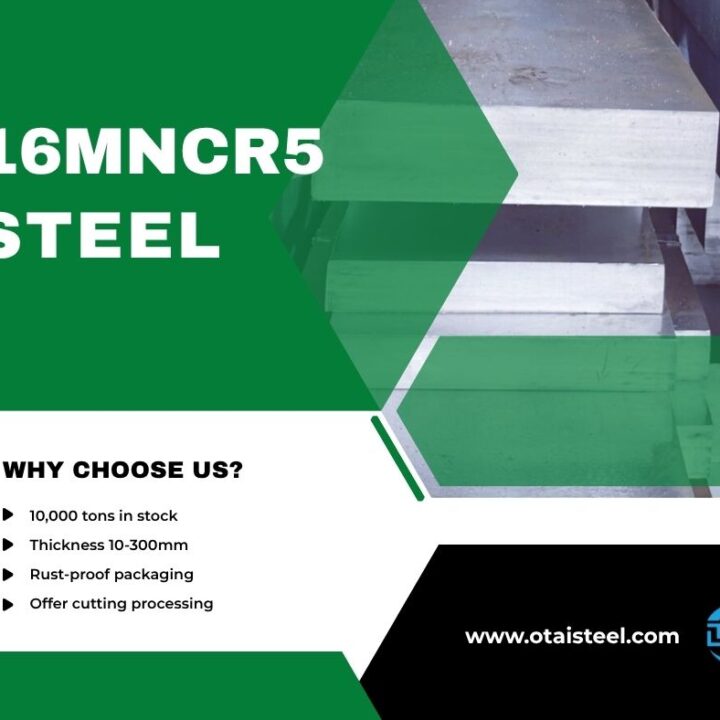
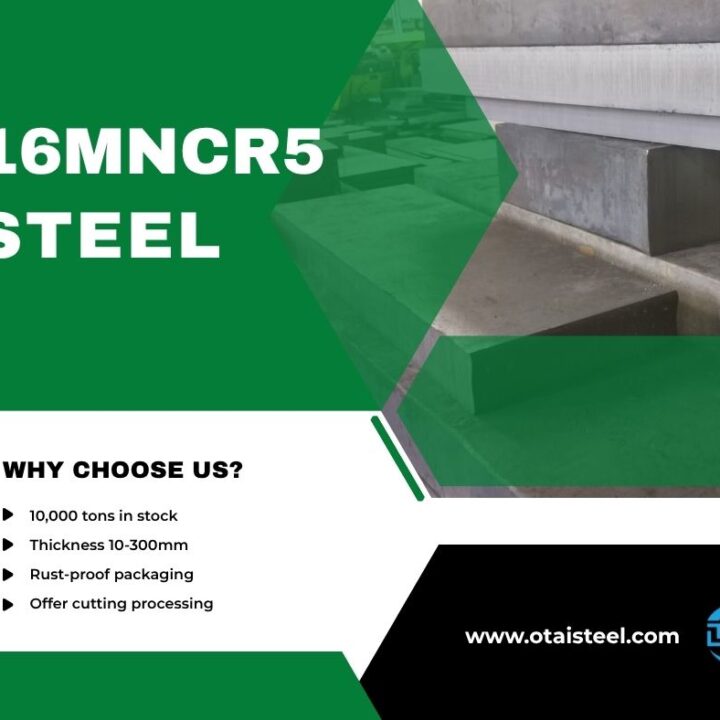
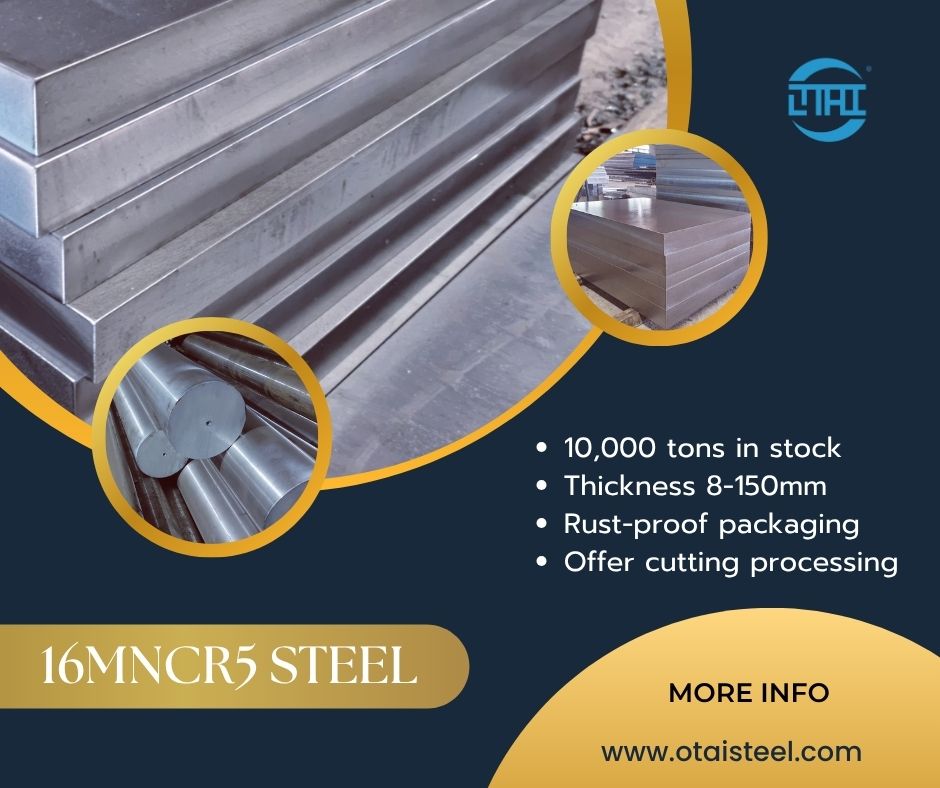
Otai Special Steel supplies premium-quality 16MnCr5 steel materials for demanding engineering applications.
- Large inventory and stable supply
- 8–150mm thickness plates available in stock
- Custom cutting and heat treatment services
- Ultrasonic testing (UT) and chemical composition verification
- Third-party inspection support (SGS)
- Professional export packaging and logistics support
We support customers in automotive, industrial machinery, agricultural equipment, and heavy engineering industries with reliable material quality and technical assistance.
❓ FAQ
Q1: What is the density of 16MnCr5 steel?
A1: The typical density is approximately 7.85 g/cm³ or 7850 kg/m³.
Q2: Does heat treatment change the density of 16MnCr5?
A2: Heat treatment slightly changes the microstructure but has almost no practical effect on density.
Q3: Why is density important in gear design?
A3: Density affects component weight, rotational inertia, bearing load, and energy efficiency.
Q4: Is 16MnCr5 heavier than aluminum?
A4: Yes. 16MnCr5 steel is significantly denser than aluminum alloys.
Q5: Which industries commonly use 16MnCr5 steel?
A5: Automotive, industrial machinery, agricultural equipment, and heavy engineering industries widely use this material for gears and transmission components.