16MnCr5 Sheet Metal for Industrial Components: Is It Right for Your Application?
📑 Table of Contents
- 🔍 1. What Is 16MnCr5 Sheet Metal?
- 🧪 2. 16MnCr5 Chemical Composition
- ⚙️ 3. How Chemical Composition Affects Performance
- 📊 4. 16MnCr5 Mechanical Properties and Hardness
- 🔥 5. 16MnCr5 Heat Treatment and Carburizing
- 🏭 6. 16MnCr5 Applications and Material Selection
- 📏 7. 16MnCr5 Sheet Metal Thickness, Cutting & Machining
- 📋 8. What Should You Confirm Before Buying 16MnCr5?
- 🔬 9. MTC, Inspection and Quality Requirements
- 🏢 10. 16MnCr5 Supply from Otai Special Steel
- ❓ 11. FAQ About 16MnCr5 Sheet Metal
🔍 1. What Is 16MnCr5 Sheet Metal?
If you are searching for 16MnCr5 sheet metal, the first point to clarify is what you actually need to buy. 16MnCr5, material number 1.7131, is an alloy case-hardening steel specified under EN 10084. It is designed for components that need a hard, wear-resistant surface after carburizing while retaining a comparatively tougher core.
That makes the grade particularly relevant when your finished component faces repeated contact, friction or surface wear. Gears are a typical example. The working surface needs high hardness, but the whole component does not necessarily need to become uniformly hard and brittle.
For procurement, this distinction is important. You are not simply buying steel with a particular hardness value. You are buying a material that will become part of a larger manufacturing process involving machining, carburizing, quenching, tempering and final inspection.
So, when you evaluate 16MnCr5 sheet or plate, look at three stages:
| Stage | What matters | Why it matters to the buyer |
|---|---|---|
| Raw material | Chemical composition, supply condition, dimensions | Determines whether the material fits your machining process |
| Heat treatment | Carburizing, quenching, tempering and case depth | Creates the required surface and core properties |
| Finished component | Surface hardness, core performance and dimensional accuracy | Determines whether the component actually meets the drawing |
The important point is that raw-material hardness alone does not describe the final performance of a carburized 16MnCr5 component.
🧪 2. 16MnCr5 Chemical Composition
The chemistry explains why 16MnCr5 behaves differently from ordinary carbon steel. Under EN 10084, the principal composition limits include carbon at 0.14–0.19%, manganese at 1.00–1.30% and chromium at 0.80–1.10%. Silicon has a maximum of 0.40%, phosphorus a maximum of 0.025%, and sulfur a maximum of 0.035%.
EN 10084 chemical composition of 16MnCr5
| Element | EN 10084 range / limit | Procurement significance |
|---|---|---|
| C | 0.14–0.19% | Supports carburizing behavior while maintaining a relatively low-carbon core before treatment |
| Si | ≤ 0.40% | Controlled alloying element; the actual heat chemistry should be checked on the MTC |
| Mn | 1.00–1.30% | Contributes to hardenability and strength |
| P | ≤ 0.025% | A controlled residual element; important for specification compliance |
| S | ≤ 0.035% | Influences machinability and must remain within the agreed specification |
| Cr | 0.80–1.10% | Supports hardenability and the response of the steel during case hardening |
These figures represent the EN 10084 composition limits commonly cited for 16MnCr5. They should not be confused with a particular steel mill’s Typical Analysis.
Standard range versus Typical Analysis
This distinction becomes important when you compare supplier datasheets. For example, Ovako publishes a Typical Analysis for one 16MnCr5 variant of approximately 0.16% C, 0.20% Si, 1.20% Mn and 1.00% Cr. Those values illustrate one producer’s typical chemistry; they do not replace the standard composition limits or the chemistry of your actual heat.
Your MTC should show the actual chemical analysis of the heat supplied to your order. Therefore, if your customer has tight chemistry requirements, ask for the actual MTC instead of using a website’s typical analysis as the acceptance value.
⚙️ 3. How Chemical Composition Affects Performance
The numbers in the chemistry table are not just certification data. They explain why engineers choose this grade for specific components.
Carbon: 0.14–0.19%
The relatively low carbon level is central to the case-hardening concept. Before carburizing, the base material does not contain the same carbon level that a high-carbon tool steel would contain. During carburizing, the surface absorbs additional carbon, allowing the outer layer to develop high hardness after quenching.
For you as a buyer, this means you should not reject 16MnCr5 simply because its raw-material carbon percentage looks low. That low carbon content is part of the reason the grade works for a hard-surface/tough-core design.
Manganese: 1.00–1.30%
Manganese contributes to hardenability and strength. The relatively high manganese range compared with plain carbon steel helps the material respond to hardening more effectively.
If you are purchasing larger or more complex components, the heat-treatment response becomes particularly relevant. The final result depends not only on chemistry but also on section size, quenching conditions and the actual process used.
Chromium: 0.80–1.10%
Chromium supports hardenability and contributes to the performance of this case-hardening steel. That makes the Cr content worth checking when you receive the MTC.
In other words, if your specification calls for 16MnCr5, do not treat the grade name as enough evidence. Check the actual heat chemistry against the agreed standard.
Phosphorus and sulfur
The standard limits phosphorus to 0.025% maximum and sulfur to 0.035% maximum in the EN 10084 chemistry commonly listed for 16MnCr5.
These values matter because residual elements form part of the material specification. For normal procurement, you may not need to analyze the metallurgical effect of every hundredth of a percent. You do, however, need the actual certificate when your customer requires documented compliance.
📊 4. 16MnCr5 Mechanical Properties and Hardness
This is where the previous “sheet metal” question needs more precision. 16MnCr5 does not have one universal hardness value that applies to every delivery condition.
The mechanical properties depend on the supply condition, product form and thickness. For example, published EN 10084 data summarized by SteelNumber lists, for nominal thickness up to 16 mm in the +A condition, a tensile strength of about 550 MPa, 0.2% proof strength of about 420 MPa, minimum elongation of 21% and Brinell hardness around 207 HBW.
| Property | Published value / range | Condition / note |
|---|---|---|
| Tensile strength, Rm | ≥ 550 MPa | +A, nominal thickness up to 16 mm |
| 0.2% proof strength, Rp0.2 | ≥ 420 MPa | +A, nominal thickness up to 16 mm |
| Elongation, A | ≥ 21% | +A, L0 = 80 mm |
| Brinell hardness | 140–207 HBW depending on condition | Published ranges vary with delivery condition |
| Hardness, +FP | 140–187 HBW | Ferrite-pearlite treated condition |
Ovako’s current 16MnCr5 material data gives a similar picture: +A material is listed at about 207 HB typical, while +FP material is listed at 140–187 HB.
For procurement, the lesson is simple: always specify the delivery condition when hardness matters. Otherwise, two suppliers can quote the same grade while offering material in different conditions.
Raw-material hardness is not case hardness
This distinction is especially important for 16MnCr5. A raw plate or blank may have a hardness suitable for machining, while the finished component can achieve a much harder carburized surface after heat treatment.
Therefore, if your drawing requires a surface hardness such as a specified HRC range, do not ask the raw-material supplier to guarantee that value unless the supplier is also performing the complete heat-treatment process. Instead, confirm the raw-material condition and separately define the final heat-treatment specification.
🔥 5. 16MnCr5 Heat Treatment and Carburizing
Heat treatment is where the low-carbon chemistry of 16MnCr5 becomes commercially useful.
Ovako lists a carburizing range of 880–980°C, a quenching range of 860–900°C, and a tempering range of 150–200°C for its 16MnCr5 material data. The same source lists AC1 at about 734°C, AC3 at about 827°C, and an Ms temperature around 430°C.
| Process | Published temperature range | Purpose |
|---|---|---|
| Carburizing | 880–980°C | Adds carbon to the surface |
| Quenching | 860–900°C | Hardens the carburized layer |
| Tempering | 150–200°C | Adjusts the hardened structure and reduces excessive stresses |
| Normalizing | 860–890°C | Used as a preparation or conditioning treatment where specified |
These are published heat-treatment recommendations, not universal production recipes. Actual parameters depend on component size, furnace atmosphere, carburizing equipment, quenching medium, required case depth and distortion control. Ovako also notes that case-hardening steels are typically carburized at high temperatures and then quenched to harden the carburized layer.
What this means when you are buying the raw steel
Suppose your customer requires a specific effective case depth. The carburizing time and process will influence how much carbon enters the surface. Therefore, the heat-treatment requirement can affect your production cycle and finishing allowance.
Before ordering, give your supplier the final component requirements whenever possible:
- Target surface hardness
- Effective case depth
- Core hardness or core mechanical requirement
- Final component dimensions
- Machining allowance
- Heat-treatment route
This information gives the supplier context that a simple grade name cannot provide.
Typical case depth
Ovako explains that carburized layers are typically around 0.5–1.0 mm, although deeper cases are possible depending on the application and process.
Do not treat 0.5–1.0 mm as a mandatory 16MnCr5 specification. It is a general typical range for carburizing steels. Your drawing may require a different effective case depth, and the heat-treatment supplier should establish the appropriate process.
🏭 6. 16MnCr5 Applications and Material Selection
16MnCr5 is commonly associated with mechanical engineering components that need case hardening. The grade’s combination of low carbon, manganese and chromium makes it suitable for components where surface wear resistance and core toughness need to work together.
| Application | Why 16MnCr5 may fit | What to confirm before purchase |
|---|---|---|
| Gears | Hard surface for repeated contact and wear | Case depth, surface hardness, distortion control |
| Shafts | Wear-resistant working areas with a tougher core | Final dimensions and machining allowance |
| Pins | Useful surface hardness after case hardening | Contact load and required case depth |
| Bushings | Supports wear resistance at contacting surfaces | Machining condition and final hardness |
| Transmission components | Case hardening suits repeated mechanical loading | Heat-treatment process and dimensional stability |
If your application does not require a carburized surface, however, 16MnCr5 may not automatically be the logical choice. The material should match the actual failure mode of the component: wear, contact fatigue, impact, bending fatigue, machining requirements or a combination of these factors.
That is why procurement should start with the component requirement and then work backward toward the steel grade.
📏 7. 16MnCr5 Sheet Metal Thickness, Cutting & Machining
“Sheet metal” is a broad commercial term. For industrial steel purchasing, the actual thickness matters much more than the word “sheet.” If your requirement is for thicker flat stock, specify the exact thickness and dimensions in the RFQ so the supplier can quote the correct plate or flat product.
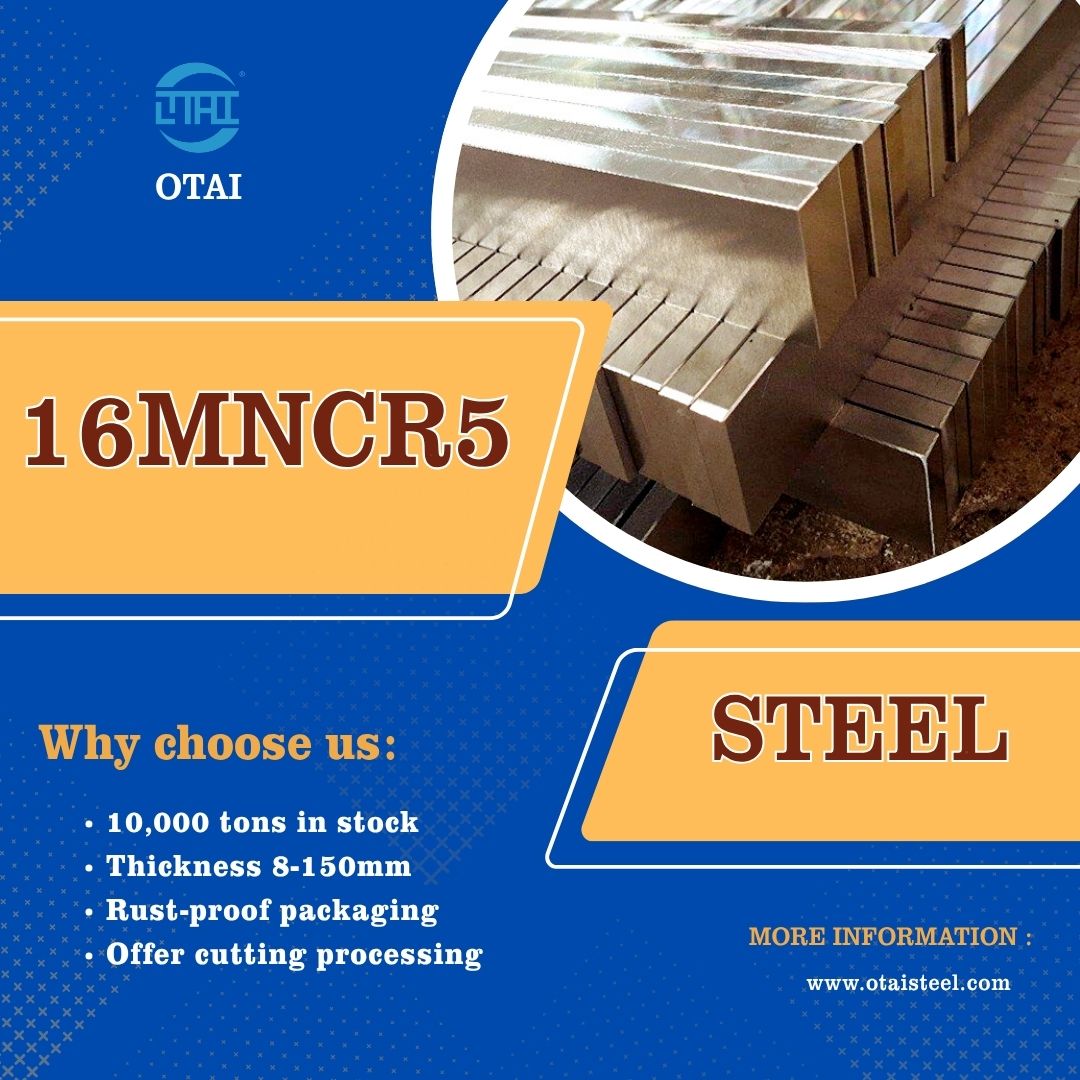
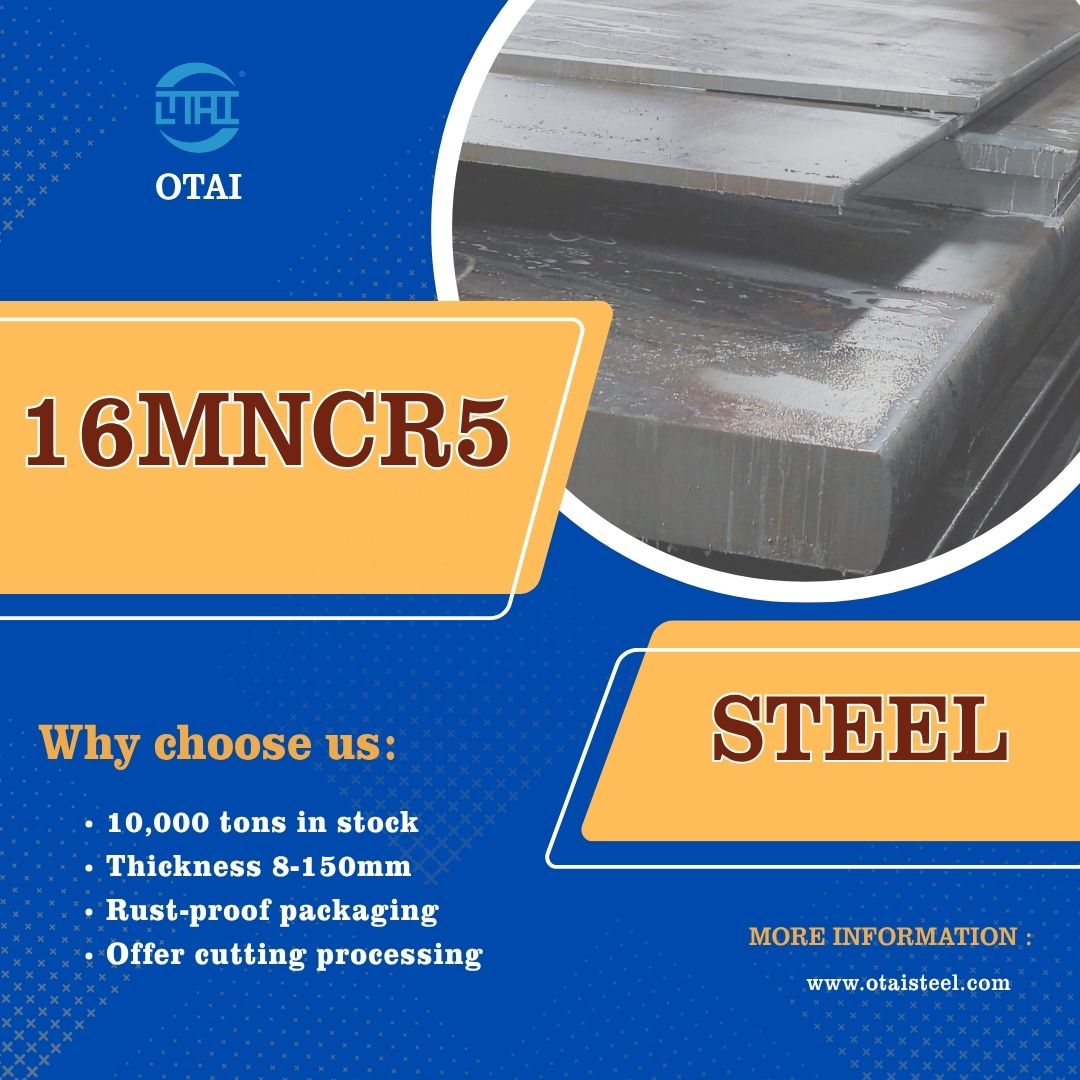
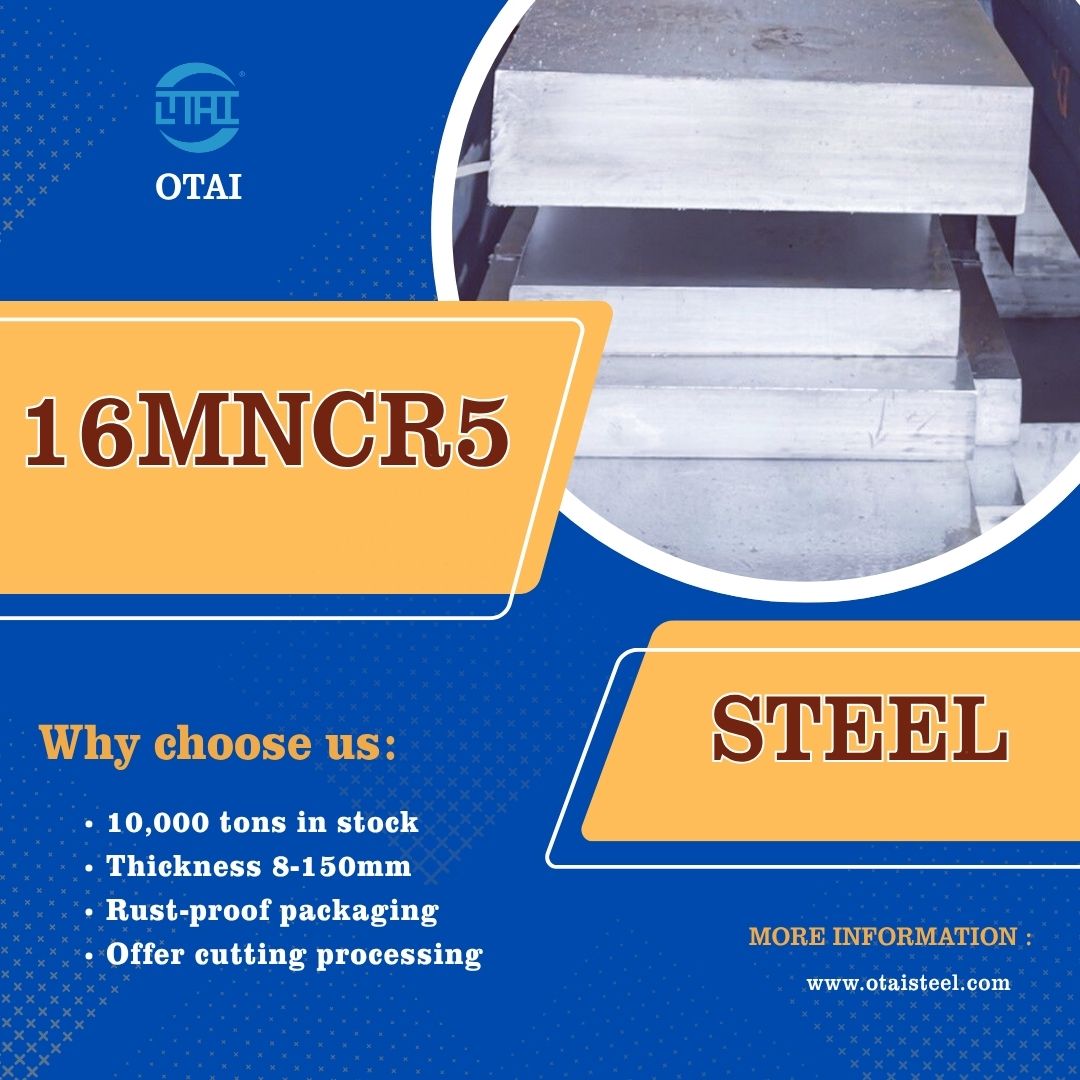
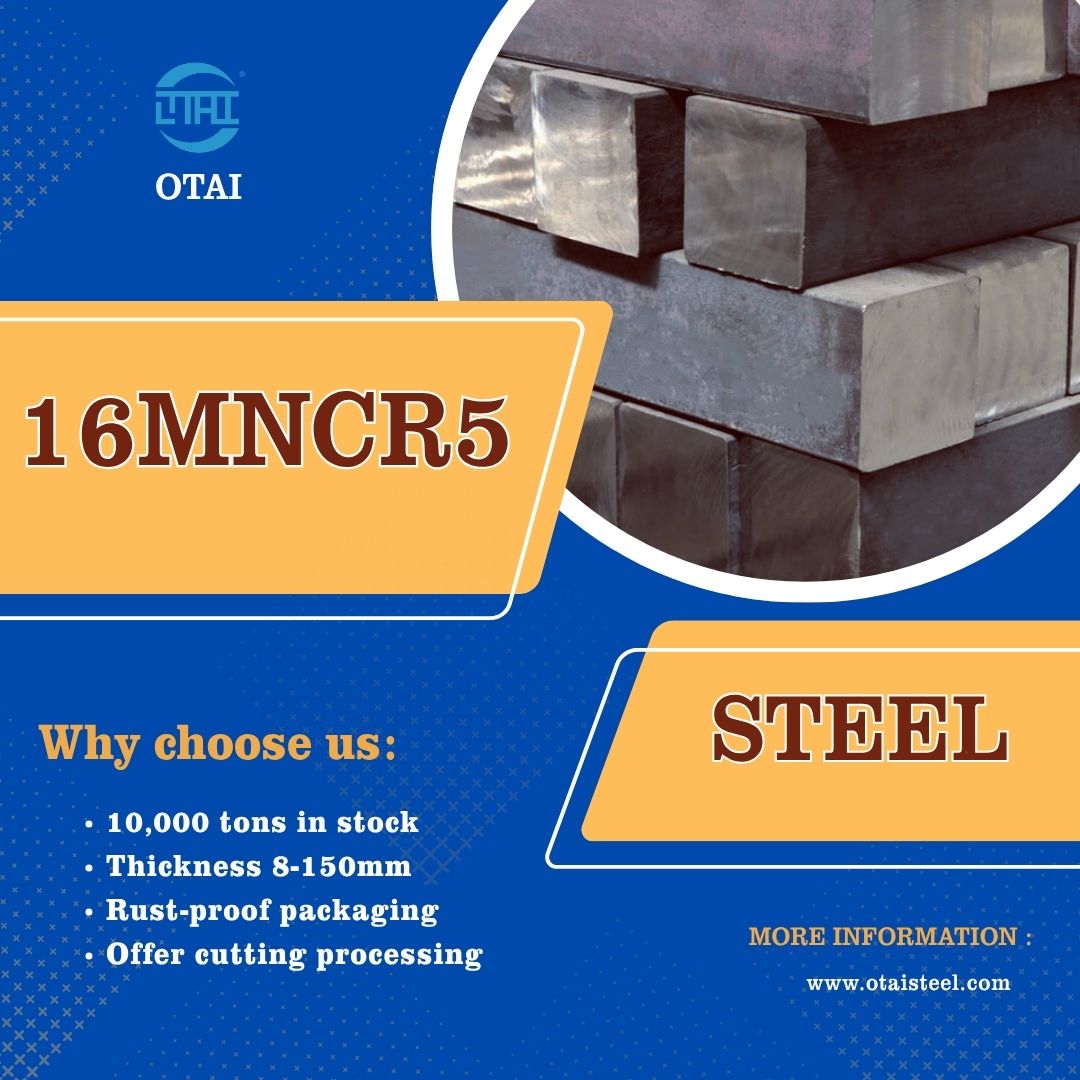
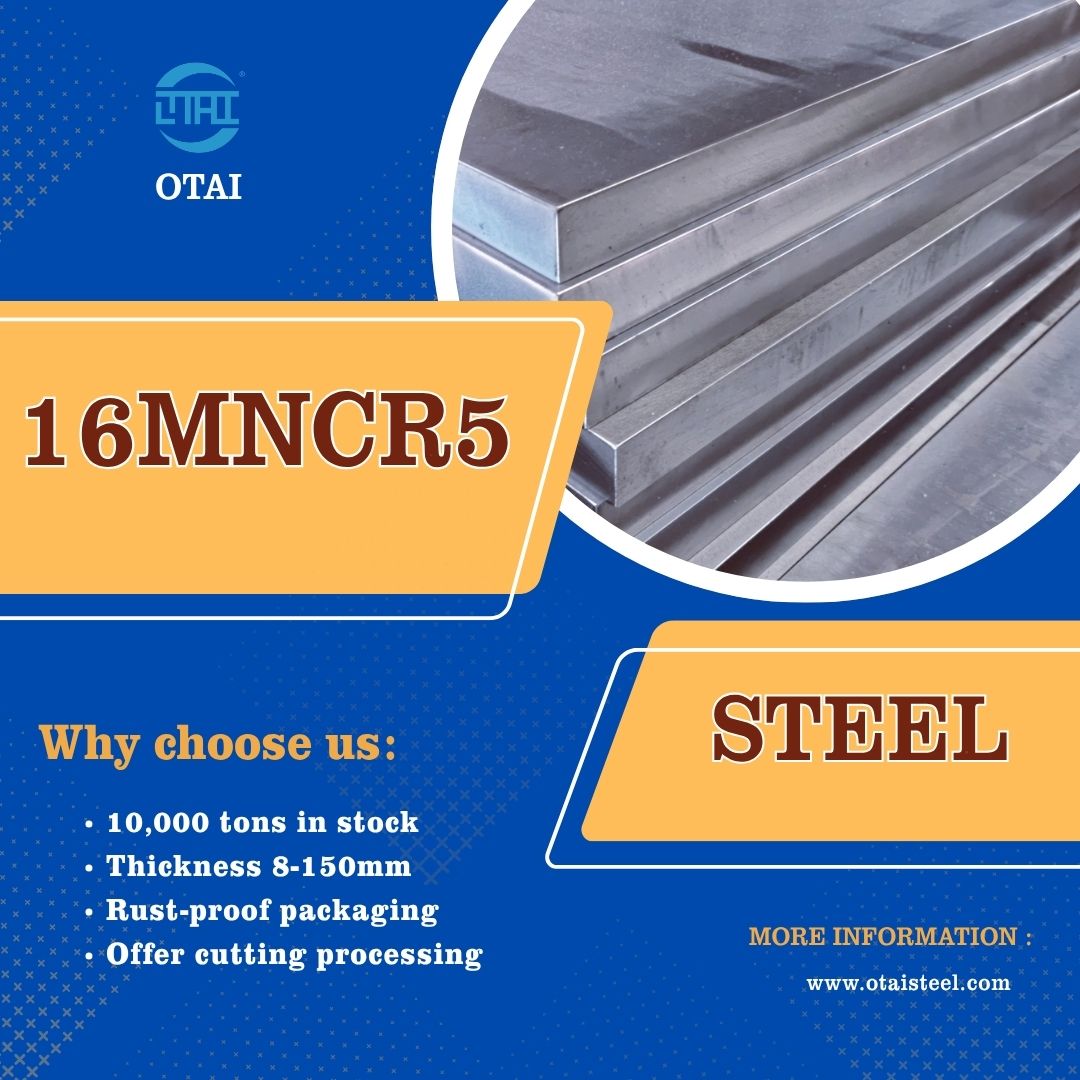
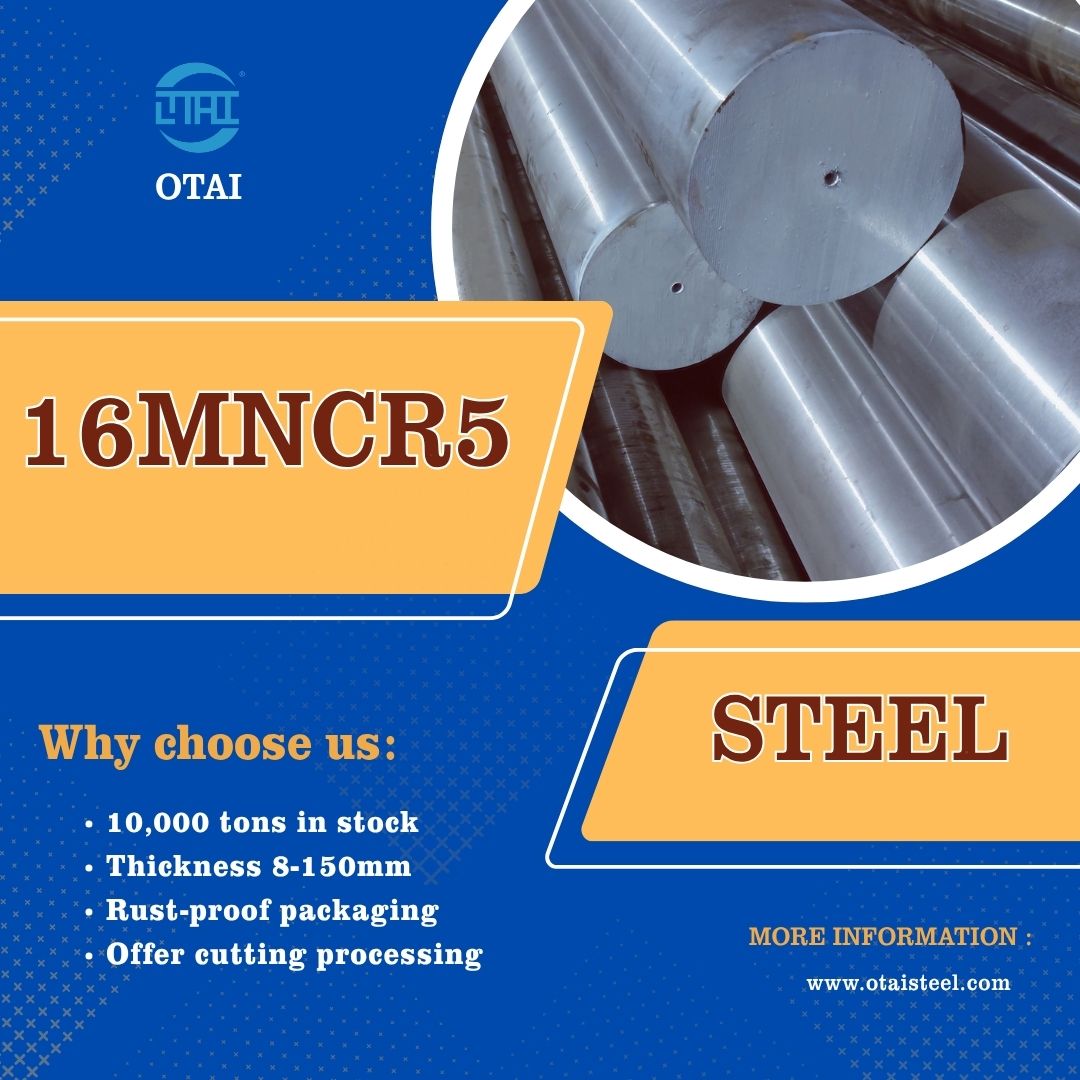
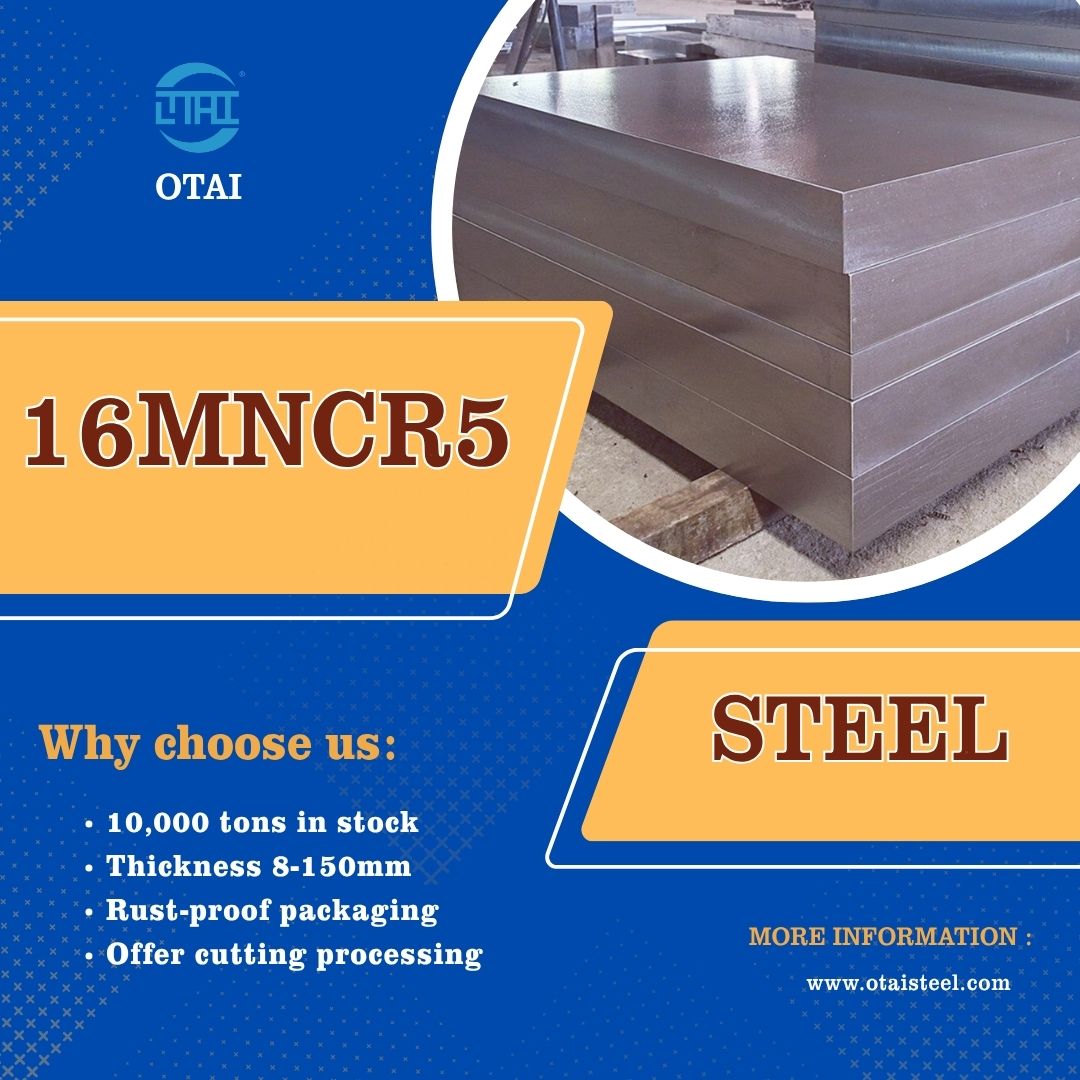
For buyers sourcing 16MnCr5 flat steel from Otai, the current stock range is:
📏 16MnCr5 steel plate thickness range: 8–150mm in stock.
This range is more relevant to industrial machined components than to thin sheet-metal fabrication. If your finished component starts from a thick blank, the supplier can discuss cutting dimensions and machining allowance before shipment.
Why starting thickness matters
Imagine your finished component requires a 45 mm section, but your machining process needs additional material for rough machining and finishing. Buying material too close to the final dimension may leave insufficient allowance. Buying substantially thicker stock, on the other hand, can increase machining time and material waste.
For that reason, provide both the finished dimension and the required blank dimension whenever possible.
| Requirement | Information to provide |
|---|---|
| Thickness | Required plate thickness or blank thickness |
| Width | Finished or cutting width |
| Length | Finished or cutting length |
| Tolerance | Required dimensional tolerance |
| Machining | Saw cutting, CNC machining or grinding if required |
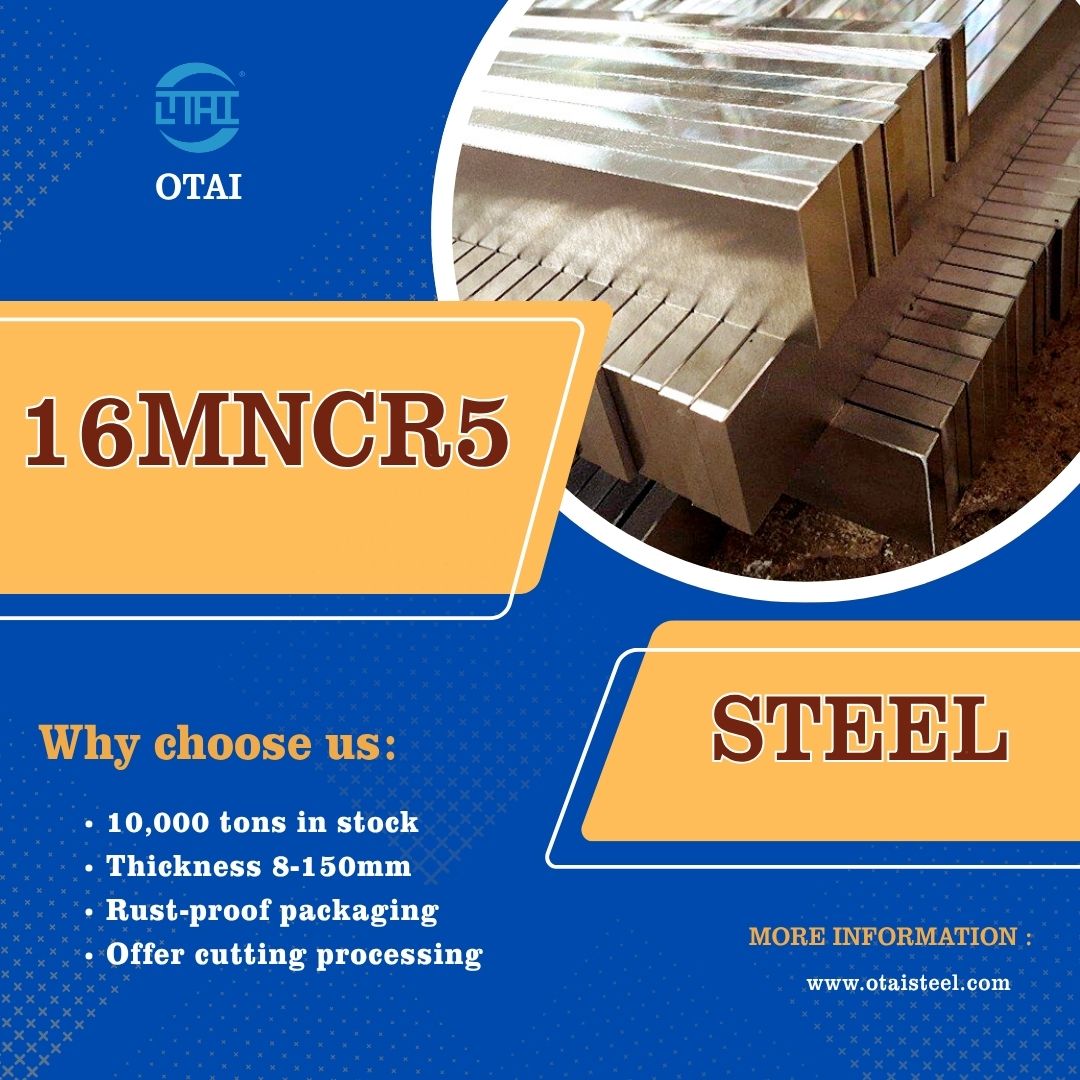
Otai operates 20 saw cutting machines and can provide customized cutting according to agreed dimensions and tolerances. CNC machining and grinding can also support buyers who want to reduce the number of separate suppliers involved in the project.
📋 8. What Should You Confirm Before Buying 16MnCr5?
A technically correct grade can still become the wrong purchase if the commercial specification is incomplete. Before you send an RFQ for 16MnCr5 sheet or plate, prepare the following information.
Grade and standard
Specify 16MnCr5, material number 1.7131 where applicable, and the required standard. EN 10084 identifies 16MnCr5 as a case-hardening steel.
Chemical composition
Ask whether the quotation and MTC will comply with the agreed chemistry. If your customer requires heat-specific chemistry, request the MTC rather than accepting a generic datasheet.
Supply condition and hardness
State the required delivery condition. Published data show different hardness ranges for +A and +FP conditions, so simply writing “16MnCr5, HB” can leave too much room for interpretation.
Dimensions and cutting
Specify thickness, width, length, quantity and cutting tolerance. If you need blanks rather than full plates, give the blank dimensions directly.
Heat-treatment target
If the material will become a carburized component, tell the supplier the target case depth and final surface hardness whenever those values are already defined by your engineering department.
Inspection documents
Confirm MTC requirements, EN 10204 certification if applicable, ultrasonic testing, third-party inspection and any customer-specific inspection requirements before production.
A clear RFQ should therefore answer at least these questions:
- What exact grade and standard do you need?
- What thickness and cutting dimensions do you need?
- What delivery condition do you require?
- What hardness range applies to the supplied material?
- Will the finished component undergo carburizing?
- What case depth and surface hardness does the drawing require?
- What certificate and inspection documents must accompany the shipment?
🔬 9. MTC, Inspection and Quality Requirements
For international steel procurement, the difference between “the material should be 16MnCr5” and “the shipment is documented as compliant 16MnCr5” matters.
The first statement describes your purchasing intention. The second requires evidence from the actual material.
What the MTC should tell you
A heat-specific MTC can document the actual chemical analysis of the material supplied. Depending on the agreed specification and delivery condition, it can also include mechanical test results and other relevant information.
For example, if the specification calls for carbon between 0.14% and 0.19%, the actual MTC value should fall within the applicable requirement. The same principle applies to manganese, chromium, silicon, phosphorus and sulfur.
Do not use a Typical Analysis as a substitute for the actual MTC.
Ultrasonic testing
For thicker plate and critical machined components, buyers may also request ultrasonic testing to assess internal quality. The required acceptance level should come from the applicable project or customer specification.
Third-party inspection
When your customer requires independent verification, third-party inspection can be arranged before shipment. Discuss the inspection scope early so the supplier can coordinate the inspection with production and delivery.
For overseas orders, packaging also matters. Anti-rust protection, strapping or bundling and wooden cases can help protect the steel during international transportation and storage.
🏢 10. 16MnCr5 Supply from Otai Special Steel
- 📏 16MnCr5 steel plate thickness range: 8–150mm in stock.
- 📦 More than 10,000 tons of steel inventory supports regular industrial orders.
- ✂️ 20 saw cutting machines support customized cutting sizes.
- ⚙️ CNC machining and grinding are available for projects requiring additional processing.
- 📐 Custom dimensions and tolerances can be discussed according to project requirements.
- 🔬 Ultrasonic testing and third-party inspection support are available when required.
- 📋 Material testing and certification can be arranged according to the agreed specification.
- 📦 Export packaging can include strapping/bundling, wooden cases and anti-rust protection.
- 🌍 Otai has exported tool steel and alloy steel to customers in more than 54 countries since 1999.
- 🤝 Cutting, machining, inspection, packaging and export support can be coordinated as a one-stop service.
If your requirement is for 16MnCr5 sheet or plate for a specific machining and heat-treatment process, send the grade, thickness, dimensions, quantity, supply condition and inspection requirements together. That gives the supplier enough information to check the available material and prepare a practical quotation.
❓ 11. FAQ About 16MnCr5 Sheet Metal
What is the chemical composition of 16MnCr5?
Under EN 10084, 16MnCr5 contains 0.14–0.19% carbon, 1.00–1.30% manganese and 0.80–1.10% chromium. Silicon is limited to 0.40% maximum, phosphorus to 0.025% maximum and sulfur to 0.035% maximum. These are standard composition limits; the actual heat chemistry should be confirmed on the MTC.
What is the hardness of 16MnCr5?
There is no single hardness value for every supply condition. Published data list approximately 207 HBW for +A material and 140–187 HBW for +FP material. The applicable value depends on the delivery condition and product specification.
What temperature is used for 16MnCr5 carburizing?
Ovako lists 880–980°C as a carburizing range for 16MnCr5. It also lists 860–900°C for quenching and 150–200°C for tempering. Actual production parameters should match the component geometry, furnace process, case-depth requirement and quenching system.
What is 16MnCr5 mainly used for?
16MnCr5 is a case-hardening steel used for mechanical engineering components that need a hard surface and comparatively tougher core. Typical applications include gears and other transmission or mechanical components exposed to wear and repeated contact.
What 16MnCr5 plate thickness is available from Otai?
Otai Special Steel keeps 16MnCr5 steel plate in 8–150 mm thicknesses in stock. Customized cutting, machining, grinding and inspection support can be discussed according to the project requirements.