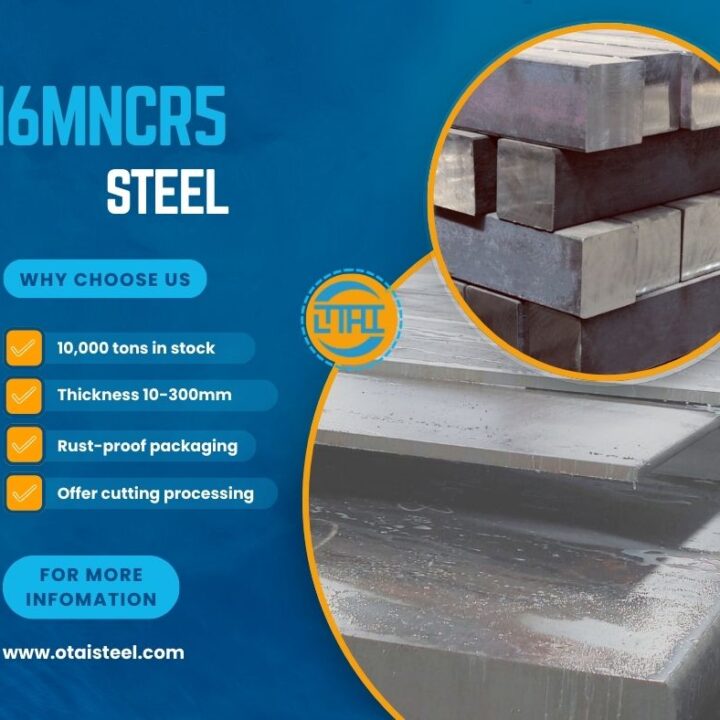
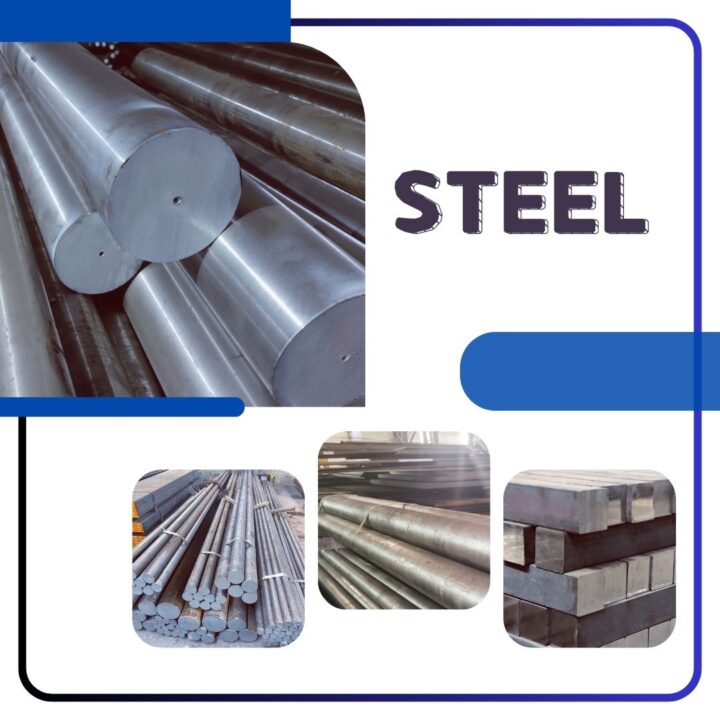
16MnCr5 Steel Exporter for Industrial Buyers: Stock, Quality and Shipping
📑 Table of Contents
- 🌍 What Industrial Buyers Need from a 16MnCr5 Steel Exporter
- 📦 16MnCr5 Steel Plate Stock and Available Sizes
- 🧪 Grade Specifications and Quality Documentation
- ⚙️ Delivery Condition and Case-Hardening Requirements
- 🔍 Inspection, Traceability and Quality Control
- 🚢 Export Packaging, Shipping and Lead Time
- 💰 Comparing 16MnCr5 Steel Exporters and Total Procurement Cost
- 📝 How to Prepare an Effective Export Inquiry
- 🏢 Company Advantages
- ❓ Frequently Asked Questions
🌍 What Industrial Buyers Need from a 16MnCr5 Steel Exporter
Choosing a 16MnCr5 steel exporter involves more than finding a supplier with a competitive price. International buyers need a reliable source that can match the required grade, confirm available dimensions, provide appropriate quality documentation, and arrange delivery with clear commercial terms. These factors become especially important when the steel enters a production process with strict dimensional, metallurgical, or traceability requirements.
16MnCr5, identified by material number 1.7131, is a chromium-manganese case-hardening steel commonly specified for components that need a hard, wear-resistant surface and a comparatively tough core after suitable heat treatment. Typical applications include gears, pinions, shafts, bushings, and other mechanical parts. Because the final performance depends on both the base material and the carburizing process, buyers should evaluate the supplier’s ability to meet the material specification rather than rely on the grade name alone.
What separates a capable exporter from a basic trading source?
A capable exporter should help buyers resolve several questions before the purchase order:
- Can the supplier provide the specified 16MnCr5 grade and product form?
- Does the available stock match the required thickness, width, length, and quantity?
- Can the supplier confirm the delivery condition and applicable material standard?
- Will the shipment include the required material test documentation and traceability?
- Can the exporter provide cutting, packaging, inspection coordination, and international shipping support?
These questions connect technical compliance with purchasing efficiency. For example, a lower-priced material may create additional cost if its condition does not suit the machining plan or if the documentation fails to meet the customer’s requirements. Likewise, a supplier with suitable stock can shorten the sourcing process when the required dimensions and delivery condition match the available material.
Evaluate supply capability before committing to volume
For repeat production, buyers should also consider whether the supplier can support consistent specifications across future shipments. A useful exporter communicates stock status clearly, identifies technical differences before dispatch, and confirms any special inspection or packaging requirements in advance. This approach reduces avoidable delays and makes supplier performance easier to evaluate over time.
📦 16MnCr5 Steel Plate Stock and Available Sizes
Stock availability is often one of the first considerations when selecting a 16MnCr5 steel plate exporter. Buyers need to know whether the supplier can provide the requested dimensions without unnecessary production delays or excessive material waste. For cut-to-size requirements, the relationship between the available plate dimensions and the finished component size also affects purchasing efficiency.
Available 16MnCr5 plate thickness
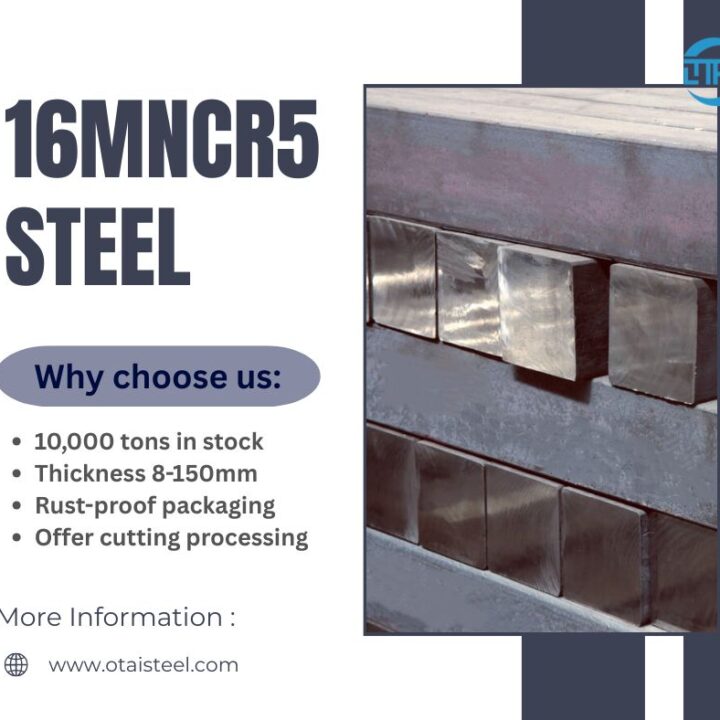
Otai Special Steel’s stated current stock range for 16MnCr5 steel plate is 8–150 mm thickness. Buyers should confirm the exact dimensions, quantity, surface condition, and delivery condition available for their inquiry. The stated range indicates the thickness range held in stock; it does not guarantee that every thickness, width, length, and condition combination is immediately available.
| Supply item | Current stated range or service | What buyers should confirm |
|---|---|---|
| 16MnCr5 steel plate | 8–150 mm thickness in stock | Exact thickness, width, length, quantity, and delivery condition |
| Cut-to-size supply | Saw cutting can be arranged | Cut dimensions, tolerances, quantity per piece, and machining allowance |
| Quality documentation | Documentation requirements can be discussed with the supplier | Certificate type, traceability, and any additional inspection requirements |
| Export delivery | Packaging and shipping arrangements can be quoted | Destination, shipping terms, packaging, and dispatch schedule |
Match the stock dimensions to the production plan
When selecting plate thickness, consider the finished component, required machining allowance, cutting losses, and the orientation of the part within the plate. Buying a plate that is too small can force the use of multiple pieces, while buying substantially oversized material may increase material cost and machining time.
For repeat orders, provide a clear size list rather than a single total weight whenever possible. Include the required dimensions and quantity for each size. This allows the exporter to check the requested combination more accurately and identify opportunities to reduce cutting waste.
Confirm the delivery condition separately
Stock availability does not automatically establish that the plate meets a specific hardness or mechanical-property requirement. A buyer who needs material for subsequent carburizing may have different delivery requirements from a buyer who expects the exporter to supply a particular pre-treated condition. State the required condition in the inquiry and obtain confirmation before payment or production scheduling.
🧪 Grade Specifications and Quality Documentation
Reliable international steel procurement begins with an accurate material specification. For 16MnCr5, buyers commonly refer to EN 10084, the European standard for case-hardening steels. The material designation 16MnCr5 and material number 1.7131 help identify the grade, but the purchase documents should also define the applicable standard, product form, delivery condition, and any additional contractual requirements.
Check the chemical composition against the applicable standard
The following table summarizes commonly published EN 10084 composition limits for 16MnCr5. Buyers should verify the governing standard edition and its requirements when preparing a formal purchase specification.
| Element | Commonly published range or limit (% by mass) | Relevance to buyers |
|---|---|---|
| Carbon (C) | 0.14–0.19 | Supports the low-carbon core and subsequent case-hardening process |
| Silicon (Si) | ≤ 0.40 | Part of the specified chemical composition |
| Manganese (Mn) | 1.00–1.30 | Contributes to hardenability and strength response |
| Phosphorus (P) | ≤ 0.025 | A controlled residual element |
| Sulfur (S) | ≤ 0.035 | Should meet the specified grade requirements; special variants may differ |
| Chromium (Cr) | 0.80–1.10 | Supports hardenability and case-hardening performance |
Do not confuse standard limits with actual heat analysis
A standard defines acceptable chemical composition limits; a mill’s typical analysis describes representative production data; and an actual material test certificate (MTC) reports results associated with the supplied heat or batch, according to the certificate and contract. These are three different types of information.
For procurement, use standard limits to establish the contractual benchmark and the MTC to verify the reported results for the supplied material. Do not treat one supplier’s typical analysis as the universal composition of every 16MnCr5 heat. If your customer requires specific additional limits or a particular certificate format, state those requirements before the exporter prepares the offer.
Review the certificate and material identification
Before accepting a quotation, ask which certificate type the supplier can provide and whether the documents will identify the grade, heat or batch number, dimensions, delivery condition, and relevant test results. Make sure the certificate requirements match the purchase order and the receiving procedures at your facility.
For projects that require a particular inspection level, define it in writing. This prevents misunderstandings about whether the quotation includes standard mill documentation, additional testing, or independent inspection services.
⚙️ Delivery Condition and Case-Hardening Requirements
16MnCr5 is a case-hardening steel, not a generic quenched-and-tempered alloy steel for every application. Its low-carbon composition supports a core that can retain useful toughness, while carburizing introduces additional carbon at the surface. Subsequent hardening and tempering can then create a hard outer case suitable for components exposed to wear and contact stress.
Choose the delivery condition for the next manufacturing step
Buyers often purchase 16MnCr5 in a condition suitable for machining or further heat treatment. Commonly specified delivery conditions include soft-annealed material (+A) and material treated to a ferrite-pearlite structure (+FP), subject to the applicable standard and product form.
The correct choice depends on the machining process, dimensional requirements, and the heat treatment planned for the finished component. If your factory will machine the plate and then send the parts for carburizing, tell the exporter about that sequence. This allows both sides to clarify the required incoming condition and avoid assuming that the steel will already meet final surface-hardness targets.
Surface hardness and case depth belong to the finished-part specification
Buyers sometimes ask a steel exporter to guarantee a surface hardness that only becomes relevant after carburizing and hardening. However, the grade designation alone does not guarantee a specific final case depth or surface hardness. Those outcomes depend on the heat-treatment process, component geometry, required case depth, quenching method, and other processing parameters.
If the drawing specifies surface hardness, effective case depth, core hardness, or distortion limits, pass those requirements to the heat-treatment provider. Confirm which party is responsible for achieving and verifying the finished-part properties.
Consider hardenability when repeatability matters
For production runs where consistent core properties and heat-treatment response matter, buyers may need a specified hardenability requirement, such as an applicable H-band designation under the governing standard. Do not assume that plain 16MnCr5 and a hardenability-controlled variant have identical contractual requirements.
Discuss the requirement with your engineering team before ordering. The exporter can then confirm whether the requested grade designation and documentation match the specification. If the project needs a particular hardenability band, include it in the inquiry rather than trying to resolve the difference after the material arrives.
🔍 Inspection, Traceability and Quality Control
For international buyers, quality control must extend beyond the appearance of the steel. Material identification, certificate review, dimensional inspection, and any agreed additional testing help confirm that the shipment matches the purchase specification. A clear inspection plan also gives the buyer and exporter a common basis for handling nonconformities.
Establish the inspection scope before shipment
Start with the standard requirements and the project’s own acceptance criteria. Depending on the application, the purchase order may require chemical analysis, hardness checks, dimensional verification, ultrasonic testing, or third-party inspection. Not every order needs every test, so specify the checks that matter to your application and ask the exporter to confirm availability and cost.
For plate orders, dimensional checks may include thickness, width, length, and cut-size tolerance. If the plate will be machined into precision components, clarify whether the quoted dimensions refer to raw stock, saw-cut material, or finished dimensions. This distinction can affect both acceptance and downstream machining allowance.
Maintain traceability from certificate to shipment
Traceability helps connect the material supplied with its supporting documents. Buyers should confirm how the supplier identifies the heat or batch and how that identification links to the MTC and packing list. If your receiving system requires labels on individual pieces or bundles, explain that requirement before dispatch.
Where third-party inspection is mandatory, agree on the inspection agency, scope, timing, and release procedure in advance. Late requests can delay loading or require the supplier to rearrange the shipment. A defined inspection plan helps both parties coordinate the required checks with production and dispatch.
Document deviations and acceptance criteria
If the material must meet a customer-specific requirement beyond the standard, record that requirement in the purchase order. The same applies to certificate language, test reporting, special markings, or packaging identification. Clear documentation reduces the chance that a shipment meets the basic grade designation but fails a project-specific receiving requirement.
When a discrepancy appears, the buyer should preserve the relevant labels, documents, and inspection records and contact the supplier promptly. Agreeing on an acceptance process before shipment makes it easier to investigate differences and decide on an appropriate resolution.
🚢 Export Packaging, Shipping and Lead Time
Even when the material meets the technical specification, poor packaging or incomplete shipping coordination can disrupt an international order. A reliable 16MnCr5 steel exporter should clarify how the plate will be protected, identified, loaded, and documented for the destination market. Buyers should assess these arrangements alongside price and availability.
Choose packaging for the product and transport route
Steel plate packaging should account for the plate dimensions, total weight, handling method, moisture exposure, and destination requirements. Depending on the order, suppliers may arrange strapping, bundling, anti-rust protection, protective wrapping, or wooden-box packaging. The appropriate method depends on the material and transport plan rather than one universal export package.
If your receiving warehouse requires a specific lifting arrangement, bundle size, label format, or protective material, state it before the exporter prepares the goods. For long-distance shipping, clarify how the supplier will protect the material against corrosion and handling damage during transit and storage.
Understand shipping documents and commercial terms
Before confirming an export order, buyers should align the quotation and purchase order on the destination, delivery terms, shipping method, and responsibility for freight and other charges. Depending on the agreed transaction and route, shipping documentation may include a commercial invoice, packing list, transport document, certificate of origin when applicable, and the required material certificate.
Do not assume that every document or export service comes automatically with a steel quotation. Ask the supplier to confirm which documents it will provide and which items the buyer or freight forwarder must arrange. This is especially important when the buyer’s customs broker, bank, or end customer requires specific document wording.
Plan lead time around the full order process
Delivery timing depends on stock confirmation, cutting or other processing, inspection, packaging, document preparation, booking availability, and transit time. Therefore, an exporter should confirm a realistic dispatch plan for the specific order rather than offer a general lead time without considering the requested services.
For urgent requirements, provide the desired arrival date and ask the supplier to distinguish the estimated preparation time from the estimated transit time. Also confirm whether special inspection or customer approval must take place before dispatch. These steps help procurement teams plan inventory and production more accurately.
💰 Comparing 16MnCr5 Steel Exporters and Total Procurement Cost
When comparing international suppliers, the lowest quoted price per ton does not always represent the lowest delivered cost. Material compliance, cutting requirements, inspection, packaging, shipping, and the risk of production delays can all affect the final procurement result. Buyers should compare quotations using the same technical and commercial assumptions.
Compare offers on an equivalent basis
A useful comparison starts with the same grade, standard, product form, dimensions, delivery condition, quantity, and documentation requirements. If one exporter quotes material in a specified condition and another offers a different condition, the two prices are not directly comparable. The difference may affect machining cost, heat treatment, or the amount of work required after receipt.
| Cost or risk factor | Questions for the exporter | Potential procurement impact |
|---|---|---|
| Base material price | Does the quote cover the exact grade, dimensions, and condition? | Prevents misleading price comparisons |
| Cutting and tolerances | Are cutting fees and specified tolerances included? | Affects usable yield and additional machining |
| Testing and documentation | Which certificates and inspections are included? | Avoids unexpected verification charges |
| Packaging and freight | What packaging, shipping terms, and freight charges apply? | Clarifies delivered cost and transport responsibility |
| Delivery reliability | What is the estimated preparation and dispatch schedule? | Helps reduce production interruption risk |
Balance price with supply reliability
For a one-time purchase, price and immediate availability may dominate the decision. For recurring production, buyers should also consider consistency, communication, traceability, and the supplier’s ability to repeat the agreed specification. A small price difference may be worthwhile if the selected supplier reduces avoidable processing or delivery problems.
Request a written quotation that separates material cost from any additional processing, inspection, packaging, or shipping charges where practical. Confirm the quotation’s validity period and the assumptions behind the lead time. This gives purchasing teams a clearer basis for budget approval and supplier comparison.
Check the supplier’s technical communication
A useful exporter does not simply accept an unclear inquiry. The supplier should ask about missing dimensions, condition, certification, or inspection requirements when these details affect the offer. That exchange helps both sides identify technical gaps before the order enters production or shipping.
For long-term supply, keep the approved specification and acceptance criteria consistent across purchase orders. When the project changes, document the change rather than relying on informal assumptions. Clear specifications and transparent pricing support a more dependable buyer-supplier relationship.
📝 How to Prepare an Effective Export Inquiry
A complete inquiry helps a 16MnCr5 steel exporter check availability, assess technical requirements, and quote the correct scope of supply. Instead of sending only the grade name and a total weight, provide the key details that affect the product, quality documents, and delivery arrangement.
Information to include in your RFQ
| Inquiry detail | Example or requirement |
|---|---|
| Grade and standard | 16MnCr5 / 1.7131, applicable standard and edition |
| Product form | Steel plate |
| Dimensions | Thickness, width, length, and any cut-size requirements |
| Quantity | Total weight and quantity per size or piece |
| Delivery condition | Required condition for machining or subsequent heat treatment |
| Quality documents | Required MTC, traceability, testing, or third-party inspection |
| Packaging | Anti-rust protection, bundling, wooden boxes, or labeling requirements |
| Destination and shipping | Destination port or address, preferred shipping terms, and target delivery date |
Clarify the application when it affects the specification
If the material will become a gear, shaft, pinion, or another case-hardened component, state the intended manufacturing route when relevant. The exporter may not determine the final component design, but this context can help identify questions about delivery condition, hardenability, machining allowance, and documentation.
If the drawing requires a particular surface hardness or case depth, distinguish those finished-part requirements from the incoming steel specification. Confirm who will perform the carburizing and final heat treatment and who will verify the results.
Request a complete written quotation
Ask the exporter to confirm the available dimensions, delivery condition, price basis, lead time, certificate scope, packaging, and shipping terms. If some requirements remain unconfirmed, request a clear list of exclusions or open items before placing the order.
For repeat purchases, keep the final approved specification and documentation requirements as part of your procurement record. A clear RFQ and a complete written offer help both sides reduce misunderstandings, compare commercial options fairly, and plan delivery with greater confidence.
🏢 Company Advantages
- 16MnCr5 steel plate stock: Current stated thickness range of 8–150 mm in stock. Confirm the exact dimensions, quantity, delivery condition, and availability for each inquiry.
- Large overall inventory: More than 10,000 tons of stock across the company’s steel supply range, supporting a broad range of industrial sourcing requirements.
- Cutting capacity: 20 saw-cutting machines support customer-specified cutting requirements.
- Customized processing: CNC machining, grinding, and customized dimensional and tolerance requirements can be discussed according to the project.
- Quality support: Material documentation, quality testing, ultrasonic testing, and third-party inspection support can be arranged or confirmed according to the agreed requirements.
- Export experience: Supplying international customers since 1999, with exports to more than 54 countries.
- Export packaging: Strapping, bundling, anti-rust protection, and wooden-box packaging can be discussed according to product dimensions and shipping needs.
- One-stop service: Cutting, processing coordination, packaging, and export support can help buyers simplify the sourcing process.
- Procurement-focused communication: The team can review the required grade, plate dimensions, delivery condition, documentation, and shipping details before preparing a quotation.
To request a quotation for 16MnCr5 steel plate, provide your required thickness, width, length, quantity, delivery condition, certificate requirements, and destination. Otai Special Steel can then check the relevant supply options and confirm the services available for your order.
❓ Frequently Asked Questions
1. What should I look for in a 16MnCr5 steel exporter?
Look for a supplier that can confirm the required grade, dimensions, delivery condition, material documentation, and shipping arrangements. For industrial purchasing, also assess cutting capability, traceability, inspection support, packaging options, and the clarity of the written quotation.
2. What thickness of 16MnCr5 steel plate does Otai Special Steel stock?
Otai Special Steel’s current stated stock range for 16MnCr5 steel plate is 8–150 mm thickness. Buyers should confirm the exact size, quantity, delivery condition, and availability before placing an order, because not every dimension and condition combination is necessarily available at the same time.
3. Which standard covers 16MnCr5 steel?
16MnCr5, material number 1.7131, is commonly specified under EN 10084 for case-hardening steels. The buyer should state the applicable standard and any additional requirements in the purchase documents, then check the supplier’s material certificate against the agreed specification.
4. Does 16MnCr5 steel arrive with a hardened surface?
Not necessarily. 16MnCr5 is a case-hardening steel, and the final surface hardness and case depth generally depend on the subsequent carburizing and hardening process. Buyers should specify the required incoming delivery condition and separately define finished-part heat-treatment requirements where applicable.
5. What information is needed for an export quotation?
Provide the grade and standard, plate thickness, width, length, quantity, delivery condition, certificate and inspection requirements, packaging preferences, destination, and target delivery date. These details help the exporter confirm availability and quote the correct scope of supply, processing, and shipping services.