 16MnCr5 Equivalent Material in EN Grade: Steel Grades Comparison and Applications
📑 Table of Contents
🔍 1. What Is 16MnCr5 Equivalent Material in EN Grade?
⚙️ 2. 16MnCr5 Chemical Composition and EN Standard
📊 3. 16MnCr5 Equivalent Steel Grades Comparison
⚖️ 4. 16MnCr5 vs 20MnCr5 Equivalent Materials
🔥 5. Heat Treatment Differences Between Equivalent Grades
🏭 6. Applications of 16MnCr5 Equivalent Materials
📏 7. 16MnCr5 Plate Specifications and Supply Conditions
📦 8. Otai Special Steel Advantages
❓ FAQ About 16MnCr5 Equivalent Material
🔍 1. What Is 16MnCr5 Equivalent Material in EN Grade?
When engineers search for 16MnCr5 equivalent material in EN grade, they usually want to identify alternative steel grades that have similar chemical composition, mechanical properties and heat treatment performance.
16MnCr5 is a European carburizing steel grade widely used for gears, shafts, transmission parts and other components requiring a hard surface and a tough core.
The material belongs to the EN carburizing steel family and is mainly defined according to European standards. Its material number is 1.7131, and it is specified under EN 10084 for case hardening steels.
The most common reason for searching an 16MnCr5 equivalent grade is international purchasing. Different countries use different steel designation systems, so engineers need to confirm suitable replacement grades before production.
Although equivalent materials may have similar alloy designs, they should always be checked according to chemical composition, hardness requirements, heat treatment condition and final application.
Basic Information of 16MnCr5 Steel
| Property | Description |
|---|---|
| Steel Grade | 16MnCr5 |
| Material Number | 1.7131 |
| Standard | EN 10084 |
| Steel Type | Low carbon alloy carburizing steel |
| Main Alloy Elements | Manganese (Mn), Chromium (Cr) |
| Main Application | Gears, shafts, transmission components |
| Heat Treatment | Carburizing, quenching and tempering |
Why Is 16MnCr5 Used for Gear Manufacturing?
The special design of 16MnCr5 provides excellent performance after carburizing treatment.
- Low carbon content: Provides a tough internal structure.
- Chromium addition: Improves hardenability and wear resistance.
- Manganese addition: Increases strength and improves heat treatment response.
- Carburizing ability: Creates a hard wear-resistant surface layer.
Because of these advantages, 16MnCr5 remains one of the most popular European gear steels.
⚙️ 2. 16MnCr5 Chemical Composition and EN Standard
Understanding chemical composition is essential when comparing 16MnCr5 EN equivalent material. Alloy elements determine hardenability, carburizing performance and mechanical properties after heat treatment.
The composition of 16MnCr5 is carefully balanced. It contains lower carbon than many engineering steels, which allows manufacturers to create a hard surface while maintaining a ductile core.
Typical Chemical Composition of 16MnCr5
| Element | Content (%) | Function |
|---|---|---|
| Carbon (C) | 0.14–0.19 | Provides carburizing capability |
| Silicon (Si) | ≤0.40 | Improves steel strength |
| Manganese (Mn) | 1.00–1.30 | Improves strength and hardenability |
| Phosphorus (P) | ≤0.035 | Controlled for toughness |
| Sulfur (S) | ≤0.035 | Improves machinability |
| Chromium (Cr) | 0.80–1.10 | Improves wear resistance |
Relationship Between Composition and Performance
| Element | Performance Effect |
|---|---|
| Carbon | Controls surface hardness after carburizing |
| Manganese | Improves strength and core toughness |
| Chromium | Improves hardenability and wear resistance |
| Silicon | Supports deoxidation and strength |
The balanced chemistry of 16MnCr5 explains why this steel performs well in applications requiring both surface hardness and internal toughness.
📊 3. 16MnCr5 Equivalent Steel Grades Comparison
When purchasing steel internationally, customers often compare different national standards. Finding the correct 16MnCr5 equivalent grade helps manufacturers maintain similar performance while sourcing materials from different regions.
The closest equivalents usually have similar carbon levels, chromium content and carburizing characteristics. However, each standard may have slight differences in chemical limits and mechanical requirements.
16MnCr5 Equivalent Material Comparison Table
| Standard | Equivalent Grade | Country / Region | Material Type |
|---|---|---|---|
| EN | 16MnCr5 | Europe | Case hardening steel |
| DIN | 16MnCr5 / 1.7131 | Germany | Carburizing steel |
| UNI | 16CrMn5 | Italy | Case hardening alloy steel |
| AFNOR | 16MC5 | France | Low carbon alloy steel |
| GB | 16CrMn | China | Gear steel |
| JIS | SCM415 (similar) | Japan | Chromium molybdenum carburizing steel |
16MnCr5 Equivalent Grades in Different Standards
The following materials are frequently compared with 16MnCr5 when engineers search for international alternatives.
| Grade | Main Difference | Typical Application |
|---|---|---|
| 16MnCr5 | European standard carburizing steel | Gears, shafts, transmission parts |
| 20MnCr5 | Higher carbon content, higher hardenability | Heavy-duty gears |
| 8620 | Nickel-chromium-molybdenum steel | Automotive gears and shafts |
| 5115 | American low carbon alloy steel | Carburized components |
Important Factors When Selecting Equivalent Materials
- Chemical composition: Similar alloy elements are necessary to achieve comparable performance.
- Carburizing behavior: The steel must develop a hard surface layer after treatment.
- Core toughness: Internal strength is important for gear and shaft applications.
- Manufacturing standard: Different standards may have different quality requirements.
Therefore, choosing a replacement for 16MnCr5 requires more than checking the name. Engineers should consider the complete technical requirements of the final component.
⚖️ 4. 16MnCr5 vs 20MnCr5 Equivalent Materials
Among carburizing steels, 16MnCr5 and 20MnCr5 are two commonly compared materials. Both belong to the EN case hardening steel family, but their carbon content and performance are slightly different.
Understanding the difference between these two grades is important when selecting the correct 16MnCr5 equivalent material for gear and mechanical applications.
16MnCr5 vs 20MnCr5 Comparison
| Property | 16MnCr5 | 20MnCr5 |
|---|---|---|
| Standard | EN 10084 | EN 10084 |
| Material Number | 1.7131 | 1.7147 |
| Carbon Content | 0.14–0.19% | 0.17–0.22% |
| Chromium | 0.80–1.10% | 1.00–1.30% |
| Surface Hardness After Carburizing | High | Slightly Higher |
| Core Toughness | Excellent | Very Good |
| Main Use | Standard gears and shafts | Higher load gears |
Which Material Should You Choose?
16MnCr5 is suitable for general gear manufacturing and components requiring good wear resistance with excellent core toughness.
20MnCr5 is often selected for heavier loads because it provides slightly higher strength after carburizing.
| Application Requirement | Recommended Material |
|---|---|
| Standard transmission gears | 16MnCr5 |
| Heavy-duty gears | 20MnCr5 |
| High wear resistance | 20MnCr5 |
| Balanced toughness and strength | 16MnCr5 |
Both materials are excellent carburizing steels, but the final selection depends on component design, loading conditions and required service life.
🔥 5. Heat Treatment Differences Between Equivalent Grades
Heat treatment is a critical factor when comparing 16MnCr5 EN equivalent material. Even similar steel grades can achieve different results depending on carburizing temperature, quenching method and tempering process.
Typical Heat Treatment Process of 16MnCr5
| Process | Temperature | Purpose |
|---|---|---|
| Carburizing | 880–950°C | Increase surface carbon content |
| Quenching | After carburizing | Create hard martensitic surface |
| Tempering | 150–200°C | Reduce stress and improve toughness |
Effect of Heat Treatment on Performance
| Property | Before Treatment | After Carburizing |
|---|---|---|
| Surface Hardness | Moderate | 58–62 HRC |
| Core Structure | Soft and tough | Tough low-carbon core |
| Wear Resistance | Normal | Excellent |
| Fatigue Resistance | Good | Improved |
The ability to achieve a hard surface and tough core is the key reason why 16MnCr5 and its equivalent grades are widely used in gear manufacturing.
🏭 6. Applications of 16MnCr5 Equivalent Material
The excellent carburizing performance of 16MnCr5 makes it one of the most widely used case hardening steels in mechanical manufacturing. Many industries select this material because it provides a combination of high surface hardness, good wear resistance and a tough internal core.
When engineers search for 16MnCr5 equivalent material in EN grade, they usually need alternatives that can provide similar performance in gear manufacturing, automotive components and industrial machinery.
Common Applications of 16MnCr5 and Equivalent Materials
| Industry | Components | Reason for Using 16MnCr5 |
|---|---|---|
| Automotive Industry | Transmission gears, shafts, pinions | High wear resistance and fatigue strength |
| Gear Manufacturing | Precision gears, reduction gears | Excellent carburizing performance |
| Mechanical Engineering | Drive parts, rotating components | Good strength and toughness balance |
| Agricultural Machinery | Gearboxes, shafts and connecting parts | Reliable performance under heavy loads |
| Industrial Equipment | Machine transmission components | Long service life and wear resistance |
Why Is 16MnCr5 Popular for Gear Production?
Gear components require different properties between the surface and the core. The surface must resist wear, while the core must absorb impact loads without cracking.
- Hard surface after carburizing: Provides excellent resistance against contact wear.
- Tough core structure: Helps prevent sudden failure under impact loading.
- Good machinability: Allows efficient manufacturing before heat treatment.
- Stable dimensional performance: Suitable for precision mechanical parts.
For these reasons, 16MnCr5 and its equivalent grades remain important materials in modern gear and transmission manufacturing.
📏 7. 16MnCr5 Plate Specifications and Supply Conditions
Besides chemical composition and mechanical properties, material availability is also an important factor when customers choose 16MnCr5 equivalent steel grades.
Different manufacturing projects require different thicknesses, widths and delivery conditions. Therefore, suppliers must provide flexible sizes and professional processing services.
Typical 16MnCr5 Plate Specifications
| Item | Specification |
|---|---|
| Steel Grade | 16MnCr5 |
| Material Number | 1.7131 |
| Standard | EN 10084 |
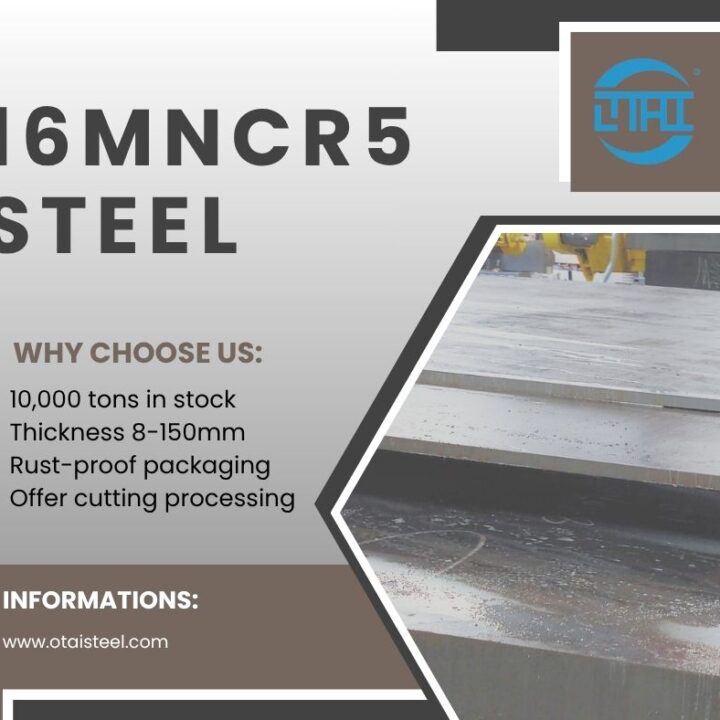
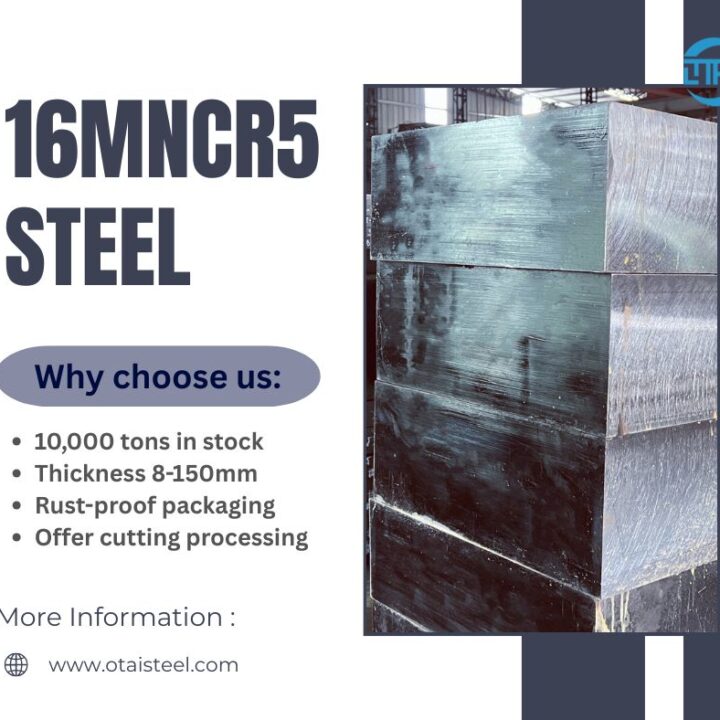
| Thickness Range | 8–150 mm available in stock |
| Supply Condition | Hot rolled, annealed or customized condition |
| Surface Condition | Black surface or machined surface |
| Processing Options | Cutting, machining and heat treatment |
Available Processing Services for 16MnCr5
| Service | Description |
|---|---|
| Cutting Service | Cutting plates according to customer drawings and dimensions |
| Heat Treatment | Carburizing, quenching and tempering support |
| Machining | Surface machining and customized processing |
| Quality Inspection | Ultrasonic testing and third-party inspection available |
| Packaging | Anti-rust packaging and export wooden cases |
Selecting the correct size and delivery condition is important because the final performance of 16MnCr5 depends not only on chemical composition but also on processing history.
📦 8. Otai Special Steel Advantages for 16MnCr5 Supply
For customers looking for reliable 16MnCr5 equivalent material, stable supply capability and strict quality control are important factors.
Otai Special Steel specializes in supplying alloy steels, carburizing steels and special steel plates for international customers in automotive, machinery and industrial manufacturing industries.
Why Choose Otai Special Steel?
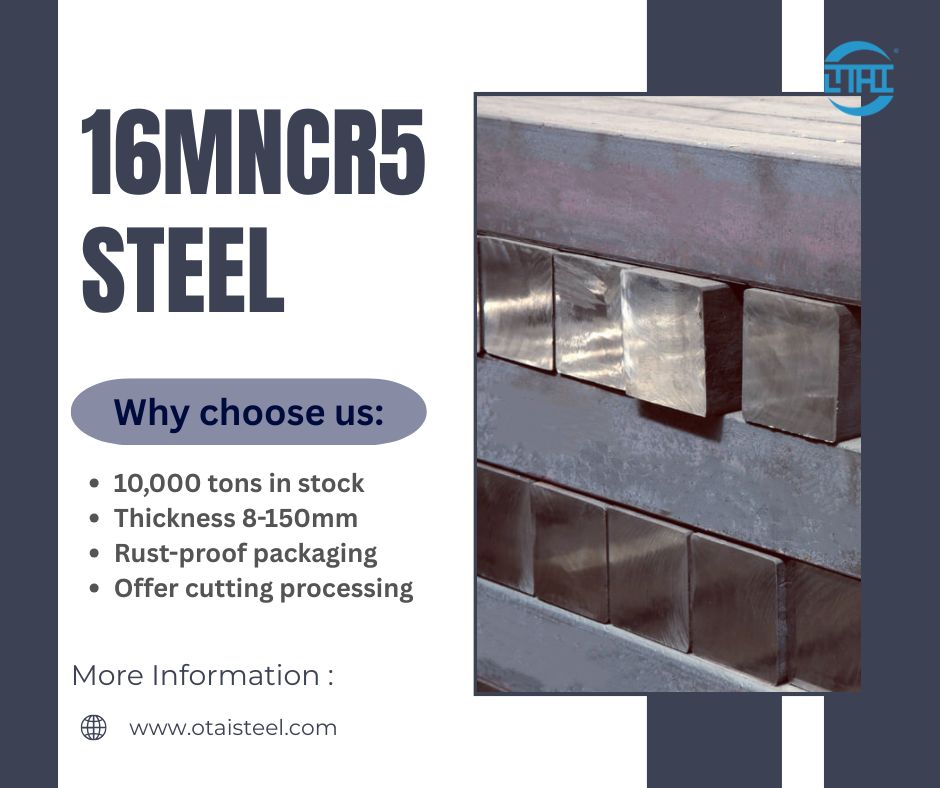
- Stock availability: Otai provides 8–150mm thickness 16MnCr5 plates available in stock to support different manufacturing requirements.
- Professional steel supply experience: We supply special steels to customers with strict technical requirements.
- Processing service: Cutting and customized processing services are available according to customer drawings.
- Heat treatment support: Professional solutions help customers achieve required carburizing and hardness performance.
- Quality assurance: Ultrasonic testing and third-party inspection can be arranged for critical projects.
- Export packaging: Anti-rust protection, steel strapping and wooden box packaging ensure safe international transportation.
With professional knowledge of 16MnCr5 equivalent steel grades, Otai helps customers select suitable materials according to application requirements, manufacturing standards and performance expectations.
❓ FAQ About 16MnCr5 Equivalent Material
1. What is the closest 16MnCr5 equivalent material?
The closest equivalents of 16MnCr5 include 16CrMn5, 16MC5 and some similar carburizing steels. However, chemical composition and application requirements should always be confirmed before replacement.
2. Is 16MnCr5 the same as 42CrMo4?
No. 16MnCr5 is a low carbon carburizing steel mainly used for gears, while 42CrMo4 is a chromium-molybdenum engineering steel with higher carbon content and different applications.
3. What is the material number of 16MnCr5?
The material number of 16MnCr5 is 1.7131. It is defined under EN 10084 case hardening steel standards.
4. Can 16MnCr5 replace 20MnCr5?
In some applications they may be alternatives, but 20MnCr5 generally provides slightly higher hardenability and is often selected for heavier load gears.
5. Does Otai supply 16MnCr5 plates?
Yes. Otai supplies 16MnCr5 plates with 8–150mm thickness available in stock, along with cutting service, heat treatment support, ultrasonic testing and customized solutions.