16MnCr5 Suppliers: Which Factors Matter When Sourcing?
📑 Table of Contents
- 📘 Why Does Supplier Selection Matter for 16MnCr5?
- 📋 Which Standards and Material Specifications Should Suppliers Meet?
- 🧪 How Should Buyers Check 16MnCr5 Chemical Composition?
- 🔥 How Do Delivery Condition and Heat Treatment Affect Quality?
- 📏 Why Do Stock Availability and Dimensions Matter?
- 🔍 What Quality Inspection and MTC Documents Should Suppliers Provide?
- 📦 How Do Processing, Packaging, and Delivery Affect Sourcing?
- 💰 How Can Buyers Compare 16MnCr5 Supplier Quotations?
- 🤝 What Questions Should You Ask a 16MnCr5 Supplier?
- 🏭 Company Advantages
- ❓ Frequently Asked Questions
📘 Why Does Supplier Selection Matter for 16MnCr5?
Choosing reliable 16MnCr5 suppliers involves more than finding a company that offers the correct steel grade. Buyers also need to evaluate material compliance, production consistency, delivery condition, dimensional accuracy, inspection documents, and the supplier’s ability to support international orders.
16MnCr5 is a case-hardening alloy steel commonly used for components that require a hard, wear-resistant surface and a relatively tough core. Typical applications include gears, shafts, pinions, and other transmission components. Since these parts often operate under repeated loads and friction, the steel’s chemical composition and subsequent heat treatment can directly affect component performance.
Why supplier capability affects the final component
A supplier may quote 16MnCr5 at an attractive price, but the quotation alone does not confirm whether the material suits your manufacturing process. For example, differences in steelmaking quality, delivery condition, and dimensional tolerances can influence machining efficiency and heat-treatment results.
Moreover, international buyers must consider communication, documentation, packaging, and shipping arrangements. A supplier that understands export requirements can reduce misunderstandings and help keep the purchasing process under control.
What should procurement teams prioritize?
Start by checking whether the supplier can meet your technical specifications. Then assess stock availability, inspection capabilities, processing services, and delivery reliability. These factors help distinguish a suitable long-term supplier from a trading company that can only provide a basic quotation.
| Evaluation Factor | Why It Matters |
|---|---|
| Material compliance | Confirms that the supplied steel matches the required grade and standard. |
| Stock availability | Helps shorten procurement lead times and supports production planning. |
| Quality inspection | Provides evidence of material identity and conformity. |
| Processing capability | Reduces additional machining and preparation work after delivery. |
| Export experience | Supports documentation, packaging, and international logistics. |
For procurement teams, the best supplier is not necessarily the one with the lowest initial price. Instead, look for a supplier that can consistently meet the material, processing, inspection, and delivery requirements of your project.
📋 Which Standards and Material Specifications Should Suppliers Meet?
Before requesting a quotation, buyers should identify the applicable material standard and confirm the exact grade designation. This step prevents confusion between similar case-hardening steels and helps suppliers prepare an accurate offer.
Understand the 16MnCr5 grade designation
16MnCr5 is a European case-hardening steel grade. Its material number is 1.7131. The grade belongs to the family of low-carbon alloy steels designed for carburizing or other case-hardening processes.
Buyers commonly refer to EN 10084 when specifying case-hardening steels. Depending on the purchasing specification and applicable edition, EN ISO 683-3 may also be relevant. Always confirm the exact standard and edition required by the drawing, purchase order, or end customer.
Check the complete purchasing specification
A grade name alone does not define every requirement. A complete specification should identify the product form, dimensions, delivery condition, tolerances, inspection requirements, and documentation expectations.
| Specification Item | Information to Confirm |
|---|---|
| Steel grade | 16MnCr5 and material number 1.7131. |
| Applicable standard | EN 10084 or the standard specified in the contract. |
| Product form | Plate, bar, or another specified product form. |
| Dimensions | Thickness, width, length, diameter, and dimensional tolerances. |
| Delivery condition | The required condition, such as +A, +N, or another agreed condition. |
| Inspection documents | MTC type, inspection scope, and any additional testing requirements. |
Do not assume equivalent grades are automatically interchangeable
Some buyers compare 16MnCr5 with other case-hardening steels, including grades used in different national standards. Although certain materials may offer similar functions, their chemical limits, hardenability, and product requirements can differ.
Therefore, do not approve a substitute based only on a supplier’s statement that two grades are equivalent. Request a documented comparison and obtain approval from your engineering or quality team before changing the specified material.
A capable supplier should be able to discuss the applicable standard, identify differences between requested and offered specifications, and clarify any deviation before accepting the order.
🧪 How Should Buyers Check 16MnCr5 Chemical Composition?
Chemical composition is a key factor when evaluating 16MnCr5 suppliers. The steel’s carbon and alloying elements influence its response to carburizing, hardening, and subsequent heat treatment. Buyers should therefore compare the material certificate with the specified standard rather than relying on a general product description.
Understand the role of the main alloying elements
16MnCr5 contains carbon, manganese, and chromium as important alloying elements. Carbon supports the development of a hard surface after carburizing and hardening. Manganese and chromium contribute to hardenability and influence the steel’s response during heat treatment.
The exact composition limits depend on the applicable standard and product requirements. A buyer should use the specified standard as the controlling reference instead of treating a single supplier’s typical analysis as a universal chemical formula.
| Element | Function in 16MnCr5 | Buyer Consideration |
|---|---|---|
| Carbon (C) | Supports surface carbon enrichment and hardening. | Check compliance with the specified grade limits. |
| Manganese (Mn) | Contributes to hardenability and strength. | Compare the reported value with the applicable standard. |
| Chromium (Cr) | Improves hardenability and supports case-hardening performance. | Verify the value on the actual material certificate. |
| Silicon (Si) | Acts as a deoxidizing element and influences steel properties. | Check the standard limit and reported analysis. |
| Sulfur (S) and Phosphorus (P) | Residual elements that can affect cleanliness and performance. | Confirm that both remain within the required limits. |
Distinguish standard limits, typical analysis, and MTC results
These three types of chemical information serve different purposes:
- Standard composition limits: The permitted ranges or maximum values defined by the applicable material standard.
- Mill Typical Analysis: Representative values provided by a steel producer. These values describe typical production chemistry, not guaranteed limits for every heat.
- Actual MTC chemical analysis: The measured composition reported for the supplied heat or batch.
For purchasing approval, the actual MTC should receive particular attention. Buyers should compare each reported element against the correct standard limits and check that the certificate refers to the material being supplied.
Request traceability between the certificate and the material
A chemical analysis report has limited value if the buyer cannot connect it to the delivered steel. Ask the supplier to confirm the heat number, batch identification, and marking arrangements. These details help your receiving team match the certificate with the physical material.
When a project requires additional chemical verification, buyers can also discuss third-party testing or independent inspection before shipment.
🔥 How Do Delivery Condition and Heat Treatment Affect Quality?
Delivery condition is an important purchasing detail because it influences how 16MnCr5 behaves during storage, machining, and subsequent heat treatment. Buyers should specify the required condition instead of assuming that every supplier delivers the same material state.
Common delivery conditions to discuss
Depending on the applicable specification and product form, buyers may encounter delivery-condition designations such as +A, +N, +TH, and +FP. Their exact meaning and applicability should be checked against the relevant standard and the supplier’s technical documentation.
| Condition | General Description | Purchasing Check |
|---|---|---|
| +A | Annealed condition. | Confirm the specified hardness and suitability for machining. |
| +N | Normalized condition. | Check whether this condition matches the customer’s processing route. |
| +TH | Treated to a specified hardness range. | Request the agreed hardness range and supporting test results. |
| +FP | Ferrite-pearlite structure condition. | Confirm the required structure and applicable product specification. |
Understand the role of carburizing
16MnCr5 is commonly selected for components that need a hard surface and a tougher core. Carburizing introduces additional carbon into the surface layer. Subsequent hardening develops the required surface hardness, while the core retains properties that support load-bearing performance.
The final result depends on several factors, including the initial material condition, component geometry, carburizing temperature, holding time, quenching method, and tempering process. Therefore, the steel grade alone cannot guarantee a specific case depth or final hardness.
Discuss heat-treatment requirements before placing an order
Buyers should provide the supplier with the intended manufacturing route whenever possible. If the material will undergo carburizing after machining, clarify the required starting condition and any dimensional or surface requirements.
For finished components, specify the required case depth, surface hardness, core hardness, and applicable test method separately. A steel supplier can provide the material and relevant documentation, but the final component performance also depends on the customer’s heat-treatment process.
📏 Why Do Stock Availability and Dimensions Matter?
Stock availability directly affects procurement lead time. For buyers with urgent production schedules, a supplier that holds suitable material in stock may offer a practical advantage over a source that needs to arrange a new production run.
However, buyers should distinguish between material that is physically available and material that a supplier can only arrange after receiving an order. Ask for confirmation of the actual stock dimensions, quantity, delivery condition, and inspection status.
Check available dimensions against your cutting plan
For plate procurement, thickness, width, and length all influence material utilization. If the supplier offers a thickness close to the required finished size, your machining team may reduce material removal and processing time.
Before requesting a quotation, prepare a clear dimension list. Include the required tolerance and cutting allowance when these details affect the final component.
| Dimension or Requirement | What Buyers Should Specify |
|---|---|
| Thickness | Nominal thickness and acceptable thickness tolerance. |
| Width | Required width and whether cutting is necessary. |
| Length | Standard or custom length, including cutting allowance. |
| Quantity | Total weight, number of pieces, and any split-delivery requirement. |
| Surface condition | Required surface quality and any machining allowance. |
Confirm the actual 16MnCr5 stock range
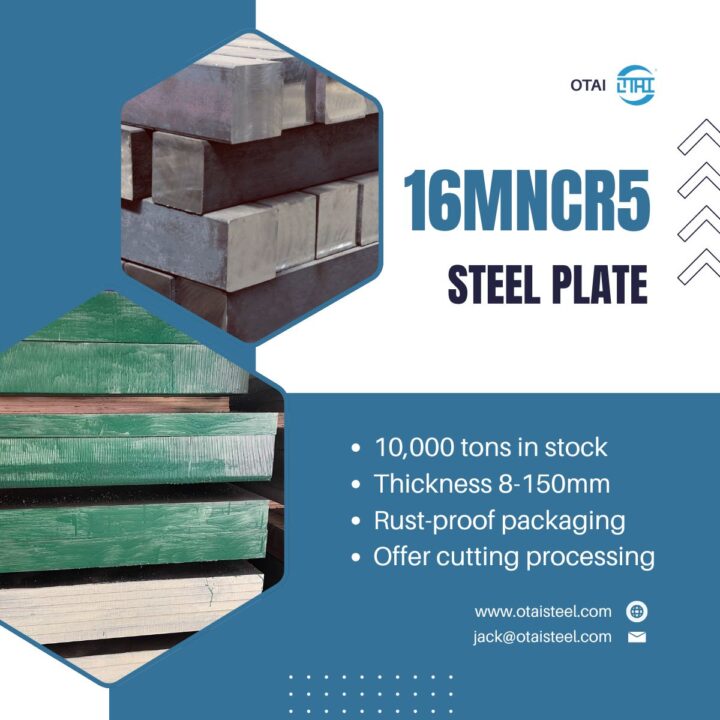
For buyers sourcing 16MnCr5 plate, Otai maintains a stated stock thickness range of 8–150 mm. This gives procurement teams a useful starting point when evaluating plate requirements.
Nevertheless, availability can vary by thickness, width, length, quantity, and delivery condition. Buyers should send their detailed dimension list to confirm current stock and the most suitable cutting plan.
Consider cutting and machining services
Suppliers with saw-cutting and machining equipment can provide material closer to the dimensions required by the customer. This may reduce local processing work and simplify incoming material preparation.
When comparing offers, check whether cutting costs, dimensional tolerances, and machining allowances appear in the quotation. A low material price may not represent the lowest total cost if additional processing is necessary.
🔍 What Quality Inspection and MTC Documents Should Suppliers Provide?
Quality documentation helps buyers verify material identity and assess whether the delivered steel meets the purchase specification. Reliable 16MnCr5 suppliers should explain what inspection documents they can provide and how they maintain traceability.
Review the material test certificate
The Material Test Certificate (MTC) is one of the most important documents in steel procurement. Depending on the order requirements, buyers may request an EN 10204 Type 3.1 certificate or another agreed inspection document.
A Type 3.1 certificate generally provides inspection results validated by the manufacturer’s authorized inspection representative who is independent of the production department. Type 2.2 documentation provides a different level of inspection information. Buyers should select the document type according to the contract and applicable quality requirements.
| Document or Inspection | Purpose | Buyer Action |
|---|---|---|
| MTC | Records material grade, heat number, and test results. | Check grade, chemistry, mechanical data where applicable, and traceability. |
| EN 10204 Type 3.1 | Provides specific inspection results validated under the manufacturer’s inspection system. | Confirm the certificate meets the contract requirement. |
| EN 10204 Type 2.2 | Provides a test report based on non-specific inspection. | Check whether this document level is acceptable for the application. |
| Ultrasonic testing | Checks internal discontinuities according to the agreed testing procedure. | Specify the testing standard, acceptance level, and scope. |
| Third-party inspection | Provides independent verification when required. | Agree on the inspection agency, timing, and inspection scope. |
Check material traceability
Every certificate should correspond to the material delivered. Buyers should verify that the heat number or batch identification on the MTC matches the markings or records supplied with the goods.
For larger projects, traceability becomes especially important when the customer needs to track material across multiple production batches. A supplier should explain how it labels, separates, and records materials during storage and processing.
Agree on additional inspection before shipment
Some applications require more than routine material documentation. Depending on the component and end-user requirements, buyers may request ultrasonic testing, dimensional inspection, hardness testing, or third-party inspection.
Define these requirements before order confirmation. Include the testing scope, acceptance criteria, inspection location, and reporting format in the purchase agreement. This approach reduces disputes after the material arrives.
📦 How Do Processing, Packaging, and Delivery Affect Sourcing?
Material quality is only one part of a successful steel purchase. Processing, packaging, and shipping arrangements also affect the condition of the goods when they reach the buyer’s facility.
Evaluate the supplier’s processing capability
Depending on the order, buyers may need cutting, precision sawing, machining, grinding, or other preparation services. A supplier with suitable equipment can coordinate these operations and reduce the number of external processing steps.
For example, cutting plate to specified dimensions can simplify transportation and incoming inspection. However, buyers should confirm the cutting tolerance and whether the supplier will leave enough machining allowance for the next production stage.
| Service | Potential Purchasing Benefit | Details to Confirm |
|---|---|---|
| Saw cutting | Supplies material in more convenient dimensions. | Cutting tolerance, size, and quantity. |
| CNC machining | Reduces certain preparation steps at the buyer’s facility. | Machining scope, drawing, and dimensional requirements. |
| Grinding | Can improve dimensional accuracy and surface finish. | Final dimensions, flatness, and surface requirements. |
| Inspection coordination | Helps verify agreed requirements before dispatch. | Inspection method, schedule, and report format. |
Check packaging for international transportation
Steel products may travel through several handling and storage stages before reaching the destination. Appropriate packaging helps protect the material against rust, moisture, impact, and handling damage.
Depending on the product dimensions and shipping route, packaging may include anti-rust protection, strapping, bundling, protective wrapping, and wooden cases. Buyers should also consider container loading arrangements and lifting requirements for heavy steel products.
Clarify shipping terms and delivery responsibilities
Before confirming an order, agree on the delivery term, shipping port, estimated lead time, and responsibility for transportation costs. If the order involves custom cutting or additional inspection, allow enough time for these operations before shipment.
International buyers should also confirm the export documents required by their customs broker. Clear communication at the quotation stage helps avoid unnecessary delays during dispatch and customs clearance.
💰 How Can Buyers Compare 16MnCr5 Supplier Quotations?
Comparing quotations from multiple 16MnCr5 suppliers requires more than checking the price per ton. Different suppliers may quote different delivery conditions, dimensions, inspection levels, and service scopes. Buyers should therefore compare offers on the same technical and commercial basis.
Use a consistent quotation checklist
Send the same specification to every supplier. This makes it easier to identify differences in the offered material and prevents a lower quotation from appearing more attractive simply because it excludes important requirements.
| Quotation Item | Supplier A | Supplier B |
|---|---|---|
| Material grade and standard | Check exact compliance. | Check exact compliance. |
| Dimensions and tolerances | Compare the complete dimension list. | Compare the complete dimension list. |
| Delivery condition | Confirm the offered condition. | Confirm the offered condition. |
| Inspection documents | Confirm MTC and additional tests. | Confirm MTC and additional tests. |
| Processing costs | Check cutting and machining charges. | Check cutting and machining charges. |
| Packaging and delivery | Check packing method and shipping term. | Check packing method and shipping term. |
| Lead time | Confirm stock status and dispatch schedule. | Confirm stock status and dispatch schedule. |
Calculate the total procurement cost
The final purchasing cost may include more than the quoted material price. Cutting, machining, inspection, packaging, freight, insurance, and import-related expenses can all influence the total landed cost.
For this reason, buyers should request a detailed quotation that separates material costs from additional services. This makes supplier comparison more transparent and helps purchasing teams identify where cost differences come from.
Balance price, quality, and delivery reliability
A competitive quotation should meet the technical specification and provide a realistic delivery schedule. If a supplier offers a substantially lower price, ask whether the material comes with the required certificate, whether the dimensions match the request, and whether the quoted quantity is actually available.
Likewise, a higher quotation may include value-added services that reduce processing time or quality risks. Evaluate the full offer against your production requirements instead of selecting a supplier based on one number.
🤝 What Questions Should You Ask a 16MnCr5 Supplier?
Direct questions can help buyers assess whether a supplier understands the material and can support the order from quotation to delivery. Before placing an order, prepare a short checklist that covers technical, quality, commercial, and logistical requirements.
About material and stock
- Can you supply 16MnCr5 according to the required standard and material number 1.7131?
- Which thicknesses and dimensions do you currently have available?
- Can you confirm the actual stock quantity and delivery condition?
- Can you provide the MTC for the offered material?
- Can you supply material with the required dimensional tolerances?
Questions about quality and processing
- Can you provide EN 10204 Type 3.1 documentation if required?
- Can you arrange ultrasonic testing or third-party inspection?
- How do you maintain heat-number traceability during cutting and packing?
- Can you provide saw cutting, CNC machining, or grinding services?
- Can you confirm the inspection scope and acceptance criteria before production?
Questions about delivery and commercial terms
- What is the lead time for the requested dimensions and quantity?
- How will the material be protected during international transportation?
- Can you provide wooden cases or other export packaging when necessary?
- Which shipping terms and payment conditions can you offer?
- Can you support repeat orders with consistent specifications and documentation?
Pay attention not only to the answers but also to how clearly the supplier communicates. A professional supplier should be able to identify missing information, explain technical limitations, and confirm the scope of its offer in writing.
For buyers planning long-term cooperation, it is also useful to evaluate the supplier’s stock capacity, processing equipment, quality-control procedures, and export experience. These factors can make a meaningful difference when purchasing 16MnCr5 repeatedly or managing multiple projects.
For product details and available 16MnCr5 steel plate information, visit Otai 16MnCr5 Case Hardening Steel.
🏭 Company Advantages
Otai Special Steel supplies alloy steels and tool steels to international industrial buyers. Since 1999, the company has developed export experience across more than 54 countries and provides material supply and processing support for different manufacturing requirements.
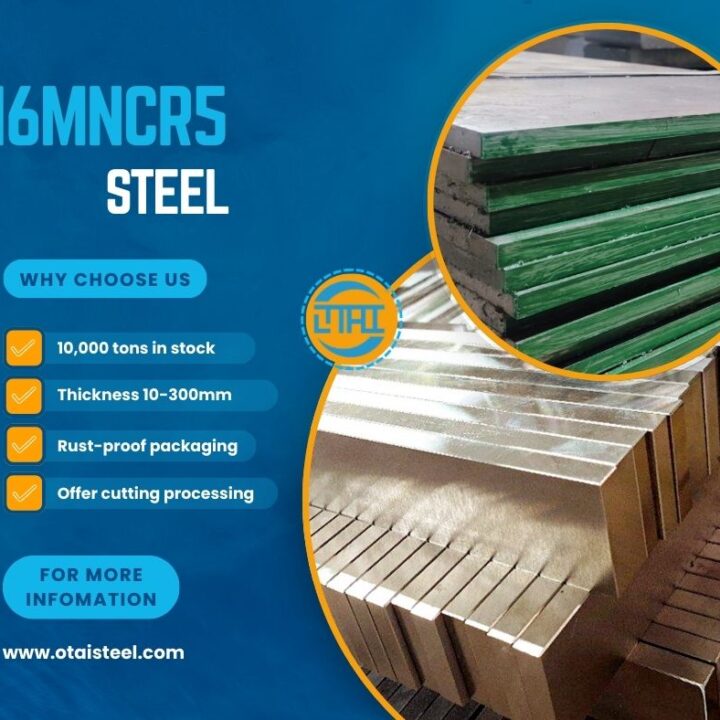
- 16MnCr5 stock availability: Steel plate thickness range of 8–150 mm in stock.
- Large inventory: More than 10,000 tons of steel stock across its product range.
- Cutting capacity: 20 saw cutting machines support material cutting and order preparation.
- Processing services: CNC machining, grinding, and customized cutting services.
- Custom dimensions: Support for customer-specific sizes and dimensional tolerances.
- Quality inspection: Material testing, ultrasonic testing arrangements, and third-party inspection support.
- Export packaging: Anti-rust protection, strapping, bundling, and wooden case packaging options.
- One-stop service: Material supply, cutting, processing coordination, inspection, and export support.
- International experience: Export supply experience serving customers in more than 54 countries since 1999.
For buyers sourcing 16MnCr5, Otai can discuss the required plate dimensions, stock availability, cutting requirements, inspection documents, and export packaging. Contact the team with your specification and quantity to request a quotation.
❓ Frequently Asked Questions
1. What is the material number of 16MnCr5?
The material number of 16MnCr5 is 1.7131. It is a European case-hardening alloy steel commonly used for gears, shafts, and other components that require a hardened surface and a relatively tough core.
2. Which standard applies to 16MnCr5 steel?
EN 10084 is a commonly referenced standard for 16MnCr5 case-hardening steel. Buyers should confirm the applicable standard and edition in their drawings, purchase specifications, or contracts.
3. What is 16MnCr5 steel used for?
Manufacturers commonly use 16MnCr5 for gears, pinions, shafts, transmission components, and other mechanical parts that need surface wear resistance and core toughness after suitable case-hardening treatment.
4. What documents should I request from a 16MnCr5 supplier?
Request a material test certificate that identifies the grade, heat number, and relevant test results. Depending on the contract, you may also require EN 10204 Type 3.1 documentation, ultrasonic testing reports, dimensional inspection records, or third-party inspection reports.
5. What 16MnCr5 plate thicknesses does Otai have in stock?
Otai’s stated 16MnCr5 steel plate stock thickness range is 8–150 mm. Actual availability depends on the required dimensions, quantity, and delivery condition. Contact the team to confirm current stock and obtain a quotation.