 16MnCr5 Hardening Process – Heat Treatment Steps for Maximum Performance
The 16MnCr5 hardening process plays a critical role in achieving the excellent wear resistance, fatigue strength, and surface hardness that make this steel one of the most popular case-hardening grades in the engineering industry. Manufacturers widely use 16MnCr5 for gears, shafts, pinions, sprockets, and transmission components because it develops a hard surface layer while maintaining a tough core.
Understanding the 16MnCr5 hardening process helps engineers optimize component performance and extend service life. Proper carburizing, quenching, and tempering procedures allow the steel to withstand heavy loads, repeated stress cycles, and abrasive operating conditions.
🔵 What Is 16MnCr5 Steel?
16MnCr5 is a low-alloy case-hardening steel specified under EN 10084. The steel contains carbon, manganese, and chromium, which work together to provide excellent hardenability and wear resistance. Engineers often select this material when they need a hard surface combined with a strong and tough core.
Unlike through-hardening steels, 16MnCr5 develops its best performance after carburizing and case hardening. This characteristic makes it particularly suitable for components exposed to surface wear and dynamic loading.
| Property | Performance |
|---|---|
| Carburizing Capability | Excellent |
| Wear Resistance | Excellent |
| Fatigue Strength | High |
| Core Toughness | High |
| Machinability | Good |
🟢 Why Is the 16MnCr5 Hardening Process Important?
The 16MnCr5 hardening process determines the final hardness profile, wear resistance, and fatigue life of the component. Without proper heat treatment, the steel cannot achieve the performance levels required for demanding industrial applications.
A correctly executed hardening process creates a high-carbon surface layer while preserving a relatively low-carbon core. This structure allows the component to resist wear while absorbing impact loads without cracking.
As a result, gears and transmission components manufactured from 16MnCr5 can operate for long periods under heavy mechanical stress.
| Benefit | Impact on Performance |
|---|---|
| Hard Surface | Improved wear resistance |
| Tough Core | Better impact resistance |
| Enhanced Fatigue Strength | Longer service life |
| Stable Microstructure | Consistent properties |
🟠 Step 1: Carburizing
Carburizing is the first and most important stage of the 16MnCr5 hardening process. During this treatment, manufacturers expose the steel to a carbon-rich atmosphere at elevated temperatures. Carbon atoms diffuse into the surface layer, increasing the carbon concentration near the surface.
This enrichment creates the foundation for a hard wear-resistant case after quenching. Engineers can control case depth by adjusting carburizing temperature and holding time.
| Parameter | Typical Range |
|---|---|
| Carburizing Temperature | 880–950°C |
| Holding Time | Several hours |
| Atmosphere | Carbon-rich gas |
| Purpose | Increase surface carbon |
🟣 Step 2: Quenching
After carburizing, the next stage of the 16MnCr5 hardening process is quenching. Manufacturers rapidly cool the component to transform the carburized surface into martensite. This transformation creates the high hardness required for wear-resistant applications.
The chromium and manganese content in 16MnCr5 improves hardenability, helping the steel achieve a consistent hardened layer. Proper quenching parameters help prevent distortion and ensure uniform properties throughout the case-hardened zone.
| Quenching Medium | Typical Use |
|---|---|
| Oil | Most common |
| Polymer Solution | Controlled cooling |
| Special Quench Systems | Precision components |
🔷 Step 3: Tempering
After quenching, manufacturers normally perform tempering as the final stage of the 16MnCr5 hardening process. Although quenching creates a very hard martensitic structure, it also introduces internal stresses. Tempering reduces these stresses and improves dimensional stability while preserving most of the hardness achieved during quenching.
Engineers carefully select the tempering temperature according to the application requirements. Lower tempering temperatures maintain higher hardness levels, while higher temperatures improve toughness and reduce the risk of cracking. For gears and transmission components, manufacturers often choose a balance between wear resistance and impact strength.
A properly controlled tempering cycle allows the 16MnCr5 hardening process to produce components that combine excellent surface durability with reliable long-term performance.
| Tempering Parameter | Typical Range |
|---|---|
| Tempering Temperature | 150–200°C |
| Holding Time | 1–3 Hours |
| Main Purpose | Stress Relief |
| Result | Improved Toughness |
🔴 Hardness Achieved After the 16MnCr5 Hardening Process
One of the main goals of the 16MnCr5 hardening process is to achieve a hard wear-resistant surface. After carburizing, quenching, and tempering, the surface hardness typically reaches levels suitable for demanding industrial applications.
The hardened case protects the component against abrasion, pitting, and contact fatigue. Meanwhile, the tougher core absorbs shock loads and prevents brittle failure. This combination explains why manufacturers frequently choose 16MnCr5 for high-performance gears and shafts.
| Property | Typical Value |
|---|---|
| Surface Hardness | 58–62 HRC |
| Core Hardness | 30–45 HRC |
| Wear Resistance | Excellent |
| Fatigue Resistance | High |
⚙️ Case Depth Requirements
Case depth is another critical factor in the 16MnCr5 hardening process. The ideal case depth depends on the component size, load conditions, and expected service life. Engineers usually specify a case depth that provides sufficient wear resistance without increasing processing time unnecessarily.
A shallow case may wear out prematurely, while an excessively deep case can increase manufacturing costs. For this reason, heat treatment specialists carefully monitor carburizing parameters to achieve the target depth.
| Application | Typical Effective Case Depth |
|---|---|
| Small Gears | 0.5–0.8 mm |
| Automotive Gears | 0.8–1.2 mm |
| Heavy-Duty Gears | 1.2–2.0 mm |
| Industrial Shafts | 0.8–1.5 mm |
📈 Microstructure After Heat Treatment
The final microstructure developed during the 16MnCr5 hardening process largely determines the material’s performance. After carburizing and quenching, the surface primarily consists of high-carbon martensite. This structure provides exceptional hardness and wear resistance.
The core usually contains lower-carbon martensite, bainite, or tempered structures depending on the exact heat treatment schedule. This microstructural combination creates the ideal balance between strength and toughness.
| Region | Typical Microstructure |
|---|---|
| Surface Layer | High-Carbon Martensite |
| Transition Zone | Mixed Structure |
| Core | Tempered Martensite |
| Result | Hard Surface + Tough Core |
🚜 Applications That Benefit from the 16MnCr5 Hardening Process
The 16MnCr5 hardening process allows manufacturers to produce highly durable components for demanding environments. Industries around the world rely on this heat treatment route because it delivers a combination of wear resistance, fatigue strength, and toughness that few materials can match at a similar cost level.
Automotive transmissions, industrial gearboxes, agricultural machinery, construction equipment, and mining systems frequently use case-hardened 16MnCr5 components. The improved surface hardness extends service life and reduces maintenance requirements.
| Component | Main Benefit |
|---|---|
| Gears | Wear Resistance |
| Pinions | Contact Fatigue Strength |
| Shafts | Toughness and Durability |
| Sprockets | Extended Service Life |
| Transmission Parts | Load-Carrying Capacity |
🏭 Company Advantages – Otai Special Steel
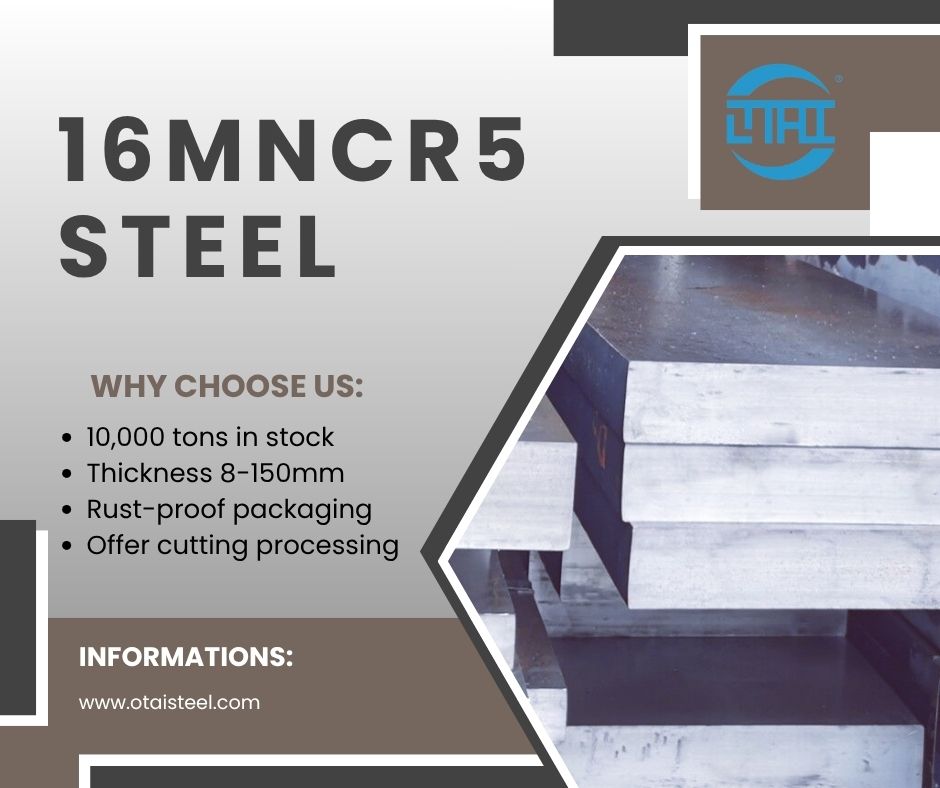
- 📏 16MnCr5 steel plate thickness range: 8–150mm in stock
- 📦 Large inventory available for immediate shipment
- ✂️ Precision cutting, machining, and heat treatment services
- 🔬 Ultrasonic testing and third-party inspection support
- 📦 Anti-rust packaging, strap packaging, and wooden box packaging available
- 🌍 Extensive experience supplying global industrial customers
❓ FAQ – 16MnCr5 Hardening Process
1. What is the purpose of the 16MnCr5 hardening process?
The process increases surface hardness, wear resistance, and fatigue strength while maintaining a tough core.
2. What hardness can 16MnCr5 achieve after hardening?
The surface hardness typically reaches approximately 58–62 HRC after proper carburizing, quenching, and tempering.
3. Is carburizing necessary for 16MnCr5?
Yes. Carburizing enriches the surface with carbon and enables the steel to develop a hard wear-resistant case.
4. Which quenching medium works best for 16MnCr5?
Oil quenching is the most common choice because it provides a good balance between hardness and dimensional control.
5. What industries commonly use hardened 16MnCr5?
Automotive, industrial machinery, mining, agriculture, and power transmission industries widely use hardened 16MnCr5 components.
🏁 Conclusion
The 16MnCr5 hardening process combines carburizing, quenching, and tempering to create a hard wear-resistant surface supported by a strong and tough core. This heat treatment route enables 16MnCr5 to deliver excellent performance in gears, shafts, sprockets, and other power transmission components.
By carefully controlling case depth, hardness, and microstructure, manufacturers can maximize component life and improve reliability in demanding industrial environments. For companies seeking high-quality 16MnCr5 steel plates and professional processing services, choosing an experienced supplier remains a key factor in achieving consistent results.