📑 Table of Contents
- 🔍 What Does a 4130 Steel Stockist Need to Offer?
- 📏 Check 4130 Steel Plate Stock and Available Sizes
- ⚙️ Confirm Grade, Standard and Supply Condition
- 🧪 Review Quality Documents and Inspection Options
- 🔥 Evaluate Heat Treatment and Mechanical Requirements
- ✂️ Compare Cutting, Machining and Custom Services
- 🌍 Assess Export Experience and Delivery Reliability
- 💰 Compare Quotations Beyond the Steel Price
- 📋 Prepare an RFQ for a 4130 Steel Stockist
- 🏢 Company Advantages
- ❓ Frequently Asked Questions
🔍 What Does a 4130 Steel Stockist Need to Offer?
Choosing a 4130 steel stockist involves more than finding a company that lists the grade on its website. Industrial buyers need a supplier that can confirm actual availability, provide the correct material condition, meet dimensional requirements, and support the documentation and delivery process. A suitable stockist helps reduce purchasing delays and limits the risk of receiving material that does not match the drawing or purchase specification.
4130 is a chromium-molybdenum alloy steel commonly used where strength, toughness, and heat-treatment response matter. However, the grade designation alone does not define every property of the supplied product. Plate thickness, applicable standard, delivery condition, and processing history all influence whether the material suits a particular project.
Stock availability versus general supply capability
A company may advertise 4130 steel without holding the exact dimensions you need. Some suppliers work mainly on a mill-order basis, while others maintain inventory and can arrange cutting or other processing. Buyers should distinguish between 4130 steel in stock, material available through a sourcing network, and material that requires a new production order.
Ask the stockist to confirm the available thickness, width, length, quantity, delivery condition, and expected dispatch date. If the project has a fixed production schedule, request confirmation in writing rather than relying on a general product listing.
Match the stockist to your project
For a one-off prototype, small quantities and custom cutting may matter most. For ongoing production, repeatability, traceability, stable supply, and consistent documentation may be more important. Export buyers also need to consider packaging, shipping coordination, and communication across time zones.
The best stockist is therefore not necessarily the one with the lowest quoted price. It is the one that can demonstrate that its material, services, and delivery commitments align with the project’s technical and commercial requirements.
📏 Check 4130 Steel Plate Stock and Available Sizes
Dimensions are among the first details to verify when comparing a 4130 steel plate stockist. Stock ranges vary by supplier, product form, thickness, and material condition. A published range should be treated as a guide to the supplier’s offering, not as proof that every size is available for immediate shipment.
Confirm thickness, width and length
For 4130 steel plate, the thickness can affect availability, cutting options, material utilization, and the achievable properties through the section. Buyers should provide the full dimensions instead of asking only whether a stockist carries 4130. If the drawing includes tight dimensional tolerances, identify them clearly and confirm whether they apply before or after cutting and machining.
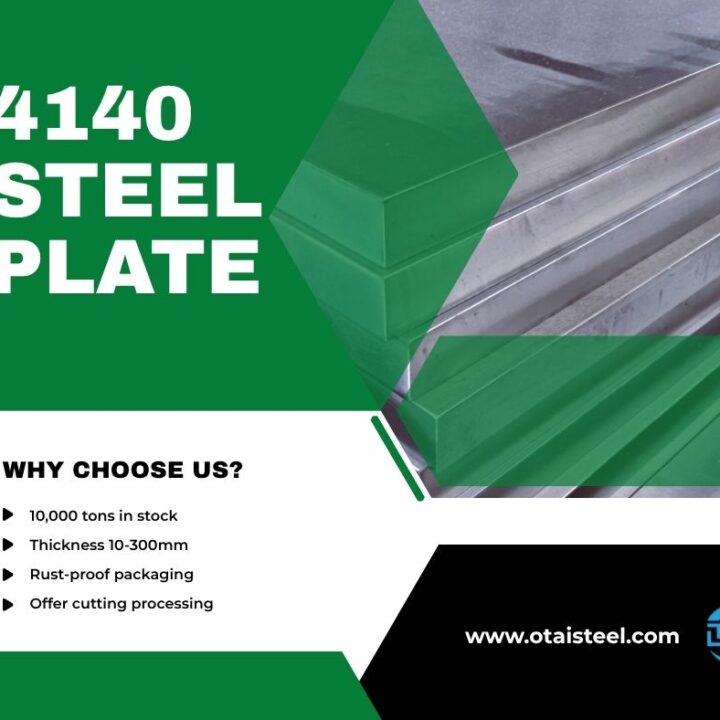
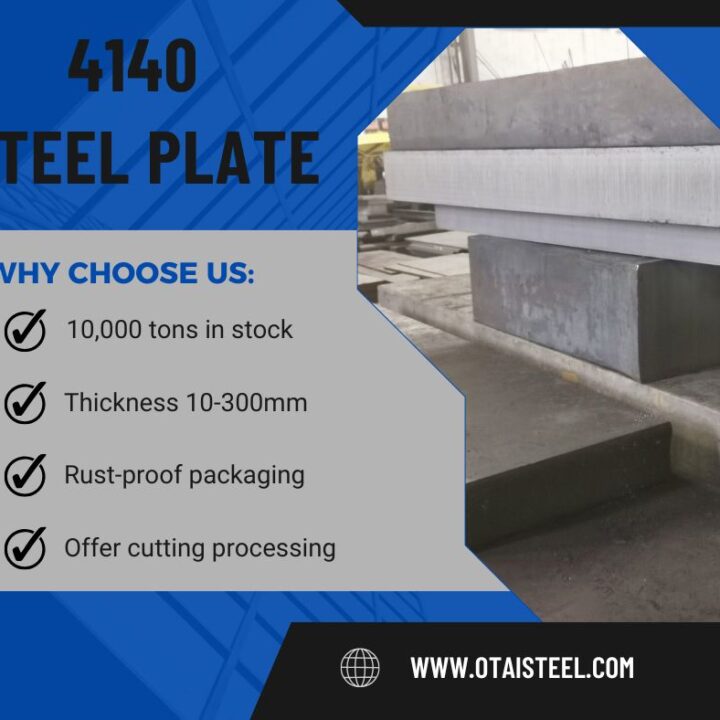
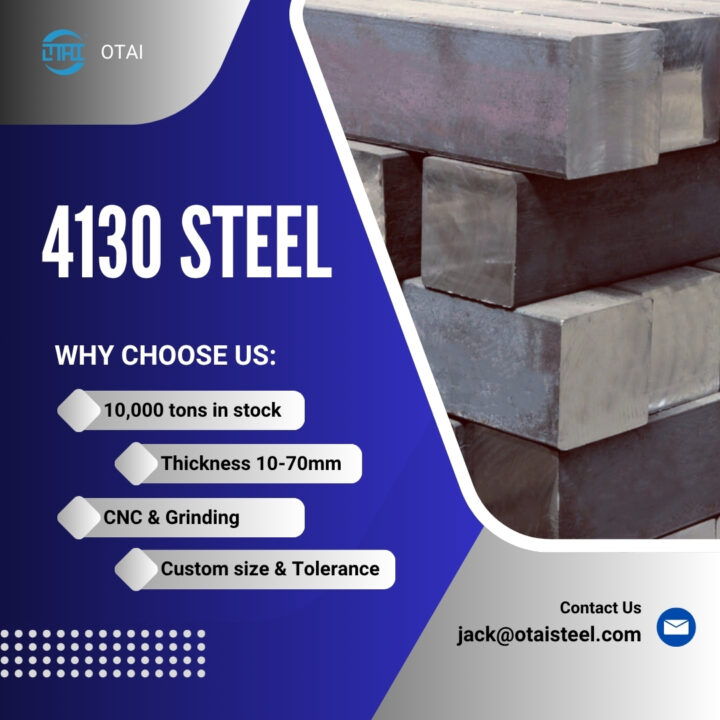
Otai Special Steel’s stated current stock range for 4130 plate is 10–70 mm in thickness. The exact size, quantity, and delivery condition still require confirmation. Buyers should not assume that every thickness in this range is available in every condition or that the same range applies to other product forms.
Use the right product form
Some projects require plate blanks, while others specify a finished component or a different product form. A stockist should confirm that the product offered matches the drawing and purchase specification. Do not accept a different product form simply because it is available sooner without first obtaining technical approval.
If your project requires cut-to-size blanks, send the final dimensions and quantity per size. The stockist can then check whether the available plate can meet the requirements and estimate cutting allowances and material yield. This also helps prevent a quotation from comparing full plates with finished blanks as though they were identical products.
Ask how stock is verified
Before issuing a purchase order, request confirmation of the actual available quantity and expected dispatch schedule. For urgent projects, clarify whether the supplier has already allocated the material to another order and whether cutting or inspection could extend the lead time.
| Dimension or supply detail | What to confirm | Why it matters |
|---|---|---|
| Thickness | Required nominal thickness and acceptable tolerance | Affects stock selection and machining allowance |
| Width and length | Full plate dimensions or individual blank sizes | Determines cutting feasibility and material yield |
| Quantity | Total weight, number of plates, and pieces per size | Supports accurate availability and pricing checks |
| Delivery condition | Required condition and supporting test results | Helps establish whether the material suits the production route |
| Lead time | Stock confirmation, processing time, and dispatch date | Reduces the risk of production delays |
⚙️ Confirm Grade, Standard and Supply Condition
A reliable 4130 alloy steel supplier should confirm the grade and applicable specification before quoting. The number “4130” identifies a recognized chromium-molybdenum alloy steel grade, but it does not automatically establish the required product standard, dimensional tolerance, heat-treatment condition, or mechanical properties. Buyers should identify these details in the inquiry to avoid receiving a technically unsuitable substitute.
Verify the grade and governing standard
Start with the grade designation shown on the engineering drawing or material specification. If the drawing specifies a particular SAE/AISI, ASTM, or other standard, include that reference and any applicable revision. Different standards may address different product forms or requirements, so the supplier should confirm that its offered material complies with the specification relevant to your application.
When a stockist proposes an alternative grade, compare the chemical composition limits, product requirements, and mechanical properties rather than relying on a similar grade name. A material that appears equivalent in a general comparison may not meet every requirement in a customer drawing or regulated project.
Confirm the delivery condition
4130 plate may be offered in different supply or processing conditions, depending on the source and specification. The correct choice depends on whether the material will undergo machining, welding, heat treatment, or further manufacturing after delivery. A buyer should not assume that all stock is supplied in the same condition.
If you need material for subsequent processing, state the intended manufacturing route and any required incoming properties. If you need a specific heat-treated condition, define the required hardness or mechanical properties and ask the supplier to confirm whether the available stock can meet them.
Check the product specification against the drawing
Dimensions and grade are only part of the purchasing decision. Depending on the project, the drawing or contract may also require surface quality, straightness, dimensional tolerances, traceability, or additional testing. Ask the stockist to identify any deviations before accepting the quotation.
For reference, buyers can review Otai’s 4130 steel product page and then confirm the exact specification and availability required for their project. Product-page information supports initial selection, while the final purchase order should define the contractual requirements.
🧪 Review Quality Documents and Inspection Options
For industrial procurement, a stockist must do more than supply a grade name. Buyers need suitable evidence that the material meets the agreed specification. Quality documentation also helps receiving teams trace material, verify compliance, and investigate problems if a component fails to meet production requirements.
Request the appropriate material test certificate
Ask whether the supplier can provide a material test certificate (MTC) that matches the purchase order. Depending on the specification and certificate type, the documentation may include the grade, applicable standard, heat or batch identification, chemical analysis, mechanical test results, and other required inspection details.
Review the certificate for consistency. The grade, material identification, dimensions or product description, and test results should correspond to the material being supplied. If the project requires actual test results, do not rely solely on a general datasheet or a typical chemical composition published online.
Distinguish standard requirements from typical data
Technical webpages often show typical chemistry or mechanical properties to help buyers understand a grade. These values do not necessarily represent guaranteed limits for every product. The applicable standard defines its own requirements, while the actual MTC reports results for the supplied heat or batch where testing applies.
For this reason, use the correct source for each decision: standards and contractual specifications for acceptance criteria, supplier technical data for preliminary evaluation, and the relevant inspection records for shipment verification. If a quotation includes a value that differs from your requirement, ask for clarification before placing the order.
Agree on additional inspection before production
Some projects require hardness testing, ultrasonic testing, third-party inspection, or customer-specific quality documents. These requirements can influence cost and lead time. Define the scope, acceptance criteria, inspection location, and reporting format in advance so that the supplier can include the correct services in the quotation.
Not every plate order needs every type of inspection. Select tests based on the drawing, applicable specification, service conditions, and customer requirements. For critical applications, involve the engineering or quality team before approving the material.
Maintain traceability after cutting
If the supplier cuts a large plate into multiple blanks, ask how it will maintain the link between the pieces and the original material identification. A clear marking and documentation process helps prevent traceability gaps after delivery.
For repeat orders, use consistent document requirements and acceptance criteria. This makes incoming inspection easier and helps the purchasing team compare deliveries across suppliers without repeatedly redefining the quality requirements.
🔥 Evaluate Heat Treatment and Mechanical Requirements
4130 steel is often selected for components that need a combination of strength, toughness, and hardenability. However, these properties depend on the material condition and processing route. When choosing a 4130 steel stockist for industrial projects, confirm that the offered material suits the planned manufacturing process rather than assuming that the grade designation guarantees a specific performance level.
Define the required mechanical properties
Start by identifying the properties that control the application. Depending on the component, these may include tensile strength, yield strength, elongation, impact performance, or hardness. The drawing or governing specification should determine which properties require verification.
Hardness alone cannot fully describe performance. Two samples with similar hardness may behave differently because of differences in microstructure, heat treatment, section size, or other material characteristics. If the design depends on several properties, specify each one instead of treating hardness as a substitute for all mechanical testing.
Coordinate the heat-treatment route
If the part will receive heat treatment after machining, confirm the incoming condition and the processing plan with the manufacturing team. The selected route should account for machining allowance, distortion risk, final dimensions, and the required properties after treatment.
If the stockist is expected to supply material in a specified treated condition, define the required condition and acceptance criteria in the RFQ. Ask which test results the supplier will provide and whether the properties apply to the supplied plate, a test specimen, or the finished component.
Consider thickness and section effects
Section size can affect the response to heat treatment. A thick component may cool differently from a smaller specimen, which can influence the properties achieved at different locations. Therefore, a result from one thickness should not automatically be assumed to apply to another thickness.
When the application requires consistent properties through the section, involve the engineering team in defining a suitable test plan. The stockist should confirm whether the proposed material and processing route can satisfy the documented requirements for the actual dimensions.
Discuss welding and further fabrication where relevant
Some 4130 components require welding or other fabrication. These operations can affect the heat-affected zone and the properties of the finished part. Welding procedures and any required preheating or post-weld heat treatment should follow the applicable engineering specification and qualified procedure.
Do not ask a stockist to guarantee a finished-component property if the supplier is only supplying raw plate and has no responsibility for subsequent processing. Instead, define which requirements apply at delivery and which belong to the fabrication or heat-treatment stage.
✂️ Compare Cutting, Machining and Custom Services
For many industrial buyers, the value of a stockist lies in the services available alongside the steel. Buying plate in a convenient size can reduce handling, simplify production planning, and lower material waste. However, buyers should compare the exact scope of processing rather than assuming that every supplier includes cutting, machining, and finishing in its standard price.
Check cut-to-size capability
If your production requires plate blanks, provide the dimensions of each piece and the total quantity. A supplier with suitable saw-cutting equipment may be able to prepare blanks to reduce your in-house cutting workload. Confirm the achievable cutting tolerance, edge condition, and whether the quoted size includes a machining allowance.
Also ask how the supplier calculates material yield. Cutting several pieces from one plate can produce a different cost per blank from purchasing individual pieces. A clear cutting plan helps both parties estimate the amount of material required and avoid unnecessary surplus.
Evaluate CNC machining and grinding
Some projects require more than rough cutting. CNC machining and grinding may help achieve specified dimensions, surface finishes, or tolerances. Before requesting these services, provide the drawing or clearly list the required operations. The supplier can then determine whether the work fits its capabilities or requires coordination with another processor.
Distinguish between raw-material dimensions and finished-part dimensions in the quotation. Otherwise, two suppliers may quote different scopes of work, making a direct price comparison misleading.
Coordinate processing with material condition
Processing requirements should match the material condition. For example, a component that will undergo further heat treatment may need additional machining allowance to account for distortion or material removal. The appropriate allowance depends on the component design and production process, so it should not be assumed from a generic rule.
If the project requires heat treatment, cutting, machining, and final inspection, clarify which party handles each stage. Agree on the inspection point and responsibility for final dimensions before production begins.
Compare service scope in writing
Ask each supplier to separate material cost, cutting, machining, inspection, packaging, and freight where practical. This structure makes it easier to identify the source of price differences. It also helps the buyer decide whether to purchase raw plate or partially processed blanks.
A stockist that can coordinate several stages may simplify purchasing, but the buyer should still verify the quality requirements and delivery commitments for each service.
🌍 Assess Export Experience and Delivery Reliability
For international buyers, selecting a 4130 steel stockist for export requires checks beyond material quality. Communication, export documentation, packaging, shipping coordination, and the ability to meet the required schedule all affect the purchasing outcome. A supplier may have suitable material but still be a poor fit if it cannot support the project’s delivery process.
Confirm lead time and dispatch arrangements
Ask the supplier to separate stock confirmation, cutting or processing time, inspection time, and shipping time. These stages can have different schedules. If the project has a fixed production start date, request a realistic dispatch commitment and clarify which events could affect it.
For urgent orders, verify that the required quantity is available and not merely expected from a future shipment. Where material needs additional testing or processing, include that work in the delivery plan instead of assuming that stocked material can ship immediately.
Check packaging and corrosion protection
Steel plate may need suitable protection during storage and transport. Depending on the destination and shipping method, buyers may specify anti-rust protection, strapping, bundling, or wooden cases. The supplier should confirm the packaging arrangement and whether it meets any customer or transport requirements.
Packaging should also support safe unloading and material identification. If the shipment contains different sizes or heat numbers, ask the supplier to label bundles clearly and provide packing details that match the shipping documents.
Review export communication and documentation
A stockist serving overseas customers should communicate clearly about specifications, order changes, production status, and shipping arrangements. Buyers should confirm which commercial and shipping documents the supplier can provide and which party will handle each export requirement.
Agree on the delivery term, named place, shipping responsibility, and any required destination-specific documents. These details can affect the total landed cost, so they should form part of the initial quotation rather than being resolved only after order confirmation.
Look for evidence of repeatable service
Past export experience can help demonstrate familiarity with international purchasing workflows, but it does not replace order-specific verification. Ask for clear written commitments on the current order’s grade, dimensions, quality documents, packaging, and schedule.
For recurring projects, consistent communication and traceability can be just as important as the initial material price. A dependable supply process helps buyers plan inventory and reduce disruption between production runs.
💰 Compare Quotations Beyond the Steel Price
The lowest quoted price does not always produce the lowest total purchasing cost. A comparison becomes meaningful only when each stockist quotes the same grade, dimensions, condition, processing scope, inspection requirements, and delivery basis. If one supplier quotes raw plate and another includes cut-to-size blanks, the two prices do not represent the same offer.
Build a like-for-like comparison
Ask suppliers to identify the material price and any additional charges for cutting, machining, testing, packaging, and freight. Also confirm whether the quotation includes the required certificate and any special inspection. Where the quotation excludes an important requirement, request a revised offer before making the decision.
| Cost or risk factor | Question to ask | Potential purchasing impact |
|---|---|---|
| Material price | Does the offer cover the same grade, condition, and dimensions? | Prevents misleading price comparisons |
| Cutting and machining | Are the requested sizes and tolerances included? | Reveals additional processing costs |
| Quality documentation | Are MTCs and required tests included? | Reduces unexpected inspection expenses |
| Lead time | Is the stock confirmed, and when can it ship? | Helps avoid schedule-related costs |
| Freight and packaging | What shipping terms and packaging does the price cover? | Clarifies total landed cost |
| Material conformity | Does the offered material meet every mandatory requirement? | Lowers the risk of rejection and rework |
Consider the cost of material waste
Cutting optimization can affect the effective cost of each usable blank. If the project needs several dimensions, provide a complete cutting list and ask the stockist to assess whether the available plate can produce the required pieces efficiently. Compare the usable yield, not just the price per kilogram.
However, do not accept a substitute thickness or grade solely to reduce waste without checking engineering requirements. Material utilization is valuable only when the resulting blanks remain compliant with the drawing and specification.
Balance price, quality and delivery risk
A competitive supplier should provide a clear quotation, confirm the technical scope, and explain any exclusions. Buyers can then weigh the quoted cost against delivery reliability, inspection support, and the consequences of receiving nonconforming material.
For repeat purchases, consider maintaining a consistent specification and supplier evaluation process. This creates a stronger basis for comparing offers over time and identifying whether price changes come from material costs, processing, freight, or changes in the order scope.
📋 Prepare an RFQ for a 4130 Steel Stockist
A complete request for quotation (RFQ) allows suppliers to evaluate the same requirements and reduces the need for repeated clarification. Rather than asking only for the price of 4130 steel, include the grade, dimensions, delivery condition, quantity, testing requirements, processing needs, and destination.
Information to include in your inquiry
| RFQ field | Details to provide |
|---|---|
| Grade and standard | 4130 and the required material standard or specification |
| Product form | Steel plate or another specified form |
| Dimensions | Thickness, width, length, tolerances, and cut-piece sizes |
| Quantity | Number of plates or blanks, weight, and any repeat-order forecast |
| Supply condition | Required delivery condition and mechanical properties |
| Quality documents | MTC, traceability, hardness testing, ultrasonic testing, or third-party inspection as applicable |
| Processing | Saw cutting, CNC machining, grinding, or other specified services |
| Delivery | Destination, required arrival date, packaging, and shipping terms |
Use the same criteria to evaluate every supplier
Once the quotations arrive, compare each offer against the original specification. Check whether the supplier has confirmed actual stock, the required condition, inspection documentation, processing tolerances, and the delivery schedule. Record any exceptions instead of treating an incomplete offer as fully compliant.
If a stockist proposes an alternative grade or supply condition, request the relevant technical documentation and obtain approval from the responsible engineer or customer before accepting the change. This protects the project from avoidable material rejection and rework.
Confirm the details before issuing the purchase order
The purchase order should identify the agreed grade, standard, dimensions, condition, quantity, quality documents, and acceptance requirements. Include processing, packaging, and delivery commitments where applicable. Any agreed deviation should appear in writing so that both parties work from the same specification.
A clear RFQ makes it easier to distinguish a genuine stockist from a supplier whose listing only indicates general sourcing capability. It also helps procurement teams evaluate price, quality, and delivery on a consistent basis.
🏢 Company Advantages
- Substantial inventory: More than 10,000 tons of steel across the company’s supply range. Confirm current 4130 availability and the exact required dimensions before ordering.
- 4130 steel plate: Current stated stock thickness range of 10–70 mm, subject to confirmation of grade, condition, size, and quantity.
- Cutting capacity: 20 saw-cutting machines to support customer-specified plate cutting.
- Custom processing: CNC machining, grinding, and customized dimensions and tolerances can be discussed according to project requirements.
- Quality support: Material documentation, quality testing, ultrasonic testing, and third-party inspection support can be arranged according to the agreed specification.
- International experience: Exporting steel to more than 54 countries since 1999, supporting overseas procurement and supply coordination.
- Export packaging: Strapping, bundling, anti-rust protection, and wooden-case packaging can be arranged according to product and shipping requirements.
- One-stop service: Supply coordination, cutting, processing, packaging, and export support help simplify the purchasing process.
When contacting Otai Special Steel, provide your 4130 plate dimensions, quantity, required condition, technical standard, inspection requirements, and destination. The team can then check the applicable supply options and confirm which processing and delivery services fit your project.
❓ Frequently Asked Questions
1. What should I look for in a 4130 steel stockist?
Look for verified stock availability, compliance with the required material specification, suitable delivery conditions, traceable quality documentation, and clear delivery commitments. If your project needs cutting or machining, confirm those capabilities and the associated tolerances before comparing quotations.
2. What thickness of 4130 steel plate does Otai stock?
Otai’s stated current stock range for 4130 steel plate is 10–70 mm in thickness. Availability depends on the exact dimensions, quantity, and supply condition, so confirm the specific requirement before placing an order.
3. What documents should a 4130 steel stockist provide?
Depending on the purchase specification, the supplier may need to provide an MTC, material identification and traceability, chemical analysis, mechanical test results, and additional inspection reports. Specify the required documents in the RFQ and verify that they correspond to the supplied material.
4. Can a 4130 steel stockist supply cut-to-size plate?
Some stockists offer saw cutting and other processing services. Provide the required blank dimensions, quantities, tolerances, and machining allowances. Confirm whether the quotation covers raw plate, cut blanks, or finished components because each option represents a different scope of work.
5. How can I compare 4130 steel stockist quotations accurately?
Compare quotations using the same grade, standard, dimensions, supply condition, quality requirements, processing scope, packaging, and delivery terms. Include inspection and freight costs where applicable, and confirm actual availability and lead time. A like-for-like comparison gives a more reliable picture of total purchasing cost than the material price alone.