41Cr4 Steel Young’s Modulus: How Does It Affect Component Design?
📑 Table of Contents
- 🔍 What Is Young’s Modulus of 41Cr4 Steel?
- 📐 How Does Elastic Modulus Affect Component Design?
- ⚙️ 41Cr4 Young’s Modulus vs. Other Mechanical Properties
- 🔥 Does Heat Treatment Change the Young’s Modulus of 41Cr4?
- 📊 41Cr4 Elastic Modulus and Related Physical Properties
- 🏭 How Does Young’s Modulus Affect 41Cr4 Applications?
- 🔄 41Cr4 vs. 5140 and Other Alloy Steels
- 📦 What Should Buyers Check When Sourcing 41Cr4 Steel?
- 🏢 Why Choose Otai for 41Cr4 Steel?
- ❓ Frequently Asked Questions
🔍 What Is Young’s Modulus of 41Cr4 Steel?
The Young’s modulus of 41Cr4 steel is approximately 210 GPa (210,000 MPa) at or near room temperature. Also called the elastic modulus or modulus of elasticity, this value describes how strongly a material resists elastic deformation when an external force acts on it.
For engineers designing shafts, gears, axles, pins, and other mechanical components, Young’s modulus helps predict how much a 41Cr4 component will stretch, compress, or bend under a given load. It is therefore an important input for structural calculations and finite element analysis (FEA).
What does 210 GPa mean?
Young’s modulus expresses the relationship between normal stress and elastic strain. Within the linear elastic range, engineers can use Hooke’s law:
E = σ / ε
Where:
- E: Young’s modulus or elastic modulus.
- σ: Applied normal stress, usually expressed in MPa or Pa.
- ε: Elastic strain, expressed as a dimensionless value.
A higher Young’s modulus means that a material experiences less elastic strain under the same stress. Conversely, a lower modulus indicates greater elastic deformation under an equivalent loading condition.
For 41Cr4, a reference value of 210 GPa means that the steel has a relatively high resistance to elastic deformation, consistent with the general stiffness of conventional carbon and alloy steels.
What is the Young’s modulus in other units?
International engineering projects may use different unit systems. Buyers and engineers should therefore recognize the common conversions when reviewing technical documents or entering material data into design software.
| Unit | 41Cr4 reference value |
|---|---|
| GPa | 210 GPa |
| MPa | 210,000 MPa |
| Pa | 2.10 × 10¹¹ Pa |
| ksi | Approximately 30,500 ksi |
| N/mm² | 210,000 N/mm² |
These values represent the same elastic modulus expressed in different units. When engineers compare material data from different suppliers, they should check the units carefully to avoid errors in calculations.
Is 210 GPa a guaranteed value for every 41Cr4 product?
No. The figure is a typical reference value, not necessarily a guaranteed acceptance value for every producer, heat, or delivery condition. Published 41Cr4 reference data report approximately 210 GPa, but the actual behavior of a component can also depend on temperature, material condition, test method, and loading conditions.
For ordinary room-temperature engineering calculations, 210 GPa is a widely used starting value. For precision or safety-critical designs, engineers should confirm the applicable material data and design assumptions with the relevant producer or engineering specification.
📐 How Does Elastic Modulus Affect Component Design?
Young’s modulus directly affects the elastic deformation of a 41Cr4 component. When engineers know the modulus, they can estimate how much a part will stretch under tension, shorten under compression, or deflect under bending loads.
This matters because a component can remain below its yield strength and still deform enough to affect machine accuracy, alignment, vibration, or operating performance.
Axial deformation in shafts and rods
For a component subjected to an axial load, engineers can estimate elastic elongation or shortening using:
δ = FL / AE
Where:
- δ: Axial deformation.
- F: Applied axial force.
- L: Original component length.
- A: Cross-sectional area.
- E: Young’s modulus.
For a given force, length, and cross-sectional area, a higher modulus produces less elastic deformation. This relationship helps engineers determine whether a 41Cr4 shaft or connecting rod can maintain the required dimensional stability under operating loads.
Bending stiffness in mechanical components
Young’s modulus also influences bending stiffness. In beam calculations, bending rigidity is represented by EI, where E is Young’s modulus and I is the second moment of area.
This means that material selection and component geometry work together. A designer can increase bending stiffness by selecting a material with a higher modulus, increasing the cross-sectional dimensions, or changing the component’s shape.
For 41Cr4, the modulus provides the material input for the calculation, while the shaft diameter, plate thickness, length, and support arrangement determine how the component responds to bending loads.
Deflection and dimensional accuracy
In machine tools, transmission systems, hydraulic equipment, and precision machinery, excessive elastic deformation can affect operating accuracy. A shaft that bends too much under load may cause misalignment, uneven contact, or increased wear in connected components.
Therefore, engineers should evaluate both stiffness and strength. A design may satisfy its yield-strength requirement but still fail to meet its deflection limit.
Why component geometry still matters
Using 41Cr4 does not automatically guarantee that a component will be sufficiently rigid. A long, thin shaft can experience considerable deflection even when manufactured from a relatively stiff alloy steel.
For this reason, designers should consider:
- Applied load and loading direction.
- Component length and cross-sectional dimensions.
- Support conditions and connection points.
- Allowable elastic deformation.
- Operating temperature and loading frequency.
- Fatigue and service-life requirements.
For procurement teams, this distinction is important: selecting the correct grade is only one part of meeting a component’s design requirements. The dimensions, delivery condition, and manufacturing tolerances also matter.
⚙️ 41Cr4 Young’s Modulus vs. Other Mechanical Properties
Young’s modulus, yield strength, tensile strength, and hardness describe different aspects of steel performance. Although engineers often review these values together, they should not treat them as interchangeable measurements.
For example, Young’s modulus describes elastic stiffness, while yield strength indicates the stress at which permanent deformation begins. Tensile strength represents the maximum tensile stress reached during a tensile test, and hardness measures resistance to localized indentation.
Young’s modulus vs. yield strength
Yield strength helps engineers determine whether a 41Cr4 component can withstand a particular load without permanent deformation. Young’s modulus helps predict how much elastic deformation occurs before the material reaches that limit.
These properties answer different design questions. A component may have high yield strength but still experience elastic deflection under a particular load. Increasing the yield strength through heat treatment does not automatically produce a corresponding increase in elastic stiffness.
Young’s modulus vs. tensile strength
Tensile strength measures the maximum engineering stress reached during a tensile test. Young’s modulus, in contrast, describes the initial linear elastic response of the material.
Two steel products can have different tensile strengths while retaining similar Young’s modulus values. This distinction is particularly important when comparing annealed and quenched-and-tempered 41Cr4.
Young’s modulus vs. hardness
Hardness indicates how strongly a material resists indentation or localized plastic deformation. It does not directly measure the material’s elastic stiffness.
For example, heat treatment can significantly increase 41Cr4 hardness, but engineers should not assume that a harder condition has a proportionally higher Young’s modulus. The modulus of conventional steel generally changes much less than its hardness and strength during ordinary heat treatment.
| Property | What it measures | Why it matters in design |
|---|---|---|
| Young’s modulus | Elastic stiffness | Predicts elastic deformation |
| Yield strength | Resistance to the start of permanent deformation | Sets a design stress limit |
| Tensile strength | Maximum tensile stress in a test | Assesses tensile load capacity |
| Hardness | Resistance to indentation | Supports wear and processing assessments |
| Toughness | Ability to absorb energy before fracture | Important under impact and dynamic loading |
When specifying 41Cr4, engineers should identify the properties relevant to the application instead of relying on one mechanical value. A shaft may require a particular combination of stiffness, yield strength, fatigue resistance, and toughness, while another component may place greater emphasis on surface hardness.
🔥 Does Heat Treatment Change the Young’s Modulus of 41Cr4?
Heat treatment significantly changes the strength, hardness, and microstructure of 41Cr4 steel. However, its effect on Young’s modulus is usually much smaller under ordinary room-temperature conditions.
This distinction matters because 41Cr4 is commonly supplied in different delivery conditions, including soft-annealed and quenched-and-tempered states. These conditions can have very different yield strengths and hardness levels, but engineers generally use a similar elastic modulus reference value for conventional room-temperature calculations.
Annealed 41Cr4
Annealing softens 41Cr4 and improves its machinability. Manufacturers may choose this condition when they need to remove substantial material before final processing or heat treatment.
Although annealing changes the microstructure and mechanical strength, the elastic modulus remains broadly comparable to the typical steel reference value. Designers should not assume that annealed 41Cr4 has a dramatically lower Young’s modulus simply because its hardness and strength are lower.
Quenched and tempered 41Cr4
Quenching and tempering increase the strength and hardness of 41Cr4. The resulting material can support more demanding mechanical applications, subject to section size and the specified heat treatment condition.
Nevertheless, the higher yield strength does not mean that the elastic modulus increases by the same percentage. For preliminary calculations, approximately 210 GPa remains a reasonable reference value unless the applicable material data or design standard specifies otherwise.
What about induction hardening?
Induction hardening creates a hardened surface layer while retaining a comparatively tougher core. This process can improve surface wear resistance and contact performance in components such as shafts, gears, and pins.
It does not normally justify assigning a substantially different bulk Young’s modulus to the entire component. However, a detailed analysis of a surface-hardened part may need to consider its layered material condition, residual stresses, geometry, and service loads.
When does temperature matter?
Temperature can influence Young’s modulus. As steel temperature increases, its elastic modulus generally decreases. Consequently, a room-temperature value should not automatically be used for components operating at elevated temperatures.
For equipment exposed to substantial heating or temperature cycles, engineers should obtain suitable temperature-dependent material data. This is especially important for high-temperature machinery, thermal processing equipment, and components that experience repeated heating and cooling.
In short, heat treatment primarily helps manufacturers adjust strength and hardness, while temperature is a more important consideration when evaluating changes in elastic modulus during service.
📊 41Cr4 Elastic Modulus and Related Physical Properties
Young’s modulus is only one of several physical properties engineers may need when designing 41Cr4 components. Poisson’s ratio, shear modulus, density, thermal expansion, and thermal conductivity can also influence mechanical calculations and operating performance.
Typical physical-property reference values
The following table summarizes commonly published reference values for 41Cr4. These figures are useful for preliminary engineering calculations, but they should not replace product-specific data where a design requires verified properties.
| Physical property | Typical reference value | Engineering purpose |
|---|---|---|
| Young’s modulus | 210 GPa | Elastic deformation calculations |
| Poisson’s ratio | 0.30 | Lateral strain calculations |
| Shear modulus | 80 GPa | Torsional and shear calculations |
| Density | 7,800 kg/m³ | Mass and weight calculations |
| Average thermal expansion coefficient | Approx. 12 × 10⁻⁶/K (20–300°C) | Thermal dimensional changes |
| Thermal conductivity | Approx. 40–45 W/(m·K) | Heat transfer calculations |
These values are typical published reference data, not guaranteed properties for every 41Cr4 product. The thermal expansion coefficient and conductivity also depend on temperature and material condition.
Relationship between Young’s modulus, shear modulus, and Poisson’s ratio
For an isotropic, linear-elastic material, engineers can estimate the relationship between these three properties using:
G = E / [2(1 + ν)]
Where G is the shear modulus, E is Young’s modulus, and ν is Poisson’s ratio.
Using E = 210 GPa and ν = 0.30 gives a shear modulus of approximately 80.8 GPa. This is consistent with the commonly published reference value of about 80 GPa.
This relationship is useful in torsional design. For example, engineers calculating the twist of a 41Cr4 shaft need the shear modulus, shaft geometry, applied torque, and component length.
Why should designers use consistent material data?
Material properties are often entered into engineering software as a group. If the Young’s modulus, Poisson’s ratio, and shear modulus come from unrelated sources or different assumptions, the resulting model may contain inconsistencies.
For routine design, a consistent set of typical steel values can support preliminary calculations. For detailed FEA, precision components, and safety-critical equipment, engineers should use material data appropriate to the actual grade, condition, and operating temperature.
🏭 How Does Young’s Modulus Affect 41Cr4 Applications?
41Cr4 is a medium-carbon chromium alloy steel used for components that require a combination of strength, toughness, and hardenability. Its typical Young’s modulus of approximately 210 GPa provides a useful stiffness reference for designing these components.
Shafts and axles
Shafts and axles may experience bending, torsion, and axial loads during operation. Young’s modulus helps engineers predict elastic deformation under these loads, while shear modulus supports torsional calculations.
For long shafts, excessive bending or twisting can affect alignment and transmission accuracy. Designers therefore need to evaluate the material properties together with shaft diameter, length, support spacing, and operating torque.
Gears and transmission components
41Cr4 can be considered for selected gears and transmission components that require suitable strength and surface-hardening performance. Young’s modulus contributes to the elastic response of gear teeth and supporting structures under contact loads.
However, gear design also depends on tooth geometry, contact stress, fatigue strength, surface hardness, lubrication, and manufacturing accuracy. The elastic modulus alone cannot determine whether a particular 41Cr4 gear will meet its service-life requirements.
Pins, bolts, and connecting components
Pins, bolts, and connecting components may experience tensile, shear, and bending loads. Young’s modulus helps estimate elastic extension and deformation, while yield strength and tensile strength help assess load capacity.
For these applications, buyers should confirm the required delivery condition and mechanical properties. The material’s dimensions and machining tolerances also affect the fit and performance of the finished part.
Hydraulic and general engineering equipment
Selected hydraulic components, machine parts, and industrial fittings may use 41Cr4 where the required strength and manufacturing conditions suit the grade.
Designers should consider the complete operating environment, including pressure, temperature, vibration, fatigue, and possible corrosion exposure. 41Cr4 is an alloy steel, not a stainless steel, so additional corrosion protection may be necessary in demanding environments.
Match the material to the actual design requirement
For procurement teams, a useful approach is to separate stiffness requirements from strength and hardness requirements. If the design depends on elastic deflection, confirm the modulus and component geometry. If the component must withstand high loads without permanent deformation, verify the required yield strength and delivery condition as well.
This approach helps prevent buyers from selecting a grade based only on one property while overlooking other requirements that determine component performance.
🔄 41Cr4 vs. 5140 and Other Alloy Steels
When engineers evaluate 41Cr4, they may also consider AISI 5140, 40Cr, SCr440, and 42CrMo4. These grades have related applications or alloy designs, but their specifications are not automatically interchangeable.
41Cr4 and AISI 5140
41Cr4 and AISI 5140 are commonly treated as closely related chromium alloy steel grades. Both are used for mechanical components that require strength and can respond to heat treatment.
Published reference values for Young’s modulus are generally around 210 GPa for conventional steel grades in this family. Therefore, the difference between these grades is usually more important in chemical composition limits, applicable standards, hardenability, and specified mechanical properties than in their typical room-temperature elastic modulus.
41Cr4 and 42CrMo4
42CrMo4 contains chromium and molybdenum, while 41Cr4 is primarily a chromium alloy steel. The additional molybdenum in 42CrMo4 contributes to its hardenability and strength potential.
Both grades can have a typical Young’s modulus around 210 GPa. However, 42CrMo4 may be more suitable for components with higher strength requirements, depending on the section size and delivery condition.
Comparison of typical elastic modulus values
| Steel grade | Typical Young’s modulus reference | Important selection consideration |
|---|---|---|
| 41Cr4 | Approx. 210 GPa | Medium-carbon chromium alloy steel |
| AISI 5140 | Approx. 210 GPa | Check the applicable grade specification |
| 40Cr | Approx. 210 GPa | Verify national standard and chemistry limits |
| 42CrMo4 | Approx. 210 GPa | Consider higher strength requirements and section size |
Note: These are general engineering reference values, not a guarantee that every producer’s material has identical measured properties. Grade equivalence must be checked against the relevant standard, chemical composition, product dimensions, and delivery condition.
The key procurement point is that a similar Young’s modulus does not mean two steel grades have identical performance. Buyers should compare strength, toughness, hardenability, chemistry, and certification requirements before approving a substitute.
📦 What Should Buyers Check When Sourcing 41Cr4 Steel?
For industrial procurement, confirming the grade name alone is not enough. Buyers should specify the required standard, product dimensions, delivery condition, mechanical properties, and inspection requirements. These details help ensure that the supplied material matches the component design.
1. Confirm the grade and applicable standard
41Cr4 is associated with material number 1.7035. Buyers should identify the required standard and edition in the inquiry rather than relying only on a grade name or an assumed equivalent.
If a project allows AISI 5140 or another alternative, the engineering team should approve the substitution after comparing chemical composition and mechanical requirements.
2. Specify the product form and dimensions
State whether the project requires 41Cr4 plate, round bar, or another product form. Include thickness or diameter, width, length, quantity, and dimensional tolerances.
These details help suppliers check available inventory and determine whether additional cutting or machining is necessary.
3. Define the delivery condition
41Cr4 may be supplied in different conditions, such as soft annealed or quenched and tempered, depending on the product and agreed specification.
Annealed material may suit extensive machining, while quenched-and-tempered material may be more appropriate when the component requires specified strength and hardness. State the required condition clearly in the purchase order.
4. Check the material test certificate
The MTC provides traceability and test information for the supplied material. Buyers should review:
- Steel grade and applicable material standard.
- Heat number and product identification.
- Actual chemical composition.
- Delivery condition and heat treatment information.
- Mechanical test results required by the specification.
- Dimensions and inspection records.
Young’s modulus is not necessarily a routine acceptance test on every commercial steel MTC. If the design requires a verified elastic modulus or other special physical-property data, buyers should state this requirement in advance and agree on the testing or documentation method with the supplier.
5. Consider inspection and processing requirements
Some applications require additional inspection, such as ultrasonic testing, dimensional checks, surface examination, or third-party inspection. Buyers should define the applicable inspection standard and acceptance criteria before production or shipment.
Also consider whether the supplier can provide cutting, CNC machining, grinding, or other processing services. These capabilities may reduce the number of production steps that buyers need to arrange separately.
| Procurement item | Information to specify |
|---|---|
| Grade | 41Cr4 / 1.7035 and applicable standard |
| Product form | Plate, round bar, or other agreed form |
| Dimensions | Thickness or diameter, width, and length |
| Delivery condition | Annealed, normalized, or quenched and tempered |
| Mechanical properties | Hardness, tensile strength, yield strength, and impact requirements |
| Inspection | MTC, UT, dimensional inspection, and third-party inspection if required |
| Processing | Cutting, CNC machining, grinding, and tolerances |
| Delivery | Quantity, packaging, lead time, and shipping requirements |
For product details and supply information, visit Otai’s official 41Cr4 / 1.7035 alloy steel page. Confirm the required product form, dimensions, and delivery condition with the supplier before placing an order.
🏢 Why Choose Otai for 41Cr4 Steel?
Otai Special Steel is a China-based supplier of alloy steel and tool steel, supporting international buyers with material supply, processing, inspection, and export services. Since 1999, the company has developed experience serving customers in more than 54 countries and regions.
Our advantages include:
- Large inventory: More than 10,000 tons of steel stock to support different purchasing requirements.
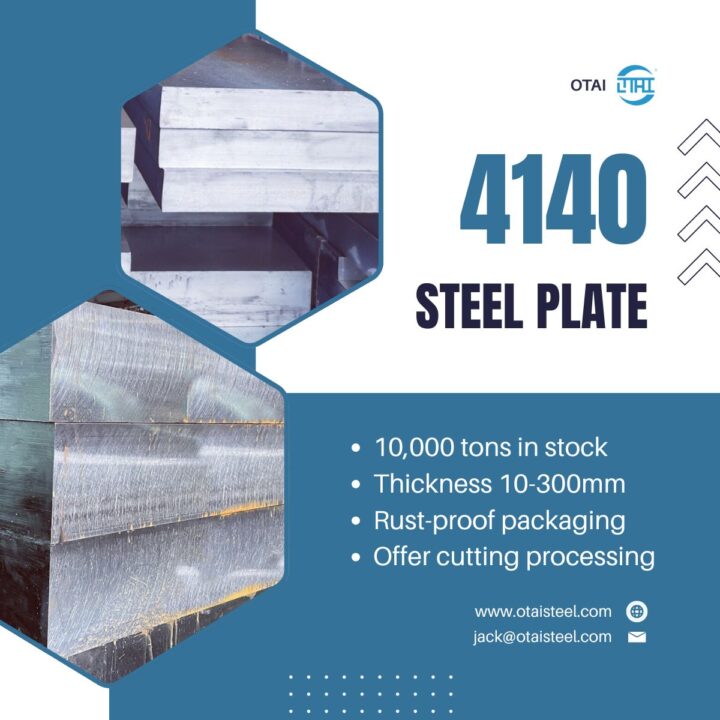
- 41Cr4 / 5140 plate stock: Thickness range of 4–300 mm.
- Cutting capacity: 20 saw cutting machines for preparing materials to customer dimensions.
- Precision processing: CNC machining, grinding, and customized cutting services.
- Flexible dimensions: Support for customized sizes and tolerances according to project requirements.
- Quality control: Material testing and ultrasonic testing support where required.
- Third-party inspection: Support for independent inspection according to agreed requirements.
- Export packaging: Anti-rust protection, strapping, bundled packaging, and wooden boxes.
- One-stop service: Assistance with material selection, processing, inspection, and delivery.
- International supply experience: Experience supporting buyers across more than 54 countries and regions.
Whether you need 41Cr4 plate for machined components or material for other industrial applications, Otai can help check available stock and discuss suitable supply conditions.
When requesting a quotation, provide the grade, standard, dimensions, quantity, delivery condition, and inspection requirements. This information helps our team evaluate your requirements and provide a more accurate supply proposal.
❓ Frequently Asked Questions
1. What is the Young’s modulus of 41Cr4 steel?
The typical Young’s modulus of 41Cr4 steel is approximately 210 GPa, equivalent to 210,000 MPa or about 30,500 ksi. This is a common room-temperature engineering reference value.
2. Is 41Cr4 a stiff material?
Yes. With a typical elastic modulus of approximately 210 GPa, 41Cr4 has stiffness comparable to many conventional carbon and alloy steels. Actual component rigidity also depends on geometry, dimensions, loading conditions, and support arrangements.
3. Does heat treatment increase the Young’s modulus of 41Cr4?
Heat treatment significantly affects hardness and strength, but it generally has a much smaller influence on Young’s modulus under ordinary room-temperature conditions. Engineers commonly use approximately 210 GPa as a reference for both annealed and quenched-and-tempered 41Cr4 unless more specific data are available.
4. What is the difference between Young’s modulus and yield strength?
Young’s modulus measures resistance to elastic deformation, while yield strength indicates the stress at which permanent deformation begins. Both properties matter in component design, but they answer different engineering questions.
5. Is the Young’s modulus of 41Cr4 the same as 5140?
Both grades commonly use a typical Young’s modulus reference of approximately 210 GPa. However, their chemical composition limits and applicable standards should still be checked separately. Similar elastic modulus values do not make two grades automatically interchangeable.