16MnCr5 AISI 5115: Equivalent Grades, Composition, Properties and Applications
📑 Table of Contents
🔍 1. 16MnCr5 AISI 5115: Are They Equivalent?
🧪 2. Chemical Composition Comparison
📊 3. Mechanical Properties and Hardness
🔥 4. Heat Treatment and Carburizing
⚙️ 5. Machinability and Manufacturing
🏭 6. Applications of 16MnCr5 and AISI 5115
🦾 7. 16MnCr5 vs AISI 5115 for Gears and Shafts
💡 8. Which Grade Should You Choose?
🔍 1. 16MnCr5 AISI 5115: Are They Equivalent?
When buyers search for 16MnCr5 AISI 5115, they are usually trying to determine whether AISI 5115 can serve as an equivalent grade to 16MnCr5. Both steels belong to the low-carbon alloy steel family and can support case-hardening applications. However, they are not identical grades under their respective standards.
16MnCr5 is a European case-hardening steel commonly identified by the material number 1.7131. AISI 5115 is an American alloy steel grade with a different chemical composition range and specification background.
The two grades share an important design concept. Both provide relatively low carbon content before carburizing, allowing manufacturers to create a harder surface while maintaining a tougher core. This makes both grades suitable for selected gears, shafts, pins, and other components.
| Feature | 16MnCr5 | AISI 5115 |
|---|---|---|
| Standard system | European / EN | American / AISI |
| Material number | 1.7131 | AISI designation |
| Steel type | Low-carbon case-hardening alloy steel | Low-carbon alloy case-hardening steel |
| Main alloying elements | Manganese and chromium | Chromium and other alloying elements according to specification |
| Typical treatment | Carburizing, quenching and tempering | Carburizing and hardening for suitable applications |
| Typical applications | Gears, shafts, pinions, bushings | Gears, shafts and machine components |
The key point is that 16MnCr5 is not exactly the same steel as AISI 5115. An engineer should compare the applicable chemical limits, mechanical requirements, heat-treatment specifications, product dimensions, and final component requirements before treating one grade as a direct substitute for the other.
Therefore, the phrase 16MnCr5 AISI 5115 equivalent should be understood as an engineering comparison rather than a statement that the two grades are chemically identical.
🧪 2. Chemical Composition Comparison
Chemical composition is one of the most important factors when comparing 16MnCr5 and AISI 5115. Their similar low-carbon design supports case hardening, but the alloying balance differs.
| Element | 16MnCr5 Typical Range | AISI 5115 Typical Range | Main Effect |
|---|---|---|---|
| Carbon (C) | 0.14–0.19% | Approx. 0.13–0.18% | Core hardenability and carburizing response |
| Silicon (Si) | Up to about 0.40% | Controlled according to specification | Strength and deoxidation |
| Manganese (Mn) | 1.00–1.30% | Lower than the typical 16MnCr5 range | Hardenability and strength |
| Chromium (Cr) | 0.80–1.10% | Approximately 0.70–1.00% | Hardenability and wear performance |
| Nickel (Ni) | Not a major alloying element | Not normally a major alloying element | Toughness depending on specification |
| Molybdenum (Mo) | Not a primary alloying element | Not normally a primary alloying element | Depends on the specific grade specification |
The exact composition should always come from the applicable material standard and mill certificate. Different standards may define slightly different limits, while commercial material can also vary depending on product form and manufacturing route.
Why 16MnCr5 contains more manganese
Manganese contributes to hardenability and strength. The relatively high manganese level in 16MnCr5 works together with chromium to support the response of the steel during carburizing and subsequent quenching.
This combination makes the grade useful for components where the final surface needs high hardness while the core still needs sufficient mechanical performance.
AISI 5115 composition
AISI 5115 also uses a low-carbon alloy design intended for case-hardening applications. Chromium contributes to hardenability and supports the development of suitable properties after heat treatment.
Because the composition ranges are not identical, buyers should avoid assuming that every AISI 5115 product will match every 16MnCr5 requirement.
For this reason, a proper 16MnCr5 vs AISI 5115 composition comparison should always use the actual standard, product condition, and certificate rather than relying only on a grade name.
📊 3. Mechanical Properties and Hardness
The mechanical properties of both steels depend strongly on their delivery condition and heat treatment. Neither grade has one fixed hardness or tensile strength for every application.
Before carburizing, both materials remain relatively low in carbon. After carburizing and quenching, the surface properties change substantially.
| Property | 16MnCr5 | AISI 5115 |
|---|---|---|
| Initial carbon level | Low | Low |
| Core hardenability | Good | Good for suitable section sizes |
| Carburized surface hardness | Very high after suitable treatment | Very high after suitable treatment |
| Core toughness | Good | Good with suitable treatment |
| Wear resistance | Excellent after case hardening | Excellent after case hardening |
| Fatigue performance | Good potential | Good potential |
| Typical application focus | European gear and transmission components | American-standard case-hardened components |
16MnCr5 hardness
The hardness of 16MnCr5 depends on the material condition. A soft delivery condition supports machining, while carburizing and quenching create a much harder surface.
The final surface hardness depends on carburizing temperature, carbon potential, case depth, quenching conditions, tempering, and the component geometry.
AISI 5115 hardness
AISI 5115 can also achieve a hard surface through suitable carburizing and hardening. However, the actual hardness profile depends on the specific specification and heat-treatment process.
Therefore, engineers should compare the required surface hardness and core hardness rather than comparing untreated material hardness alone.
Which has better hardness?
Neither grade is automatically harder. Both can develop a high-hardness carburized case when manufacturers apply suitable heat treatment.
The more important question is whether the selected grade can achieve the required case depth, core properties, dimensional stability, and fatigue performance for the component.
This makes the 16MnCr5 AISI 5115 hardness comparison a heat-treatment question as much as a material-selection question.
🔥 4. Heat Treatment and Carburizing
Heat treatment is central to the performance of 16MnCr5 and AISI 5115. Their low-carbon chemistry makes them particularly suitable for case-hardening processes.
| Heat-Treatment Process | 16MnCr5 | AISI 5115 |
|---|---|---|
| Annealing | Possible | Possible |
| Normalizing | Possible | Possible |
| Carburizing | Very common | Suitable |
| Quenching | Used after carburizing | Used after carburizing |
| Tempering | Common after quenching | Common after quenching |
| Induction hardening | Application dependent | Application dependent |
Carburizing 16MnCr5
During carburizing, carbon diffuses into the surface of the component. The manufacturer then controls quenching to transform the enriched surface into a hard structure.
The core remains lower in carbon. As a result, the finished component can combine high surface hardness with useful core toughness.
Carburizing AISI 5115
AISI 5115 also supports case-hardening applications. The manufacturer controls the carburizing cycle according to the required case depth and final performance.
The exact treatment should follow the applicable material specification and the component manufacturer’s process qualification.
Why case hardening matters
Case hardening provides a useful property gradient. The surface handles wear and contact stress, while the core supports the load and helps resist cracking.
This approach works particularly well for gears and transmission components. However, manufacturers must also control distortion because carburizing and quenching can change component dimensions.
Therefore, buyers comparing 16MnCr5 and AISI 5115 heat treatment should consider not only the steel grade but also the required case depth, quenching method, tempering condition, and final dimensional tolerances.
⚙️ 5. Machinability and Manufacturing
Both grades can provide practical machinability before final case hardening. Manufacturers can machine the material while it remains in a suitable soft condition.
Turning, milling, drilling, boring, and other machining operations can take place before carburizing. This approach helps manufacturers achieve accurate dimensions without machining a very hard surface.
After carburizing and quenching, the surface becomes significantly harder. Precision components may then require grinding or other finishing processes.
| Manufacturing Stage | 16MnCr5 | AISI 5115 |
|---|---|---|
| Pre-treatment turning | Suitable | Suitable |
| Pre-treatment milling | Suitable | Suitable |
| Drilling | Suitable in soft condition | Suitable in soft condition |
| Post-hardening machining | More difficult | More difficult |
| Grinding | Common for precision components | Common for precision components |
| Heat-treatment distortion control | Important | Important |
Machining before carburizing
Manufacturers often perform rough and semi-finish machining before carburizing. They leave suitable machining allowances for final finishing after heat treatment.
This process becomes particularly important for gears, shafts, and precision transmission parts because heat treatment can cause dimensional changes.
Choosing bar dimensions
16MnCr5 round bar provides a convenient starting material for shafts, pins, gear blanks, and other cylindrical components.
Selecting a bar diameter close to the required finished dimension can reduce material waste and shorten machining time. However, engineers should also consider the required final geometry and heat-treatment distortion.
For demanding applications, buyers should confirm surface quality, dimensional tolerances, internal quality, and inspection requirements before ordering.
🏭 6. Applications of 16MnCr5 and AISI 5115
The applications of these steels overlap because both support case-hardening processes. However, the preferred grade often depends on the regional standard, engineering specification, supply chain, and component requirements.
| Application | 16MnCr5 | AISI 5115 |
|---|---|---|
| Gears | Excellent | Suitable |
| Pinions | Excellent | Suitable |
| Shafts | Suitable for selected designs | Suitable for selected designs |
| Pins | Suitable | Suitable |
| Bushings | Suitable | Suitable |
| Transmission components | Excellent for selected applications | Suitable for selected applications |
| Automotive components | Common | Common in suitable applications |
16MnCr5 applications
Common 16MnCr5 applications include gears, pinions, shafts, bushings, pins, rollers, and transmission components.
The grade works particularly well when manufacturers need a carburized surface with high hardness and a comparatively tough core.
AISI 5115 applications
AISI 5115 can also serve case-hardened machine components where its specification and mechanical requirements match the design.
The grade can be considered for gears, shafts, pins, and other components where surface hardness and core toughness are important.
Why the application matters
A material grade should never be selected based only on a similar chemical composition. Component geometry, load, contact stress, fatigue requirements, case depth, production process, and applicable standard all influence the final choice.
For example, a small industrial gear and a large transmission shaft may require very different heat-treatment parameters even when they use the same steel grade.
🦾 7. 16MnCr5 vs AISI 5115 for Gears and Shafts
Gears represent one of the clearest use cases for comparing 16MnCr5 and AISI 5115. Both grades can support carburized gear components, but engineers must verify whether the selected grade meets the complete component specification.
The carburized case provides resistance to wear and repeated contact stress. Meanwhile, the lower-carbon core provides support and toughness beneath the hardened surface.
| Gear Requirement | 16MnCr5 | AISI 5115 |
|---|---|---|
| Carburized surface | Excellent | Suitable |
| High surface hardness | Excellent after treatment | Excellent after treatment |
| Core toughness | Good | Good |
| Contact fatigue resistance | Good potential | Good potential |
| European-standard projects | Natural choice | Requires specification review |
| American-standard projects | Requires specification review | Natural choice |
Gears
For gear teeth, surface hardness is critical because the teeth experience repeated contact. A properly carburized surface can reduce wear and improve resistance to contact-related damage.
At the same time, the core must remain sufficiently tough. A very hard but brittle component can fail under impact or cyclic loading.
Shafts and pins
Shafts and pins may require a different balance of properties. Some designs need surface wear resistance, while others prioritize bending strength, torsional strength, or core toughness.
Therefore, 16MnCr5 vs AISI 5115 for gears should focus on the actual service conditions rather than assuming that one grade is universally superior.
Engineering substitution
When replacing one grade with another, engineers should compare chemical composition, hardenability, case depth, mechanical properties, heat-treatment response, dimensional requirements, and applicable standards.
A supplier can provide useful material documentation, but the final substitution decision should follow the customer’s engineering specification and qualification procedure.
💡 8. Which Grade Should You Choose?
The best choice between 16MnCr5 and AISI 5115 depends on the applicable standard and the required final properties. Neither grade should automatically replace the other without checking the engineering specification.
Choose 16MnCr5 when:
- Your project follows European EN material standards.
- You need a low-carbon alloy steel for carburizing.
- The component requires a hard and wear-resistant surface.
- You are manufacturing gears, pinions, shafts, pins, or bushings.
- You need a commonly specified European case-hardening grade.
- The required chemical and mechanical properties match 16MnCr5 / 1.7131.
Consider AISI 5115 when:
- Your project uses AISI or related American material specifications.
- The component requires case hardening.
- The required chemical composition matches AISI 5115.
- The heat-treatment process has been qualified for the grade.
- The component requires a hard surface and suitable core toughness.
- The engineering specification specifically calls for AISI 5115.
| Requirement | Recommended Grade / Action |
|---|---|
| EN-standard gear component | 16MnCr5 |
| AISI-standard case-hardened component | AISI 5115 |
| Carburized gear | Compare case depth and hardenability |
| Existing 16MnCr5 design | Verify AISI 5115 before substitution |
| Existing AISI 5115 design | Verify 16MnCr5 before substitution |
| International sourcing | Confirm standard and mill certificate |
For buyers searching for 16MnCr5 AISI 5115 equivalent, the safest approach is to compare the actual material specification rather than relying on an online equivalence chart.
The required dimensions also matter. A suitable steel grade is only useful when the supplier can provide the required diameter, length, delivery condition, inspection documentation, and processing support.
For critical components, buyers should confirm the chemical analysis, mechanical requirements, heat-treatment condition, case depth, surface hardness, core properties, and inspection standards before approving a substitute grade.
📦 9. Otai Special Steel Advantages
- 16MnCr5 bar stock: Otai Special Steel can supply 16MnCr5 steel bars for machining, gear manufacturing, shafts, pins, and other industrial applications.
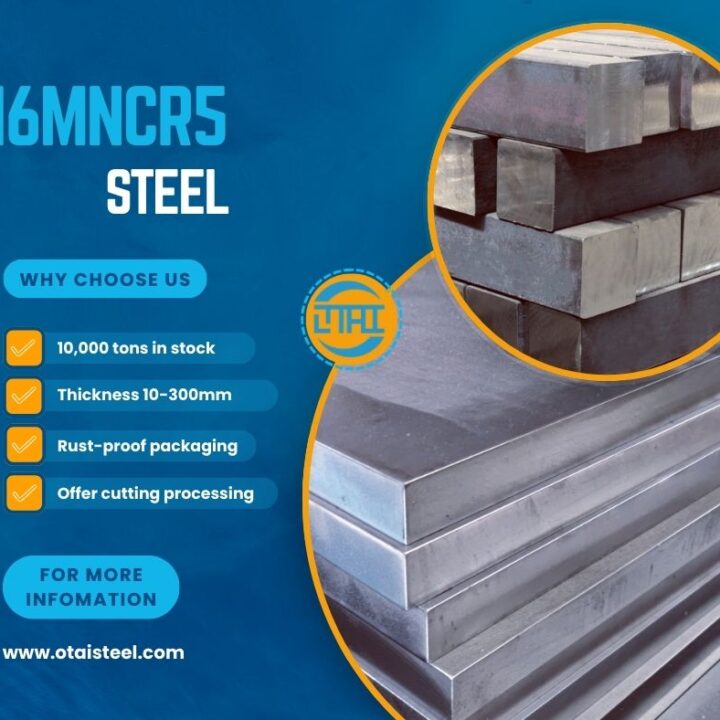
- 8–150 mm plate stock: We maintain 16MnCr5 steel plates in 8–150 mm thicknesses available in stock for different fabrication and engineering requirements.
- Different dimensions: We can supply different diameters, thicknesses, widths, and lengths according to project requirements.
- Cutting service: We can arrange cutting according to customer drawings and specified dimensions.
- Heat treatment: Annealing, normalizing, quenching, tempering, and other heat-treatment services can be arranged according to requirements.
- Quality inspection: Ultrasonic testing and third-party inspection can be arranged for orders with specific quality requirements.
- Export packaging: Steel strapping, wooden cases, and anti-rust packaging help protect steel products during international transportation.
- International supply experience: Otai Special Steel has supplied steel products to customers with demanding technical requirements, including Fortune Global 500 companies.
If you are comparing 16MnCr5 AISI 5115 for a specific project, provide the required dimensions, applicable standard, heat-treatment condition, mechanical requirements, and quantity. Otai Special Steel can help confirm suitable material and processing options.
❓ 10. Frequently Asked Questions
1. Is 16MnCr5 the same as AISI 5115?
No. 16MnCr5 and AISI 5115 are different steel grades under different standards. They share similar low-carbon case-hardening characteristics, but their chemical composition and specification requirements are not identical.
2. Is AISI 5115 an equivalent to 16MnCr5?
AISI 5115 can be considered for some applications where 16MnCr5 is specified, but it should not be treated as an automatic one-to-one equivalent. Engineers should compare chemical composition, hardenability, heat treatment, case depth, and required mechanical properties.
3. What is 16MnCr5 mainly used for?
16MnCr5 is mainly used for case-hardened components such as gears, pinions, shafts, pins, bushings, and transmission parts that require high surface hardness and good core toughness.
4. Can both 16MnCr5 and AISI 5115 be carburized?
Yes. Both grades can support suitable case-hardening processes. However, the exact carburizing parameters, case depth, quenching conditions, and final properties should follow the applicable material specification and component requirements.
5. Does Otai Special Steel supply 16MnCr5?
Yes. Otai Special Steel can supply 16MnCr5 steel bars and also maintains 16MnCr5 steel plates in 8–150 mm thicknesses available in stock. Cutting, heat treatment, inspection, and export packaging can also be arranged according to project requirements.