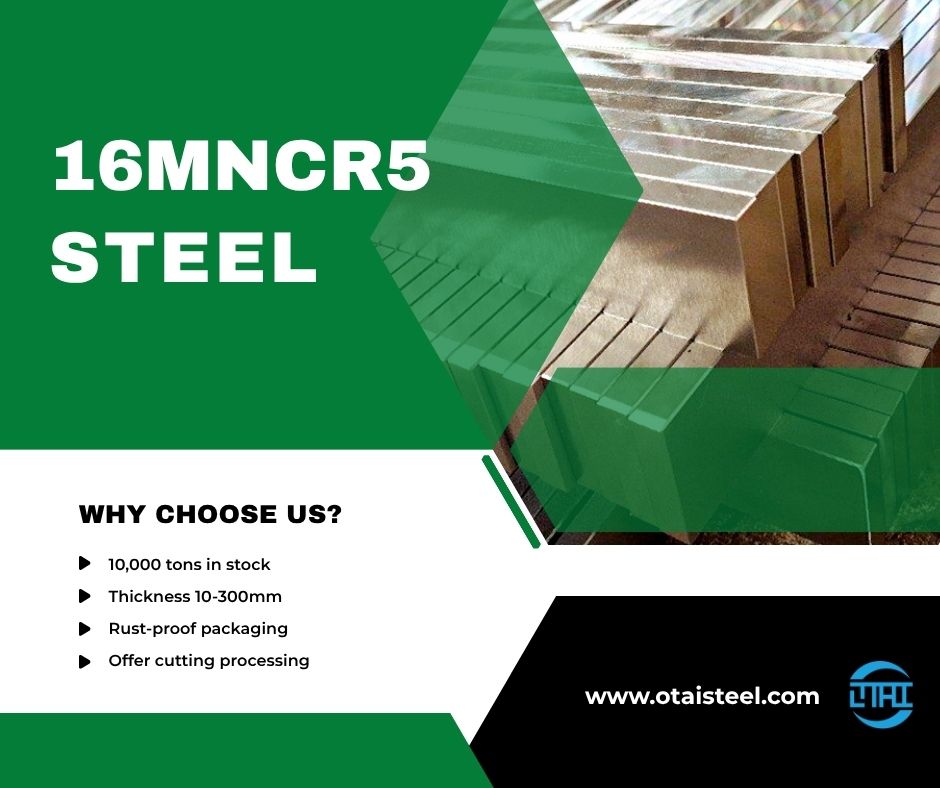
16MnCr5 Shear Strength: Engineering Values, Estimation Methods, and Real Applications
🔍 Introduction
The 16MnCr5 shear strength plays a vital role in the design of components subjected to torsion, transverse forces, and cyclic loading. As a typical case hardening steel, 16MnCr5 offers a unique combination of a hardened outer layer and a tough inner core, which directly influences how it performs under shear stress.
This article explains the shear performance of 16MnCr5 in a practical and engineering-focused way, covering typical values, estimation formulas, heat treatment effects, and real-world applications.
⚙️ Understanding Shear Behavior in 16MnCr5
Shear strength refers to the maximum stress a material can withstand before failure along a plane parallel to the applied force. For 16MnCr5, this property mainly depends on the core condition rather than the hardened surface.
Key Insight:
- Surface layer → improves wear resistance
- Core structure → carries shear and torsional loads
This distinction is essential when evaluating load-bearing performance.
📊 Typical Mechanical Properties and Shear Estimates
Although direct shear data is not always provided in standards, engineers commonly estimate it based on tensile strength.
| Condition | Tensile Strength (MPa) | Estimated Shear Strength (MPa) |
|---|---|---|
| Annealed | 500–700 | 300–420 |
| Normalized | 700–900 | 420–540 |
| Quenched & Tempered | 800–1100 | 480–660 |
| Carburized (core) | 900–1200 | 540–720 |
These values provide a reliable reference for design calculations.
🧮 Practical Method to Estimate Shear Strength
In most engineering cases, shear capacity is approximated using a simple relationship:
Formula:
Shear Strength ≈ 0.6 × Tensile Strength
Example:
| Tensile Strength | Estimated Shear |
|---|---|
| 1000 MPa | ~600 MPa |
| 900 MPa | ~540 MPa |
This approach is widely accepted when precise testing data is unavailable.
🔥 Influence of Heat Treatment on Performance
Heat treatment has the strongest impact on mechanical behavior.
Observations:
- Annealed condition → lowest resistance to shear
- Normalized → moderate improvement
- Quenched and tempered → significant increase
- Carburized → optimized surface + strong core
Key Point:
The carburizing process enhances surface hardness, but the internal structure determines resistance to deformation and failure.
🧪 Behavior After Carburizing
After carburizing, the material exhibits a dual structure:
- Surface hardness: 58–62 HRC
- Core strength: remains responsible for load-bearing
This combination allows components to resist both wear and mechanical stress simultaneously.
⚖️ Relationship Between Tensile and Shear Properties
Understanding the relationship between tensile and shear performance helps in design decisions.
| Property | Typical Range |
|---|---|
| Tensile Strength | 800–1200 MPa |
| Shear Capacity | 480–720 MPa |
Insight:
Shear resistance typically falls between 50% and 60% of tensile strength, depending on microstructure and processing.
🧱 Core Strength vs Surface Hardness
One of the defining features of 16MnCr5 is the contrast between its surface and core.
Characteristics:
- Hardened outer layer → protects against wear and contact fatigue
- Tough inner core → absorbs stress and prevents brittle failure
Application Example:
In gears:
- Surface handles friction and contact pressure
- Core withstands torsion and bending
This balance significantly improves service life.
🔬 Key Factors Affecting Shear Performance
Several variables influence how the material behaves under load:
1. Heat Treatment
Controls hardness, toughness, and internal stress distribution
2. Microstructure
Fine grain structures improve resistance to deformation
3. Alloying Elements
Chromium and manganese enhance hardenability and strength
4. Cooling Rate
Faster cooling generally increases strength but may reduce toughness
5. Manufacturing Process
Forging and controlled rolling improve internal integrity
🏭 Industrial Applications
Shear-related properties are critical in many engineering components:
Common Uses:
- Transmission gears
- Drive shafts
- Camshafts
- Mechanical power systems
These parts rely on strong internal resistance to handle torsion and repeated loading.
🧭 Design Considerations
When selecting 16MnCr5 for engineering applications, consider:
- Type of load (static, dynamic, or cyclic)
- Required surface hardness
- Core mechanical properties
- Safety factors and design margins
Practical Advice:
Always base calculations on core properties rather than surface hardness values.
⚠️ Common Mistakes to Avoid
- Using surface hardness to estimate load capacity
- Ignoring the effect of heat treatment
- Overestimating strength without safety factors
- Neglecting stress concentrations in design
Avoiding these issues leads to safer and more reliable components.
🏆 Company Advantages
At Otai Special Steel, we provide high-quality 16MnCr5 with consistent and reliable performance:
- Over 10,000 tons of inventory available year-round
- Full size range from 6mm to 300mm
- Precision cutting and customized heat treatment services
- Strict quality control including ultrasonic testing (UT) and chemical analysis
- Support for third-party inspections such as SGS
- Extensive experience supplying global industrial clients
We help customers achieve optimal material performance in demanding applications.
❓ FAQ
1. What is the typical shear capacity of 16MnCr5?
It usually ranges between 480 and 720 MPa depending on condition.
2. How can it be estimated without testing?
A common method is multiplying tensile strength by 0.6.
3. Does carburizing improve shear resistance?
It mainly improves surface hardness; the core governs load-bearing behavior.
4. Why is core strength important?
Because it determines resistance to torsion and structural failure.
5. Where is this material commonly used?
In gears, shafts, and transmission components requiring both strength and wear resistance.