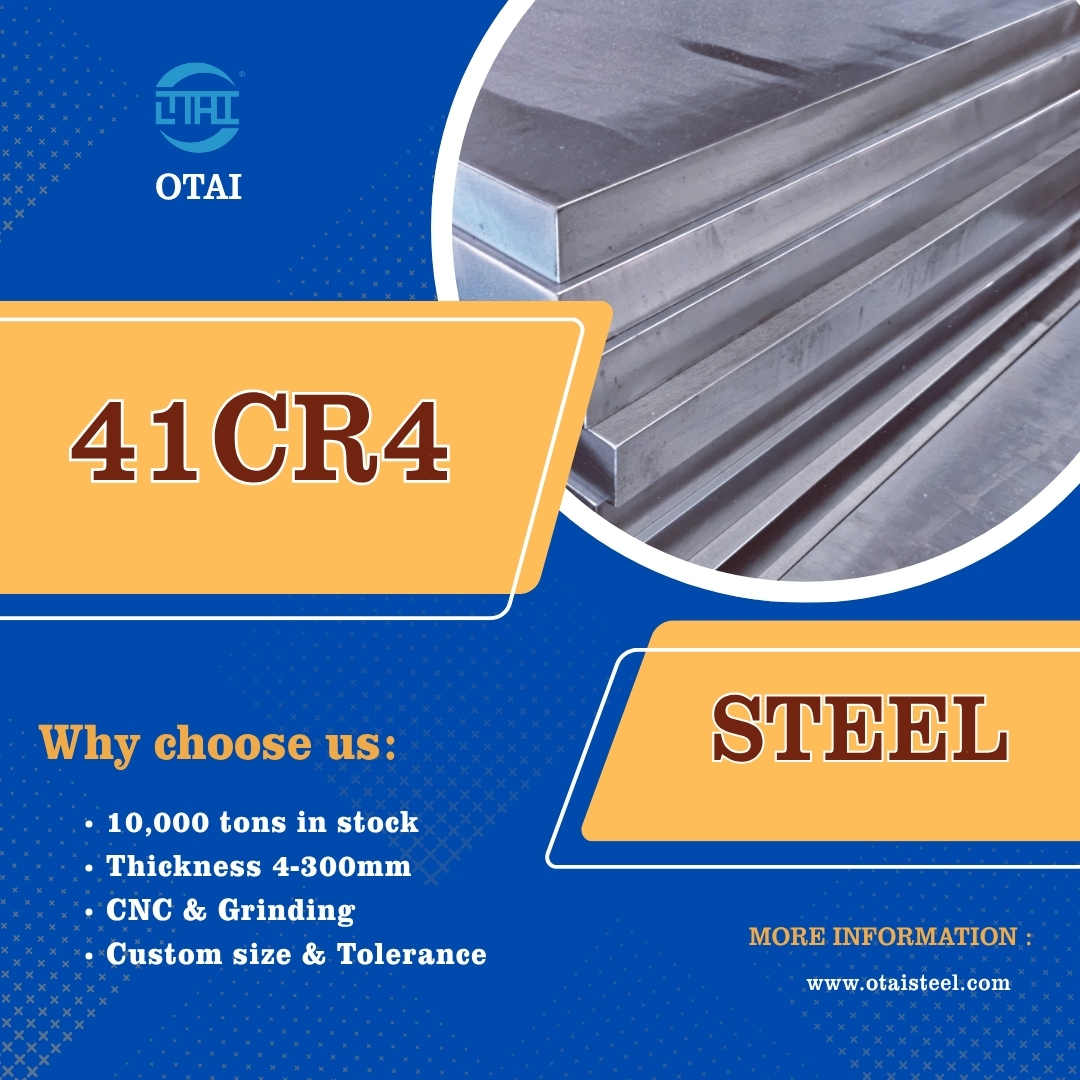
41Cr4 Material: Composition, Properties, Hardness and Applications
🔍 1. What Is 41Cr4 Material?
41Cr4 material is a medium-carbon chromium alloy steel designed mainly for quenching and tempering. The grade belongs to the family of engineering steels that combine useful strength, toughness and hardenability after heat treatment.
European material references commonly associate 41Cr4 with material number 1.7035. The grade also appears under several international designations, including 42C4, 530M40 and SCr440 in comparison references. However, a similar designation does not automatically guarantee identical chemical or mechanical requirements.
Carbon gives the steel its response to hardening, while chromium improves hardenability and contributes to wear resistance. As a result, manufacturers can use 41Cr4 for components that need more strength and surface hardness than ordinary low-alloy structural steels can provide.
Ovako describes 41Cr4 as a quenching-and-tempering steel for components with lower strength requirements than 42CrMo4. The same source also identifies the grade as suitable for induction surface hardening and reports a minimum surface hardness of 52 HRC for its reference application.
From a purchasing perspective, the term 41Cr4 material should cover more than the grade name. A complete inquiry should also identify the applicable standard, product form, dimensions, delivery condition, mechanical requirements and inspection documents.
| Item | 41Cr4 Reference |
|---|---|
| Steel grade | 41Cr4 |
| Material number | 1.7035 |
| Steel type | Chromium alloy steel for quenching and tempering |
| Main alloying element | Chromium |
| Typical treatment route | Quenching and tempering |
| Surface hardening | Induction hardening |
For international projects, buyers should treat the material number and standard as important identification details. That approach reduces confusion when different markets use similar names for related alloy steels.
🧪 2. 41Cr4 Material Chemical Composition
The chemical composition of 41Cr4 requires careful interpretation because a standard range, a steelmaker’s typical analysis and an actual heat analysis serve different purposes.
For example, Ovako’s current 41Cr4 material data lists the following composition limits for its 5515 variant: carbon 0.38–0.45%, silicon up to 0.40%, manganese 0.60–0.90%, phosphorus up to 0.025%, sulfur up to 0.035% and chromium 0.90–1.20%.
| Element | Reference Range / Limit | Role in the Steel |
|---|---|---|
| Carbon (C) | 0.38–0.45% | Supports hardness and strength after quenching |
| Silicon (Si) | ≤0.40% | Supports deoxidation and strength |
| Manganese (Mn) | 0.60–0.90% | Improves hardenability and strength |
| Phosphorus (P) | ≤0.025% | Controlled impurity |
| Sulfur (S) | ≤0.035% | Controlled for cleanliness and machinability |
| Chromium (Cr) | 0.90–1.20% | Improves hardenability and wear resistance |
These values represent a specified composition range from the cited manufacturer data, rather than one fixed chemical analysis for every 41Cr4 product. The distinction matters because steelmakers can report a typical analysis that sits near the middle of the permitted range.
Saarstahl, for instance, reports C 0.42%, Si 0.25%, Mn 0.70%, Cr 1.05% and S below 0.035% as a typical analysis for its 41Cr4 reference. Those numbers illustrate a representative heat; they do not replace the specified range or the actual MTC.
For procurement, the mill test certificate confirms the actual chemical analysis of the supplied heat. Buyers should therefore compare the MTC against the agreed material standard instead of expecting every 41Cr4 heat to show exactly the same percentages.
Chromium plays an important role in this grade because it increases hardenability. Carbon, meanwhile, determines much of the attainable hardness after quenching. Manganese adds further hardenability and strength, while silicon supports deoxidation and contributes to the overall alloy design.
⚙️ 3. 41Cr4 Material Properties
41Cr4 material offers a useful combination of strength, toughness and hardenability. The grade works particularly well when an engineer needs a medium-carbon alloy steel that can respond to conventional quenching and tempering or surface hardening.
Chromium helps the steel harden more effectively than a comparable plain-carbon steel. As a result, the material can develop useful mechanical properties through heat treatment without relying on a very high alloy content.
Ovako reports typical physical-property values of approximately 7,800 kg/m³ density, 210 GPa Young’s modulus, 0.30 Poisson’s ratio and 80 GPa shear modulus for its 41Cr4 reference. The same data sheet gives a typical thermal conductivity of 40–45 W/m·K at ambient temperature.
| Property | Typical Reference | Practical Significance |
|---|---|---|
| Density | Approx. 7,800 kg/m³ | Useful for weight and material calculations |
| Young’s modulus | Approx. 210 GPa | Indicates elastic stiffness |
| Poisson’s ratio | Approx. 0.30 | Used in engineering calculations |
| Shear modulus | Approx. 80 GPa | Relevant to torsional calculations |
| Thermal conductivity | Approx. 40–45 W/m·K | Relevant to heating and cooling calculations |
Mechanical performance depends strongly on the delivery condition. Annealed material favors machining, whereas quenched-and-tempered material provides substantially higher strength.
Section size also affects the final result. Larger sections cool differently during quenching, so the center and surface may develop different hardness levels. Engineers should therefore evaluate the actual component size rather than applying one hardness value to every section.
Compared with 42CrMo4, 41Cr4 generally serves components with lower strength requirements. Ovako makes this distinction directly in its material description.
For buyers, the practical takeaway is simple: specify the required mechanical condition together with the grade. A request for “41Cr4” alone may not tell the supplier whether the project needs annealed material, normalized material or quenched-and-tempered material.
🔥 4. 41Cr4 Heat Treatment
Heat treatment controls the final hardness and strength of 41Cr4. The most common route combines austenitizing, quenching and tempering, while soft annealing prepares the steel for easier machining.
Ovako recommends 670–710°C for soft annealing. Its quenching-and-tempering reference uses 830–860°C for austenitizing and 540–680°C for tempering, with water or oil as the quenching medium.
| Treatment | Reference Temperature | Cooling / Process | Purpose |
|---|---|---|---|
| Soft annealing | 670–710°C | Air according to Ovako reference | Reduce hardness and improve machinability |
| Austenitizing | 830–860°C | Prepare for quenching | Create the required austenitic structure |
| Quenching | After austenitizing | Water or oil | Increase hardness through rapid cooling |
| Tempering | 540–680°C | After quenching | Balance hardness, strength and toughness |
Saarstahl gives a closely related reference sequence: normalizing at 850–880°C, soft annealing at 680–720°C, hardening at 820–860°C and tempering at 540–680°C.
The two data sheets show why buyers should treat heat-treatment temperatures as reference ranges rather than one universal recipe. Different steelmakers, section sizes and furnace conditions can require different process settings.
Holding time deserves the same caution. The required time depends on section thickness, furnace type, charge size, heating rate and the selected heat-treatment procedure. Engineers should therefore determine the holding time from the applicable heat-treatment specification instead of applying one fixed number to every 41Cr4 component.
Quenching also requires process control. A faster cooling rate can increase hardness, but aggressive cooling may increase distortion and cracking risk. The correct quenching medium should match the component geometry and the required final properties.
Tempering follows quenching and adjusts the balance between hardness and toughness. A lower tempering temperature generally retains more hardness, while a higher temperature reduces hardness and can improve toughness.
📏 5. 41Cr4 Hardness and Mechanical Properties
41Cr4 hardness varies with the material condition. Soft-annealed material, quenched-and-tempered material and induction-hardened material can show very different hardness values even though they carry the same grade designation.
Ovako lists a soft-annealed hardness below 241 HB for its specified 20–160 mm round-bar range. For its quenched-and-tempered reference, 20–40 mm sections show tensile strength of 900–1100 MPa and minimum yield strength of 660 MPa, while 40.1–100 mm sections show tensile strength of 800–950 MPa and minimum yield strength of 560 MPa.
| Condition / Section | Yield Strength | Tensile Strength | Elongation |
|---|---|---|---|
| +A, 20–160 mm reference | — | — | — |
| +QT, 20–40 mm | ≥660 MPa | 900–1100 MPa | ≥12% |
| +QT, 40.1–100 mm | ≥560 MPa | 800–950 MPa | ≥14% |
These figures come from a specific Ovako product reference, so buyers should not treat them as universal values for every 41Cr4 plate. Section size and heat-treatment condition can change the final mechanical properties significantly.
Induction hardening creates another performance range. Ovako specifies a minimum surface hardness of 52 HRC for its 41Cr4 induction-hardening reference. The actual hardness profile depends on heating frequency, power, heating time, quenching and component geometry.
When a customer asks for “41Cr4 hardness,” the supplier should therefore clarify the condition first. A hardness requirement for incoming plate does not mean the same thing as a hardness requirement for the final machined and heat-treated component.
🔧 6. Machining, Welding and Induction Hardening
Machining behavior depends strongly on the supplied condition. Annealed 41Cr4 generally provides a more manageable starting point for cutting and machining than hardened material.
Before production begins, the machining team should confirm the actual hardness and dimensional condition. This step helps engineers select suitable cutting parameters and avoid unnecessary tool wear.
Heat treatment can change dimensions because the steel undergoes structural transformation and thermal contraction. Therefore, manufacturers often leave a suitable machining allowance before final hardening when the component requires tight dimensional control.
Grinding becomes especially important after hardening. The process can bring a component to its final dimensional tolerance, but excessive heat during grinding can damage the surface. Controlled grinding parameters and adequate coolant help reduce this risk.
Welding requires additional care because 41Cr4 contains roughly 0.4% carbon. Depending on section thickness and the welding procedure, preheating, controlled heat input and post-weld heat treatment may help reduce cracking risk.
Induction hardening offers a different processing route. An induction coil rapidly heats the selected surface area, and subsequent quenching creates a hard surface layer. The component core can retain a tougher structure.
This combination works well for parts that experience repeated contact, friction or surface wear. Engineers can adjust the induction process according to the required surface hardness and hardening depth.
For procurement, the important distinction is between supplied material condition and final component condition. A supplier should not quote one universal hardness or case depth without knowing the customer’s heat-treatment requirements.
🏭 7. 41Cr4 Material Applications
41Cr4 material suits mechanical components that require moderate-to-high strength after heat treatment together with useful toughness and hardenability.
Typical applications include:
- Drive components
- Crankshaft-related components
- Front vehicle axles
- Axle journals
- Steering components
- Machine shafts
- Transmission-related components
- Induction-hardened mechanical parts
- Wear-exposed engineering components
Saarstahl specifically lists crankshafts, front vehicle axles, axle journals and steering components among the applications for its 41Cr4 reference.
Component size plays an important role in material selection. A small mechanical component may achieve the required hardness throughout its section, while a larger section can develop a different hardness profile after the same quenching process.
Surface requirements also influence the choice. When the design needs a hard working surface but a tougher interior, induction hardening can provide a useful processing route.
Strength requirements provide another selection factor. Ovako positions 41Cr4 below 42CrMo4 in terms of the strength requirements of recommended components, so engineers should compare the actual design load rather than select the grade solely from a generic application list.
For that reason, a good material-selection process considers the component load, section size, final hardness, heat-treatment method, machining route and inspection requirements together.
🔄 8. 41Cr4 Equivalent Grades and Material Comparison
Buyers often search for 41Cr4 equivalent, especially when sourcing material across Europe, China, Japan or North America. Several grades appear in comparison tables, but the word “equivalent” requires careful handling.
| Grade | Common Identification | Relationship to 41Cr4 | Procurement Check |
|---|---|---|---|
| 41Cr4 | EN / 1.7035 | Primary reference grade | Confirm the required EN specification |
| 5140 | SAE / AISI | Frequently compared alloy steel | Compare chemistry and mechanical requirements |
| SCr440 | JIS | Common comparison designation | Verify the exact JIS requirement |
| 42CrMo4 | EN / 1.7225 | Higher-alloy comparison grade | Check Mo content, strength and hardenability |
Ovako lists 41Cr4 alongside designations such as 530M40, EN18, SCr440 and 42C4 in its similar-designation section. That list provides useful cross-reference information, but it does not mean that every designation carries identical requirements in every product standard.
Saarstahl also lists SAE 5140 among the international grades associated with its 41Cr4 / 1.7035 reference. Its document separately identifies 41Cr4 as a DIN EN 10083 quenching-and-tempering steel.
When a customer wants to substitute another grade, the purchasing team should compare chemical composition, standard, product form, heat-treatment condition, mechanical properties and inspection requirements.
A similar chemical composition can support an engineering comparison, but it does not automatically authorize material substitution. The final decision should follow the customer’s drawing, technical specification or engineering approval procedure.
🛒 9. How to Buy 41Cr4 Material
Industrial buyers should define the complete material requirement before requesting a quotation. The grade name alone does not tell a supplier enough about the required product.
For a 41Cr4 steel plate purchase, the inquiry should normally include:
- 41Cr4 grade and material number 1.7035
- Applicable material standard
- Required thickness
- Width and length
- Total quantity or weight
- Delivery condition
- Dimensional tolerance
- Surface requirements
- Mechanical-property requirements
- MTC requirements
- Ultrasonic testing requirements when applicable
- Third-party inspection requirements when applicable
- Export packaging requirements
Buyers should also clarify whether they need material for machining before heat treatment or material that already meets a final quenched-and-tempered condition. That distinction can change the quotation, processing route and delivery schedule.
For precision projects, dimensional tolerance deserves particular attention. Standard rolled plate and cut-to-size material may require different downstream machining allowances, especially when the customer plans additional heat treatment.
Inspection documents provide another important checkpoint. The MTC should identify the supplied heat and report the actual chemical analysis together with the required test results. This document allows the purchasing team to compare the shipment against the agreed specification.
Stock availability can also shorten the procurement cycle. Before placing an order, ask the supplier to confirm the actual available thickness and quantity rather than relying on a general statement that the grade remains available.
For export orders, packaging should match the transportation route. Anti-rust protection, bundled packaging and wooden cases can help protect steel products during long-distance transportation.
🏢 10. Why Choose Otai for 41Cr4 Material?
- 41Cr4 / 5140 steel plate in stock: Otai keeps 41Cr4 / 5140 steel plate in 4–300 mm thickness for industrial purchasing requirements.
- 10,000+ tons of steel stock: Large inventory supports regular industrial orders and export requirements.
- 20 saw cutting machines: Otai can cut steel plate according to customer-specified dimensions.
- Custom size and tolerance: Buyers can discuss required dimensions and machining allowances before shipment.
- CNC and grinding: Additional processing can support projects that require closer dimensional control.
- One-stop service: Cutting, machining, inspection, packaging and export coordination can be arranged through one supplier.
- International export experience: Otai has exported steel to 54+ countries since 1999.
- Inspection support: Material certificates, ultrasonic testing and third-party inspection can be arranged according to project requirements.
- Export packaging: Anti-rust packaging, bundled packaging and wooden box packaging can support international transportation.
For a 41Cr4 material inquiry, send the required plate thickness, width, length, quantity, standard, delivery condition and inspection requirements. With these details, the supplier can check available stock and prepare a more accurate quotation.
❓ FAQ
1. What is 41Cr4 material?
41Cr4 is a medium-carbon chromium alloy steel for quenching and tempering. The material commonly carries the number 1.7035 and can also support induction surface hardening.
2. What is the chemical composition of 41Cr4?
A current Ovako 41Cr4 reference specifies 0.38–0.45% carbon, 0.60–0.90% manganese and 0.90–1.20% chromium, with silicon up to 0.40%, phosphorus up to 0.025% and sulfur up to 0.035%. The actual heat chemistry should come from the supplier’s MTC.
3. What is the hardness of 41Cr4?
The answer depends on the material condition. Ovako specifies a soft-annealed hardness below 241 HB for its referenced product range, while its induction-hardening data calls for a minimum surface hardness of 52 HRC.
4. What temperature should I use for 41Cr4 heat treatment?
Ovako recommends 830–860°C for austenitizing and 540–680°C for tempering in its 41Cr4 reference. Saarstahl gives hardening at 820–860°C and tempering at 540–680°C. The final production cycle should follow the applicable material specification and actual component geometry.
5. Is 41Cr4 equivalent to 5140 or SCr440?
41Cr4, SAE 5140 and JIS SCr440 frequently appear together in international comparison tables, but buyers should not assume automatic one-to-one interchangeability. Compare the applicable standard, chemical composition, delivery condition, mechanical requirements and MTC before approving a substitution.