16MnCr5 Vendor: How to Choose the Right Steel Supplier?
Choosing a reliable 16MnCr5 vendor involves more than comparing prices. For manufacturers of gears, shafts, pinions, and other wear-resistant components, the supplier’s material knowledge, stock availability, quality control, and delivery capability can directly affect production efficiency and final product performance.
16MnCr5 is a chromium-manganese case-hardening steel commonly selected when a component needs a hard, wear-resistant surface and a tough core. However, buyers must confirm that the supplied material meets the required standard, delivery condition, dimensions, and heat-treatment requirements. A vendor who understands these details can help prevent material mismatches, machining problems, and delays.
This article explains how international buyers can evaluate 16MnCr5 vendors, compare their technical and commercial capabilities, and select a supplier that can support consistent procurement.
📑 Table of Contents
- 📘 What Does a 16MnCr5 Vendor Supply?
- 🔍 Manufacturer, Stockist or Trading Supplier: Which Should You Choose?
- 📏 How Should Buyers Check 16MnCr5 Stock Availability?
- 🧪 Which Technical Documents Should a Vendor Provide?
- 🛠️ How Does Material Quality Affect Manufacturing?
- 📦 What Processing and Export Services Matter?
- 💰 How Can Buyers Compare 16MnCr5 Vendor Prices?
- 🌍 How Can International Buyers Evaluate Supplier Reliability?
- ✅ How Should You Make the Final Vendor Selection?
- 🏭 Why Consider OTAI as Your 16MnCr5 Steel Supplier?
- ❓ Frequently Asked Questions
📘 What Does a 16MnCr5 Vendor Supply?
Understanding the material before contacting suppliers
A 16MnCr5 vendor supplies an alloy case-hardening steel identified by the material number 1.7131. The grade belongs to the chromium-manganese family of engineering steels. Its relatively low carbon content supports a tough core, while carburizing and subsequent heat treatment can create a hard surface layer for wear-resistant applications.
Manufacturers commonly use 16MnCr5 for gears, pinions, shafts, bushings, and other mechanical components that experience surface contact, friction, or repeated loading. Its suitability depends on component geometry, load conditions, required case depth, core properties, and the heat-treatment process.
Different vendors may offer different product forms
Not every supplier stocks the same forms or dimensions. Some focus on round bars and bright steel, while others supply hot-rolled plates or customized cut pieces. Buyers should therefore describe the required product form rather than asking only whether a vendor sells 16MnCr5.
For example, a gear manufacturer may need a specific bar diameter for turning and machining. A customer producing larger mechanical components may require plate material cut to individual dimensions. The vendor should confirm the actual product form, available dimensions, delivery condition, and applicable technical standard.
When evaluating a supplier, ask for these basic details:
- Steel grade: 16MnCr5.
- Material number: 1.7131.
- Product form: plate, round bar, or another specified form.
- Required dimensions and dimensional tolerances.
- Delivery condition, such as hot-rolled or annealed, as applicable.
- Applicable material standard and inspection requirements.
A professional vendor should clarify the technical requirements before quoting. This first discussion can reveal whether the supplier understands the material or simply offers a price based on the grade name.
🔍 Manufacturer, Stockist or Trading Supplier: Which Should You Choose?
Understand the supplier’s actual business model
When searching for a 16MnCr5 vendor, buyers may encounter steel manufacturers, distributors, stockists, and international trading suppliers. These businesses can all participate in the supply chain, but their capabilities and responsibilities differ.
A steel mill produces steel and controls its manufacturing processes. A distributor or stockist purchases material and maintains inventory for customers who need more flexible quantities or faster access to available sizes. A trading supplier may coordinate sourcing, inspection, processing, packaging, and export arrangements across different production partners.
Rather than assuming that one business model is always better, buyers should assess which supplier can meet their project requirements.
Compare the main vendor types
| Vendor Type | Main Strength | Potential Limitation | Suitable Purchasing Situation |
|---|---|---|---|
| Steel manufacturer | Direct production control and mill documentation | May have higher minimum quantities or longer production schedules | Large-volume and planned procurement |
| Steel stockist | Ready inventory and flexible cutting services | Available sizes depend on current stock | Urgent requirements and smaller quantities |
| Trading supplier or distributor | Sourcing flexibility and export coordination | Buyers must verify the original material source and quality controls | Overseas purchasing and combined service requirements |
Questions that reveal a vendor’s real capabilities
Ask the supplier whether it owns the inventory, sources material after receiving orders, or works with established mills. Also confirm who issues the material test certificate, who handles inspection, and who accepts responsibility if the delivered material fails to meet the agreed specification.
For international procurement, a capable stockist or distributor can provide practical advantages. The supplier may coordinate cutting, machining, inspection, export packaging, and shipment through one purchasing contact. This arrangement can reduce communication between multiple service providers.
However, buyers should not rely on a company’s title alone. A business calling itself a manufacturer may still outsource certain processing steps, while an experienced distributor may maintain substantial inventory and strong quality-control procedures.
📏 How Should Buyers Check 16MnCr5 Stock Availability?
Confirm the exact product form and dimensions
Stock availability is one of the most practical factors when selecting a 16MnCr5 vendor. A supplier may list the grade on its website but have no suitable material available for immediate shipment. Buyers should distinguish between regular supply capability, actual warehouse inventory, and material that requires new production.
Start by providing the required thickness, width, length, quantity, and tolerance. If you need cut pieces, include the finished dimensions and indicate whether the supplier should allow machining allowance. These details help the vendor check whether its existing inventory can meet the order.
For plate procurement, thickness alone is not enough. A supplier may have the requested thickness but lack the required width or length. Similarly, a nominally available size may require additional cutting or machining before it fits the customer’s production plan.
Check whether the vendor can support repeat orders
A one-time stock offer does not necessarily prove long-term supply reliability. Manufacturers with recurring production schedules should ask whether the supplier can support repeat orders with consistent specifications and documentation.
Discuss the expected annual consumption, purchasing frequency, and acceptable delivery lead time. The vendor can then explain whether it can reserve stock, arrange replenishment, or coordinate production with an established mill.
The following checklist helps buyers evaluate inventory capability:
| Stock Check | What Buyers Should Confirm | Why It Matters |
|---|---|---|
| Product form | Plate, bar, or another required form | Prevents purchasing the wrong material form |
| Dimensions | Actual thickness, width, length, or diameter | Reduces cutting waste and machining costs |
| Quantity | Available tonnage and minimum order quantity | Helps confirm whether the vendor can fulfill the order |
| Delivery condition | Specified condition and supporting documentation | Affects machining and subsequent heat treatment |
| Replenishment | Restocking lead time and repeat-order arrangements | Supports stable production planning |
Do not confuse website specifications with confirmed stock
Product pages often describe a supplier’s general supply range. That information does not automatically mean every listed size is available in the warehouse today. Ask for a current stock confirmation before making purchasing decisions.
For example, buyers looking for 16MnCr5 plate should verify the actual thickness and dimensions available for their required quantity. They should also confirm whether the material comes from one heat or multiple heats if consistent batch traceability matters to the application.
🧪 Which Technical Documents Should a Vendor Provide?
Verify the applicable material standard
Technical documentation helps buyers establish whether the supplied material matches the agreed specification. For 16MnCr5, the material number is 1.7131, and the grade is associated with European case-hardening steel requirements. EN ISO 683-3 is a relevant technical delivery standard for case-hardening steels, while older purchasing documents may refer to EN 10084.
Buyers should identify the standard and edition stated in their drawings, purchase specifications, or quality requirements. Do not assume that a grade name alone resolves every technical requirement. Product form, delivery condition, dimensions, and supplementary inspection requirements may also affect acceptance.
Check the Material Test Certificate
A Material Test Certificate (MTC) provides important evidence of the supplied steel’s chemical composition and traceability. Depending on the agreed inspection document, it may also include mechanical test results, delivery condition, heat number, and other inspection information.
For 16MnCr5, buyers should pay particular attention to the following chemical elements:
| Element | Common EN ISO 683-3:2022 Cast Analysis Range or Limit (%) | Why It Matters |
|---|---|---|
| Carbon (C) | 0.14–0.19 | Influences hardenability and the response to carburizing and heat treatment. |
| Silicon (Si) | 0.40 max. | Acts as a deoxidizing and alloying element. |
| Manganese (Mn) | 1.00–1.30 | Contributes to hardenability and strength. |
| Phosphorus (P) | 0.025 max. | A controlled residual element that can affect toughness. |
| Sulfur (S) | 0.035 max. | Affects machinability and inclusion characteristics. |
| Chromium (Cr) | 0.80–1.10 | Supports hardenability and wear-related performance after heat treatment. |
Note: These are standard cast-analysis requirements, not a prediction of the exact composition of every production heat. The actual heat analysis on the MTC should be checked against the specified standard and purchase requirements.
Confirm traceability and inspection records
Every delivered batch should have a traceable relationship between the physical material and its inspection documents. Check whether the heat number on the MTC corresponds to the markings or labels on the material and whether the supplier can maintain this traceability after cutting.
For projects with stricter quality requirements, buyers may request additional inspection arrangements. These can include dimensional checks, hardness testing, ultrasonic testing where applicable, or third-party inspection. Agree on the inspection scope and acceptance criteria before production or shipment.
A supplier who provides complete, consistent documentation makes it easier for the buyer’s quality department to approve incoming material and investigate any later production issue.
🛠️ How Does Material Quality Affect Manufacturing?
Material consistency influences machining results
Even when two batches carry the same 16MnCr5 grade designation, differences in delivery condition, hardness, dimensions, and material quality can affect workshop performance. Buyers should therefore consider how the supplied steel will behave during machining and subsequent heat treatment.
For example, inconsistent hardness may lead to changes in cutting conditions, tool wear, or machining time. Poor dimensional control can also increase material waste because the workshop must remove additional stock to achieve the finished component size.
These problems can raise the total production cost even when the original purchase price appears attractive. A vendor should be able to explain the supplied condition and provide relevant inspection information rather than relying only on the grade name.
Consider the requirements of carburizing and hardening
16MnCr5 is a case-hardening steel. Manufacturers typically select it when they need a wear-resistant surface combined with a tougher core. The final result depends on the component design and the complete heat-treatment process, not simply on the steel grade.
Carburizing introduces carbon into the surface. Subsequent hardening and tempering help develop the required surface hardness and core properties. Process parameters, case depth, distortion control, and final inspection must follow the component’s engineering requirements.
Consequently, buyers should tell the vendor whether the material will undergo carburizing and whether the project has specific requirements for machinability, surface condition, or heat-treatment preparation. This information helps the supplier recommend an appropriate delivery condition and avoid misunderstandings.
Look beyond the lowest material price
Material quality affects the full manufacturing process. A low-cost batch that causes machining difficulties, excessive scrap, or inconsistent heat-treatment results may become more expensive than a slightly higher-priced batch with better consistency and traceability.
When comparing vendors, consider the following cost factors:
- Machining allowance and dimensional accuracy.
- Material hardness and consistency in the agreed delivery condition.
- Surface quality and the amount of preparation required.
- Inspection records and batch traceability.
- Potential production losses caused by material defects or specification mismatches.
The right vendor helps control material-related production risks, not just the initial purchasing budget.
📦 What Processing and Export Services Matter?
Check whether the supplier can prepare material for your workshop
For many overseas buyers, the value of a 16MnCr5 vendor extends beyond supplying raw steel. Cutting and machining services can reduce the amount of work required after the material arrives at the customer’s facility.
Ask whether the supplier can cut plates or bars to the required dimensions, maintain agreed tolerances, and provide machining or grinding where available. If the material needs further processing, clarify the scope, technical requirements, and inspection responsibilities before confirming the order.
For plate buyers, precision sawing can help reduce excess material and simplify downstream machining. However, buyers should distinguish between saw-cut dimensions and finished machined dimensions. The supplier must understand the required allowance and tolerance for each operation.
Evaluate packaging for international transportation
Export packaging protects steel during handling, storage, and transportation. Inadequate protection may lead to surface rust, damaged edges, or mixed material identification, particularly when shipments pass through several handling stages.
Depending on the product form and shipping method, a vendor may offer anti-rust protection, bundled or strapped packages, protective wrapping, and wooden cases. Buyers should specify their packaging requirements in the purchase order instead of assuming that every supplier uses the same export standard.
Confirm shipping and communication arrangements
International procurement also requires clear communication about lead time, shipping documents, loading arrangements, and delivery terms. The supplier should explain whether the quoted lead time covers stock preparation, cutting, inspection, packing, and dispatch.
Before placing an order, confirm:
- Whether the quoted material is available or requires production.
- Estimated processing and inspection time.
- Packaging method and material identification.
- Shipping terms and the party responsible for freight arrangements.
- Commercial invoice, packing list, and agreed quality documents.
- How the supplier will communicate shipment updates or unexpected delays.
A vendor that coordinates these activities effectively can simplify overseas purchasing and reduce the risk of delays caused by unclear responsibilities.
💰 How Can Buyers Compare 16MnCr5 Vendor Prices?
Make sure quotations use the same technical basis
Price comparison is useful only when each vendor quotes against the same requirements. One supplier may offer standard stock material, while another includes cutting, inspection, or customized packaging. Comparing their unit prices without considering these differences can lead to the wrong purchasing decision.
Send every shortlisted vendor the same inquiry details. Include the grade, material number, product form, dimensions, quantity, delivery condition, applicable standard, inspection requirements, and destination. Also state whether you need the material in full stock lengths or cut pieces.
Understand the factors that influence the quotation
The price of 16MnCr5 can vary according to raw material costs, production conditions, order quantity, dimensions, delivery condition, and processing requirements. Smaller orders may also carry higher unit costs because cutting, handling, and export preparation involve fixed expenses.
Transportation and packaging can further affect the final landed cost. For this reason, international buyers should evaluate the complete commercial offer rather than selecting the lowest ex-works or unit price.
| Quotation Item | Questions to Ask | Purchasing Impact |
|---|---|---|
| Material price | Does the price cover the exact grade, dimensions, and delivery condition? | Ensures a fair comparison of material costs |
| Cutting and machining | Are processing costs included or charged separately? | Shows the actual preparation cost |
| Inspection | Are testing, certificates, and third-party inspection included? | Clarifies quality-control expenses |
| Packaging | Does the offer include the required export protection? | Avoids unexpected packing charges |
| Freight and delivery | Which Incoterm, destination, and delivery schedule apply? | Helps calculate the total landed cost |
Evaluate commercial reliability as well as price
A competitive quotation should also include clear payment terms, validity, lead time, and responsibility for nonconforming material. If a vendor offers a much lower price than other suppliers, ask how it achieves that price and whether the offer covers the same technical requirements.
For repeat procurement, stable pricing arrangements and reliable replenishment may be more valuable than a one-time discount. Buyers should select a supplier that can support the project’s total cost and delivery objectives over time.
🌍 How Can International Buyers Evaluate Supplier Reliability?
Review the supplier’s export experience
Overseas steel procurement involves more than technical compliance. Buyers also need a supplier that understands export documentation, packaging requirements, shipment coordination, and communication across different time zones.
Ask how long the company has supplied international customers and which markets it regularly serves. Experience with overseas orders can indicate familiarity with common export procedures, but buyers should still evaluate the supplier’s actual performance and quality-control arrangements.
Check communication and technical support
Clear communication is especially important when purchasing alloy steel. A reliable vendor should respond to technical questions with specific information instead of giving vague assurances. For example, if a buyer asks about a delivery condition, MTC, or dimensional tolerance, the supplier should provide a clear answer or explain what needs confirmation.
Before committing to a large order, evaluate how the vendor handles drawings, revised specifications, inspection requests, and delivery changes. A supplier that records these details carefully can reduce misunderstandings between purchasing, engineering, and quality departments.
Assess quality management and problem resolution
Ask whether the supplier has documented procedures for material identification, inspection, stock management, and nonconforming products. If a problem occurs, the vendor should be able to investigate the batch, review relevant documents, and explain the proposed corrective action.
Buyers can also request references, sample documentation, inspection reports, or a video meeting to understand the supplier’s operations. For high-value projects, an independent inspection before shipment may provide additional confidence.
Use these indicators to compare shortlisted vendors:
- Established export experience and clear company information.
- Traceable material sources and consistent MTC documentation.
- Actual inventory or a transparent production arrangement.
- Defined inspection and quality-control procedures.
- Responsive technical and commercial communication.
- Clear delivery commitments and a practical complaint-handling process.
These checks help buyers distinguish a dependable long-term supplier from a vendor that focuses only on winning an individual order.
✅ How Should You Make the Final Vendor Selection?
Use a structured evaluation instead of relying on one factor
After collecting quotations and technical documents, buyers should compare vendors against a consistent set of criteria. This approach helps purchasing teams balance price, material quality, inventory, service, and delivery performance.
A supplier evaluation table can make the decision more objective. Assign a score to each category according to the project’s priorities. For example, a manufacturer facing urgent production requirements may give stock availability and lead time greater weight. A buyer purchasing material for a critical component may prioritize traceability, inspection, and technical compliance.
| Evaluation Category | Suggested Weight | Evaluation Focus |
|---|---|---|
| Technical compliance | 25% | Grade, standard, delivery condition, and MTC |
| Stock and supply capacity | 20% | Available dimensions, quantity, and replenishment |
| Quality control | 20% | Inspection, traceability, and problem resolution |
| Price and commercial terms | 15% | Total cost, payment terms, and quotation clarity |
| Processing and service | 10% | Cutting, machining, and packaging support |
| Export and delivery | 10% | Shipping arrangements and delivery reliability |
The percentages above are an example evaluation model, not an industry standard. Buyers should adjust them to match their application and purchasing priorities.
Start with a clearly defined purchase inquiry
Once you have shortlisted suitable vendors, send a complete inquiry and request a formal quotation. Provide drawings or dimensional details when necessary, and state the required technical standard and inspection scope.
Before placing the order, review the quotation, technical agreement, delivery schedule, and payment terms together. Confirm that all important requirements appear in the purchase documentation. Any special inspection, packaging, or traceability requirements should also be recorded in writing.
For a first transaction, buyers may consider a smaller trial order when commercially practical. This allows the purchasing and quality teams to evaluate material conformity, documentation, communication, and delivery performance before developing a larger supply arrangement.
The best 16MnCr5 vendor is not necessarily the cheapest or the largest company. It is the supplier whose technical capability, stock, quality controls, and commercial service match your actual production requirements.
🏭 Why Consider OTAI as Your 16MnCr5 Steel Supplier?
OTAI Special Steel supplies alloy steel and tool steel to international customers. For buyers sourcing 16MnCr5, the company combines available plate inventory with cutting, machining, inspection coordination, and export services.
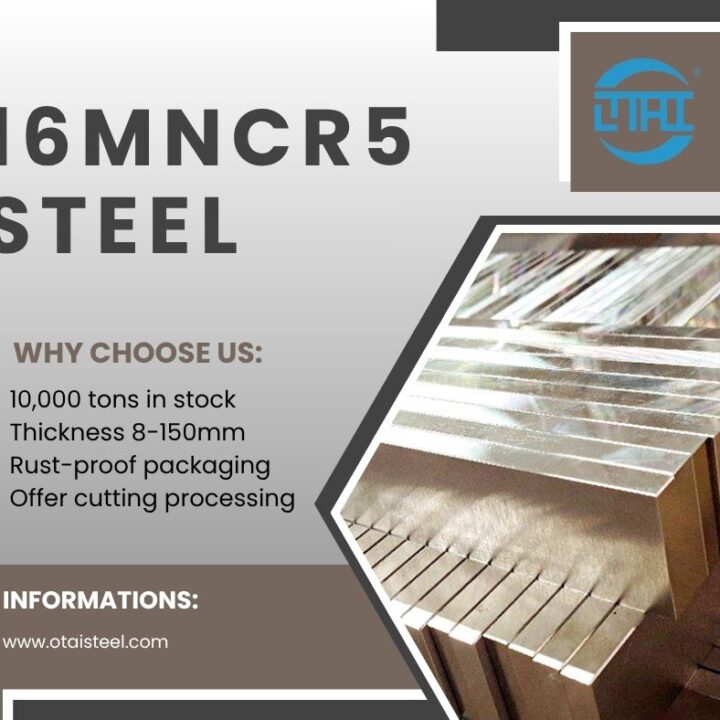
- 16MnCr5 plate stock: Thickness range from 8–150 mm.
- Large inventory: More than 10,000 tons of steel stock across the company’s product range.
- Cutting capability: 20 saw cutting machines support material cutting and size preparation.
- Processing services: CNC machining, grinding, and customized dimensions and tolerances, subject to order requirements.
- Quality support: Material testing, ultrasonic testing where specified, and third-party inspection coordination.
- Export experience: Supplying international customers in more than 54 countries since 1999.
- Packaging options: Anti-rust protection, strapping, bundled packages, and wooden cases according to shipment requirements.
- One-stop service: Material supply, cutting, processing coordination, inspection support, and export arrangements.
For technical information and product details, visit the OTAI 16MnCr5 case-hardening steel product page.
When requesting a quotation, buyers should provide the required plate thickness, width, length, quantity, delivery condition, and inspection requirements. This allows OTAI to check the available 16MnCr5 plate stock and prepare a quotation based on the actual project specifications.
❓ Frequently Asked Questions
1. What should I look for when choosing a 16MnCr5 vendor?
Check the vendor’s material knowledge, stock availability, technical documentation, quality-control procedures, processing capability, and export experience. Also confirm that the supplier can provide the required dimensions, delivery condition, and inspection records. A reliable vendor should explain these details clearly before accepting the order.
2. Is 16MnCr5 the same as material number 1.7131?
Yes. 16MnCr5 is the steel grade designation, while 1.7131 is its European material number. Buyers should include both identifiers in their inquiry when possible to reduce confusion during quotation and material verification.
3. Which standard should a 16MnCr5 supplier follow?
EN ISO 683-3 is a relevant standard for case-hardening steels, and older specifications may refer to EN 10084. However, buyers should follow the exact standard and edition stated in their drawings or purchase specification. They should also confirm the product form, delivery condition, and any additional requirements.
4. What documents should I request from a 16MnCr5 vendor?
Request an MTC that identifies the steel grade, material number, heat number, chemical analysis, and relevant inspection results. Depending on the project, you may also need dimensional inspection records, hardness results, ultrasonic testing reports, or third-party inspection documents.
5. Can a 16MnCr5 stockist provide customized cutting and export services?
Yes, some stockists and distributors offer cutting, machining, grinding, packaging, and export coordination. However, these services vary by supplier. Confirm the available processing equipment, dimensional tolerances, packaging method, additional costs, and delivery schedule before placing the order.