 Welding 4140 Alloy: Preheating, Filler Metal, Cracking and PWHT
📑 Table of Contents
🔍 1. Can 4140 Alloy Steel Be Welded?
🔥 2. Why Welding 4140 Alloy Requires Special Control
🌡️ 3. Preheating 4140 Before Welding
🧪 4. Filler Metal Selection for 4140
⚙️ 5. Welding Methods and Recommended Practice
🛡️ 6. Post-Weld Heat Treatment and Stress Relief
⚠️ 7. Welding Cracks, Hardness and HAZ Problems
🏭 8. Applications and Practical Welding Tips
🔍 1. Can 4140 Alloy Steel Be Welded?
Yes, welding 4140 alloy is possible. However, 4140 requires more control than low-carbon structural steel. Its relatively high carbon content and chromium-molybdenum alloy system increase hardenability. As a result, careless welding can create hard zones, residual stress and cracking.
AISI 4140 is a medium-carbon chromium-molybdenum alloy steel. Engineers commonly select it when components need high strength, toughness, fatigue resistance and wear resistance. These same characteristics also make welding more demanding.
The biggest concern does not usually come from the molten weld metal alone. Instead, the heat-affected zone (HAZ) can undergo rapid cooling. That cooling can produce a hard microstructure near the weld.
Hydrogen can make the situation worse. If hydrogen enters the weld area while the HAZ remains hard and highly stressed, delayed cracking can occur.
Therefore, successful 4140 alloy steel welding normally requires a controlled welding procedure. Preheating, suitable filler metal, controlled heat input, interpass temperature and post-weld treatment all deserve attention.
| Welding Factor | Why It Matters for 4140 |
|---|---|
| Carbon content | Increases hardenability and cracking risk |
| Chromium and molybdenum | Increase hardenability and strength |
| Preheating | Slows cooling and reduces thermal stress |
| Low-hydrogen consumables | Help reduce hydrogen-assisted cracking risk |
| Heat input | Influences cooling rate and HAZ microstructure |
| PWHT | Can reduce residual stress and temper hard zones |
Welding Is Easier Before Hardening
The condition of the 4140 material also matters. Welding an annealed or normalized component generally presents fewer challenges than welding a highly hardened 4140 component.
When possible, manufacturers often perform major welding operations before final hardening. They can then apply the required heat treatment after welding to restore the desired mechanical properties.
Welding a pre-hardened component can create local changes in hardness and microstructure. The HAZ may become softer in some areas and harder in others, depending on the original condition and welding thermal cycle.
For this reason, the welding procedure should match the material’s original hardness and the required final properties.
🔥 2. Why Welding 4140 Alloy Requires Special Control
The main welding challenge comes from 4140’s hardenability. When the area around a weld cools too quickly, the HAZ can form hard martensitic structures.
A hard HAZ is not automatically a problem. However, high hardness combined with tensile residual stress and hydrogen creates a much greater risk of delayed cracking.
The risk becomes more significant as section thickness increases. Thick material can create stronger thermal gradients, while large components may require greater control of the complete welding sequence.
The Role of Carbon
Carbon strongly affects hardenability. Compared with mild steel, 4140 contains enough carbon to respond significantly to rapid cooling.
The alloying elements chromium and molybdenum further increase hardenability. Therefore, the HAZ can become hard even when the welding operator does not intentionally perform a hardening treatment.
Hydrogen-Assisted Cracking
Hydrogen represents another major concern during welding 4140 alloy steel. Moisture, contaminated surfaces and poorly stored consumables can introduce hydrogen into the welding zone.
Hydrogen can diffuse into the steel while the HAZ is still hot. If the region later becomes hard and highly stressed, delayed cracking can develop hours after welding.
This explains why a weld can look acceptable immediately after completion and still develop cracks later.
| Risk | Potential Cause | Control Strategy |
|---|---|---|
| HAZ cracking | Rapid cooling and high hardness | Preheat and control cooling |
| Hydrogen cracking | Moisture and hydrogen-bearing consumables | Use properly dried low-hydrogen consumables |
| Distortion | Uneven thermal expansion and contraction | Control welding sequence and heat input |
| Residual stress | Local heating and cooling | Use suitable PWHT when required |
| Property changes | Welding thermal cycle | Verify hardness and mechanical properties after welding |
Thickness Changes the Welding Strategy
Thickness is one of the first details a welding engineer should consider. A thin 4140 section can lose heat rapidly, while a large section behaves differently because its thermal mass changes the cooling pattern.
As thickness increases, preheating and interpass temperature control often become more important.
The exact procedure should come from a qualified welding procedure specification rather than from a single universal temperature or welding parameter.
For buyers researching how to weld 4140 steel, this is a key point: successful welding depends on the material condition, thickness, joint design, welding process and required final properties.
🌡️ 3. Preheating 4140 Before Welding
Preheating is one of the most important techniques when welding 4140 alloy. It raises the starting temperature of the base metal and slows the cooling rate after welding.
A slower cooling rate can reduce the formation of excessively hard HAZ structures. Preheating also helps reduce thermal gradients and can lower residual stress around the joint.
For many 4140 welding procedures, engineers use a preheat range around 300–500°F (150–260°C). However, this is a practical starting range, not a universal requirement. The actual temperature should depend on material thickness, carbon equivalent, initial hardness, welding process and applicable welding procedure.
| Condition | General Welding Consideration |
|---|---|
| Thin annealed 4140 | Lower thermal risk, but controlled preheat may still be required |
| Thick 4140 plate | Greater need for controlled preheat and interpass temperature |
| Hardened 4140 | Higher risk of local property changes and cracking |
| High-restraint joint | Greater residual stress; stronger thermal control may be necessary |
How Preheating Works
Imagine welding two sections of 4140 at room temperature. The weld zone becomes extremely hot while the surrounding steel remains relatively cold. The temperature difference creates a steep thermal gradient.
If the material then cools rapidly, the HAZ can transform into a hard microstructure.
Preheating raises the temperature of the surrounding material before welding. This reduces the temperature difference between the weld and the base metal.
As a result, the weld area can cool more slowly and more uniformly.
Interpass Temperature Matters Too
Preheating should not be viewed as a one-time step. The joint should remain within the specified temperature range during multi-pass welding.
If the joint cools too much between passes, the next weld pass can create another rapid thermal cycle.
Therefore, monitoring the 4140 welding preheat temperature and interpass temperature helps maintain a more predictable welding process.
Use Temperature Measurement Correctly
Welding personnel can use temperature crayons, contact thermometers or suitable infrared equipment to monitor the joint. The measurement location should follow the qualified welding procedure.
The goal is consistent thermal control rather than simply heating the steel as much as possible.
Excessive heat can also create problems. Very high temperatures or excessive heat input can enlarge the HAZ and affect mechanical properties.
Therefore, good welding practice seeks a controlled thermal cycle rather than maximum heating.
🧪 4. Filler Metal Selection for 4140
Filler metal selection affects weld strength, toughness, hardness and cracking resistance. The correct choice depends on the required joint properties and the condition of the 4140 base material.
For many repair and fabrication applications, low-hydrogen electrodes or wires are preferred because hydrogen control plays an important role in preventing delayed cracking.
| Filler Metal Approach | Potential Advantage | Typical Consideration |
|---|---|---|
| Low-hydrogen consumable | Reduces hydrogen-related cracking risk | Requires correct storage and handling |
| Matching-strength filler | Can provide high joint strength | May require stricter preheat and PWHT control |
| Lower-strength filler | Can reduce cracking sensitivity in some repair applications | Joint strength must meet the design requirement |
| Special repair alloy | Can address specific service conditions | Requires engineering validation |
Why Low-Hydrogen Consumables Matter
Hydrogen control starts before welding. Electrodes and fluxes can absorb moisture during storage. If operators use damp consumables, the weld can receive additional hydrogen.
For 4140 alloy steel welding, consumable storage and handling should therefore follow the manufacturer’s requirements and the qualified welding procedure.
Matching Strength Is Not Always the Only Goal
It may seem logical to select a filler metal with exactly the same strength as the base metal. However, the strongest possible weld is not always the safest weld.
In repair welding, engineers may select a lower-strength or more ductile filler to reduce cracking sensitivity. The correct choice depends on the joint’s service requirements.
The welding engineer should consider tensile strength, yield strength, toughness, hardness, service temperature and post-weld heat treatment together.
Cleanliness Is Essential
Oil, grease, rust, moisture and scale can interfere with welding quality. Contamination can also contribute to hydrogen-related problems.
Before welding, clean the joint area and make sure the base metal is dry. Good surface preparation is a simple step that can prevent significant problems later.
⚙️ 5. Welding Methods and Recommended Practice
Several welding processes can join 4140 alloy steel. The best process depends on plate thickness, joint geometry, production volume, equipment and the required mechanical properties.
The most common options include SMAW, GMAW and GTAW. Each process provides a different level of control over heat input, deposition rate and weld quality.
| Welding Process | Typical Advantage | 4140 Consideration |
|---|---|---|
| SMAW | Flexible and suitable for field or repair work | Use appropriate low-hydrogen electrodes and control preheat |
| GMAW / MIG | High productivity and continuous wire feeding | Control heat input and shielding gas conditions |
| GTAW / TIG | Excellent weld-pool control | Useful for precision work and smaller joints |
| SAW | High deposition rate for suitable production work | Requires careful procedure qualification and heat control |
SMAW for 4140
SMAW can work well for repair and fabrication projects. However, electrode selection and moisture control become particularly important.
Low-hydrogen electrodes can help reduce the risk of hydrogen-assisted cracking. Operators should store and condition the electrodes according to the electrode manufacturer’s instructions.
The joint should also reach the specified preheat temperature before the first pass. Operators should maintain the required interpass temperature during subsequent passes.
GMAW and GTAW
GMAW can provide good productivity for fabrication shops. It allows continuous wire feeding and can reduce the time required for long welds.
GTAW provides better control of the weld pool and heat input. It can therefore suit precision joints, repairs and applications where weld quality receives particular attention.
Regardless of the process, the welding procedure should control current, voltage, travel speed, shielding and heat input.
Control Heat Input
Too little heat input can promote rapid cooling and increase HAZ hardness. Excessive heat input can enlarge the HAZ and create undesirable changes in the material structure.
The goal is therefore a controlled welding thermal cycle.
For best practices for welding 4140 steel, the procedure should balance preheat, heat input, interpass temperature and cooling rate rather than focusing on only one parameter.
🛡️ 6. Post-Weld Heat Treatment and Stress Relief
Post-weld heat treatment can play an important role in demanding 4140 applications. The welding thermal cycle creates residual stresses and can produce hard regions in the HAZ.
A suitable PWHT process can temper hard microstructures, reduce residual stress and improve the overall stability of the welded component.
However, PWHT does not have one universal temperature that applies to every 4140 component. Engineers should select the treatment according to material condition, section thickness, joint design and applicable specifications.
Why PWHT Helps 4140
The HAZ can contain high residual stresses after welding. If the HAZ also contains high hardness, the combination can increase cracking sensitivity.
Controlled post-weld heating allows the material to relax some of these stresses. It can also temper hard structures produced during welding.
| PWHT Objective | Potential Benefit |
|---|---|
| Stress relief | Reduces residual welding stresses |
| Tempering HAZ | Can reduce excessive local hardness |
| Hydrogen control | Appropriate post-heating can help hydrogen diffuse from the weld region |
| Dimensional stability | Can reduce the risk of later distortion in some applications |
| Property uniformity | Can improve consistency between weld and surrounding material |
Preheating and PWHT Are Not the Same
Preheating occurs before and during welding. It mainly controls the cooling rate and thermal gradient.
PWHT occurs after welding. It mainly addresses residual stress, HAZ hardness and the final metallurgical condition.
A successful procedure may require both.
Post-Heating Can Also Matter
Some welding procedures use controlled post-heating immediately after welding. This approach can slow cooling and provide additional time for hydrogen to diffuse from the weld area.
The exact treatment should follow the qualified procedure. Improvised heating can produce inconsistent results.
For 4140 welding and heat treatment, engineers should therefore treat welding and heat treatment as one connected manufacturing process.
⚠️ 7. Welding Cracks, Hardness and HAZ Problems
Cracking is one of the biggest concerns when welding 4140 alloy steel. Understanding the relationship between hardness, hydrogen and residual stress helps explain why these cracks occur.
Delayed Hydrogen Cracking
Delayed cracking may appear after the weld has already cooled. This behavior makes it especially difficult to identify through simple visual inspection immediately after welding.
Three factors commonly increase the risk:
- Hydrogen in the weld area
- A hard and crack-sensitive HAZ
- Tensile residual stress
Removing one or more of these factors can significantly reduce the risk. Proper preheating reduces cooling severity. Low-hydrogen consumables reduce hydrogen input. Suitable PWHT can reduce residual stress and temper hard regions.
HAZ Hardness
The HAZ is the part of the base metal that does not melt but experiences enough heat to change its microstructure.
With 4140, rapid cooling can create a hard HAZ. This region may become more crack-sensitive than the softer surrounding material.
| Problem | Typical Mechanism | Prevention Approach |
|---|---|---|
| HAZ cracking | Hard microstructure plus residual stress | Preheat and control cooling |
| Hydrogen cracking | Hydrogen + hard HAZ + stress | Use low-hydrogen practice |
| Porosity | Gas trapped in weld metal | Clean joint and maintain shielding |
| Distortion | Uneven thermal expansion and contraction | Control sequence and heat input |
| Excessive HAZ softening | High thermal exposure | Optimize welding and PWHT parameters |
Inspect the Weld and HAZ
Visual inspection provides the first quality check, but critical 4140 components may require additional non-destructive testing.
Depending on the application, engineers may use magnetic particle testing, ultrasonic testing, radiographic testing or hardness testing.
Hardness testing can be particularly useful because it helps identify unexpected hardness changes around the weld.
For critical components, inspection should follow the applicable welding code, customer specification and qualified procedure.
A proper inspection plan is especially valuable when the component will experience high cyclic loads, impact or pressure during service.
🏭 8. Applications and Practical Welding Tips
4140 is widely used for shafts, gears, axles, pins, bolts, machine components and other parts that require a strong alloy steel. Welding can be useful for repair, fabrication and component modification, but the procedure should reflect the service requirements.
Common Applications
| Application | Why 4140 Is Selected | Welding Consideration |
|---|---|---|
| Drive shafts | High strength and fatigue resistance | Control HAZ hardness and residual stress |
| Gear components | Good strength and wear resistance | Consider final heat treatment after welding |
| Axles | High load-bearing capability | Use a qualified welding procedure |
| Pins and shafts | Good combination of strength and toughness | Pay attention to joint restraint |
| Repair components | Good mechanical performance | Remove cracks and contaminated material before welding |
Practical Welding Checklist
Before starting a 4140 welding job, confirm the material grade and delivery condition. Check whether the component is annealed, normalized, quenched and tempered, or otherwise heat treated.
Next, identify the section thickness and joint design. These factors influence the required thermal control.
Clean the joint carefully. Remove oil, grease, rust, paint, moisture and other contamination.
Select a suitable low-hydrogen filler metal and follow the manufacturer’s storage requirements.
Bring the joint to the specified preheat temperature before welding. Maintain the required interpass temperature during multi-pass welding.
After welding, follow the specified cooling and post-weld heat-treatment procedure. Do not expose the joint to uncontrolled rapid cooling unless the qualified procedure specifically permits it.
Finally, inspect the weld and HAZ. For critical components, use the appropriate non-destructive testing and hardness checks.
Five Key Rules
- Do not weld 4140 like mild steel. Its higher hardenability requires greater thermal control.
- Control hydrogen. Keep consumables dry and the joint clean.
- Use preheat when required. Preheat helps reduce rapid cooling and HAZ hardness.
- Consider PWHT. It can reduce residual stress and temper hard regions when the application requires it.
- Verify the final condition. Inspection should confirm that the welded component meets the required quality and mechanical-property criteria.
The most important lesson is simple: welding 4140 alloy is achievable, but the welding procedure must respect the steel’s hardenability. A controlled thermal cycle, suitable consumables and proper post-weld treatment can greatly improve weld reliability.
For manufacturers searching for 4140 weldability, the material should therefore be evaluated as a complete system rather than by weldability alone. Base-metal condition, joint design, thickness, welding process and final heat treatment all influence the result.
📦 9. Otai Special Steel Advantages
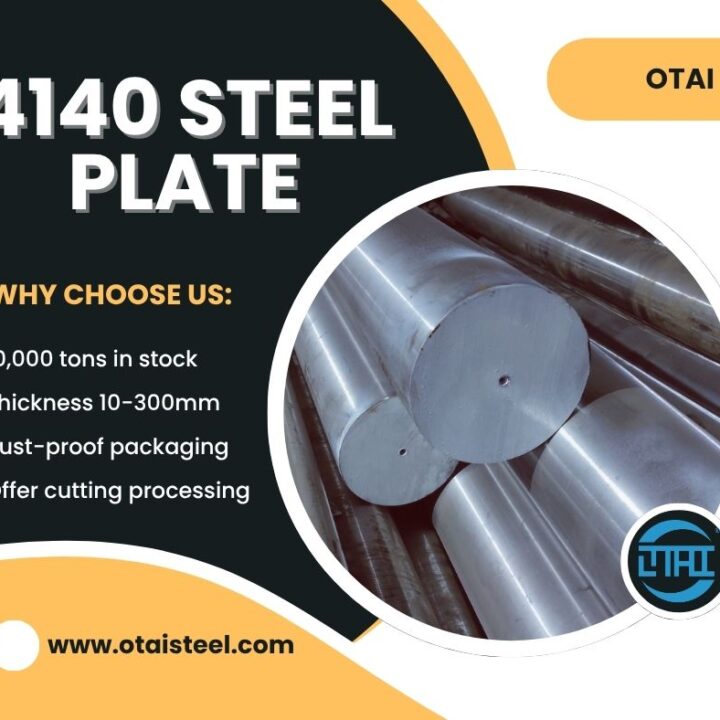
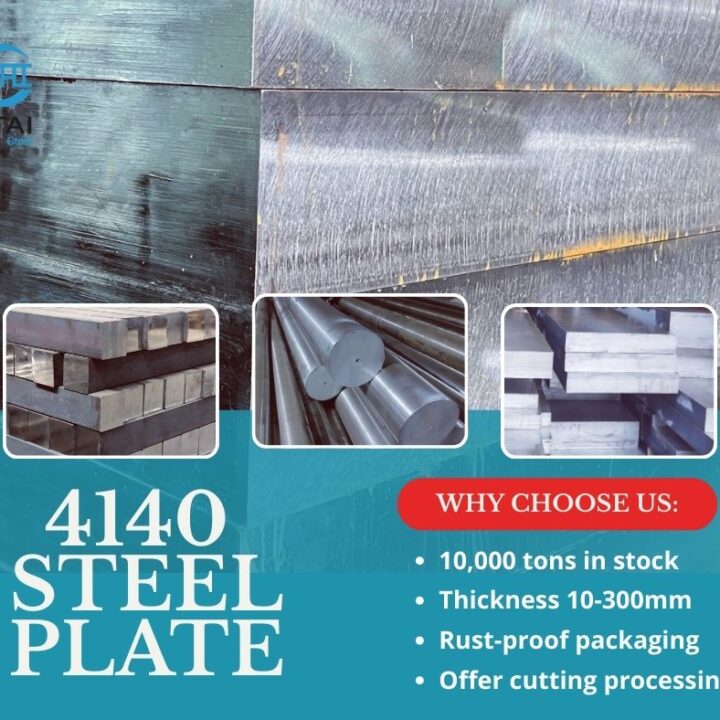
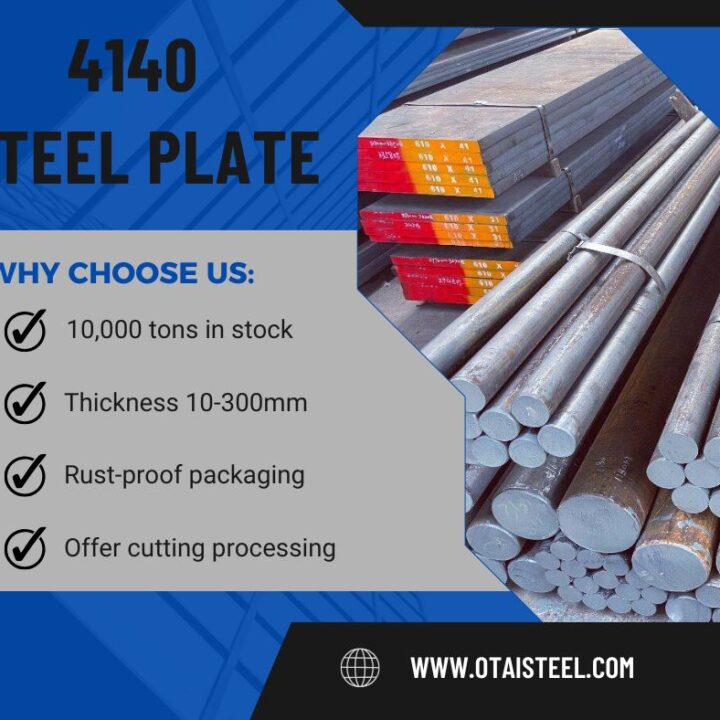
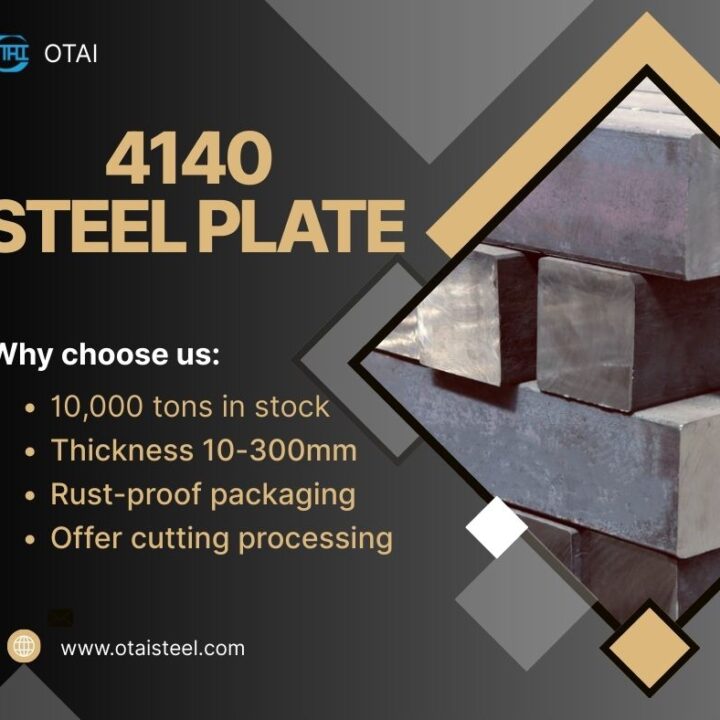
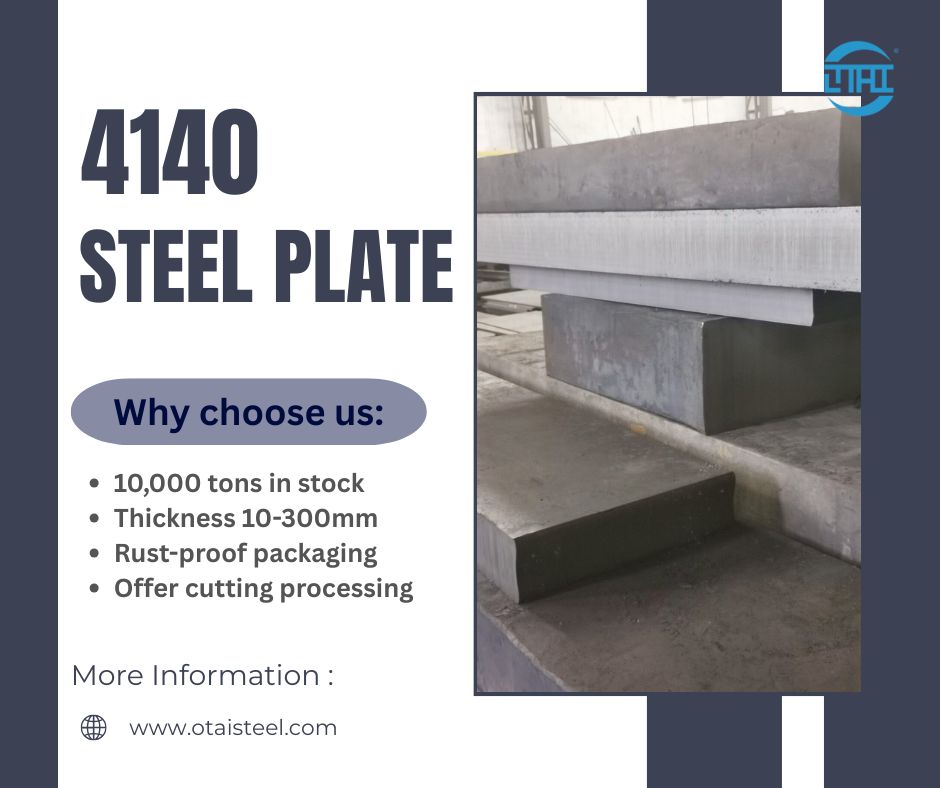
Otai Special Steel supplies 4140 alloy steel plates for machinery, shafts, gears, axles and other demanding industrial applications. We focus on stable material quality, practical processing support and reliable international delivery.
- Large inventory: We maintain around 10,000 tons of steel inventory, with different sizes available for customer requirements.
- 4140 plate stock: Various thicknesses and dimensions are available, helping customers shorten procurement lead times.
- Cutting and processing: We provide cutting and other processing services according to drawings and project requirements.
- Heat treatment support: We can support different heat-treatment requirements for 4140 alloy steel applications.
- Quality assurance: Ultrasonic testing and third-party inspection can be arranged for projects with strict quality requirements.
- Export packaging: Steel strapping, wooden boxes and anti-rust packaging are available for international shipments.
- International supply experience: Otai has supplied steel to customers with demanding technical requirements, including Fortune Global 500 companies.
When purchasing 4140 for welding, customers should provide the material thickness, delivery condition, welding requirements and final application. This information helps the supplier recommend a suitable material condition and processing route.
❓ 10. FAQ About Welding 4140 Alloy
1. Can 4140 alloy steel be welded?
Yes. 4140 can be welded, but it requires more control than ordinary low-carbon steel. Preheating, low-hydrogen consumables, controlled cooling and suitable post-weld heat treatment can help reduce cracking and undesirable HAZ hardness.
2. Does 4140 need to be preheated before welding?
In many applications, yes. A commonly used practical preheat range is around 300–500°F (150–260°C), but the exact temperature depends on thickness, material condition, carbon equivalent, joint restraint and the qualified welding procedure.
3. What filler rod should I use for 4140?
The correct filler depends on the required joint strength, toughness, base-metal condition and welding procedure. Low-hydrogen consumables are commonly preferred. A matching-strength filler is not automatically the best choice for every repair or fabrication application.
4. Is 4140 difficult to weld?
4140 is more difficult to weld than mild steel because its chromium-molybdenum alloy system gives it high hardenability. Rapid cooling can produce a hard HAZ, while hydrogen and residual stress can increase the risk of delayed cracking.
5. Does 4140 require post-weld heat treatment?
PWHT may be required for demanding applications, especially when the component has high hardness, large section thickness, high restraint or strict mechanical-property requirements. The exact treatment should follow the qualified welding procedure and applicable specification.
6. Can hardened 4140 be welded?
It can be welded, but welding hardened 4140 presents additional risks. The welding thermal cycle can change the local hardness and microstructure. In many cases, engineers prefer to weld the material before final hardening when the component design allows it.
7. How can I prevent cracks when welding 4140?
Use a qualified welding procedure, clean the joint thoroughly, control hydrogen, apply the specified preheat, maintain interpass temperature and follow the required cooling and PWHT procedure. For critical parts, hardness and non-destructive testing can provide additional verification.