41Cr4 Thermal Conductivity: Does Temperature Affect Heat Transfer?
📑 Table of Contents
- 🔍 What Is Thermal Conductivity in 41Cr4 Steel?
- 📊 What Is the Typical Thermal Conductivity of 41Cr4?
- 🌡️ How Does Temperature Affect 41Cr4 Thermal Conductivity?
- ⚙️ Does Heat Treatment Change Thermal Conductivity?
- 🔬 How Does 41Cr4 Compare with Other Alloy Steels?
- 🏭 Why Does Thermal Conductivity Matter in Manufacturing?
- 📋 What Other Thermal Properties Should Engineers Check?
- 🛒 What Should Buyers Confirm When Sourcing 41Cr4?
- 🏢 Why Source 41Cr4 from OTAI?
- ❓ Frequently Asked Questions
When engineers select 41Cr4 steel for mechanical components, they often focus on strength, hardness, and wear resistance. However, thermal conductivity also deserves attention when a component experiences repeated heating, machining, heat treatment, or changes in operating temperature.
41Cr4 is a chromium alloy steel commonly used for shafts, gears, axles, and other mechanical parts requiring a suitable balance of strength and toughness. Its thermal conductivity describes how readily heat travels through the material. This property affects temperature distribution during manufacturing and influences how quickly different sections respond to heating or cooling.
At room temperature, technical data for 41Cr4 commonly report a thermal conductivity of approximately 46 W/(m·K). The value decreases as temperature rises. Therefore, engineers should not use one room-temperature figure for every operating or processing condition.
This article examines representative thermal conductivity values, explains temperature-related changes, and discusses what engineers and buyers should consider when selecting 41Cr4 for industrial applications.
🔍 What Is Thermal Conductivity in 41Cr4 Steel?
Understanding the meaning of thermal conductivity
Thermal conductivity measures a material’s ability to transfer heat. Engineers generally express it using the symbol λ or k, with the unit W/(m·K), meaning watts per meter-kelvin.
A higher thermal conductivity indicates that a material can transfer heat more readily under comparable conditions. Conversely, a lower value means heat travels less readily through the material.
For 41Cr4 steel, this property helps engineers estimate how heat moves through shafts, gears, machine components, and other steel parts. It also supports calculations involving heating rates, temperature gradients, and cooling behavior.
Why does this property matter?
Consider a steel shaft that experiences friction during operation. The contact area generates heat, and the material transfers that heat toward surrounding sections. Thermal conductivity influences how quickly the temperature difference spreads through the shaft.
Similarly, during industrial heat treatment, the surface and core of a steel component may heat or cool at different rates. Thermal conductivity is one factor affecting this temperature distribution, although component dimensions, heating equipment, convection, radiation, and the heat-treatment process also play important roles.
Engineers should therefore evaluate thermal conductivity alongside mechanical properties. A material may provide the required strength and hardness but still need additional thermal analysis when the component operates under demanding temperature conditions.
Thermal conductivity is not the same as heat capacity
Three thermal properties often appear together in engineering data sheets:
- Thermal conductivity: Describes how readily heat passes through a material.
- Specific heat capacity: Describes how much energy is needed to raise one kilogram of material by one kelvin.
- Thermal diffusivity: Describes how quickly a temperature change spreads through a material relative to its ability to store heat.
These properties answer different engineering questions. Thermal conductivity helps estimate heat transfer, while specific heat capacity helps estimate energy requirements. Thermal diffusivity is particularly useful when engineers study transient heating and cooling.
For this reason, a thermal conductivity figure alone cannot fully predict how quickly a 41Cr4 component will reach a particular temperature.
📊 What Is the Typical Thermal Conductivity of 41Cr4?
Room-temperature reference value
Published technical data for 41Cr4 report a thermal conductivity of approximately 46 W/(m·K) at 20°C. This value provides a useful starting point for engineering calculations involving components near room temperature.
However, engineers should treat it as a reference value rather than a guaranteed measurement for every 41Cr4 batch. The reported property can vary with the material’s condition, microstructure, composition, and measurement method.
For initial material selection, the following reference values from a 41Cr4 technical data sheet provide a useful indication of how conductivity changes with temperature.
| Temperature | Thermal conductivity | Unit |
|---|---|---|
| 20°C | 46.0 | W/(m·K) |
| 100°C | 44.8 | W/(m·K) |
| 200°C | 43.5 | W/(m·K) |
| 400°C | 37.7 | W/(m·K) |
| 600°C | 31.4 | W/(m·K) |
Source: Lucefin 41Cr4 technical data. These are representative reference values, not guaranteed properties for every delivery condition or production batch. The source does not provide a value for every 100°C interval, so the table does not assume missing measurements.
Why do supplier data sheets show different values?
Engineers may find slightly different thermal conductivity figures across steel databases and supplier documents. For example, another published 41Cr4 material dataset reports approximately 45.1 W/(m·K) at 20°C rather than 46 W/(m·K).
Such differences do not automatically indicate a material quality problem. They may reflect different reference datasets, material conditions, measurement methods, or rounding conventions.
Before using a value in a detailed thermal calculation, engineers should check the source, temperature, material condition, and testing basis. A generic online value may be suitable for preliminary comparison, but critical engineering calculations should use verified technical data or measurements relevant to the actual component.
Is 41Cr4 a high-conductivity material?
41Cr4 provides useful heat-transfer capability for a chromium alloy steel, but engineers should not select it as a specialist high-thermal-conductivity material. Its primary purpose is to provide mechanical properties suitable for components that require strength and hardenability.
If rapid heat transfer is the main design requirement, engineers should compare 41Cr4 with materials specifically selected for thermal performance. However, the comparison must also consider strength, wear resistance, operating temperature, cost, and manufacturing requirements.
🌡️ How Does Temperature Affect 41Cr4 Thermal Conductivity?
Thermal conductivity generally decreases as temperature rises
Temperature has a noticeable effect on the thermal conductivity of 41Cr4. The published reference data show a gradual decrease from 46 W/(m·K) at 20°C to 31.4 W/(m·K) at 600°C.
This means that the steel transfers heat less readily at the higher temperature in the cited dataset. Engineers should account for this change when calculating temperature distribution in components exposed to elevated temperatures.
The reduction is not necessarily linear. For example, the difference between 20°C and 100°C is relatively small, while the reduction becomes more pronounced across the higher-temperature intervals shown in the data.
How much does conductivity change?
Using the reference values above, the reduction between 20°C and 600°C is approximately 31.7%. This comparison illustrates why room-temperature data alone may be insufficient for components that operate at substantially higher temperatures.
Consider a 41Cr4 mechanical component exposed to repeated heating. If an engineer uses only the room-temperature conductivity value, the calculation may overestimate the material’s ability to transfer heat at elevated temperatures.
For preliminary analysis, engineers can use temperature-dependent reference data. For critical designs, they should obtain values suitable for the actual temperature range and material condition.
What happens during heating and cooling?
During heating, different regions of a component may experience different temperatures. The surface may receive heat directly from a furnace, flame, friction source, or another hot component. Heat then moves toward cooler regions inside the steel.
During cooling, the direction of heat flow reverses as the hotter regions release energy toward cooler surroundings. Thermal conductivity affects the rate of internal heat transfer, but it does not determine the entire cooling rate.
Other factors include:
- Component dimensions: Thick sections generally require more time for heat to reach or leave the core.
- Surface conditions: Scale, coatings, and surface finish can influence heat exchange with the surroundings.
- Cooling medium: Air, oil, water, and other media have different heat-transfer characteristics.
- Specific heat capacity: The energy needed to change the material’s temperature affects heating and cooling behavior.
- Component geometry: Corners, holes, thin sections, and changes in cross-section can create uneven temperature distributions.
Why engineers should avoid simple assumptions
A decrease in thermal conductivity does not mean every 41Cr4 component will cool at the same slower rate. The actual temperature response depends on the complete thermal system, including the material, geometry, surrounding environment, and process conditions.
For applications involving repeated heating cycles, engineers should evaluate both the temperature-dependent material properties and the component’s operating conditions. This approach provides a more reliable basis for design than using a single room-temperature figure.
⚙️ Does Heat Treatment Change Thermal Conductivity?
Heat treatment changes the steel’s microstructure
41Cr4 is a chromium alloy steel commonly supplied in different delivery conditions, including annealed and quenched and tempered conditions. Heat treatment changes the microstructure and mechanical properties of the steel.
Annealing generally produces a softer condition that supports machining. Quenching increases hardness and strength, while tempering adjusts the balance between strength and toughness. These processes are important when selecting 41Cr4 for shafts, gears, and other mechanical components.
Because thermal conductivity depends partly on the material’s physical structure, changes in microstructure can influence its thermal behavior. However, the exact effect depends on the heat-treatment route and the resulting condition. Buyers should not assume that every quenched and tempered batch has a fixed conductivity correction compared with annealed material.
Why the delivery condition matters
When comparing thermal data, engineers should identify whether the reference applies to normalized, annealed, or quenched and tempered steel. A value from one material condition may not represent another condition with exactly the same precision.
This distinction becomes more important when engineers need accurate thermal calculations for components operating under repeated temperature changes or demanding heat-treatment conditions.
Heat treatment and temperature uniformity
During quenching, the surface and core of a steel section may cool at different rates. This difference affects the resulting microstructure and mechanical properties throughout the section.
Thermal conductivity contributes to internal heat transfer, but section size, hardenability, cooling medium, and quenching conditions also influence the final result. Therefore, engineers should not use thermal conductivity alone to predict hardness or mechanical properties after heat treatment.
For large sections, the supplier and heat-treatment provider should consider the actual dimensions and required properties when selecting the process. If the component has strict core requirements, additional mechanical testing may be necessary.
What should buyers request?
When thermal performance matters to a project, buyers should identify the required delivery condition and ask whether the supplier has technical data for that condition. If the design requires a precise conductivity value, request supporting test information or arrange suitable testing.
For general purchasing, a standard material certificate usually focuses on grade identification, chemical composition, and specified mechanical test results. It may not include thermal conductivity. Buyers should therefore request additional technical information when the application requires it.
🔬 How Does 41Cr4 Compare with Other Alloy Steels?
Compare equivalent grades carefully
41Cr4 is a chromium alloy steel with material number 1.7035. A commonly referenced comparable grade is AISI 5140, although buyers should verify the applicable standard and chemical composition before treating two grade designations as interchangeable.
Other chromium-molybdenum steels, such as 42CrMo4 and AISI 4140, have different alloying systems and hardenability characteristics. Engineers may compare these materials when selecting steel for shafts, gears, and other loaded components.
However, a grade comparison should not rely on thermal conductivity alone. Strength, toughness, hardenability, heat-treatment response, machinability, and availability may have a greater influence on the final selection.
Use the same temperature when comparing values
A meaningful thermal conductivity comparison requires data measured or reported at the same temperature. Comparing 41Cr4 at 20°C with another steel at 400°C would produce a misleading result.
The material condition and source should also be consistent. If one data sheet reports a typical value for annealed material while another reports a value for quenched and tempered material, the figures may not provide a direct comparison.
| Comparison factor | What engineers should check |
|---|---|
| Temperature | Compare values at the same temperature. |
| Delivery condition | Check whether the data applies to annealed, normalized, or QT material. |
| Test method | Check whether the values come from comparable measurement procedures. |
| Mechanical properties | Compare strength, toughness, hardness, and hardenability. |
| Application requirements | Evaluate loads, operating temperature, wear, and manufacturing conditions. |
| Supply availability | Confirm available product forms, dimensions, and delivery schedules. |
Does 41Cr4 offer an advantage over 4140?
Not automatically. Both grades belong to the family of alloy steels used for mechanical engineering applications, but their chemical compositions and applicable standards differ. Their thermal conductivity values should be compared using matching temperature and material-condition data.
If the component requires a particular combination of strength, toughness, and heat-treatment response, engineers should evaluate the full specification rather than select a grade based on a small difference in thermal conductivity.
For buyers comparing 41Cr4 with 5140, the same principle applies. Confirm the relevant standard, chemical composition, product form, and mechanical-property requirements before approving a substitute.
🏭 Why Does Thermal Conductivity Matter in Manufacturing?
Machining and heat generation
During turning, milling, drilling, and grinding, friction and plastic deformation generate heat. Some of this heat enters the cutting tool, some remains in the workpiece, and some leaves with the chips or surrounding coolant.
Thermal conductivity influences how heat moves through the workpiece. However, machining temperature also depends on cutting speed, feed rate, tool geometry, material hardness, coolant conditions, and the contact between the tool and workpiece.
For 41Cr4, engineers and machinists should consider the delivery condition and hardness when selecting cutting parameters. A quenched and tempered product may require different machining conditions from an annealed product.
Heat treatment and temperature control
Heat treatment requires controlled heating and cooling. During the process, the component must reach the required temperature and remain within the specified process window for the required time.
Thermal conductivity helps determine how heat moves from the surface toward the core. Nevertheless, a large section may develop temperature differences even when the furnace temperature remains stable. The component’s geometry and heating conditions must therefore be considered.
For 41Cr4 components that require quenching and tempering, uniform heating and suitable cooling conditions help achieve more consistent properties. The heat-treatment provider should select parameters based on the grade, section dimensions, and required mechanical performance.
Component performance during operation
Some 41Cr4 components experience friction, repeated loading, or localized heating during service. Examples include transmission shafts, gears, axles, and other mechanical parts.
In these applications, thermal conductivity can influence how quickly heat spreads through the component. However, the designer must also consider thermal expansion, fatigue strength, lubrication, surface condition, and the component’s actual operating temperature.
If a component experiences frequent temperature changes, uneven expansion may create additional stress. Engineers should therefore evaluate the combined effects of temperature, mechanical loading, and material properties.
When should thermal analysis be performed?
For ordinary mechanical components operating near ambient temperature, a room-temperature reference value may be sufficient for preliminary material selection. More detailed analysis becomes important when the component experiences high temperatures, rapid heating and cooling, thermal gradients, or repeated thermal cycles.
In such cases, engineers should use temperature-dependent data and consider the full geometry and operating environment. This provides a better basis for assessing component reliability than relying on a single conductivity figure.
📋 What Other Thermal Properties Should Engineers Check?
Specific heat capacity
Specific heat capacity describes the energy required to raise the temperature of one kilogram of material by one kelvin. The unit is J/(kg·K).
Published 41Cr4 technical data report a room-temperature specific heat capacity of approximately 460 J/(kg·K). This property is useful when estimating the energy needed to heat a component or the amount of energy released during cooling.
Specific heat capacity generally changes with temperature. Engineers working across a wide temperature range should therefore use temperature-dependent values rather than assume that the room-temperature figure remains constant.
Thermal expansion
Thermal expansion describes how a material changes dimension as its temperature changes. Engineers commonly express the linear coefficient of thermal expansion in 10⁻⁶/K.
For 41Cr4, published reference data show that the linear thermal expansion coefficient increases with temperature. The reported values include approximately 11.1 × 10⁻⁶/K at 100°C, 12.9 × 10⁻⁶/K at 300°C, and 14.1 × 10⁻⁶/K at 600°C.
This property matters when designing shafts, gears, precision-machined parts, and assemblies with tight dimensional tolerances. Temperature-related dimensional changes may affect clearances, alignment, and fit between connected components.
Thermal diffusivity
Thermal diffusivity combines thermal conductivity, density, and specific heat capacity. Engineers calculate it using the relationship:
Thermal diffusivity = Thermal conductivity ÷ (Density × Specific heat capacity)
Its unit is m²/s. A higher thermal diffusivity generally indicates that temperature changes spread more quickly through the material, assuming comparable conditions.
This property is useful when analyzing transient heating and cooling. It helps engineers understand how quickly a temperature disturbance moves through a component rather than simply measuring how much heat the material can conduct.
Compare the main thermal properties
| Property | Unit | Engineering purpose |
|---|---|---|
| Thermal conductivity | W/(m·K) | Evaluates heat transfer through steel. |
| Specific heat capacity | J/(kg·K) | Estimates energy required for temperature changes. |
| Thermal expansion coefficient | 10⁻⁶/K | Estimates dimensional changes caused by heating. |
| Thermal diffusivity | m²/s | Evaluates how quickly temperature changes spread. |
For demanding applications, engineers should consider these properties together. Thermal conductivity explains heat transfer, specific heat capacity explains energy storage, and thermal expansion explains dimensional changes. Thermal diffusivity connects heat transfer with the material’s ability to store energy.
🛒 What Should Buyers Confirm When Sourcing 41Cr4?
Confirm the exact grade and standard
Before placing an order, buyers should confirm that the supplier is quoting 41Cr4 with material number 1.7035. They should also identify the applicable standard and edition stated in the drawing or purchase specification.
Although 41Cr4 is commonly compared with AISI 5140, grade equivalence should not be assumed without checking chemical composition and mechanical requirements. Different standards may specify different limits, testing requirements, and delivery conditions.
Specify the delivery condition and product dimensions
41Cr4 may be supplied in different conditions depending on the product form and manufacturing route. Buyers should clarify whether they need annealed, normalized, quenched and tempered, or another agreed condition.
Product dimensions also influence the applicable mechanical-property requirements. For plate, specify thickness, width, and length. For round bar, provide diameter and required length. If the component will undergo further heat treatment, explain the intended manufacturing process so the supplier can evaluate the suitable delivery condition.
Request the right technical documents
A mill test certificate helps buyers verify the supplied material’s grade, heat number, chemical composition, and required mechanical test results. However, thermal conductivity may not appear on a standard MTC.
If the application requires a specific thermal conductivity value, request supporting technical data for the relevant material condition and temperature range. For critical applications, discuss whether additional testing or engineering validation is necessary.
Evaluate the supplier’s processing capability
In addition to material quality, buyers should consider whether the supplier can meet the required dimensions and processing tolerances. Cutting, machining, grinding, inspection, and packaging can affect the total purchasing cost and delivery schedule.
For international orders, confirm stock availability, preparation time, export packaging, and documentation before approving the quotation. A supplier that can coordinate these requirements may help reduce communication and delivery risks.
Use this purchasing checklist
- Confirm 41Cr4 / 1.7035 and the applicable material standard.
- Specify the product form and exact dimensions.
- State the required delivery condition.
- Confirm chemical composition and mechanical-property requirements.
- Request an MTC with traceable heat information.
- Request thermal conductivity data if the application requires it.
- Confirm whether additional inspection or testing is necessary.
- Check cutting, machining, grinding, and dimensional tolerance capabilities.
- Confirm actual stock availability and the expected delivery schedule.
These checks help buyers evaluate suppliers based on both technical suitability and commercial reliability. A competitive quotation matters, but the material must also meet the requirements of the intended component and manufacturing process.
🏢 Why Source 41Cr4 from OTAI?
OTAI supplies alloy steel and tool steel to international customers, supporting different material dimensions and processing requirements. For buyers sourcing 41Cr4, reliable stock, accurate cutting, and clear quality documentation are important parts of the purchasing process.
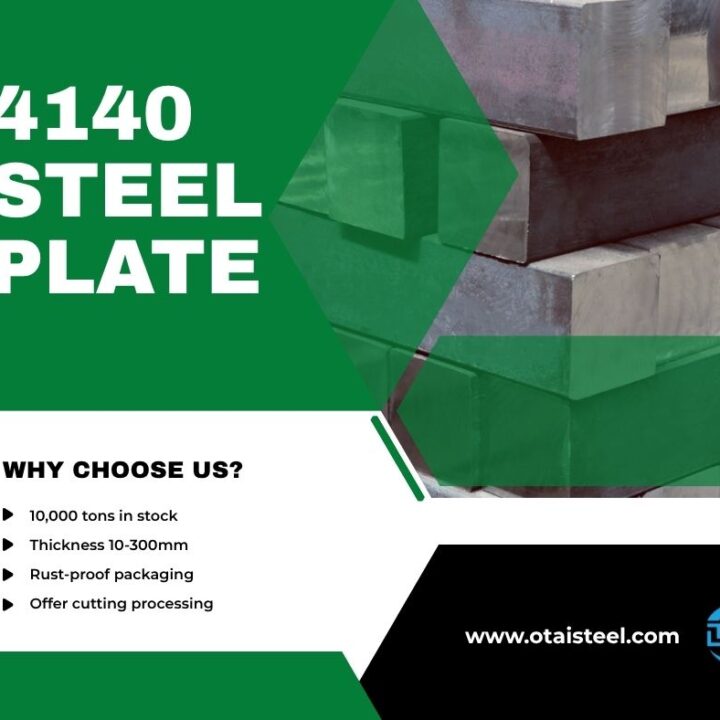
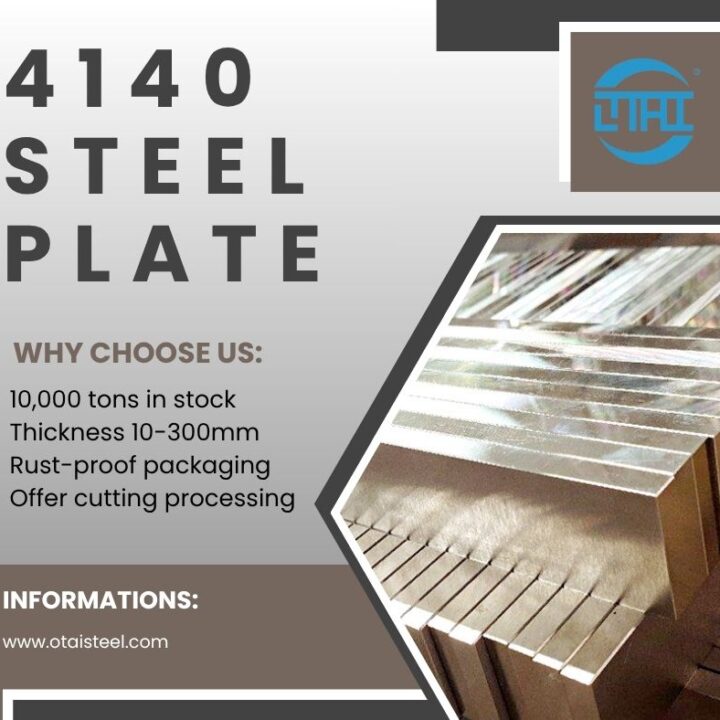
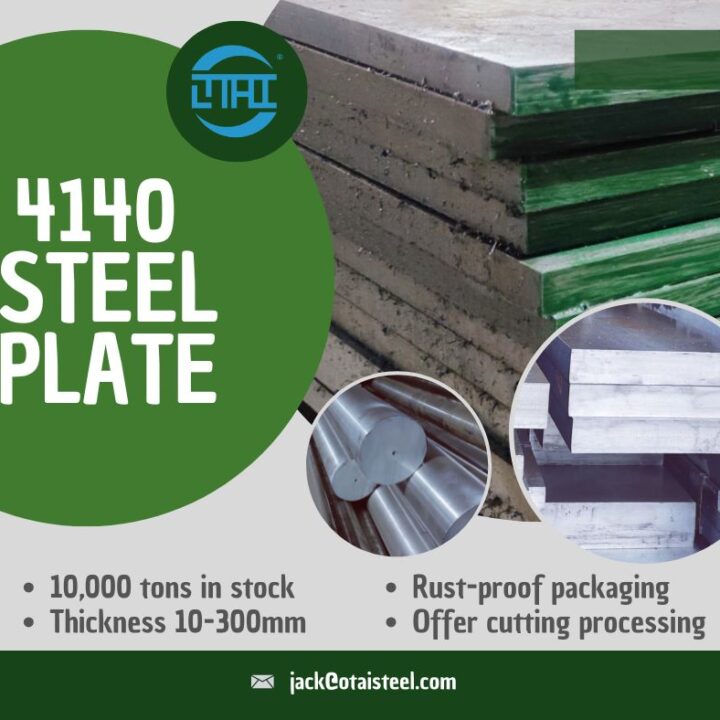
- 41Cr4 / 5140 plate stock: Thickness range from 4 mm to 300 mm.
- Large inventory: More than 10,000 tons of steel stock across our product range.
- Cutting capacity: 20 saw cutting machines to support different material sizes.
- Processing services: CNC machining, grinding, precision cutting, and customized dimensions and tolerances.
- Quality support: Material testing, ultrasonic testing arrangements, and third-party inspection support according to order requirements.
- Export experience: Supplying customers in more than 54 countries since 1999.
- One-stop service: Support for material selection, cutting, processing, inspection coordination, packaging, and export delivery.
When requesting a quotation, buyers should provide the required 41Cr4 dimensions, quantity, delivery condition, applicable standard, and inspection requirements. If the component has specific thermal performance requirements, please also identify the operating temperature range and the technical data needed for evaluation.
For related grade information and product details, visit the OTAI 5140 alloy steel product page.
❓ Frequently Asked Questions
1. What is the thermal conductivity of 41Cr4 steel at room temperature?
Published technical data commonly report approximately 46 W/(m·K) at 20°C. This is a reference value rather than a guaranteed figure for every production batch or delivery condition.
2. Does 41Cr4 thermal conductivity decrease as temperature increases?
Yes. The cited 41Cr4 technical data show a decrease from approximately 46 W/(m·K) at 20°C to 31.4 W/(m·K) at 600°C. Engineers should use temperature-dependent data when evaluating components exposed to elevated temperatures.
3. Does heat treatment affect 41Cr4 thermal conductivity?
Heat treatment changes the microstructure and mechanical properties of 41Cr4, which can also influence its thermal behavior. However, the exact change depends on the material condition and process. Buyers should request condition-specific data when precise thermal calculations are necessary.
4. Is 41Cr4 a good material for heat-transfer applications?
41Cr4 can transfer heat, with a room-temperature reference conductivity of approximately 46 W/(m·K). However, it is primarily selected for mechanical strength and hardenability rather than specialist heat-transfer performance. Engineers should compare it with other materials if thermal conductivity is the main design requirement.
5. Is 41Cr4 equivalent to AISI 5140?
41Cr4 and AISI 5140 are commonly listed as comparable chromium alloy steel grades. However, buyers should verify the chemical composition, applicable standards, delivery condition, and mechanical-property requirements before accepting one grade as a substitute for the other.