 16MnCr5 Thermal Conductivity: Heat Transfer, Physical Properties and Engineering Applications
📑 Table of Contents
📋 2. 16MnCr5 Thermal Conductivity and Physical Properties
🔥 3. Effect of Temperature on 16MnCr5 Thermal Performance
⚙️ 4. 16MnCr5 Chemical Composition and Heat Transfer Behavior
🛠️ 5. 16MnCr5 Heat Treatment and Its Influence on Thermal Properties
📊 6. 16MnCr5 Mechanical Properties Data Sheet
🏭 7. Applications Where 16MnCr5 Thermal Conductivity Matters
🔄 8. 16MnCr5 Compared with Similar Gear Steels
🔍 1. What Is 16MnCr5 Steel?
16MnCr5 is a low-carbon alloy carburizing steel widely used for manufacturing gears, shafts, transmission components, and other mechanical parts that require high surface hardness and excellent wear resistance.
When engineers search for 16MnCr5 thermal conductivity, they are usually looking for detailed physical data to understand how this gear steel transfers heat during machining, heat treatment, and practical operation.
According to DIN standards, 16MnCr5 belongs to the family of case-hardening steels. Its low carbon content provides good core toughness, while manganese and chromium improve hardenability and surface performance after carburizing.
The thermal behavior of 16MnCr5 is important because many industrial components experience repeated heating, cooling cycles, friction, and high-speed rotation. Understanding heat transfer characteristics helps engineers design more reliable parts.
| Property | Description | Engineering Importance |
|---|---|---|
| Steel Type | Low-carbon alloy carburizing steel | Suitable for surface hardening applications |
| Standard | DIN EN 10084 | International gear steel grade |
| Main Alloy Elements | Manganese and chromium | Improve hardenability and toughness |
| Carbon Level | Approx. 0.16% | Provides tough core structure |
| Typical Forms | Plate, round bar, forged parts | Suitable for machining and manufacturing |
Unlike high-carbon steels, 16MnCr5 is designed to achieve a hard outer layer while maintaining a strong and tough internal structure. This makes it especially valuable for gears and power transmission components.
A complete understanding of DIN 16MnCr5 steel specifications helps manufacturers select the correct material condition for their production requirements.
📋 2. 16MnCr5 Thermal Conductivity and Physical Properties
Thermal conductivity describes how efficiently a material transfers heat from one area to another. For engineering steels, this property affects machining temperature, heat treatment control, cooling performance, and operating stability.
The typical 16MnCr5 thermal conductivity value is approximately 42–46 W/m·K at room temperature. The exact value may vary depending on temperature, microstructure, and material condition.
| Physical Property | Typical Value |
|---|---|
| Thermal Conductivity | Approx. 42–46 W/m·K |
| Density | Approx. 7.85 g/cm³ |
| Elastic Modulus | Approx. 210 GPa |
| Specific Heat Capacity | Approx. 460 J/kg·K |
| Thermal Expansion Coefficient | Approx. 11.5–12.5 × 10⁻⁶ /°C |
| Melting Temperature | Approx. 1450°C |
Why Thermal Conductivity Matters in 16MnCr5 Steel
During carburizing and heat treatment, controlling heat transfer is essential for achieving uniform hardness and minimizing distortion.
A stable thermal response allows manufacturers to control heating and cooling cycles more accurately. This improves dimensional accuracy and reduces the risk of cracks or unwanted microstructural changes.
For gears and rotating components, thermal conductivity also influences heat dissipation during operation. Poor heat transfer can lead to excessive temperature accumulation and accelerated wear.
Therefore, 16MnCr5 physical properties should always be considered together with mechanical performance when selecting gear steel.
🔥 3. Effect of Temperature on 16MnCr5 Thermal Performance
The thermal conductivity of steel is not a fixed value. As temperature increases, the ability of steel to transfer heat usually changes due to variations in atomic activity and microstructure.
For industrial applications, understanding this behavior is important because 16MnCr5 components often experience elevated temperatures during heat treatment and operation.
| Temperature Range | Thermal Behavior | Industrial Consideration |
|---|---|---|
| Room Temperature | Stable thermal conductivity | Normal machining and service conditions |
| Carburizing Temperature | Heat transfer becomes critical | Requires controlled heating process |
| High Operating Temperature | Thermal properties may change | Consider cooling and lubrication |
During carburizing, manufacturers heat 16MnCr5 to high temperatures to allow carbon diffusion into the surface layer. Proper temperature control ensures a consistent hardened case after quenching.
For precision gear manufacturing, thermal performance works together with hardness, wear resistance, and dimensional stability.
This is why engineers evaluate both 16MnCr5 thermal conductivity and heat treatment characteristics before choosing this material for demanding applications.
⚙️ 4. 16MnCr5 Chemical Composition and Heat Transfer Behavior
The chemical composition of 16MnCr5 directly influences its thermal performance, hardenability, and mechanical behavior. Alloying elements affect the steel microstructure, which in turn influences how heat moves through the material.
The combination of manganese and chromium gives 16MnCr5 excellent carburizing performance. These elements help the steel achieve a strong hardened surface while maintaining a tough core.
The following table shows the typical 16MnCr5 chemical composition.
| Element | Content (%) | Function |
|---|---|---|
| Carbon (C) | 0.14–0.19 | Provides carburizing ability and core toughness |
| Silicon (Si) | ≤0.40 | Improves strength and deoxidation |
| Manganese (Mn) | 1.00–1.30 | Improves hardenability |
| Chromium (Cr) | 0.80–1.10 | Enhances wear resistance and hardening depth |
| Phosphorus (P) | ≤0.025 | Controlled to maintain toughness |
| Sulfur (S) | ≤0.035 | Improves machinability |
Relationship Between Composition and Thermal Conductivity
Alloying elements can slightly change the thermal conductivity of steel by affecting its crystal structure and phase composition.
For example, chromium improves corrosion resistance and hardenability but may slightly reduce thermal conductivity compared with pure carbon steel. However, this change provides better overall engineering performance.
In practical applications, the thermal conductivity of 16MnCr5 is considered together with strength, hardness, wear resistance, and heat treatment response.
Therefore, selecting this grade requires a complete understanding of both 16MnCr5 thermal conductivity value and chemical composition.
🛠️ 5. 16MnCr5 Heat Treatment and Its Influence on Thermal Properties
Heat treatment plays an important role in determining the final performance of 16MnCr5 steel. Although thermal conductivity is mainly related to chemical composition, changes in microstructure after heat treatment can influence heat transfer behavior.
The most common process for 16MnCr5 is carburizing, followed by quenching and tempering. This process creates a hard wear-resistant surface while keeping the core strong and impact-resistant.
| Process | Typical Temperature | Purpose |
|---|---|---|
| Carburizing | 880–950°C | Increase surface carbon content |
| Quenching | After carburizing | Create hardened martensitic surface |
| Tempering | Approx. 150–200°C | Reduce brittleness and improve toughness |
| Normalizing | Approx. 850–900°C | Refine grain structure |
Effect of Heat Treatment on Thermal Behavior
During carburizing, temperature control is critical because uneven heating can cause distortion and inconsistent case depth.
The heating and cooling rate affects the final microstructure, which influences thermal expansion and dimensional stability.
For gear manufacturers, proper 16MnCr5 heat treatment temperature control ensures reliable performance during long-term operation.
A correctly treated 16MnCr5 component can withstand repeated heating cycles, friction, and mechanical loads without premature failure.
📊 6. 16MnCr5 Mechanical Properties Data Sheet
Although this article focuses on 16MnCr5 thermal conductivity, mechanical properties remain essential when selecting this carburizing steel for industrial applications.
The final mechanical performance depends on carburizing depth, heat treatment process, and delivery condition.
| Mechanical Property | Typical Value | Condition |
|---|---|---|
| Tensile Strength | Approx. 650–900 MPa | After heat treatment |
| Yield Strength | Approx. 400–600 MPa | Depending on condition |
| Hardness | Approx. 170–220 HB before carburizing | Soft machining condition |
| Surface Hardness | Approx. 58–62 HRC | After carburizing and quenching |
| Elongation | Approx. 10–15% | Typical engineering range |
Balance Between Thermal and Mechanical Performance
For gear steels, thermal properties and mechanical properties must work together. Efficient heat transfer helps control operating temperature, while high hardness protects against wear.
This balance makes 16MnCr5 a preferred choice for precision gears, transmission parts, and automotive components.
🏭 7. Applications Where 16MnCr5 Thermal Conductivity Matters
The thermal performance of 16MnCr5 becomes especially important in components exposed to friction, repeated loading, and temperature changes.
Because of its excellent carburizing properties, this steel is widely used in industries requiring durable gear and transmission components.
| Industry | Typical Components | Material Advantage |
|---|---|---|
| Automotive | Transmission gears, shafts, drive components | High wear resistance and toughness |
| Mechanical Engineering | Industrial gears and precision parts | Stable performance under load |
| Power Equipment | Gear systems and rotating components | Good fatigue resistance |
| Automation Equipment | Small gears and moving parts | Excellent dimensional stability |
Automotive Gear Applications
Automotive transmission systems generate heat through friction and continuous movement. Therefore, suitable thermal performance is important for maintaining service life.
16MnCr5 provides a reliable combination of surface hardness, core toughness, and thermal stability.
Industrial Gear Applications
Industrial gear systems often operate under heavy loads for long periods. The thermal properties of the steel help manage heat generated during operation.
This reduces the risk of overheating and improves component reliability.
🔄 8. 16MnCr5 Compared with Similar Gear Steels
When selecting carburizing steels, engineers often compare 16MnCr5 with other similar grades. The final choice depends on strength requirements, thermal conditions, availability, and application environment.
| Grade | Standard | Main Characteristics |
|---|---|---|
| 16MnCr5 | DIN EN | Excellent carburizing gear steel |
| 20MnCr5 | DIN EN | Slightly higher carbon content |
| 8620 | AISI/SAE | Similar case-hardening steel |
| 18CrNiMo7-6 | EN | Higher strength premium gear steel |
Compared with 20MnCr5, 16MnCr5 generally provides slightly better toughness because of its lower carbon content.
Compared with 8620 steel, both grades are commonly used for carburized gears, but chemical composition and regional standards are different.
Understanding the differences between these grades helps engineers select the most suitable material for their production requirements.
📦 9. Otai Special Steel Advantages
Otai Special Steel is a professional supplier specializing in 16MnCr5 steel, alloy structural steel, gear steel, and engineering materials. We provide reliable material supply, customized processing, and technical support for customers worldwide.
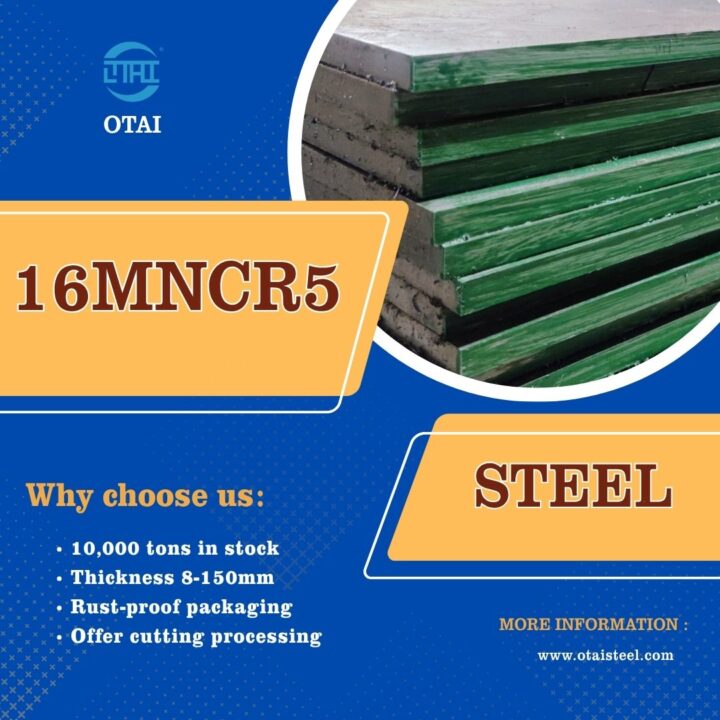
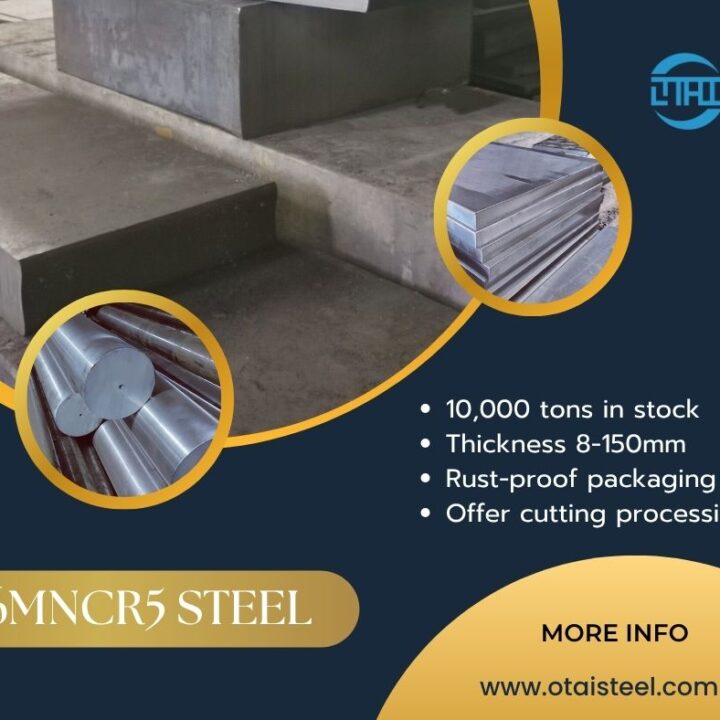
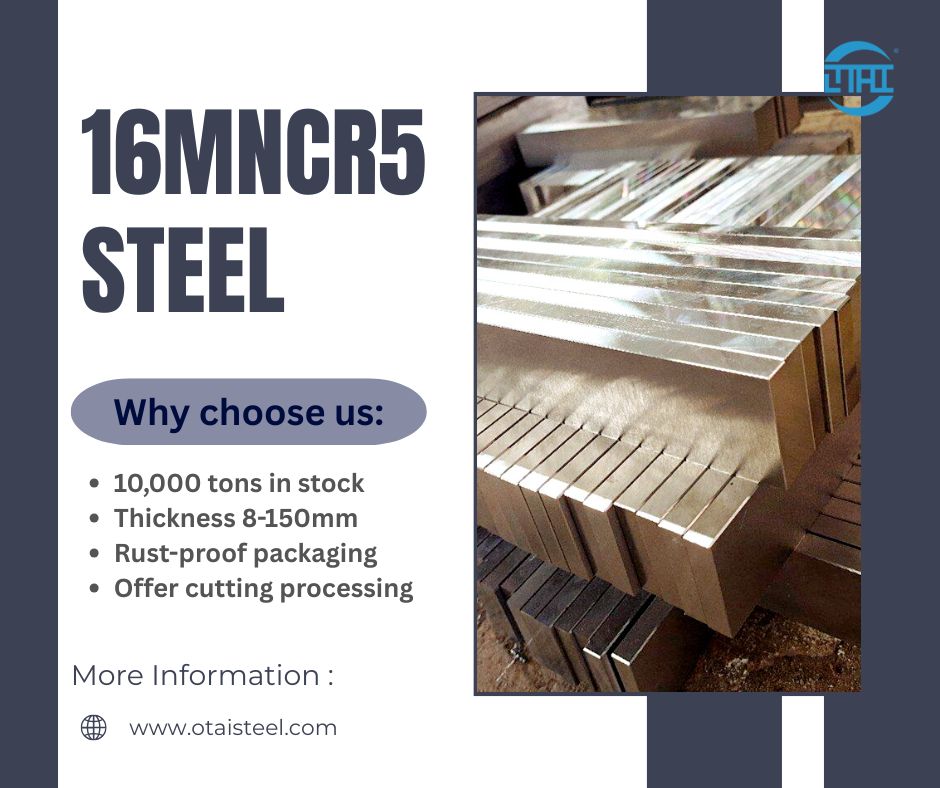
- 16MnCr5 steel plate stock: Otai Special Steel provides 16MnCr5 steel plates with thicknesses of 8–150mm available in stock to meet different manufacturing and machining requirements.
- Stable material supply: We supply 16MnCr5 steel with controlled chemical composition, reliable mechanical properties, and complete quality documents.
- Customized cutting service: Steel plates can be cut according to customer drawings, sizes, and production requirements.
- Heat treatment support: We provide technical assistance related to carburizing, quenching, tempering, and other heat treatment processes.
- Quality inspection: Ultrasonic testing and third-party inspection services are available to ensure internal quality and material reliability.
- Professional export packaging: We provide anti-rust packaging, steel strapping, and wooden box packaging solutions for international transportation.
- Technical experience: Otai Special Steel has experience supplying alloy steels for automotive components, gears, machinery parts, and industrial applications.
For customers searching for accurate 16MnCr5 thermal conductivity information, Otai Special Steel can provide technical data, material certificates, inspection reports, and professional support.
Our team helps customers select the correct 16MnCr5 steel condition according to mechanical requirements, heat treatment processes, and final applications.
❓ 10. FAQ About 16MnCr5 Thermal Conductivity
1. What is the thermal conductivity of 16MnCr5 steel?
The typical 16MnCr5 thermal conductivity value is approximately 42–46 W/m·K at room temperature. The exact value may vary depending on temperature, microstructure, and material condition.
2. Why is thermal conductivity important for 16MnCr5 gear steel?
Thermal conductivity affects heat transfer during machining, carburizing, cooling, and actual service conditions. Good thermal behavior helps improve dimensional stability and component reliability.
3. How does heat treatment affect 16MnCr5 thermal properties?
Heat treatment changes the steel microstructure, which can influence thermal expansion, heat transfer behavior, and dimensional stability. Proper carburizing and quenching processes are essential for achieving reliable gear performance.
4. What are the main applications of 16MnCr5 steel?
16MnCr5 is mainly used for carburized components such as gears, shafts, transmission parts, automotive components, and industrial machinery parts requiring high surface hardness and core toughness.
5. Does Otai Special Steel supply 16MnCr5 steel plates?
Yes. Otai Special Steel supplies 16MnCr5 steel plates with thicknesses of 8–150mm available in stock. We also provide cutting service, heat treatment support, ultrasonic testing, third-party inspection, and export packaging.