 16MnCr5 Thermal Expansion Coefficient: Data, Temperature Effects and Engineering Applications
📑 Table of Contents
🔍 1. What Is 16MnCr5 Thermal Expansion Coefficient?
📊 2. Standard Thermal Expansion Coefficient of 16MnCr5 Steel
🧪 3. Factors Affecting Thermal Expansion of 16MnCr5
🔥 4. Thermal Expansion During Heat Treatment
⚙️ 5. 16MnCr5 Thermal Expansion Data Comparison
🏭 6. Applications Where Thermal Expansion Matters
✅ 7. How Thermal Expansion Affects 16MnCr5 Design
💡 8. Buying Tips for 16MnCr5 Steel
🔍 1. What Is 16MnCr5 Thermal Expansion Coefficient?
The 16MnCr5 thermal expansion coefficient describes how much this alloy steel changes in size when its temperature increases or decreases. This property is important in mechanical engineering because temperature changes can affect dimensions, tolerances, assembly accuracy, and service performance.
16MnCr5 is a low-carbon alloy carburizing steel mainly used for gears, shafts, transmission components, and precision mechanical parts. These applications often operate under changing temperatures, making thermal expansion behavior an important design consideration.
The coefficient of thermal expansion shows the dimensional change of the steel per degree of temperature variation. Engineers use this value to calculate possible expansion or contraction during manufacturing, heat treatment, and operation.
For example, when a 16MnCr5 gear operates at elevated temperatures, the material expands slightly. If the expansion is not considered during design, it may influence gear clearance, alignment, and operating efficiency.
| Property | Description | Engineering Importance |
|---|---|---|
| Thermal expansion coefficient | Dimensional change caused by temperature variation | Helps predict size changes |
| Unit | µm/m·°C | Used for engineering calculations |
| Temperature influence | Expansion increases with temperature | Important for high-temperature applications |
| Material structure | Affected by alloy composition and heat treatment | Influences dimensional stability |
Unlike hardness or tensile strength, thermal expansion is a physical property rather than a direct mechanical strength indicator. However, it plays a major role in precision engineering.
Understanding the coefficient of thermal expansion of 16MnCr5 steel allows engineers to select proper machining allowances and maintain reliable component performance.
📊 2. Standard Thermal Expansion Coefficient of 16MnCr5 Steel
The thermal expansion coefficient of 16MnCr5 depends on temperature range, chemical composition, and material condition. In general, alloy steels expand gradually as temperature increases.
For most engineering calculations, 16MnCr5 has a linear thermal expansion coefficient close to typical chromium alloy steels.
| Temperature Range | Approximate Expansion Coefficient | Application Meaning |
|---|---|---|
| 20–100°C | Approx. 11–12 × 10⁻⁶ /°C | Normal operating temperature range |
| 100–300°C | Approx. 12–13 × 10⁻⁶ /°C | Moderate thermal expansion |
| 300–600°C | Approx. 13–14 × 10⁻⁶ /°C | Important for heat treatment processes |
| Above 600°C | Depends strongly on phase changes | Requires detailed engineering analysis |
How to Calculate Thermal Expansion
Engineers usually calculate dimensional change using the following relationship:
| Formula | Meaning |
|---|---|
| ΔL = α × L₀ × ΔT | Length change equals expansion coefficient × original length × temperature change |
Where:
- ΔL = dimensional change
- α = thermal expansion coefficient
- L₀ = original length
- ΔT = temperature difference
For example, a long 16MnCr5 shaft may experience measurable dimensional changes when heated during operation or heat treatment. Therefore, engineers must consider thermal expansion during precision machining.
The 16MnCr5 thermal expansion coefficient value is especially important for components requiring tight dimensional control.
🧪 3. Factors Affecting Thermal Expansion of 16MnCr5
Several factors influence the thermal expansion behavior of 16MnCr5 steel. Understanding these factors helps engineers improve dimensional accuracy and component reliability.
| Factor | Effect on Thermal Expansion |
|---|---|
| Chemical composition | Alloying elements influence expansion behavior |
| Temperature range | Higher temperature usually increases expansion |
| Heat treatment condition | Changes microstructure and dimensional stability |
| Residual stress | May affect dimensional changes after processing |
| Grain structure | Influences material behavior during heating |
Effect of Alloying Elements
16MnCr5 contains manganese and chromium, which improve hardenability and carburizing performance. These alloying elements also influence the steel’s physical properties, including thermal behavior.
Effect of Microstructure
The microstructure of steel changes during processes such as carburizing, quenching, and tempering. These changes can influence dimensional stability.
For precision components, engineers must consider both mechanical properties and 16MnCr5 thermal properties when designing parts.
🔥 4. Thermal Expansion During Heat Treatment
Heat treatment has a significant influence on the dimensional behavior of 16MnCr5 steel. During heating and cooling cycles, the material expands and contracts according to temperature changes.
For carburizing steels like 16MnCr5, controlling thermal expansion during heat treatment is essential because excessive dimensional changes may affect final component accuracy.
Heating Process
When 16MnCr5 is heated for carburizing or other heat treatment processes, its atoms gain energy and the steel expands. The expansion rate increases as the temperature rises.
| Heat Treatment Stage | Temperature Range | Thermal Effect |
|---|---|---|
| Preheating | Approx. 200–400°C | Gradual thermal expansion |
| Carburizing | Approx. 850–950°C | Significant expansion due to high temperature |
| Quenching | Rapid cooling | Contraction and possible dimensional changes |
| Tempering | Approx. 150–250°C | Stress relief and dimensional stabilization |
Carburizing Temperature Effects
Carburizing is normally performed at high temperatures to increase carbon content on the steel surface. During this process, 16MnCr5 experiences thermal expansion as well as microstructural changes.
After quenching, the transformation of austenite into martensite can cause additional dimensional changes. Therefore, manufacturers often consider machining allowances before heat treatment.
The relationship between temperature and expansion is one reason why engineers analyze 16MnCr5 heat treatment temperature effects before production.
Dimensional Control After Heat Treatment
For precision gears and shafts, controlling post-treatment dimensions is essential. Proper heat treatment parameters reduce distortion and improve component accuracy.
⚙️ 5. 16MnCr5 Thermal Expansion Data Comparison
Comparing 16MnCr5 with other engineering steels helps engineers understand its thermal expansion characteristics and select suitable materials for different applications.
| Steel Grade | Material Type | Approximate Thermal Expansion Coefficient | Main Application |
|---|---|---|---|
| 16MnCr5 | Carburizing alloy steel | Approx. 11–14 × 10⁻⁶ /°C | Gears and shafts |
| 20MnCr5 | Carburizing alloy steel | Approx. 11–13 × 10⁻⁶ /°C | Automotive components |
| 4140 Steel | Cr-Mo alloy steel | Approx. 12–13 × 10⁻⁶ /°C | High-strength mechanical parts |
| 1045 Steel | Medium carbon steel | Approx. 11–12 × 10⁻⁶ /°C | General engineering parts |
16MnCr5 vs 20MnCr5 Thermal Behavior
16MnCr5 and 20MnCr5 have similar applications and thermal expansion characteristics because both are carburizing steels.
The main difference is carbon content. 20MnCr5 contains slightly more carbon, which can influence hardening response and mechanical performance after heat treatment.
16MnCr5 vs 4140 Thermal Expansion
4140 steel generally has similar thermal expansion behavior because it is also an alloy steel. However, 4140 is designed for through-hardening applications, while 16MnCr5 is optimized for carburized surface hardness.
Material selection should consider not only thermal expansion but also hardness requirements, loading conditions, and manufacturing processes.
🏭 6. Applications Where Thermal Expansion Matters
Thermal expansion becomes especially important in precision mechanical components where small dimensional changes may influence performance.
| Application | Why Thermal Expansion Matters |
|---|---|
| Automotive gears | Maintains correct gear clearance during operation |
| Transmission components | Controls dimensional stability under temperature changes |
| Precision shafts | Prevents alignment problems caused by expansion |
| Industrial machinery | Improves long-term operating reliability |
| Mechanical assemblies | Ensures proper fitting between components |
Automotive Applications
Automotive gears and transmission components often experience repeated heating and cooling cycles. Engineers must consider thermal expansion to maintain accurate operation.
The combination of a tough core and carburized surface makes 16MnCr5 suitable for these demanding environments.
Gear Manufacturing
Gear manufacturers carefully control machining dimensions because heat treatment can change component size.
By understanding the 16MnCr5 expansion rate at high temperature, manufacturers can design proper machining allowances.
Precision Mechanical Components
For precision parts, even small dimensional changes can affect assembly quality. Thermal expansion data helps engineers maintain accurate tolerances.
✅ 7. How Thermal Expansion Affects 16MnCr5 Design
Engineers must consider thermal expansion during the entire manufacturing process, from material selection to final assembly.
| Design Consideration | Thermal Expansion Influence |
|---|---|
| Machining allowance | Compensates for size changes after heat treatment |
| Component clearance | Maintains proper operating gaps |
| Assembly design | Prevents fitting problems during temperature changes |
| Heat treatment planning | Reduces distortion risks |
Machining Considerations
Before carburizing, manufacturers usually machine components slightly larger because thermal treatment can change dimensions.
Correct allowance calculation improves final accuracy and reduces additional processing costs.
Service Temperature Considerations
Components operating at higher temperatures may experience continuous expansion and contraction. Engineers must ensure that these changes remain within acceptable limits.
Therefore, thermal properties should be evaluated together with strength, hardness, and wear resistance when selecting 16MnCr5 steel.
💡 8. Buying Tips for 16MnCr5 Steel
When purchasing 16MnCr5 steel, buyers should evaluate not only chemical composition and hardness but also dimensional stability and supplier quality control.
| Buying Factor | Recommendation |
|---|---|
| Material certificate | Confirm chemical composition and physical properties |
| Thermal data | Check expansion information for precision applications |
| Delivery condition | Select suitable condition for machining requirements |
| Inspection service | Use ultrasonic testing when necessary |
| Supplier capability | Choose a supplier with stable inventory and technical support |
A reliable supplier can provide accurate material information and help customers select the correct steel condition according to application requirements.
📦 9. Otai Special Steel Advantages
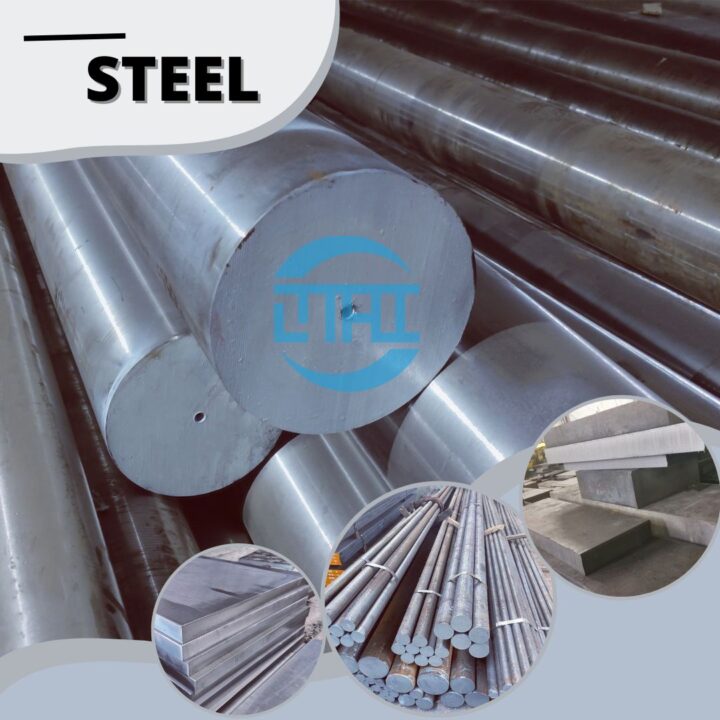
Otai Special Steel is a professional supplier specializing in 16MnCr5 steel and other alloy engineering steels. We provide reliable material supply, customized processing services, and technical support for customers worldwide.
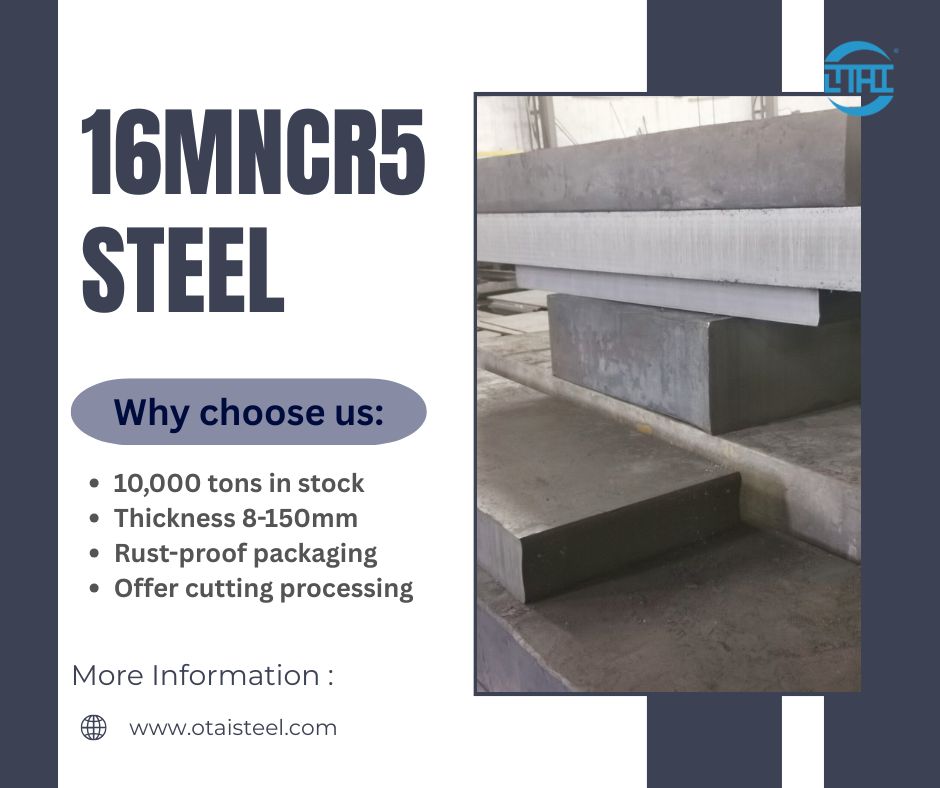
- 16MnCr5 steel plate stock: Otai Special Steel keeps 16MnCr5 steel plates with thicknesses of 8–150 mm available in stock to support different industrial manufacturing requirements.
- Stable material quality: We supply 16MnCr5 steel with controlled chemical composition, reliable physical properties, and complete material certificates.
- Professional cutting service: Customized cutting is available according to customer drawings, dimensions, and production requirements.
- Heat treatment support: We provide technical support for annealing, normalizing, carburizing processes, quenching, and tempering according to application needs.
- Quality inspection: Ultrasonic testing and third-party inspection services are available to ensure internal quality and material reliability.
- Export packaging: We provide steel strapping, wooden cases, and anti-rust packaging solutions for safe international transportation.
- Technical experience: Otai Special Steel has experience supplying alloy steels for automotive components, gears, shafts, and precision machinery applications.
For customers searching for accurate 16MnCr5 thermal expansion coefficient data, Otai Special Steel can provide material information, technical documents, and professional assistance for material selection.
Our technical team can help customers evaluate thermal properties, mechanical requirements, heat treatment conditions, and application suitability.
❓ 10. FAQ About 16MnCr5 Thermal Expansion Coefficient
1. What is the thermal expansion coefficient of 16MnCr5 steel?
The typical 16MnCr5 thermal expansion coefficient value is approximately 11–14 × 10⁻⁶ /°C depending on the temperature range and material condition.
2. Why is thermal expansion important for 16MnCr5 components?
Thermal expansion affects dimensional accuracy, assembly clearance, and operating performance. It is especially important for gears, shafts, and precision mechanical components working under changing temperatures.
3. Does heat treatment affect 16MnCr5 thermal expansion?
Yes. Carburizing, quenching, and tempering can change the microstructure and influence dimensional stability. Proper process control helps reduce distortion.
4. How do engineers calculate 16MnCr5 thermal expansion?
Engineers usually use the formula ΔL = α × L₀ × ΔT, where α represents the thermal expansion coefficient, L₀ is the original length, and ΔT is the temperature change.
5. Does Otai Special Steel supply 16MnCr5 steel plates?
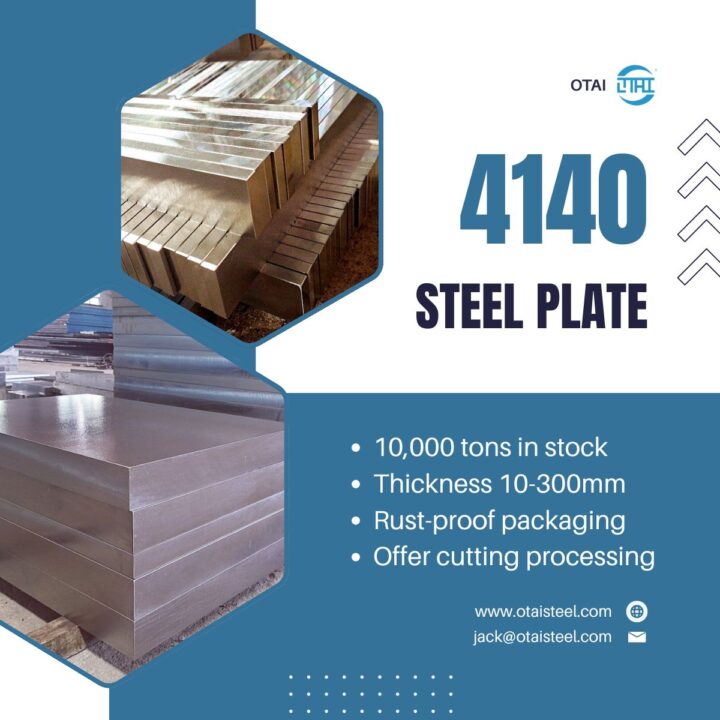
Yes. Otai Special Steel supplies 16MnCr5 steel plates with thicknesses of 8–150 mm available in stock. We also provide cutting services, heat treatment support, inspection services, and export packaging solutions.