 Chemistry of 16MnCr5: Basic Composition and Material Identification
📑 Table of Contents
🔍 1. What Is the Chemistry of 16MnCr5 Steel?
⚗️ 2. Chemical Composition of 16MnCr5
🧪 3. Role of Alloying Elements in 16MnCr5 Steel
📊 4. 16MnCr5 Chemical Composition vs Equivalent Grades
🔥 5. How Chemistry Affects 16MnCr5 Properties
⚙️ 6. Applications Based on 16MnCr5 Composition
📦 7. Otai Special Steel Advantages
❓ 8. FAQ About Chemistry of 16MnCr5
🔍 1. What Is the Chemistry of 16MnCr5 Steel?
Understanding the chemistry of 16MnCr5 is essential for engineers and buyers who need a reliable carburizing steel for gears, shafts and mechanical transmission components.
16MnCr5 is a low-alloy chromium-manganese steel defined under the EN 10084 standard. Its carefully balanced chemical composition provides excellent carburizing performance, good core toughness and sufficient surface hardness after heat treatment.
The main alloying elements in 16MnCr5 are carbon (C), manganese (Mn) and chromium (Cr). Each element contributes differently to the final performance of the steel.
The low carbon content allows the material to maintain a tough internal structure, while the chromium and manganese improve hardenability and support the formation of a hard carburized surface layer.
Basic Identification of 16MnCr5 Steel
| Item | Information |
|---|---|
| Steel Grade | 16MnCr5 |
| Standard | EN 10084 |
| Material Number | 1.7131 |
| Steel Type | Low-alloy carburizing steel |
| Main Alloy Elements | Manganese (Mn) and Chromium (Cr) |
| Main Feature | High surface hardness after carburizing with tough core |
Why Is 16MnCr5 Chemistry Important?
The chemical composition determines how the steel reacts during manufacturing and heat treatment. For carburizing steels, the balance between carbon content and alloying elements is especially important.
- Carbon content: Controls the potential surface hardness after carburizing.
- Manganese content: Improves hardenability and strength.
- Chromium content: Enhances wear resistance and improves carburizing response.
- Impurity control: Maintains toughness and fatigue resistance.
For customers selecting EN 10084 16MnCr5 steel, checking the chemical composition is one of the most important steps before purchasing.
⚗️ 2. Chemical Composition of 16MnCr5
The 16MnCr5 chemical composition is designed to provide a good combination of carburizing ability, toughness and mechanical strength.
Compared with high-carbon steels, 16MnCr5 contains relatively low carbon content. This design allows manufacturers to create a hard external layer while maintaining a strong and impact-resistant core.
Typical Chemical Composition of 16MnCr5 Steel
| Element | Content (%) | Function in Steel |
|---|---|---|
| Carbon (C) | 0.14–0.19 | Provides carburizing potential and surface hardness |
| Silicon (Si) | ≤0.40 | Improves strength and deoxidation |
| Manganese (Mn) | 1.00–1.30 | Improves hardenability and toughness |
| Chromium (Cr) | 0.80–1.10 | Improves wear resistance and hardening response |
| Phosphorus (P) | ≤0.035 | Controlled to maintain toughness |
| Sulfur (S) | ≤0.035 | Controlled for machinability |
Key Characteristics of 16MnCr5 Composition
| Characteristic | Effect |
|---|---|
| Low carbon level | Creates a tough core after carburizing |
| Manganese addition | Improves strength and hardenability |
| Chromium addition | Improves wear resistance and surface hardness |
| Balanced alloy design | Provides stable heat treatment performance |
The controlled chemistry of 16MnCr5 makes it suitable for components requiring both high surface hardness and excellent internal toughness.
🧪 3. Role of Alloying Elements in 16MnCr5 Steel
The performance of 16MnCr5 depends not only on the total alloy content but also on the interaction between different elements.
Each alloying element has a specific function during steel production, heat treatment and final application.
Functions of Main Alloy Elements
| Element | Role in 16MnCr5 |
|---|---|
| Carbon (C) | Controls hardness potential and supports carburized surface formation. |
| Manganese (Mn) | Improves hardenability and increases core strength. |
| Chromium (Cr) | Improves wear resistance and helps achieve deeper hardening. |
| Silicon (Si) | Acts as a deoxidizer and contributes to strength. |
Carbon Content and Carburizing Performance
The 16MnCr5 carbon content is intentionally kept at a low level. This allows the steel surface to absorb additional carbon during carburizing while keeping the core relatively soft and tough.
This structure is especially useful for gears and shafts because the surface resists wear while the core absorbs mechanical shock.
Chromium Content and Wear Resistance
The 16MnCr5 chromium content improves hardenability and contributes to better surface performance after carburizing and quenching.
As a result, components manufactured from 16MnCr5 can achieve longer service life under repeated contact and friction conditions.
📊 4. 16MnCr5 Chemical Composition vs Equivalent Grades
When purchasing carburizing steel internationally, buyers often compare different standards to find suitable alternatives. Understanding the chemistry of 16MnCr5 helps engineers evaluate whether another grade can provide similar performance.
The chemical design of 16MnCr5 focuses on low carbon content combined with manganese and chromium additions. This makes it different from medium-carbon alloy steels that focus mainly on high overall strength.
Common equivalent grades include 5115 steel in the United States, 16CrMn5 in Europe and SCM415 in Japan. However, equivalent does not always mean identical, so chemical composition and technical requirements should always be checked.
16MnCr5 Equivalent Grades Comparison
| Standard | Grade | Region | Main Characteristics |
|---|---|---|---|
| EN | 16MnCr5 | Europe | Low-alloy carburizing steel with Mn and Cr |
| DIN | 16MnCr5 / 1.7131 | Germany | Gear steel for carburizing applications |
| ASTM / SAE | 5115 | USA | Low-carbon alloy carburizing steel |
| JIS | SCM415 | Japan | Chromium-molybdenum carburizing steel |
| EN Alternative | 16CrMn5 | Europe | Similar Mn-Cr carburizing steel |
Chemical Comparison Between 16MnCr5 and Similar Grades
| Grade | Carbon Content | Main Alloy Elements | Main Application |
|---|---|---|---|
| 16MnCr5 | 0.14–0.19% | Mn + Cr | Gears, shafts, transmission parts |
| 16CrMn5 | Approx. 0.14–0.19% | Cr + Mn | Carburized mechanical components |
| 5115 | Approx. 0.13–0.18% | Cr + Mn | Automotive gears and shafts |
| SCM415 | Approx. 0.13–0.18% | Cr + Mo | High-performance carburized parts |
Why Chemical Verification Is Important
- Different alloy elements create different performance: chromium, manganese and molybdenum affect hardenability differently.
- Heat treatment results depend on chemistry: even small composition differences can change hardness and toughness.
- Customer standards may vary: automotive and machinery industries often require specific grades.
- Material certificates provide confidence: chemical analysis confirms the actual steel grade.
For customers looking for DIN 16MnCr5 steel composition, reviewing the mill certificate and chemical analysis is the best way to confirm material quality.
🔥 5. How Chemistry Affects 16MnCr5 Properties
The chemical composition directly determines the final properties of 16MnCr5 steel. Unlike general structural steel, 16MnCr5 is designed specifically for carburizing treatment.
The combination of low carbon content and alloying elements allows manufacturers to create a component with a hard outer layer and a tough internal structure.
Relationship Between Chemistry and Properties
| Chemical Factor | Influence on Properties |
|---|---|
| Low carbon content | Provides excellent core toughness and allows carburizing treatment. |
| Manganese addition | Improves hardenability and increases core strength. |
| Chromium addition | Improves wear resistance and surface hardness. |
| Controlled impurities | Maintains fatigue resistance and toughness. |
Why 16MnCr5 Is Suitable for Carburizing
Carburizing is a heat treatment process that increases the carbon concentration on the steel surface. After quenching, the surface becomes extremely hard while the core remains tough.
The 16MnCr5 alloy elements are carefully balanced to support this process.
| Feature | Benefit |
|---|---|
| Hard carburized surface | Excellent wear resistance for gears and moving parts |
| Tough core structure | Better resistance against impact loads |
| Good fatigue performance | Long service life under repeated stress |
| Stable heat treatment response | Reliable production quality |
Typical Mechanical Properties After Heat Treatment
| Property | Typical Value |
|---|---|
| Tensile Strength | Approx. 800–1200 MPa after carburizing and hardening |
| Surface Hardness | Approx. 58–62 HRC after carburizing |
| Core Hardness | Approx. 30–45 HRC depending on treatment |
| Fatigue Resistance | Excellent for cyclic loading applications |
The balanced 16MnCr5 chemical composition explains why this material is widely selected for precision gears, automotive transmission systems and industrial machinery.
⚙️ 6. Applications Based on 16MnCr5 Composition
The unique chemistry of 16MnCr5 makes it especially suitable for components that require a combination of surface hardness, wear resistance and internal toughness.
Because of its carburizing characteristics, manufacturers often choose this steel for parts exposed to friction, contact pressure and repeated mechanical loads.
Main Applications of 16MnCr5 Steel
| Industry | Components | Why Use 16MnCr5 |
|---|---|---|
| Automotive | Transmission gears, shafts, pinions | High surface hardness and fatigue resistance |
| Mechanical Engineering | Gear wheels, machine parts | Good wear resistance and toughness |
| Agricultural Equipment | Drive components and gears | Reliable performance under repeated loads |
| Industrial Machinery | Precision components | Stable heat treatment performance |
| Power Transmission | Rotating components | Excellent contact fatigue resistance |
Common Reasons Engineers Select 16MnCr5
- Excellent carburizing response.
- High surface hardness after treatment.
- Strong and tough core structure.
- Good dimensional stability.
- Suitable for mass production components.
For manufacturers producing gears and transmission components, understanding the chemistry of 16MnCr5 helps ensure the correct material selection and processing method.
📦 7. Otai Special Steel Advantages
Otai Special Steel supplies 16MnCr5 steel and other alloy steel materials for international customers who require stable quality, reliable delivery and professional processing support.
With experience in special steel supply, Otai provides complete solutions from material selection to cutting, inspection and export packaging.
Why Choose Otai Special Steel?
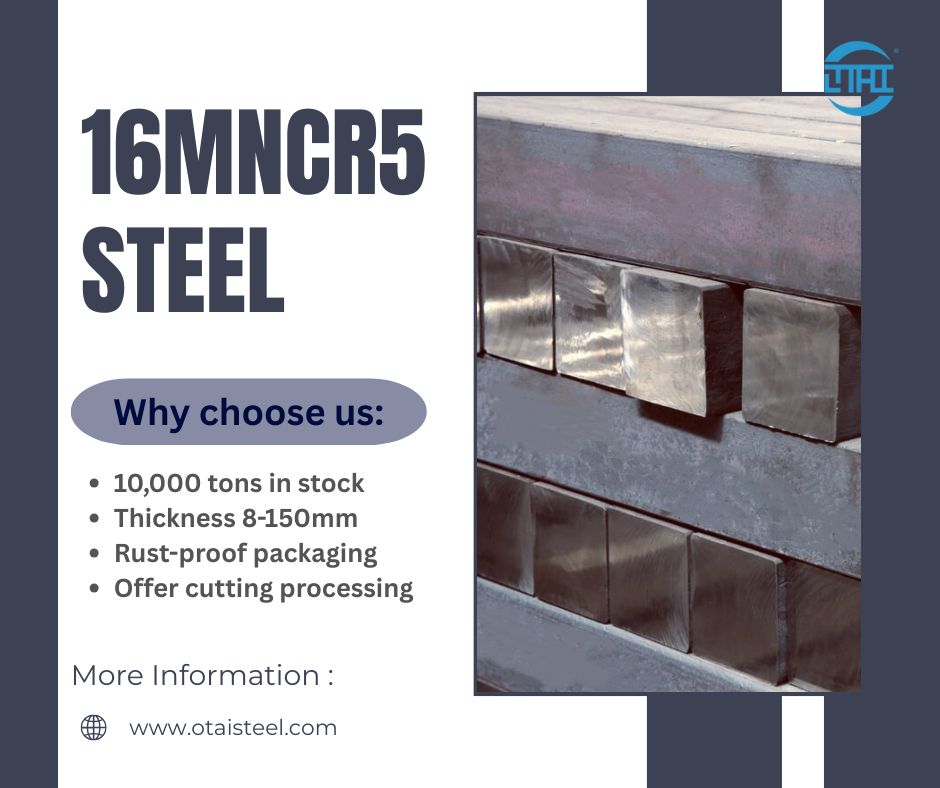
- Stable stock supply: Otai provides 8–150mm thickness plates available in stock to support customers with urgent requirements and continuous production schedules.
- Professional 16MnCr5 supply: Supply EN 10084 16MnCr5 steel according to customer specifications and technical requirements.
- Customized cutting service: Provide cutting and size processing according to drawings, dimensions and project requirements.
- Heat treatment support: Support carburizing, quenching, tempering and other heat treatment solutions.
- Quality inspection: Provide ultrasonic testing and third-party inspection services to ensure material reliability.
- Export experience: Provide professional international shipment solutions with suitable packaging methods.
- Protective packaging: Provide anti-rust packaging, steel strapping and wooden box packaging for overseas transportation.
When customers search for a reliable 16MnCr5 steel supplier, selecting a supplier with inventory, processing capability and quality control experience can reduce purchasing risks.
❓ 8. FAQ About Chemistry of 16MnCr5
1. What is the chemistry of 16MnCr5 steel?
The chemistry of 16MnCr5 mainly includes carbon, manganese and chromium. The typical composition contains approximately 0.14–0.19% carbon, 1.00–1.30% manganese and 0.80–1.10% chromium.
2. What are the main alloy elements in 16MnCr5?
The main alloy elements in 16MnCr5 are manganese (Mn) and chromium (Cr). These elements improve hardenability, wear resistance and carburizing performance.
3. Why does 16MnCr5 have low carbon content?
The low carbon content allows the steel to develop a hard carburized surface while maintaining a tough internal core. This makes it suitable for gears and transmission components.
4. Is 16MnCr5 the same as 1.7131?
Yes. 16MnCr5 is commonly identified as Werkstoff 1.7131. Both designations refer to the same EN carburizing steel grade.
5. How does chemical composition affect 16MnCr5 performance?
The chemical composition controls hardenability, surface hardness, toughness and heat treatment response. A balanced composition allows 16MnCr5 to achieve excellent performance in carburized applications.