 AISI 4140 Alloy Steel Data Sheet: Chemical Composition, Mechanical Properties and Applications
📑 Table of Contents
🔍 1. What Is AISI 4140 Alloy Steel?
📊 2. AISI 4140 Chemical Composition Data Sheet
⚙️ 3. AISI 4140 Mechanical Properties Data Sheet
🔥 4. AISI 4140 Heat Treatment and Hardness
📋 5. AISI 4140 Physical Properties and Technical Data
🏭 6. AISI 4140 Applications in Different Industries
🔄 7. AISI 4140 Equivalent Grades Comparison
💡 8. How to Select AISI 4140 Alloy Steel
🔍 1. What Is AISI 4140 Alloy Steel?
AISI 4140 alloy steel is a chromium-molybdenum alloy steel widely used in engineering, automotive, oil and gas, and heavy machinery industries. It is known for its excellent balance between strength, toughness, wear resistance, and heat treatment response.
When engineers search for an AISI 4140 alloy steel data sheet, they usually need detailed technical information including chemical composition, mechanical properties, hardness values, heat treatment conditions, and physical characteristics.
4140 steel belongs to the medium-carbon alloy steel family. The addition of chromium improves hardenability and wear resistance, while molybdenum increases strength, toughness, and resistance to softening at elevated temperatures.
Because of its reliable performance, AISI 4140 is widely selected for components that require high mechanical strength and long service life.
| Property | Description | Industrial Importance |
|---|---|---|
| Steel Type | Chromium-molybdenum alloy steel | High-strength engineering material |
| Standard | SAE / AISI 4140 | Internationally recognized grade |
| Carbon Level | Medium carbon alloy steel | Provides strength and hardness capability |
| Main Alloy Elements | Chromium and molybdenum | Improve hardenability and toughness |
| Typical Supply Forms | Plate, round bar, forged components | Suitable for different manufacturing processes |
One of the biggest advantages of 4140 steel is its versatility. It can be supplied in annealed condition for machining or heat treated to achieve higher strength and hardness.
For applications requiring reliable mechanical performance, accurate technical data is essential before selecting the material.
This is why a complete AISI 4140 alloy steel specifications sheet is commonly requested by engineers and purchasing departments.
📊 2. AISI 4140 Chemical Composition Data Sheet
The chemical composition of AISI 4140 determines its strength, hardenability, and heat treatment performance. The combination of chromium and molybdenum gives this steel better performance compared with standard carbon steels.
The following table shows the typical composition range used for AISI 4140 alloy steel.
| Element | Typical Content (%) | Function |
|---|---|---|
| Carbon (C) | 0.38–0.43 | Provides strength and hardness |
| Silicon (Si) | 0.15–0.35 | Improves strength and deoxidation |
| Manganese (Mn) | 0.75–1.00 | Improves hardenability |
| Chromium (Cr) | 0.80–1.10 | Enhances wear resistance and hardening response |
| Molybdenum (Mo) | 0.15–0.25 | Improves toughness and high-temperature strength |
| Phosphorus (P) | ≤0.035 | Controlled to maintain toughness |
| Sulfur (S) | ≤0.040 | Controlled for machinability |
Why Chemical Composition Matters
The alloying elements in 4140 steel work together to provide a balanced combination of mechanical properties.
Chromium increases the depth of hardening during heat treatment, allowing larger components to achieve consistent strength throughout the section.
Molybdenum helps prevent brittleness and improves resistance to high-temperature softening.
Because of this composition, 4140 steel performs well in demanding applications where ordinary carbon steel cannot provide enough strength.
A detailed AISI 4140 chemical composition data sheet helps customers confirm whether the material meets project requirements before production.
⚙️ 3. AISI 4140 Mechanical Properties Data Sheet
The mechanical properties of AISI 4140 depend strongly on the delivery condition and heat treatment process. The same steel grade can show different strength levels in annealed, normalized, or quenched and tempered conditions.
The following values represent common engineering ranges for 4140 steel.
| Mechanical Property | Typical Value | Condition |
|---|---|---|
| Tensile Strength | 655–1080 MPa | Depends on heat treatment |
| Yield Strength | 415–950 MPa | Depends on heat treatment |
| Elongation | 10–25% | Typical engineering range |
| Hardness | 197–600 HB | Depends on condition |
| Impact Toughness | Good | Excellent resistance to shock loading |
The combination of high tensile strength and good toughness makes 4140 steel suitable for components exposed to heavy loads, vibration, and impact.
Compared with ordinary carbon steels, AISI 4140 provides better fatigue resistance and higher strength after proper heat treatment.
For engineers evaluating AISI 4140 mechanical properties, it is important to check the exact supply condition because hardness and strength can vary significantly.
🔥 4. AISI 4140 Heat Treatment and Hardness
Heat treatment is one of the most important processes affecting the final performance of AISI 4140 alloy steel. By controlling heating temperature, cooling rate, and tempering conditions, manufacturers can achieve different combinations of hardness, strength, and toughness.
AISI 4140 can be supplied in annealed condition for machining or heat treated condition for high-strength applications. Therefore, hardness values in an AISI 4140 alloy steel data sheet should always be considered together with the delivery condition.
| Heat Treatment | Typical Temperature | Purpose |
|---|---|---|
| Annealing | Approx. 800–850°C | Reduce hardness and improve machinability |
| Normalizing | Approx. 870–900°C | Refine grain structure and improve uniformity |
| Hardening (Quenching) | Approx. 830–870°C | Increase hardness and strength |
| Tempering | Approx. 400–650°C | Adjust toughness and hardness balance |
AISI 4140 Hardness Range
The hardness of 4140 steel varies depending on the treatment condition. In general, annealed material has lower hardness for machining, while quenched and tempered material provides much higher strength.
| Condition | Typical Hardness | Main Application |
|---|---|---|
| Annealed 4140 | Approx. 197 HB | Machining and fabrication |
| Normalized 4140 | Approx. 200–250 HB | General engineering components |
| Quenched and Tempered | Approx. 28–50 HRC | High-strength mechanical parts |
| Surface Hardened | Higher surface hardness possible | Wear-resistant applications |
Proper heat treatment allows AISI 4140 to achieve an excellent balance between hardness and toughness. This is one of the main reasons why it is widely used in demanding industries.
📋 5. AISI 4140 Physical Properties and Technical Data
Besides mechanical properties, physical properties are also important when designing components made from AISI 4140 alloy steel. These values help engineers evaluate thermal behavior, machining conditions, and structural performance.
| Physical Property | Typical Value |
|---|---|
| Density | Approx. 7.85 g/cm³ |
| Modulus of Elasticity | Approx. 205 GPa |
| Thermal Conductivity | Approx. 42–44 W/m·K |
| Specific Heat Capacity | Approx. 460 J/kg·K |
| Coefficient of Thermal Expansion | Approx. 12.3 × 10⁻⁶ /°C |
| Melting Point | Approx. 1416°C |
Thermal Properties of 4140 Steel
The thermal expansion behavior of 4140 steel should be considered when components operate under changing temperatures.
For precision mechanical parts, engineers calculate dimensional changes caused by temperature variation to maintain proper clearance and assembly accuracy.
Machining Characteristics
AISI 4140 provides good machinability in annealed condition. After hardening, machining becomes more difficult and may require suitable cutting tools and processing methods.
Therefore, selecting the correct delivery condition is important for manufacturing efficiency.
🏭 6. AISI 4140 Applications in Different Industries
AISI 4140 alloy steel is widely used because it provides an excellent combination of strength, toughness, wear resistance, and fatigue performance.
Its applications cover automotive components, industrial machinery, energy equipment, and heavy-duty mechanical systems.
| Industry | Typical Components | Reason for Selection |
|---|---|---|
| Automotive | Axles, shafts, gears, connecting components | High strength and fatigue resistance |
| Oil and Gas | Drill tools, pressure components | Excellent toughness and durability |
| Heavy Machinery | Bolts, pins, hydraulic parts | Good load-bearing capability |
| Manufacturing Equipment | Molds, fixtures, machine parts | Good machinability and strength |
Automotive Applications
Automotive manufacturers use 4140 steel for components that require continuous loading and resistance to fatigue failure.
The material performs especially well in shafts, gears, and structural parts after appropriate heat treatment.
Industrial Machinery Applications
Industrial equipment often operates under high stress conditions. AISI 4140 provides the strength required for long-term operation.
Its ability to be heat treated makes it suitable for customized mechanical designs.
🔄 7. AISI 4140 Equivalent Grades Comparison
AISI 4140 has several international equivalents. However, equivalent grades should always be verified based on chemical composition, mechanical properties, and application requirements.
| Grade | Standard | Characteristics |
|---|---|---|
| AISI 4140 | USA SAE/AISI | Chromium-molybdenum alloy steel |
| 42CrMo4 | EN/DIN | Very close European equivalent |
| SCM440 | JIS | Japanese Cr-Mo alloy steel |
| 4140 | ASTM | Widely used engineering steel grade |
| EN19 | British Standard | Similar medium-carbon alloy steel |
4140 vs 42CrMo4
42CrMo4 is one of the closest equivalents to AISI 4140. Both grades contain chromium and molybdenum and provide similar mechanical performance after heat treatment.
4140 vs SCM440
SCM440 has comparable alloy content and is commonly used as an alternative in Asian markets.
When selecting equivalent grades, customers should compare actual technical data rather than relying only on material names.
💡 8. How to Select AISI 4140 Alloy Steel
Choosing the correct AISI 4140 material requires consideration of application requirements, manufacturing processes, and final performance expectations.
| Selection Factor | Important Consideration |
|---|---|
| Material condition | Select annealed or heat treated condition according to machining needs |
| Dimensions | Confirm required plate thickness or bar diameter |
| Mechanical requirements | Check strength, hardness, and toughness requirements |
| Inspection requirements | Consider ultrasonic testing and certification |
| Supplier capability | Choose a supplier with stable stock and processing support |
A reliable 4140 steel plate technical data source helps engineers make better material decisions and avoid production problems.
📦 9. Otai Special Steel Advantages
Otai Special Steel is a professional supplier specializing in AISI 4140 alloy steel, alloy steel plates, and engineering steel materials. We provide stable inventory, customized processing, and technical support for customers from different industries.
- 4140 steel round bar stock: Otai Special Steel keeps 4140 steel round bars with diameters of 14–500 mm available in stock to support various machining and manufacturing requirements.
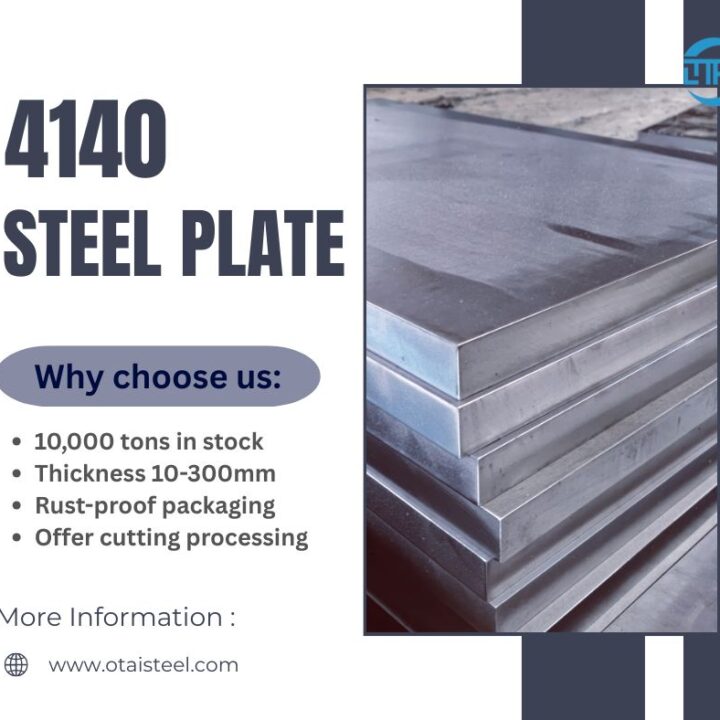
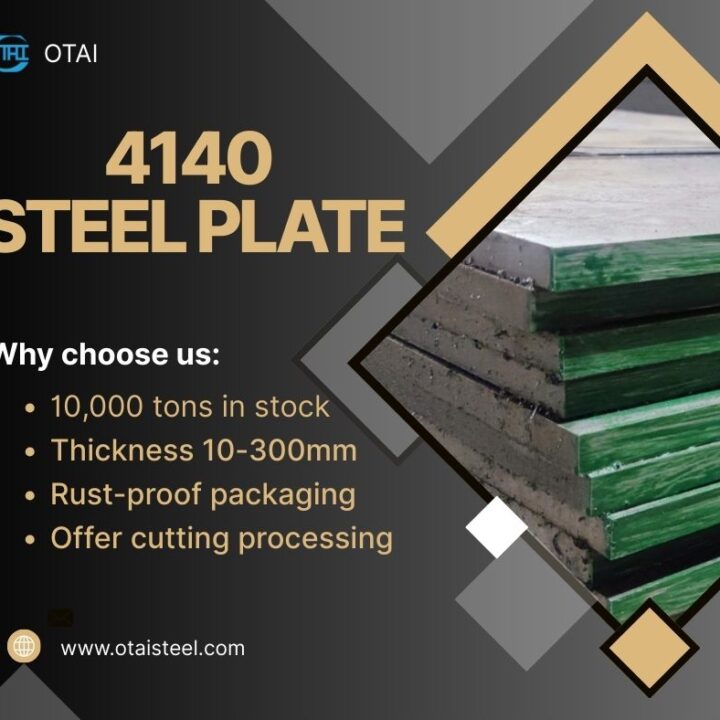
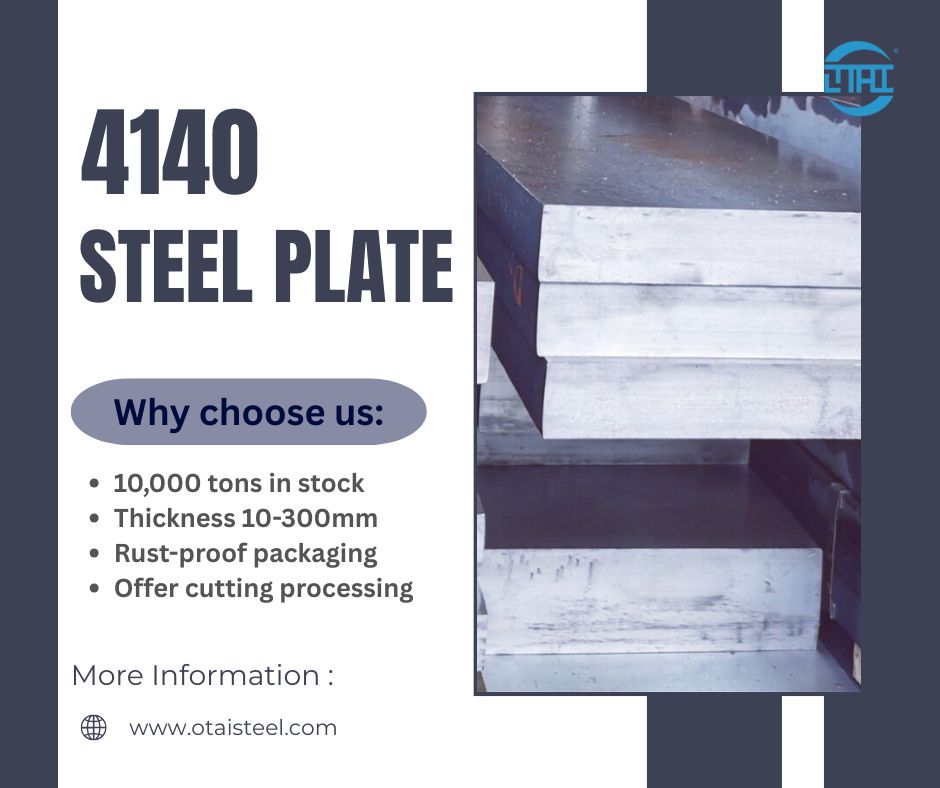
- 4140 steel plate stock: We supply 4140 steel plates with thicknesses of 13–200 mm available in stock for automotive parts, machinery components, and heavy-duty applications.
- Stable material supply: We provide AISI 4140 steel with reliable chemical composition, consistent mechanical properties, and complete material certificates.
- Cutting service: Customized cutting is available according to customer drawings, dimensions, and production requirements.
- Heat treatment support: We provide technical support for annealing, normalizing, quenching, and tempering processes to meet different performance requirements.
- Quality inspection: Ultrasonic testing and third-party inspection services are available to ensure internal quality and material reliability.
- Professional export packaging: We provide steel strapping, wooden cases, and anti-rust packaging solutions for international shipment.
- Technical experience: Otai Special Steel has extensive experience supplying alloy steels for automotive, machinery, energy, and industrial applications.
For customers searching for an accurate AISI 4140 alloy steel data sheet, Otai Special Steel can provide chemical composition information, mechanical property data, inspection documents, and technical assistance.
Our professional team can help customers select the correct 4140 steel condition according to strength requirements, machining processes, and final applications.
❓ 10. FAQ About AISI 4140 Alloy Steel Data Sheet
1. What is AISI 4140 alloy steel?
AISI 4140 is a chromium-molybdenum alloy steel known for its excellent combination of strength, toughness, wear resistance, and heat treatment performance. It is widely used for shafts, gears, bolts, machinery parts, and heavy-duty components.
2. What information is included in an AISI 4140 alloy steel data sheet?
A complete data sheet usually includes chemical composition, mechanical properties, hardness range, heat treatment conditions, physical properties, equivalent grades, and application information.
3. What is the hardness of AISI 4140 steel?
The hardness of AISI 4140 depends on the delivery condition. Annealed 4140 is typically around 197 HB, while quenched and tempered 4140 can achieve much higher hardness depending on the treatment process.
4. Is AISI 4140 the same as 42CrMo4?
AISI 4140 and 42CrMo4 are not exactly identical but are considered very close equivalent grades. Both are chromium-molybdenum alloy steels with similar chemical composition and mechanical performance.
5. Does Otai Special Steel supply AISI 4140 plates and bars?
Yes. Otai Special Steel supplies 4140 steel round bars with diameters of 14–500 mm and 4140 steel plates with thicknesses of 13–200 mm available in stock. We also provide cutting service, heat treatment support, ultrasonic testing, third-party inspection, and export packaging.