 16MnCr5 Raw Material Hardness: Hardness Values, Heat Treatment Effects and Industrial Applications
📑 Table of Contents
🔍 1. What Is 16MnCr5 Raw Material Hardness?
📊 2. Standard Hardness of 16MnCr5 in Supply Condition
🧪 3. Chemical Composition Influence on Hardness
🔥 4. Hardness Changes After Heat Treatment
⚙️ 5. 16MnCr5 Hardness Comparison Table
🏭 6. Applications Based on Hardness Requirements
✅ 7. How to Control 16MnCr5 Raw Material Quality
💡 8. Buying Tips for 16MnCr5 Steel
🔍 1. What Is 16MnCr5 Raw Material Hardness?
When engineers discuss 16MnCr5 raw material hardness, they usually refer to the hardness value of the steel in its original delivery condition before final heat treatment. This value is important because it affects machining performance, processing stability, and the preparation quality before carburizing.
16MnCr5 is a low-carbon alloy carburizing steel widely used for gears, shafts, transmission components, and wear-resistant mechanical parts. Its low carbon content provides a tough core, while carburizing creates a hard surface layer after heat treatment.
The hardness of raw 16MnCr5 material is usually not extremely high because the steel is designed for further processing. Instead, manufacturers supply it with a balanced hardness level that allows good machinability and stable production.
Understanding 16MnCr5 steel hardness before heat treatment helps manufacturers choose suitable machining parameters and predict the performance after carburizing and quenching.
| Material Condition | Typical Hardness | Main Purpose |
|---|---|---|
| As rolled | Approx. 160–220 HB | General machining and processing |
| Annealed | Approx. 140–200 HB | Improved machinability |
| Normalized | Approx. 170–230 HB | Refined structure and stability |
| Carburized and quenched | Surface hardness approx. 58–62 HRC | Wear-resistant surface performance |
The raw material hardness does not represent the final working hardness of 16MnCr5 components. Instead, it provides the foundation for later heat treatment processes.
For example, a gear manufacturer may machine a softer 16MnCr5 blank first, then apply carburizing and quenching to obtain a hard surface and a tough internal structure.
📊 2. Standard Hardness of 16MnCr5 in Supply Condition
The supplied hardness of 16MnCr5 depends on the manufacturing process, including hot rolling, annealing, normalizing, and cooling conditions.
In most industrial applications, customers receive 16MnCr5 in a condition suitable for machining and further heat treatment. The hardness range must provide a good balance between strength and machinability.
| Delivery Condition | Hardness Range | Characteristics |
|---|---|---|
| Hot Rolled | Approx. 160–220 HB | Good strength and economical processing |
| Annealed | Approx. 140–200 HB | Softer structure for machining |
| Normalized | Approx. 170–230 HB | Better grain structure and consistency |
| Cold Finished | May be higher depending on processing | Improved dimensional accuracy |
Why Raw Material Hardness Matters
The hardness of the incoming material directly affects machining efficiency. If the steel is too hard, cutting tools may wear faster and production costs may increase.
If the material is too soft, it may not provide sufficient stability during machining. Therefore, controlling the hardness range is essential for consistent production.
Relationship Between Hardness and Machinability
For carburizing steels like 16MnCr5, the ideal raw hardness allows manufacturers to perform drilling, turning, milling, and shaping operations efficiently before final heat treatment.
This is why suppliers carefully control 16MnCr5 raw material hardness in HB to meet industrial requirements.
🧪 3. Chemical Composition Influence on Hardness
The chemical composition of 16MnCr5 plays an important role in determining its hardness response. Although the steel has relatively low carbon content, alloying elements improve hardenability and surface treatment performance.
| Element | Typical Content (%) | Effect on Hardness |
|---|---|---|
| Carbon (C) | 0.14–0.19 | Controls basic strength and carburizing potential |
| Manganese (Mn) | 1.00–1.30 | Improves hardenability |
| Chromium (Cr) | 0.80–1.10 | Improves wear resistance and hardening response |
| Silicon (Si) | ≤0.40 | Supports steel strength |
| Phosphorus (P) | ≤0.025 | Controlled to maintain toughness |
Unlike medium-carbon alloy steels such as 4140, 16MnCr5 is not designed to achieve high hardness throughout the entire section. Its main advantage is achieving a hard surface while maintaining a tough core.
This characteristic makes 16MnCr5 suitable for gears and mechanical components that require both wear resistance and impact resistance.
🔥 4. Hardness Changes After Heat Treatment
The hardness of 16MnCr5 changes significantly after different heat treatment processes. The raw material hardness provides good machinability, while carburizing and quenching improve the surface hardness for demanding applications.
Because 16MnCr5 is a carburizing steel, manufacturers usually do not aim for extremely high hardness in the original material condition. Instead, the steel is designed to develop a hard wear-resistant surface while maintaining a strong and tough core.
16MnCr5 Hardness After Annealing
Annealing reduces internal stress and softens the steel structure. This process improves machinability and makes the material easier to cut, drill, and form.
| Condition | Typical Hardness | Purpose |
|---|---|---|
| Annealed 16MnCr5 | Approx. 140–200 HB | Improved machining performance |
| Normalized 16MnCr5 | Approx. 170–230 HB | Improved grain structure |
| Carburized 16MnCr5 | Surface hardness approx. 58–62 HRC | High wear resistance |
16MnCr5 Hardness After Carburizing
Carburizing is the most important heat treatment for 16MnCr5. During this process, carbon enters the surface layer of the steel, increasing surface hardness after quenching.
The final hardness can reach approximately 58–62 HRC on the surface, while the internal core remains tougher and more resistant to impact.
This combination of a hard surface and tough core makes 16MnCr5 suitable for gears, shafts, and transmission components.
Influence of Cooling Rate
Cooling conditions after heat treatment also affect hardness. Faster cooling generally increases hardness, while slower cooling produces a softer structure.
Therefore, controlling temperature, holding time, and cooling speed is essential to achieve stable mechanical properties.
⚙️ 5. 16MnCr5 Hardness Comparison Table
Understanding hardness differences between delivery conditions helps engineers select the correct material condition for machining and production.
| Material Condition | Hardness Value | Application Characteristics |
|---|---|---|
| 16MnCr5 Raw Material | Approx. 160–220 HB | Suitable for machining before heat treatment |
| 16MnCr5 Annealed | Approx. 140–200 HB | Better machinability and lower cutting resistance |
| 16MnCr5 Normalized | Approx. 170–230 HB | More uniform structure and stability |
| 16MnCr5 Carburized | Approx. 58–62 HRC surface | Excellent wear resistance |
| 16MnCr5 Quenched Core | Higher strength depending on process | Improved load-bearing capability |
Comparison with Other Carburizing Steels
16MnCr5 is often compared with other low-carbon carburizing steels because they share similar applications.
| Steel Grade | Carbon Content | Main Feature |
|---|---|---|
| 16MnCr5 | 0.14–0.19% | Excellent carburizing performance |
| 20MnCr5 | 0.17–0.22% | Slightly higher carbon content |
| 8620 Steel | Approx. 0.18–0.23% | Nickel-chromium-molybdenum carburizing steel |
| 18CrNiMo7-6 | Approx. 0.15–0.21% | High-performance carburizing steel |
Compared with many carburizing steels, 16MnCr5 provides a good balance between cost efficiency, machinability, surface hardness, and core toughness.
🏭 6. Applications Based on Hardness Requirements
The hardness requirements of 16MnCr5 depend strongly on the final application. Different components require different combinations of surface hardness, core strength, and toughness.
| Application | Hardness Requirement | Reason |
|---|---|---|
| Automotive gears | High surface hardness after carburizing | Need wear resistance and long service life |
| Transmission shafts | Hard surface with tough core | Handles repeated mechanical loads |
| Gear components | Approx. 58–62 HRC surface hardness | Reduces surface damage and wear |
| Mechanical parts | Controlled raw hardness | Allows efficient machining |
Automotive Industry
The automotive industry is one of the largest users of 16MnCr5. Gears and transmission components require a hard surface to resist wear while maintaining a strong internal structure.
Industrial Machinery
Industrial equipment requires materials that can maintain dimensional stability under continuous operation. Proper hardness control helps improve component reliability.
Gear Manufacturing
Gear manufacturers prefer 16MnCr5 because carburizing can create a wear-resistant surface without making the entire component brittle.
Therefore, controlling 16MnCr5 mechanical properties and hardness before heat treatment is essential for successful production.
✅ 7. How to Control 16MnCr5 Raw Material Quality
Consistent raw material quality is essential for achieving stable hardness and reliable final performance. Steel suppliers must control chemical composition, production processes, and inspection procedures.
| Quality Control Item | Importance |
|---|---|
| Chemical analysis | Ensures correct alloy composition |
| Hardness testing | Confirms delivery condition hardness |
| Ultrasonic testing | Detects internal defects |
| Dimensional inspection | Ensures accurate size requirements |
| Heat treatment verification | Confirms final performance |
Reliable suppliers provide hardness inspection reports and material certificates to help customers confirm that the steel meets technical requirements.
Why Hardness Testing Matters
Hardness testing is a simple but effective method to evaluate material consistency. It helps manufacturers avoid problems during machining and heat treatment.
For carburizing steels like 16MnCr5, stable raw hardness provides a better foundation for achieving consistent final hardness after carburizing.
💡 8. Buying Tips for 16MnCr5 Steel
When purchasing 16MnCr5 steel, buyers should consider hardness requirements, delivery condition, dimensional accuracy, and supplier capability.
| Buying Factor | Recommendation |
|---|---|
| Hardness condition | Confirm raw material hardness before purchase |
| Material certificate | Check chemical composition and mechanical data |
| Inspection service | Select suppliers offering ultrasonic testing |
| Processing support | Choose suppliers providing cutting and heat treatment services |
| Stock availability | Reduce waiting time with stable inventory |
Selecting the correct supplier helps ensure that the 16MnCr5 raw material hardness matches the machining and heat treatment requirements of the final component.
📦 9. Otai Special Steel Advantages
Otai Special Steel is a professional supplier specializing in 16MnCr5 steel and other high-quality alloy steels. We provide reliable material supply, customized processing services, and technical support for customers worldwide.
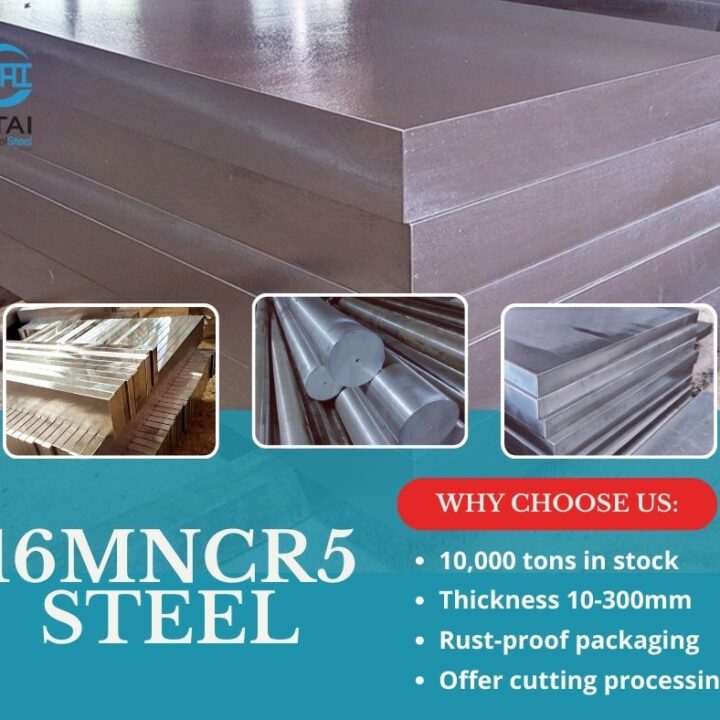
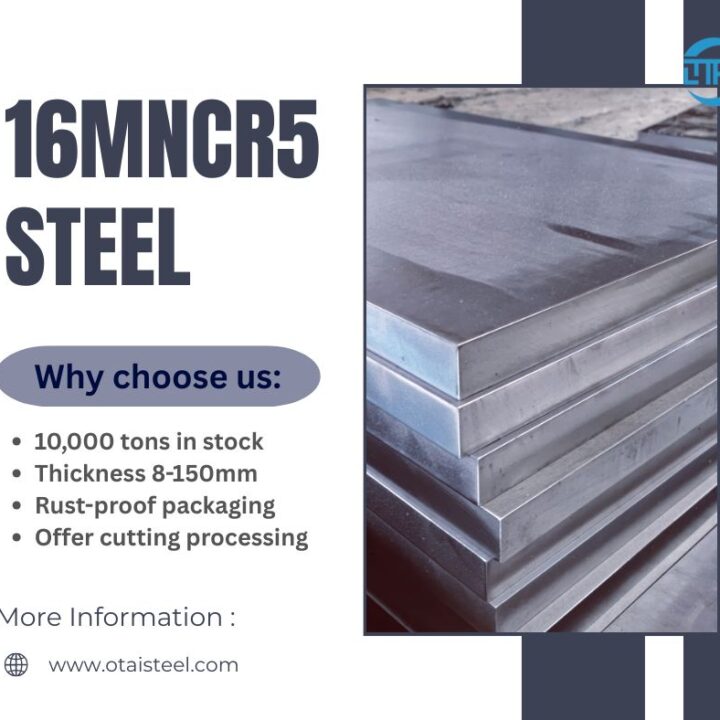
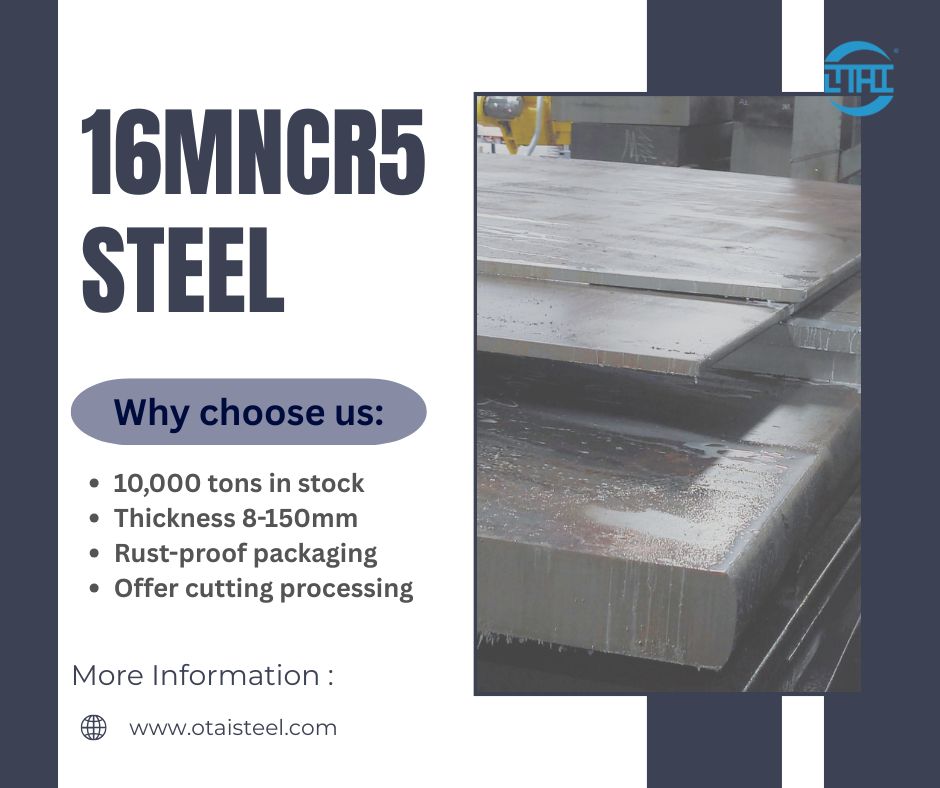
- 16MnCr5 steel plate stock: Otai Special Steel keeps 16MnCr5 steel plates with thicknesses of 8–150 mm available in stock to meet different manufacturing and engineering requirements.
- Stable material quality: We supply 16MnCr5 steel with reliable chemical composition, consistent mechanical properties, and complete material certificates.
- Professional cutting service: Customized cutting is available according to customer drawings, dimensions, and production requirements.
- Heat treatment support: We provide heat treatment solutions including annealing, normalizing, carburizing support, quenching, and tempering according to application needs.
- Quality inspection: Ultrasonic testing and third-party inspection services are available to ensure internal quality and material reliability.
- Export packaging: We provide professional packaging solutions including steel strapping, wooden cases, and anti-rust protection for international transportation.
- Technical experience: Otai Special Steel has extensive experience supplying alloy steels for automotive, gear manufacturing, machinery, and industrial applications.
For customers searching for 16MnCr5 raw material hardness information and reliable supply, Otai Special Steel can provide detailed material data, hardness inspection reports, and technical assistance.
Our team can help customers select the correct delivery condition, hardness range, and processing method according to their final application.
❓ 10. FAQ About 16MnCr5 Raw Material Hardness
1. What is the raw material hardness of 16MnCr5 steel?
The typical 16MnCr5 raw material hardness is approximately 160–220 HB in the supplied condition. The exact value depends on the production process and delivery state.
2. What is 16MnCr5 hardness before heat treatment?
Before heat treatment, 16MnCr5 usually has moderate hardness that allows good machinability. The material is designed for further carburizing and hardening rather than high hardness in the original condition.
3. What is the hardness of annealed 16MnCr5?
The typical 16MnCr5 annealed hardness is around 140–200 HB. Annealing reduces hardness and improves machining performance before further processing.
4. How hard can 16MnCr5 become after carburizing?
After carburizing and quenching, 16MnCr5 can achieve a surface hardness of approximately 58–62 HRC. This provides excellent wear resistance while maintaining a tough core.
5. Does Otai Special Steel supply 16MnCr5 steel plates?
Yes. Otai Special Steel supplies 16MnCr5 steel plates with thicknesses of 8–150 mm available in stock. We also provide cutting service, heat treatment support, inspection, and export packaging solutions.