 16MnCr5 Normalizing: Process, Temperature, Properties and Industrial Applications
📑 Table of Contents
🔍 1. What Is 16MnCr5 Normalizing?
🧪 2. Chemical Composition and Purpose of Normalizing 16MnCr5
🔥 3. 16MnCr5 Normalizing Process and Temperature
📊 4. Mechanical Properties After Normalizing
⚙️ 5. Benefits of Normalizing 16MnCr5 Steel
🏭 6. Applications of Normalized 16MnCr5 Steel
🔄 7. 16MnCr5 Normalizing vs Other Heat Treatments
💡 8. Normalizing Before Carburizing and Machining
🔍 1. What Is 16MnCr5 Normalizing?
16MnCr5 normalizing is a heat treatment process that improves the internal structure, mechanical properties, and machining performance of 16MnCr5 alloy steel. During normalizing, the steel is heated above its critical temperature and then cooled in air to produce a refined and more uniform microstructure.
16MnCr5 is a low-carbon alloy steel commonly used for gears, shafts, sprockets, and transmission components. Because it contains chromium and manganese, the material provides good hardenability and is widely selected for carburizing applications.
Before final heat treatment or surface hardening, manufacturers often use normalizing to improve the steel structure. The process helps remove internal stresses caused by forging, rolling, or previous manufacturing operations.
Unlike quenching, which aims to achieve high hardness through rapid cooling, normalizing focuses on improving structural consistency. It creates a balance between strength, toughness, and machinability.
| Feature | Before Normalizing | After Normalizing |
|---|---|---|
| Microstructure | May be uneven after manufacturing | More refined and uniform |
| Internal stress | Higher after forming processes | Reduced |
| Machinability | Depends on supply condition | Usually improved |
| Mechanical stability | Variable | More consistent |
| Preparation for carburizing | Not optimized | Improved structure for further treatment |
For manufacturers producing precision components, 16MnCr5 normalizing process provides a reliable foundation before carburizing, machining, or other surface treatments.
The main purpose of normalizing is not to create extremely high hardness. Instead, it prepares the steel by creating a stable structure that allows later processes to achieve better results.
🧪 2. Chemical Composition and Purpose of Normalizing 16MnCr5
The chemical composition of 16MnCr5 directly influences its response during normalizing. The combination of carbon, manganese, and chromium provides the foundation for strength, hardenability, and future carburizing performance.
Because 16MnCr5 is designed as a case-hardening steel, its carbon content remains relatively low. This allows manufacturers to create a hard surface layer through carburizing while maintaining a tough core.
| Element | Typical Content (%) | Effect on Steel |
|---|---|---|
| Carbon (C) | 0.14–0.19 | Provides basic strength and supports carburizing |
| Silicon (Si) | ≤0.40 | Improves deoxidation and strength |
| Manganese (Mn) | 1.00–1.30 | Improves hardenability and toughness |
| Chromium (Cr) | 0.80–1.10 | Improves wear resistance and hardenability |
| Phosphorus (P) | ≤0.025 | Controlled impurity |
| Sulfur (S) | ≤0.035 | Controlled impurity |
Why Normalize 16MnCr5 Steel?
Normalizing improves grain structure and reduces variations inside the material. A refined grain structure can improve mechanical stability and provide better results during subsequent heat treatment.
For customers searching for 16MnCr5 steel before carburizing, normalizing is often an important preparation step. A uniform structure helps achieve more consistent carburized layers and reduces the risk of uneven hardness.
In addition, normalizing can improve machining behavior. When steel has a more stable structure, cutting tools can work more efficiently and manufacturers can achieve better dimensional accuracy.
| Purpose of Normalizing | Result |
|---|---|
| Refine grain structure | Improved mechanical consistency |
| Remove manufacturing stress | Better dimensional stability |
| Prepare for carburizing | More uniform surface hardening |
| Improve machinability | Easier processing |
| Improve structural reliability | More predictable performance |
Therefore, normalizing is an important step in the overall 16MnCr5 heat treatment process, especially when the final component requires high precision and long service life.
🔥 3. 16MnCr5 Normalizing Process and Temperature
The 16MnCr5 normalizing process involves heating the steel to a temperature above the critical transformation range, holding it until the structure becomes fully austenitic, and then cooling it naturally in air.
The exact parameters depend on steel size, component shape, production requirements, and the desired final properties.
| Process Parameter | Typical Range |
|---|---|
| Heating temperature | Approx. 850–900°C |
| Holding time | Depends on section thickness |
| Cooling method | Air cooling |
| Main purpose | Grain refinement and stress reduction |
The normalizing temperature of 16MnCr5 steel must be carefully controlled. Excessive temperature may cause grain growth, while insufficient temperature may result in incomplete structural transformation.
After normalizing, the steel usually develops a fine pearlite and ferrite structure. This structure provides a good combination of strength and machinability.
📊 4. Mechanical Properties After Normalizing
After 16MnCr5 normalizing, the steel obtains a more uniform microstructure, which improves its mechanical stability and makes the material more predictable during further processing.
Normalizing does not aim to achieve the highest possible hardness. Instead, it creates a balanced condition with suitable strength, toughness, and machinability. This makes normalized 16MnCr5 an excellent base material for gears and other case-hardening components.
| Property | Typical Value After Normalizing | Performance Benefit |
|---|---|---|
| Tensile strength | Approx. 550–700 MPa | Provides stable load-bearing capability |
| Yield strength | Approx. 350–500 MPa | Improves resistance against deformation |
| Elongation | Approx. 15–20% | Maintains good toughness |
| Hardness | Approx. 170–220 HB | Suitable for machining and further treatment |
| Microstructure | Fine ferrite and pearlite | Improves structural consistency |
Improved Grain Structure
One of the most important effects of normalizing is grain refinement. During manufacturing processes such as forging and hot rolling, steel grains may become uneven. Normalizing restores a more balanced structure.
A refined grain structure improves toughness and reduces differences in mechanical properties between different areas of the material.
Better Machining Performance
Normalized 16MnCr5 usually provides better machinability compared with steel that has an unstable or stressed structure. This advantage is important for manufacturers producing gears, shafts, and precision components.
A stable machining condition helps improve surface quality, dimensional accuracy, and production efficiency.
Preparation for Further Heat Treatment
Many customers use normalized 16MnCr5 as the starting condition before carburizing, quenching, or other surface treatments. A consistent initial structure allows later heat treatment to achieve more reliable results.
⚙️ 5. Benefits of Normalizing 16MnCr5 Steel
There are many advantages of 16MnCr5 normalizing for industrial applications. The process improves the steel condition before machining and final heat treatment, helping manufacturers achieve better component performance.
1. Improved Material Uniformity
Normalizing creates a more consistent internal structure. This reduces variations in hardness and improves the reliability of finished components.
For precision mechanical parts, uniform material properties are important because they help maintain stable performance during operation.
2. Reduced Internal Stress
Forging, rolling, and machining can introduce internal stresses into steel. If these stresses remain, they may cause deformation during later processing.
Normalizing reduces these stresses and improves dimensional stability.
3. Better Carburizing Results
Because 16MnCr5 is commonly used as a carburizing steel, preparation before carburizing is extremely important.
The benefits of normalizing 16MnCr5 steel include improved carburizing consistency, better grain structure, and more predictable surface hardening results.
4. Enhanced Machinability
Normalized steel usually offers a better balance between hardness and toughness. This allows easier machining while maintaining sufficient strength.
5. Improved Service Reliability
A stable heat-treated structure helps components perform better under repeated loading, friction, and mechanical stress.
| Benefit | Industrial Value |
|---|---|
| Fine grain structure | Improves strength and toughness |
| Stress reduction | Reduces deformation risk |
| Stable hardness | Improves processing consistency |
| Better carburizing preparation | Enhances final component performance |
| Improved machinability | Reduces production difficulty |
For manufacturers requiring reliable case-hardening steel, normalizing provides an effective way to improve the condition of 16MnCr5 before additional processing.
🏭 6. Applications of Normalized 16MnCr5 Steel
Normalized 16MnCr5 steel is widely used in industries that require reliable case-hardening materials. Its combination of toughness, machinability, and structural stability makes it suitable for many mechanical applications.
| Application | Reason for Using Normalized 16MnCr5 |
|---|---|
| Automotive gears | Provides stable structure before carburizing |
| Transmission components | Offers good toughness and machinability |
| Shafts | Maintains dimensional stability after processing |
| Sprockets | Suitable for wear-resistant components |
| Industrial machinery parts | Provides reliable mechanical performance |
Automotive Gear Production
Automotive gears experience repeated contact stress and require excellent surface performance. Normalized 16MnCr5 provides a stable foundation before carburizing and quenching.
The improved structure helps manufacturers achieve consistent hardness distribution after final heat treatment.
Transmission Components
Transmission systems require components that can withstand continuous mechanical loads. Normalizing improves the material condition and supports long-term reliability.
Industrial Machinery
Industrial equipment often operates under demanding conditions. Normalized 16MnCr5 provides a practical balance between processing efficiency and mechanical performance.
🔄 7. 16MnCr5 Normalizing vs Other Heat Treatments
When processing 16MnCr5 steel, manufacturers may select different heat treatments depending on the required final properties. Normalizing, annealing, quenching, and carburizing each serve different purposes.
| Heat Treatment | Main Purpose | Main Result |
|---|---|---|
| Normalizing | Refine grain and reduce stress | Balanced strength and machinability |
| Annealing | Soften steel and improve machinability | Lower hardness |
| Quenching | Increase hardness | Hard martensitic structure |
| Carburizing | Increase surface carbon content | Hard surface with tough core |
Normalizing vs Annealing
Both processes improve steel structure, but annealing generally produces softer material. Normalizing provides higher strength and better mechanical balance.
Normalizing vs Quenching
Quenching focuses on increasing hardness through rapid cooling. However, it may create higher internal stress. Normalizing provides a more stable structure for further treatment.
Normalizing vs Carburizing
Carburizing is a surface hardening process, while normalizing is a structural preparation process. In many applications, 16MnCr5 is normalized first and then carburized to achieve the desired final performance.
💡 8. Normalizing Before Carburizing and Machining
For many gear and transmission applications, 16MnCr5 steel before carburizing requires proper preparation to achieve consistent final properties.
Normalizing helps create a refined microstructure before carburizing. This allows carbon diffusion during carburizing to occur more evenly and improves the final hardened layer quality.
| Process Sequence | Purpose |
|---|---|
| Steel supply | Ensure correct chemical composition |
| Normalizing | Improve structure and reduce stress |
| Machining | Create required component dimensions |
| Carburizing | Create hard surface layer |
| Final inspection | Verify quality requirements |
For manufacturers producing high-precision components, controlling every step of the 16MnCr5 heat treatment process is important. Proper normalizing improves production stability and helps achieve consistent final performance.
📦 9. Otai Special Steel Advantages
Otai Special Steel is a professional alloy steel supplier providing reliable 16MnCr5 steel products for customers worldwide. We focus on stable material quality, accurate dimensions, and flexible processing solutions for mechanical manufacturing applications.
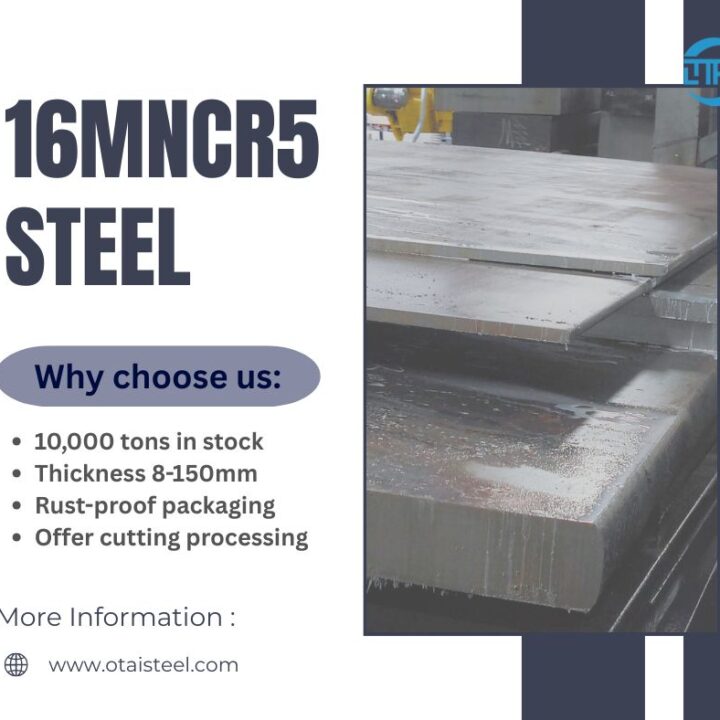
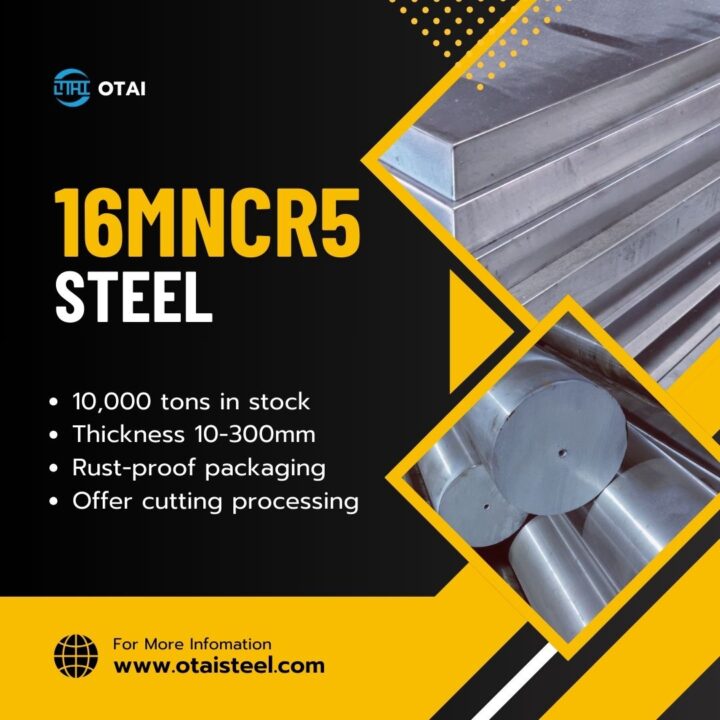
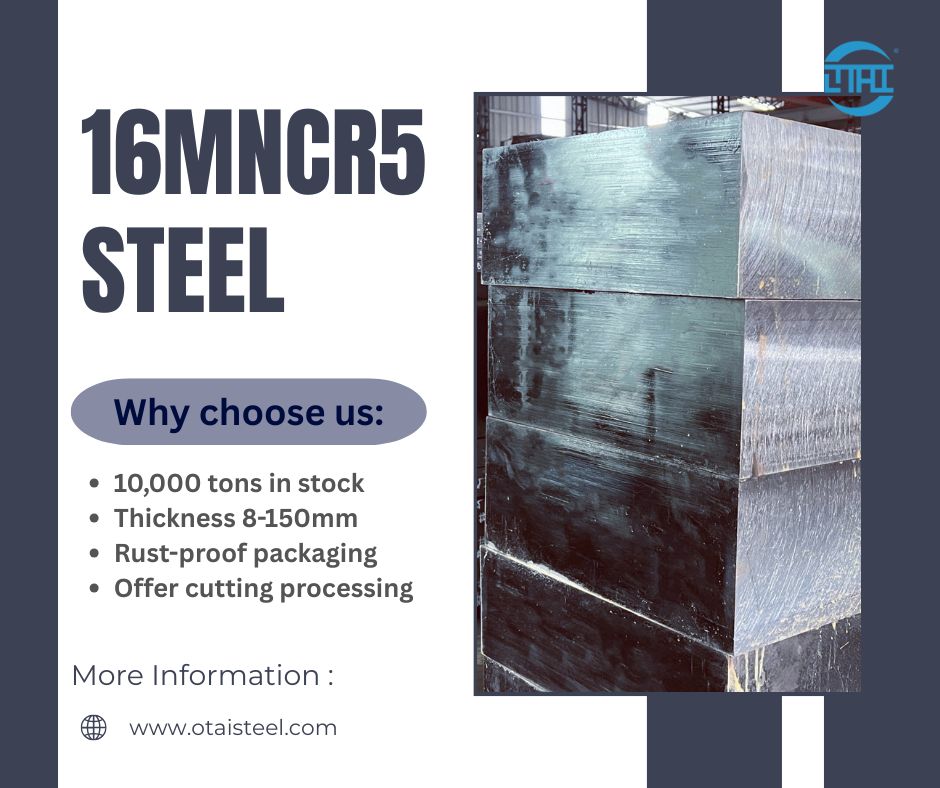
- 16MnCr5 steel plate stock: Otai Special Steel keeps 16MnCr5 steel plates with thicknesses of 8–150 mm available in stock to support different industrial requirements.
- Reliable material supply: We provide alloy steel materials with stable chemical composition and consistent quality for international customers.
- Cutting service: Customized cutting services are available according to customer drawings, dimensions, and project requirements.
- Heat treatment support: We can arrange heat treatment services, including annealing, normalizing, quenching, and tempering according to application needs.
- Quality inspection: Ultrasonic testing and third-party inspection services are available to ensure material reliability.
- Professional export packaging: We provide steel strapping, wooden case packaging, and anti-rust protection for safe international transportation.
- Technical experience: Otai Special Steel has experience supplying alloy steel products to customers with strict technical standards and industrial requirements.
For customers requiring 16MnCr5 normalizing applications, selecting the correct steel condition is essential. Otai Special Steel can provide suitable material solutions based on component design, processing requirements, and final performance expectations.
❓ 10. FAQ About 16MnCr5 Normalizing
1. What is 16MnCr5 normalizing?
16MnCr5 normalizing is a heat treatment process that heats the steel above its critical temperature and cools it in air to refine the grain structure, reduce internal stress, and improve mechanical stability.
2. What is the normalizing temperature of 16MnCr5 steel?
The typical normalizing temperature of 16MnCr5 steel is approximately 850–900°C. The exact temperature depends on section size, production conditions, and required material performance.
3. Why normalize 16MnCr5 before carburizing?
Normalizing improves the internal structure before carburizing. It helps create a more uniform microstructure, which supports more consistent carburized layers and final mechanical properties.
4. What are the benefits of normalizing 16MnCr5 steel?
The main benefits include improved grain structure, reduced internal stress, better machinability, enhanced dimensional stability, and more predictable performance during further heat treatment.
5. Does Otai Special Steel supply normalized 16MnCr5 steel plates?
Yes. Otai Special Steel supplies 16MnCr5 steel plates with thicknesses of 8–150 mm available in stock. We also provide cutting services, heat treatment support, inspection services, and export packaging solutions.