 16MnCr5 Material Supplier: How to Choose the Right Source for Industrial Production
📑 Table of Contents
🔍 1. What Makes a Reliable 16MnCr5 Material Supplier?
📋 2. 16MnCr5 Grade, Standards and Chemical Composition
⚙️ 3. 16MnCr5 Material Properties for Industrial Applications
📊 4. 16MnCr5 Product Forms and Available Sizes
🔥 5. 16MnCr5 Heat Treatment and Case Hardening
🛠️ 6. Cutting, Machining and Processing Services
🏭 7. Industries That Use 16MnCr5
🔎 8. What to Check Before Ordering 16MnCr5
🔍 1. What Makes a Reliable 16MnCr5 Material Supplier?
Choosing a reliable 16MnCr5 material supplier is important when the steel will enter automotive, gear manufacturing, transmission, or industrial production. The right supplier should provide more than a material grade and a basic quotation.
A professional supplier should understand the technical requirements behind 16MnCr5. This case-hardening steel needs suitable chemical composition, consistent quality, correct delivery condition, and reliable documentation.
For example, a gear manufacturer may need 16MnCr5 in an annealed condition for machining before carburizing. Another customer may require specific dimensions, ultrasonic testing, or custom cutting before shipment.
Therefore, buyers should evaluate suppliers based on the complete supply process rather than choosing the lowest quotation alone.
| Supplier Factor | What Buyers Should Check |
|---|---|
| Material standard | Confirm the grade and applicable standard, such as EN 10084. |
| Chemical composition | Check the actual heat analysis and required element ranges. |
| Material condition | Confirm annealed, normalized, or other required delivery conditions. |
| Stock availability | Check whether the required dimensions are already available. |
| Inspection | Confirm material certificates, UT testing, or third-party inspection options. |
| Processing | Check cutting, surface treatment, and other customization services. |
| Export experience | Review packaging and international shipping capabilities. |
A dependable 16MnCr5 steel supplier for industrial applications should also communicate clearly about tolerances, dimensions, testing requirements, and delivery conditions.
This becomes especially important for international orders. Small differences in specifications can create problems during machining or heat treatment if the buyer and supplier use different assumptions.
Clear technical communication helps reduce these risks before production begins.
📋 2. 16MnCr5 Grade, Standards and Chemical Composition
16MnCr5 is a low-carbon alloy steel designed mainly for case-hardening applications. It belongs to the European family of case-hardening steels and commonly appears under EN 10084.
The material contains manganese and chromium as important alloying elements. Its relatively low carbon content supports machining before carburizing, while the alloying elements improve hardenability.
When evaluating a DIN 16MnCr5 material supplier, buyers should confirm the exact standard and chemical requirements stated in the purchase order.
| Element | Typical Range (%) | Role in 16MnCr5 |
|---|---|---|
| Carbon (C) | 0.14–0.19 | Supports case hardening while keeping the core relatively tough. |
| Silicon (Si) | ≤0.40 | Supports deoxidation and contributes to strength. |
| Manganese (Mn) | 1.00–1.30 | Improves hardenability and strength. |
| Chromium (Cr) | 0.80–1.10 | Improves hardenability and wear performance. |
| Phosphorus (P) | ≤0.025 | Controlled to maintain material quality. |
| Sulfur (S) | ≤0.035 | Controlled for cleanliness and processing performance. |
Why Chemical Composition Matters
The chemical composition directly affects how 16MnCr5 responds to carburizing, quenching, and subsequent tempering.
Chromium and manganese help the material develop suitable hardenability. The controlled carbon level also allows manufacturers to create a hard surface without making the entire component excessively brittle.
For this reason, buyers should always request a material certificate when purchasing 16MnCr5 for critical applications.
The certificate allows the customer to compare the actual heat analysis with the specified standard. It also provides useful traceability for production and quality control.
A qualified supplier should be able to provide the necessary material documentation without creating uncertainty about the supplied grade.
⚙️ 3. 16MnCr5 Material Properties for Industrial Applications
The main advantage of 16MnCr5 comes from its ability to combine a hard wear-resistant surface with a tougher core after suitable case hardening.
This combination makes the steel particularly useful for gears, shafts, pinions, transmission components, and other parts exposed to repeated contact stress.
| Property | Typical Characteristic | Industrial Benefit |
|---|---|---|
| Carbon content | Low before carburizing | Good machinability before case hardening. |
| Hardenability | Good | Supports effective case hardening. |
| Surface hardness | Can reach approximately 58–62 HRC after suitable treatment | High resistance to wear and contact stress. |
| Core toughness | Good after proper treatment | Improves resistance to impact and dynamic loads. |
| Wear resistance | High after carburizing and hardening | Suitable for gears and transmission components. |
| Machinability | Good before case hardening | Supports efficient component manufacturing. |
Surface Performance
The carburized surface provides high hardness and strong resistance to abrasive and contact wear. This property is especially useful for gear teeth, where repeated contact can gradually damage the surface.
At the same time, the lower-carbon core can retain greater toughness than a fully hardened high-carbon steel.
Core Toughness
Core toughness is important because many mechanical components experience shock and cyclic loading. A component with a hard surface but an excessively brittle core may fail prematurely.
Proper case-hardening treatment allows 16MnCr5 to balance these requirements. However, the final properties depend on the actual heat treatment cycle, section size, carburizing depth, cooling conditions, and subsequent processing.
Therefore, a good 16MnCr5 material supplier for gears should understand both the steel grade and its intended manufacturing process.
The supplier should also communicate the supplied material condition clearly. This helps the customer select the correct machining and heat-treatment route.
📊 4. 16MnCr5 Product Forms and Available Sizes
A reliable 16MnCr5 material supplier should offer practical product forms for different manufacturing processes. Buyers may require plates, round bars, flat bars, or cut-to-size material depending on the component design.
The product form also affects machining efficiency, material utilization, transportation, and the overall purchasing process. Therefore, customers should specify the required dimensions before requesting a quotation.
| Product Form | Typical Use | Important Purchasing Details |
|---|---|---|
| 16MnCr5 steel plate | Machined components and industrial parts | Thickness, width, length, condition |
| 16MnCr5 round bar | Shafts, pins, gears and turned parts | Diameter, length, material condition |
| 16MnCr5 flat bar | Machined mechanical components | Width, thickness, length |
| Cut-to-size material | Production-ready blanks | Finished dimensions and tolerance |
16MnCr5 Steel Plate Availability
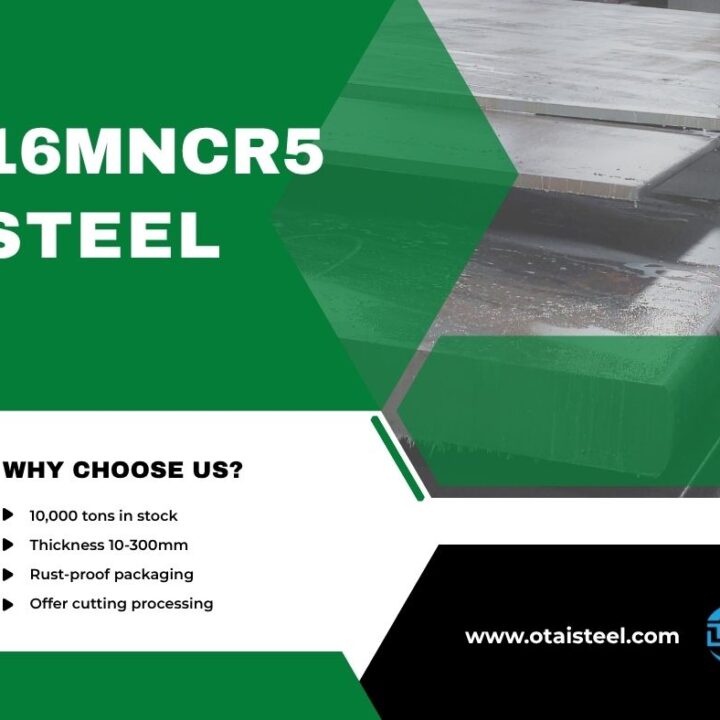
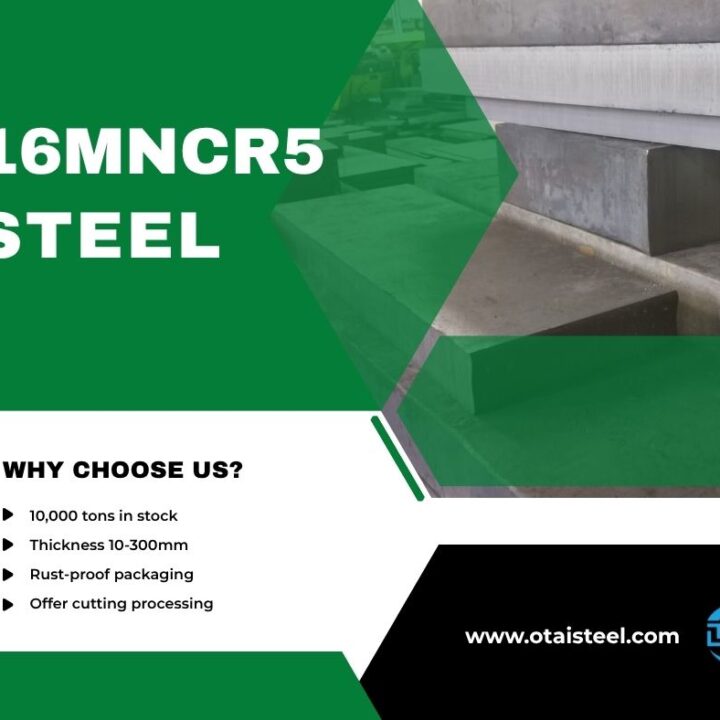
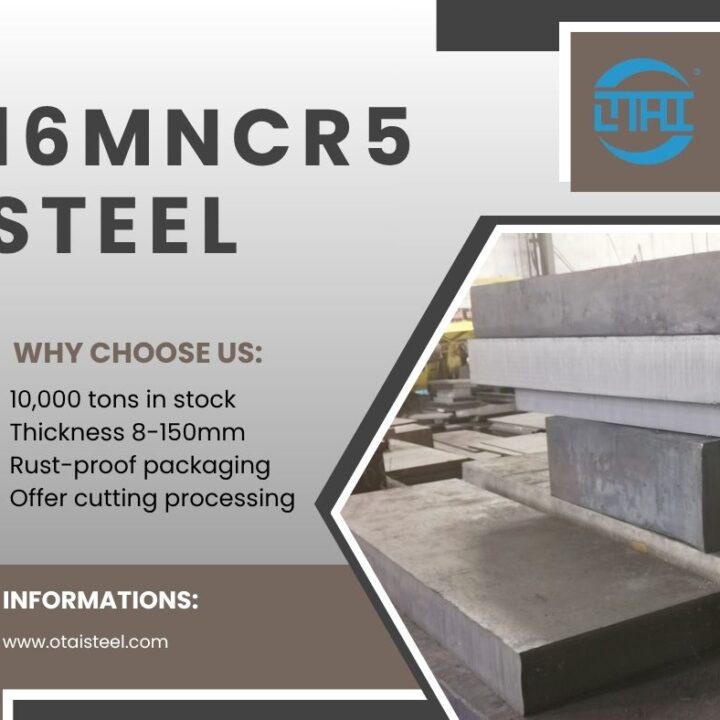
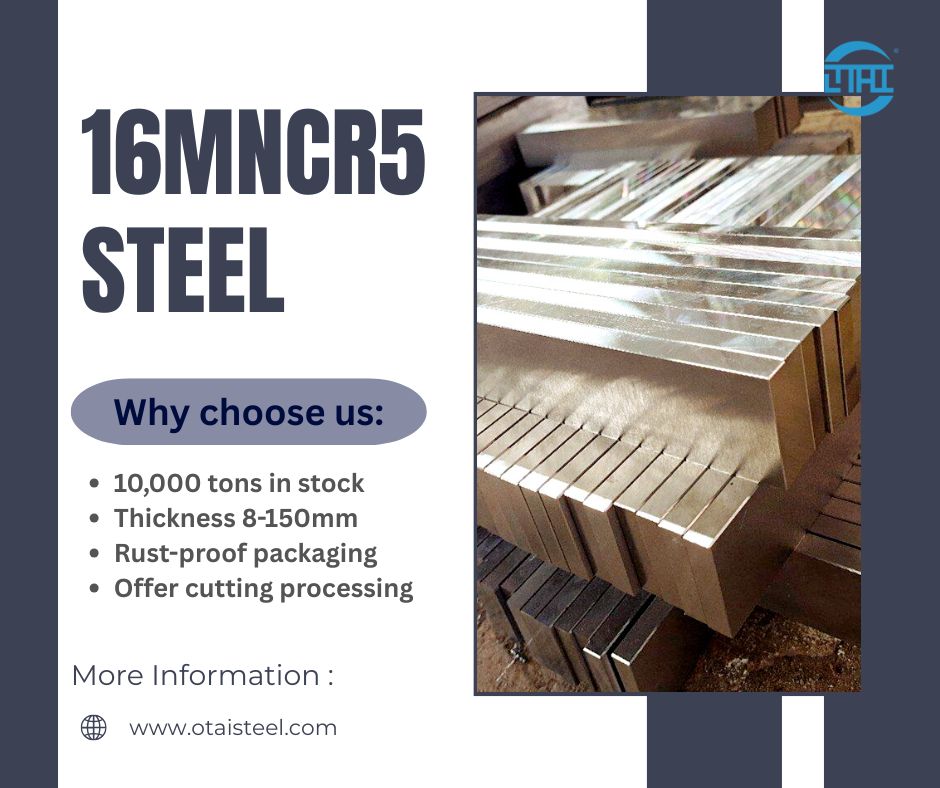
For customers who need plate material, stock availability can make the purchasing process much more efficient. Otai Special Steel keeps 16MnCr5 steel plates with thicknesses from 8–150mm available in stock.
This stock range covers many common requirements for industrial manufacturing and machining. Customers can provide the required thickness, width, length, and quantity so the supplier can check the most suitable available material.
Stock material can also reduce the waiting period associated with new production. This advantage becomes important when the steel must enter a scheduled machining or manufacturing program.
Why Exact Dimensions Matter
Dimensions affect both material utilization and processing requirements. A supplier can recommend a suitable stock size when the buyer provides complete dimensional information.
For example, purchasing a larger plate and cutting it into multiple blanks may improve material utilization compared with ordering several isolated small pieces.
Therefore, an experienced 16MnCr5 steel plate supplier should evaluate dimensions together with quantity instead of treating each requirement as a simple grade-only inquiry.
🔥 5. 16MnCr5 Heat Treatment and Case Hardening
Heat treatment plays a central role in the performance of 16MnCr5. The material typically serves applications where manufacturers need a hard surface combined with a tougher core.
A supplier should understand the relationship between the supplied condition and the customer’s final heat-treatment process. This knowledge helps prevent problems during machining and case hardening.
| Process | Purpose | Effect on Material |
|---|---|---|
| Annealing | Improve machinability | Produces a softer and more workable structure. |
| Normalizing | Refine the microstructure | Improves structural uniformity. |
| Carburizing | Increase surface carbon | Creates a carbon-enriched surface layer. |
| Quenching | Harden the carburized case | Produces a high-hardness surface. |
| Tempering | Reduce brittleness | Improves the balance between hardness and toughness. |
Why 16MnCr5 Works Well for Carburizing
The relatively low carbon content of 16MnCr5 makes it suitable for case hardening. Before carburizing, manufacturers can machine the component with greater ease than many high-carbon steels.
During carburizing, carbon enters the surface. The subsequent hardening process creates a wear-resistant case while the core maintains useful toughness.
This combination makes 16MnCr5 a common choice for gears and transmission components.
Supplier Support Before Heat Treatment
The supplier should clearly identify the delivery condition and provide relevant material documentation. This information helps the customer design the correct machining and heat-treatment process.
For demanding applications, buyers may also request additional inspection before production. Ultrasonic testing, material certificates, and third-party inspection can provide greater confidence in material quality.
A knowledgeable 16MnCr5 case hardening steel supplier should therefore support both material selection and technical communication throughout the purchasing process.
🛠️ 6. Cutting, Machining and Processing Services
Material supply becomes more valuable when the supplier can provide additional processing. Many industrial customers do not need full-size stock material. Instead, they need steel blanks prepared for the next manufacturing stage.
Cutting services can reduce material waste and simplify handling. The supplier can prepare plates or bars according to the customer’s dimensions before shipment.
| Service | Customer Benefit |
|---|---|
| Plate cutting | Provides blanks close to the required dimensions. |
| Bar cutting | Reduces preparation work before machining. |
| Custom dimensions | Improves material utilization for specific components. |
| Heat treatment support | Helps customers coordinate the required material condition. |
| Ultrasonic testing | Provides additional information about internal material quality. |
| Third-party inspection | Provides independent verification when required. |
| Export packaging | Protects material during international transportation. |
Cutting Accuracy and Material Utilization
Custom cutting should follow the customer’s dimensional requirements. Accurate cutting can reduce unnecessary machining allowance and help improve material utilization.
For large industrial orders, this can become an important part of the overall purchasing strategy. The buyer should provide a cutting list whenever multiple sizes are required.
Quality Documentation
A professional supplier should provide appropriate documentation for the supplied material. A mill test certificate can confirm chemical composition and other specified information.
When the project requires additional verification, ultrasonic testing or third-party inspection can provide further quality assurance.
These services are particularly useful when the steel will enter critical automotive or industrial production.
🏭 7. Industries That Use 16MnCr5
16MnCr5 serves many applications that require a combination of surface hardness, wear resistance, and core toughness. Its strongest advantage appears after suitable case-hardening treatment.
| Industry | Typical Components | Why 16MnCr5 Is Suitable |
|---|---|---|
| Automotive | Gears, shafts, transmission parts | Good wear resistance and fatigue performance after treatment. |
| Gear manufacturing | Gear wheels, pinions | Hard surface with a tougher core. |
| Mechanical engineering | Pins, shafts, machine components | Good balance of machinability and hardenability. |
| Power transmission | Transmission components | Suitable for repeated contact and mechanical loads. |
| Industrial machinery | Wear-resistant mechanical parts | Reliable performance after case hardening. |
16MnCr5 for Gears
Gear manufacturing remains one of the most important uses of 16MnCr5. Gear teeth experience repeated contact and sliding, which can create significant surface wear.
A carburized and hardened surface helps the teeth resist wear. Meanwhile, the tougher core helps the gear withstand dynamic loading.
For this reason, buyers looking for a 16MnCr5 material supplier for gears should evaluate not only the steel grade but also the supplier’s understanding of case-hardening requirements.
16MnCr5 for Automotive Components
Automotive transmission parts require consistent material quality and controlled manufacturing processes. Small variations in material condition can affect machining and subsequent heat treatment.
A dependable supply chain helps manufacturers maintain consistent production. Material certification, stock availability, and clear technical communication all contribute to this consistency.
🔎 8. What to Check Before Ordering 16MnCr5
Before placing an order, buyers should confirm more than the material grade. A complete specification reduces misunderstandings and helps the supplier provide the correct material.
| Item | Recommended Information |
|---|---|
| Grade | 16MnCr5 |
| Standard | EN 10084 or specified equivalent |
| Product form | Plate, round bar, flat bar, or cut-to-size material |
| Dimensions | Thickness, width, length, or diameter |
| Quantity | Total weight or number of pieces |
| Delivery condition | Annealed, normalized, or other specified condition |
| Inspection | Material certificate, UT, or third-party inspection |
| Cutting requirements | Finished blank dimensions and tolerance |
| Packaging | Anti-rust protection, steel strapping, or wooden cases |
Check Stock Before Starting a New Production Cycle
Stock availability should be one of the first questions buyers ask. A supplier with suitable material already in stock can often respond faster than a supplier that needs to arrange a new production cycle.
For customers searching for 16MnCr5 material supplier with stock, Otai Special Steel offers 16MnCr5 steel plates in thicknesses from 8–150mm.
Confirm the Material Condition
The same steel grade can behave differently during machining depending on its delivery condition. Buyers should therefore confirm the supplied condition before production.
If the customer plans to perform carburizing and hardening internally, the supplier should provide the appropriate material documentation so the manufacturing team can establish the correct process.
Compare Suppliers on More Than Price
A reliable 16MnCr5 material supplier should offer consistent quality, accurate documentation, practical stock, and suitable processing services.
A slightly lower material price may not provide the best value if the supplier cannot meet the required dimensions, delivery schedule, inspection requirements, or packaging standards.
For international industrial purchasing, the best supplier is usually the one that can provide the correct material with predictable quality and clear communication from quotation to shipment.
📦 9. Otai Special Steel Advantages
Otai Special Steel supplies 16MnCr5 material for customers in automotive, gear manufacturing, machinery, and industrial engineering. We focus on stable material quality, practical stock availability, and flexible processing services.
- 16MnCr5 steel plate stock: We keep 16MnCr5 steel plates with thicknesses of 8–150mm available in stock for customers with regular industrial requirements.
- Custom cutting: We can cut 16MnCr5 plates according to customer dimensions and production requirements.
- Material documentation: We provide material certificates and can arrange additional inspection according to project requirements.
- Quality inspection: Ultrasonic testing and third-party inspection services are available for customers who require additional quality verification.
- Heat treatment support: We can provide technical support for annealing, normalizing, carburizing, quenching, and tempering requirements.
- Export packaging: Anti-rust protection, steel strapping, and wooden box packaging help protect materials during international transportation.
For buyers comparing a 16MnCr5 material supplier, stock availability and processing capability can simplify procurement. Customers can provide their required grade, dimensions, quantity, material condition, and delivery destination for a detailed quotation.
❓ 10. FAQ About 16MnCr5 Material Suppliers
1. What should I look for in a 16MnCr5 material supplier?
Look for a supplier that can provide the correct 16MnCr5 grade, reliable chemical composition, material certificates, suitable dimensions, stable stock, and clear delivery conditions. Processing services such as cutting and inspection can also simplify procurement.
2. What standard does 16MnCr5 usually follow?
16MnCr5 is commonly associated with the European EN 10084 standard for case-hardening steels. Buyers should confirm the exact standard and technical requirements before placing an order.
3. Is 16MnCr5 suitable for gear manufacturing?
Yes. 16MnCr5 is widely used for gears, pinions, shafts, and transmission components. After suitable carburizing and hardening, the material can provide a hard wear-resistant surface while maintaining a tougher core.
4. Can a 16MnCr5 supplier provide custom-cut steel?
Yes. Depending on the supplier’s capabilities, 16MnCr5 plates and bars can be cut into specified dimensions before shipment. Customers should provide the required thickness, width, length, quantity, and tolerance.
5. Does Otai Special Steel have 16MnCr5 steel plates in stock?
Yes. Otai Special Steel keeps 16MnCr5 steel plates with thicknesses of 8–150mm available in stock. We also provide cutting, material certification, ultrasonic testing, third-party inspection, heat treatment support, and export packaging.