🔍 Introduction
The 16MnCr5 steel grade is one of the most widely used case hardening steels in modern engineering. It delivers an excellent combination of surface hardness and core toughness, making it ideal for components that operate under high stress and wear conditions.
In this article, we explore 16mncr5 steel properties and applications, including its chemical composition, mechanical performance, heat treatment process, and practical industrial usage.
⚙️ What Is 16MnCr5 Steel Grade?
16MnCr5 is a low-carbon alloy steel defined under the EN 10084 standard. It is specifically designed for carburizing processes, allowing engineers to achieve a hardened surface while maintaining a tough and ductile core.
Key characteristics:
- Low carbon content (~0.16%)
- Excellent hardenability
- Superior wear resistance after carburizing
- Good machinability before heat treatment
This makes it highly suitable for precision and high-load components.
🧪 16MnCr5 Steel Grade Chemical Composition
Understanding 16mncr5 steel chemical composition is essential for evaluating performance.
| Element | Content (%) |
|---|---|
| Carbon (C) | 0.14–0.19 |
| Manganese (Mn) | 1.0–1.3 |
| Chromium (Cr) | 0.8–1.1 |
| Silicon (Si) | 0.15–0.35 |
| Phosphorus (P) | ≤0.025 |
| Sulfur (S) | ≤0.035 |
Insight:
- Chromium improves wear resistance and hardenability
- Manganese enhances strength
- Low carbon ensures a tough core
📊 Mechanical Properties and Strength
The 16mncr5 steel grade mechanical properties table below shows typical values after heat treatment:
| Property | Value |
|---|---|
| Tensile Strength (core) | 800–1100 MPa |
| Yield Strength | 500–800 MPa |
| Surface Hardness | 58–62 HRC |
| Core Hardness | 28–40 HRC |
| Impact Toughness | High |
These figures highlight 16mncr5 steel hardness and strength, especially for carburized components.
🔥 16MnCr5 Steel Grade Heat Treatment Process
The 16mncr5 steel heat treatment process is critical to achieving optimal performance.
Typical Process:
- Carburizing: 880–950°C
- Quenching: Oil quenching
- Tempering: 150–200°C
Results:
- Extremely hard surface layer
- Tough and ductile core
- Enhanced fatigue resistance
This process enables the steel to perform under demanding service conditions.
⚖️ 16MnCr5 Steel Grade Equivalent Material
Understanding 16mncr5 steel equivalent material helps in global sourcing.
| Standard | Equivalent Grade |
|---|---|
| EN | 16MnCr5 (1.7131) |
| ASTM/AISI | 5115 |
| JIS | SCM415 |
| GB | 16CrMnH |
These equivalents provide similar performance, though slight variations may occur.
🛠️ Machinability and Weldability
The 16mncr5 steel machinability and weldability characteristics are:
| Property | Performance |
|---|---|
| Machinability | Good (annealed condition) |
| Weldability | Moderate |
| Formability | Good |
Practical advice:
Machining should be performed before carburizing to improve efficiency.
🏭 16MnCr5 Steel Grade Uses in Industry
The 16mncr5 steel grade uses in industry are extensive due to its versatility.
Common Applications:
- Automotive gears and transmission components
- Shafts and pinions
- Camshafts
- Industrial gear systems
- Heavy-duty mechanical parts
Its ability to resist wear while maintaining toughness makes it ideal for these applications.
🧱 Case Hardening Characteristics
As a 16mncr5 steel grade case hardening characteristics material, it offers excellent performance:
Typical Case Hardening Results:
- Surface hardness: 58–62 HRC
- Case depth: 0.8–1.2 mm
- Strong fatigue resistance
Hardness Distribution
| Depth (mm) | Hardness (HRC) |
|---|---|
| Surface | 60–62 |
| 0.5 mm | 55–58 |
| 1.0 mm | 50–54 |
| Core | 30–40 |
This gradient ensures durability and structural integrity.
📐 Specifications and Standards
The 16mncr5 steel grade specifications and standards include:
| Standard | Specification |
|---|---|
| EN 10084 | Case hardening steel |
| DIN | 1.7131 |
| Delivery Condition | Annealed / Normalized |
| Supply Forms | Bar, plate, forging |
⚠️ Common Mistakes When Using 16MnCr5 Steel Grade
- Improper carburizing process
- Incorrect quenching parameters
- Ignoring required case depth
- Poor quality control during heat treatment
Avoiding these issues ensures optimal material performance.
🏆 Company Advantages
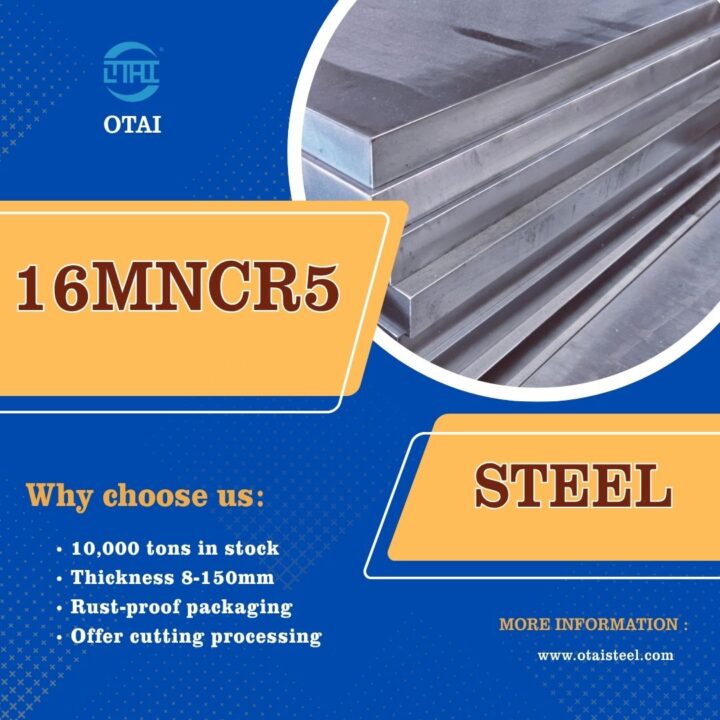
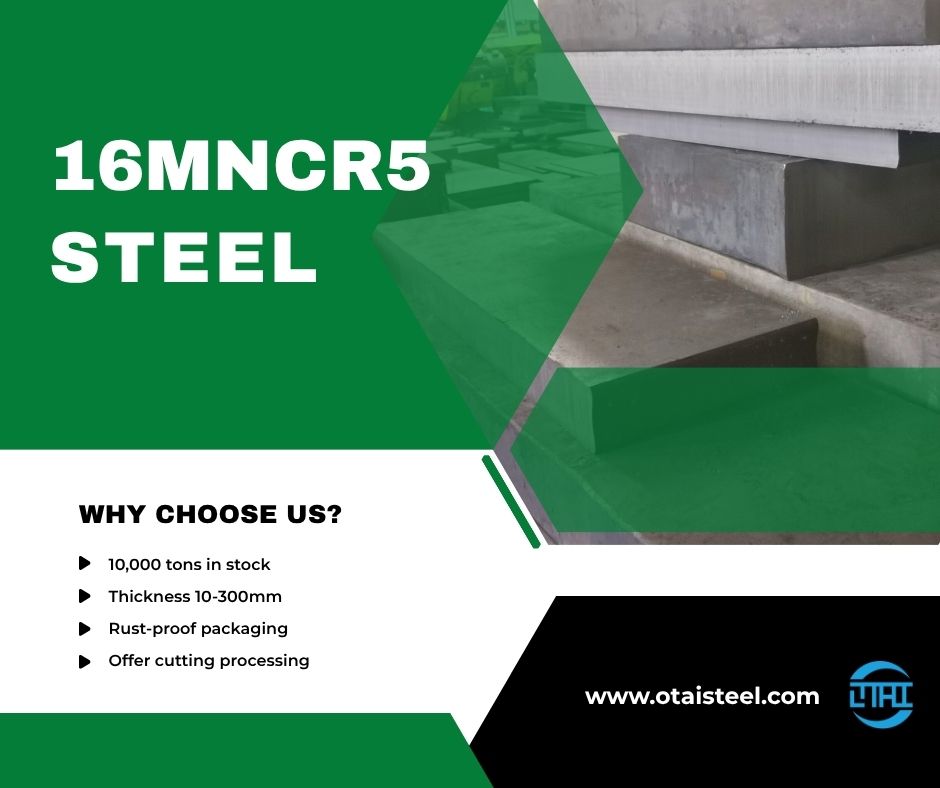
At Otai Special Steel, we supply high-quality 16MnCr5 steel grade with consistent performance:
- Over 10,000 tons of inventory available year-round
- Full size range from 6mm to 300mm
- Precision cutting and customized heat treatment services
- Strict quality control including ultrasonic testing (UT) and chemical analysis
- Support for third-party inspections such as SGS
- Extensive experience supplying global industrial clients
We help customers achieve reliable quality and efficient sourcing.
❓ FAQ
1. What is 16MnCr5 steel grade used for?
It is mainly used for gears, shafts, and wear-resistant mechanical components.
2. What is the hardness of 16MnCr5 steel grade?
Surface hardness can reach 58–62 HRC after carburizing.
3. Can 16MnCr5 steel be welded?
Yes, but preheating is recommended to prevent cracking.
4. What is the equivalent of 16MnCr5 steel grade?
Common equivalents include AISI 5115, SCM415, and 16CrMnH.
5. Why is 16MnCr5 steel grade widely used?
Because it provides an excellent balance of wear resistance and core toughness.