 Is 4140 Steel Good for Knife Making? Strength, Toughness and Performance Analysis
📑 Table of Contents
🔥 1. Introduction: Is 4140 Steel Good for Knife Making?
⚙️ 2. What Is 4140 Alloy Steel?
🔬 3. 4140 Steel Chemical Composition
📊 4. 4140 Steel Hardness and Mechanical Properties
🔥 5. Heat Treatment of 4140 Steel for Knife Applications
🔪 6. Advantages and Disadvantages of 4140 Steel Knives
⚔️ 7. 4140 Steel Compared with Other Knife Steels
🏭 Otai Special Steel Advantages
❓ FAQ About 4140 Steel for Knife Making
🔥 1. Introduction: Is 4140 Steel Good for Knife Making?
Many knife makers and steel enthusiasts ask: is 4140 steel good for knife making? The answer depends on the type of knife, expected performance, and heat treatment process.
4140 steel is a chromium-molybdenum alloy steel known for its excellent strength, toughness, and impact resistance.
Although 4140 is not traditionally classified as a dedicated knife steel like D2, 1095, or CPM steels, it can still produce functional and durable blades when properly heat treated.
The biggest advantage of 4140 steel for knife making is its outstanding toughness. A knife made from 4140 can resist shock loads, bending forces, and impact better than many high-carbon blade steels.
However, 4140 does not provide extremely high edge retention because its carbon content is lower than many specialized knife steels.
Therefore, 4140 works better for heavy-duty knives, outdoor tools, chopping blades, and applications where toughness is more important than maximum cutting performance.
Basic Characteristics of 4140 Steel for Knife Making
| Property | Description |
|---|---|
| Steel Type | Chromium-molybdenum alloy steel |
| Standard | ASTM A29 / SAE 4140 |
| Carbon Content | Approximately 0.40% |
| Main Alloy Elements | Chromium and molybdenum |
| Main Advantage | High toughness and strength |
| Main Limitation | Lower edge retention compared with premium knife steels |
For makers who need a tough working blade rather than a competition cutting knife, 4140 steel for knife making can be a practical and economical choice.
⚙️ 2. What Is 4140 Alloy Steel?
4140 is a medium-carbon chromium-molybdenum alloy steel widely used in mechanical engineering, automotive components, shafts, gears, and heavy-duty machinery parts.
The steel belongs to the family of low-alloy steels and achieves excellent mechanical properties after heat treatment.
The combination of chromium and molybdenum improves hardenability, strength, and resistance to fatigue.
Unlike stainless knife steels, 4140 does not contain enough chromium to resist corrosion. Therefore, knife makers must apply proper surface protection and maintenance.
Why Some Knife Makers Choose 4140 Steel
- Excellent impact resistance for heavy-duty blades.
- Good toughness even under high stress.
- Easy availability and affordable cost.
- Good machinability before heat treatment.
- Suitable for large knives and outdoor tools.
The main question is not simply whether 4140 can make a knife, but whether its properties match the intended application.
For survival knives, machetes, chopping tools, and utility blades, toughness often matters more than extreme hardness.
Common Applications of 4140 Steel
| Industry | Applications |
|---|---|
| Automotive | Axles, shafts, gears |
| Mechanical Engineering | Heavy-duty machine parts |
| Tool Manufacturing | Wear-resistant components |
| Knife Making | Large utility blades, chopping tools |
Because 4140 combines strength and toughness, many makers consider it when designing knives that must survive harsh working environments.
🔬 3. 4140 Steel Chemical Composition
The chemical composition of 4140 determines its performance in knife applications.
The steel contains around 0.40% carbon, which provides a balance between hardness and toughness.
Chromium improves hardenability and wear resistance, while molybdenum increases strength and high-temperature performance.
4140 Steel Chemical Composition
| Element | Content (%) | Function |
|---|---|---|
| Carbon (C) | 0.38–0.43 | Provides hardness and strength |
| Silicon (Si) | 0.15–0.35 | Improves strength and deoxidation |
| Manganese (Mn) | 0.75–1.00 | Improves toughness and hardenability |
| Chromium (Cr) | 0.80–1.10 | Improves wear resistance and hardening |
| Molybdenum (Mo) | 0.15–0.25 | Improves strength and toughness |
How Alloy Elements Affect Knife Performance
| Element | Effect on Knife Blade |
|---|---|
| Carbon | Controls hardness and edge holding ability |
| Chromium | Improves hardenability and wear resistance |
| Molybdenum | Improves toughness and strength |
| Manganese | Improves overall mechanical performance |
The balanced alloy design explains why 4140 performs well in applications requiring strength and impact resistance.
However, because its carbon content is lower than many dedicated blade steels, manufacturers should carefully control heat treatment to achieve the desired hardness.
For this reason, understanding 4140 alloy steel hardness for knives is essential before selecting this material for blade production.
📊 4. 4140 Steel Hardness and Mechanical Properties
The performance of a knife depends heavily on the hardness, toughness, and microstructure of the steel.
When people ask is 4140 steel good for knife making, hardness is one of the most important factors to consider.
4140 can achieve good hardness after proper heat treatment, but its greatest advantage remains toughness rather than extreme edge retention.
A properly treated 4140 blade can resist bending, impact, and cracking, making it suitable for demanding outdoor and industrial applications.
Typical Mechanical Properties of 4140 Steel
| Property | Typical Value |
|---|---|
| Tensile Strength | 655–1080 MPa (depending on heat treatment) |
| Yield Strength | 415–950 MPa |
| Elongation | 15–25% |
| Impact Toughness | Excellent |
| Machinability | Good |
| Wear Resistance | Moderate to Good |
4140 Steel Hardness Range for Knife Applications
| Condition | Hardness | Knife Performance |
|---|---|---|
| Annealed | Approximately 200 HB | Easy machining but low cutting performance |
| Quenched | 50–55 HRC | High hardness but increased brittleness |
| Quenched and Tempered | 40–50 HRC | Excellent toughness |
| Optimized Knife Treatment | 45–55 HRC | Balanced strength and durability |
For knife making, many makers prefer a hardness range that balances edge retention and toughness.
If the blade becomes too hard, it may lose impact resistance and become more likely to chip or crack.
If the blade remains too soft, it may lose edge holding ability and require frequent sharpening.
Therefore, the correct heat treatment determines whether 4140 steel knife blade performance meets practical requirements.
🔥 5. Heat Treatment of 4140 Steel for Knife Applications
Heat treatment is the key step that transforms 4140 from a general engineering steel into a functional knife material.
Without proper heat treatment, 4140 will not achieve the hardness and performance required for a durable blade.
The typical process includes heating, quenching, and tempering.
Best Heat Treatment for 4140 Knife Steel
| Process | Temperature Range | Purpose |
|---|---|---|
| Heat Treatment Preparation | 840–870°C | Create uniform austenite structure |
| Quenching | Oil or suitable cooling medium | Increase hardness by forming martensite |
| Tempering | 200–650°C depending on target properties | Improve toughness and reduce brittleness |
Effect of Tempering Temperature on 4140
| Tempering Condition | Result |
|---|---|
| Low Temperature Tempering | Higher hardness and better edge retention |
| Medium Temperature Tempering | Balanced hardness and toughness |
| High Temperature Tempering | Maximum toughness and impact resistance |
Recommended Heat Treatment Approach for Different Knife Types
| Knife Type | Recommended Property Balance |
|---|---|
| Outdoor Survival Knife | Higher toughness |
| Chopping Blade | Maximum impact resistance |
| Utility Knife | Balanced hardness and toughness |
| Heavy Work Knife | Strength-focused treatment |
Compared with specialized blade steels, 4140 requires more attention during heat treatment because it does not naturally achieve very high hardness levels.
However, when properly treated, it provides outstanding durability for heavy-use knives.
Advantages of Proper Heat Treatment
- Improves blade strength.
- Enhances resistance against impact damage.
- Creates a stable martensitic structure.
- Improves service life under harsh conditions.
- Balances hardness and toughness.
This is why experienced makers focus on the entire manufacturing process rather than only the steel grade.
A well-treated 4140 knife can outperform poorly treated blades made from more expensive steels.
🔪 6. Advantages and Disadvantages of 4140 Steel Knives
Before choosing 4140 for a blade project, knife makers should understand both its advantages and limitations.
The question is 4140 steel good for knife making does not have a simple yes or no answer. It depends on whether the user needs toughness, edge retention, corrosion resistance, or easy maintenance.
Advantages of 4140 Steel for Knife Making
| Advantage | Explanation |
|---|---|
| Excellent Toughness | 4140 can absorb strong impacts without easily cracking. |
| High Strength | Suitable for large and heavy-duty blades. |
| Good Hardening Ability | Chromium and molybdenum improve heat treatment performance. |
| Easy Availability | Common industrial steel with stable supply. |
| Cost Efficiency | Provides good performance at a reasonable material cost. |
Disadvantages of 4140 Steel Knives
| Limitation | Explanation |
|---|---|
| Lower Edge Retention | Lower carbon content compared with premium knife steels. |
| Poor Corrosion Resistance | Not a stainless steel and requires maintenance. |
| Requires Careful Heat Treatment | Performance depends strongly on processing quality. |
| Not Ideal for Fine Cutting | Less suitable for razor-sharp precision blades. |
Best Knife Applications for 4140 Steel
- Heavy-duty outdoor knives.
- Bushcraft knives.
- Chopping tools.
- Survival blades.
- Industrial cutting tools.
- Large utility knives.
For applications where a knife must survive impact and abuse, 4140 offers a strong advantage because toughness becomes more important than maximum sharpness.
⚔️ 7. 4140 Steel Compared with Other Knife Steels
Many knife makers compare 4140 with traditional blade steels such as 1095, D2, and A2.
Each steel has different strengths, so the best choice depends on the intended use.
4140 vs Common Knife Steels
| Steel Grade | Main Feature | Knife Performance |
|---|---|---|
| 4140 | High toughness and strength | Excellent for heavy-duty knives |
| 1095 | High carbon content | Excellent edge retention and easy sharpening |
| D2 | High wear resistance | Excellent cutting performance |
| A2 | Balanced tool steel | Good toughness and edge holding |
Detailed Comparison: 4140 vs 1095 vs D2
| Property | 4140 | 1095 | D2 |
|---|---|---|---|
| Carbon Content | 0.40% | 0.95% | 1.50%+ |
| Toughness | Excellent | Very Good | Good |
| Edge Retention | Moderate | Good | Excellent |
| Corrosion Resistance | Low | Low | Better |
| Heavy Impact Use | Excellent | Good | Fair |
When Should You Choose 4140 Instead of Knife-Specific Steels?
Choose 4140 when your priority is:
- Maximum toughness.
- Resistance to bending and impact.
- Large blade construction.
- Affordable material selection.
- Industrial or outdoor applications.
Choose specialized knife steels when your priority is:
- Long-lasting sharp edges.
- Fine cutting performance.
- High corrosion resistance.
- Premium knife production.
Therefore, 4140 steel for knife making is a practical option for functional blades where durability is more important than extreme cutting performance.
🏭 Otai Special Steel Advantages
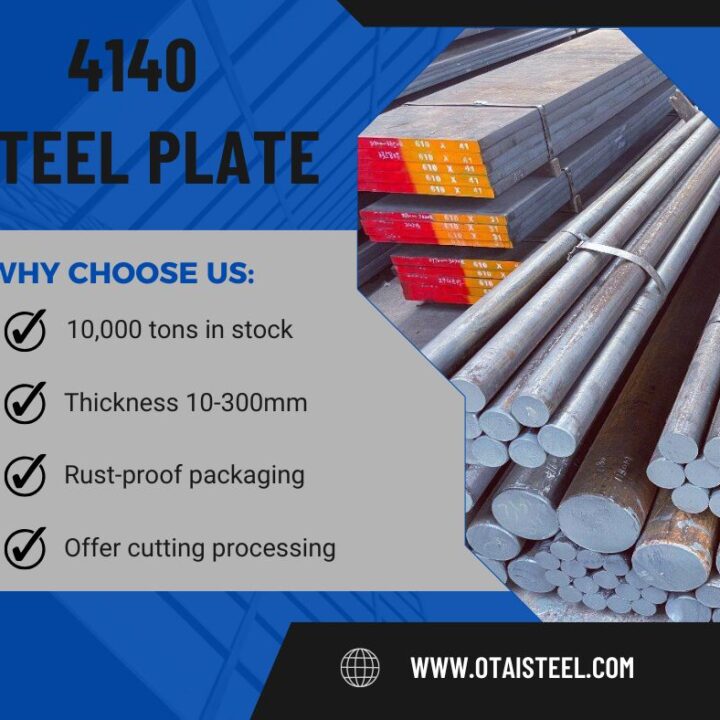
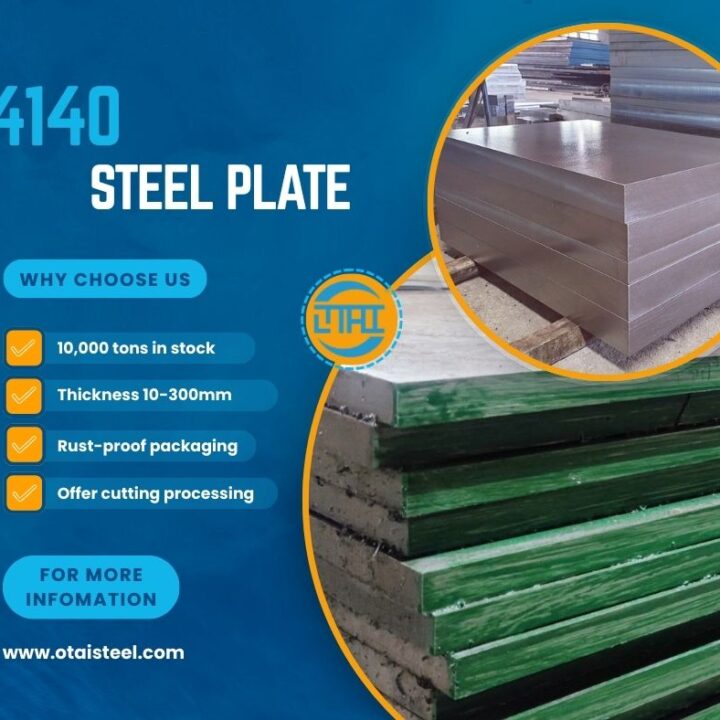
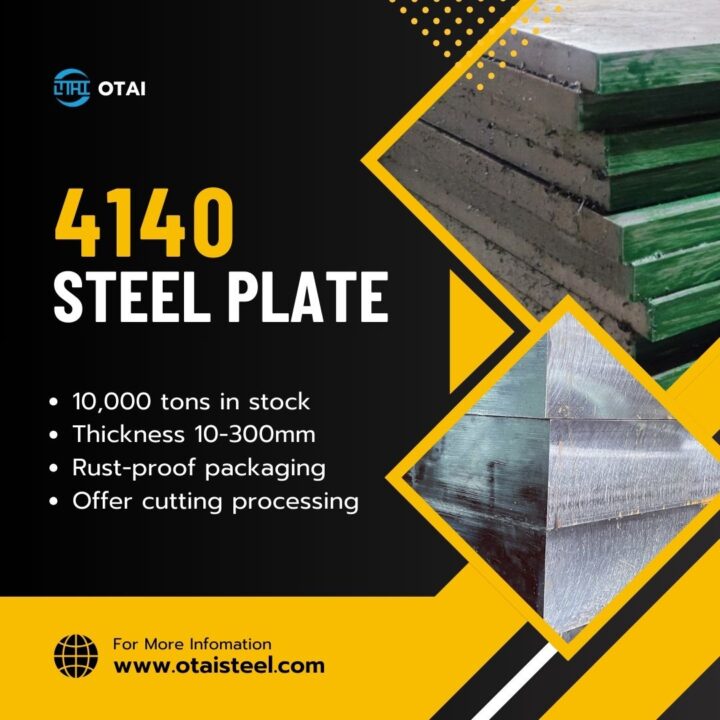
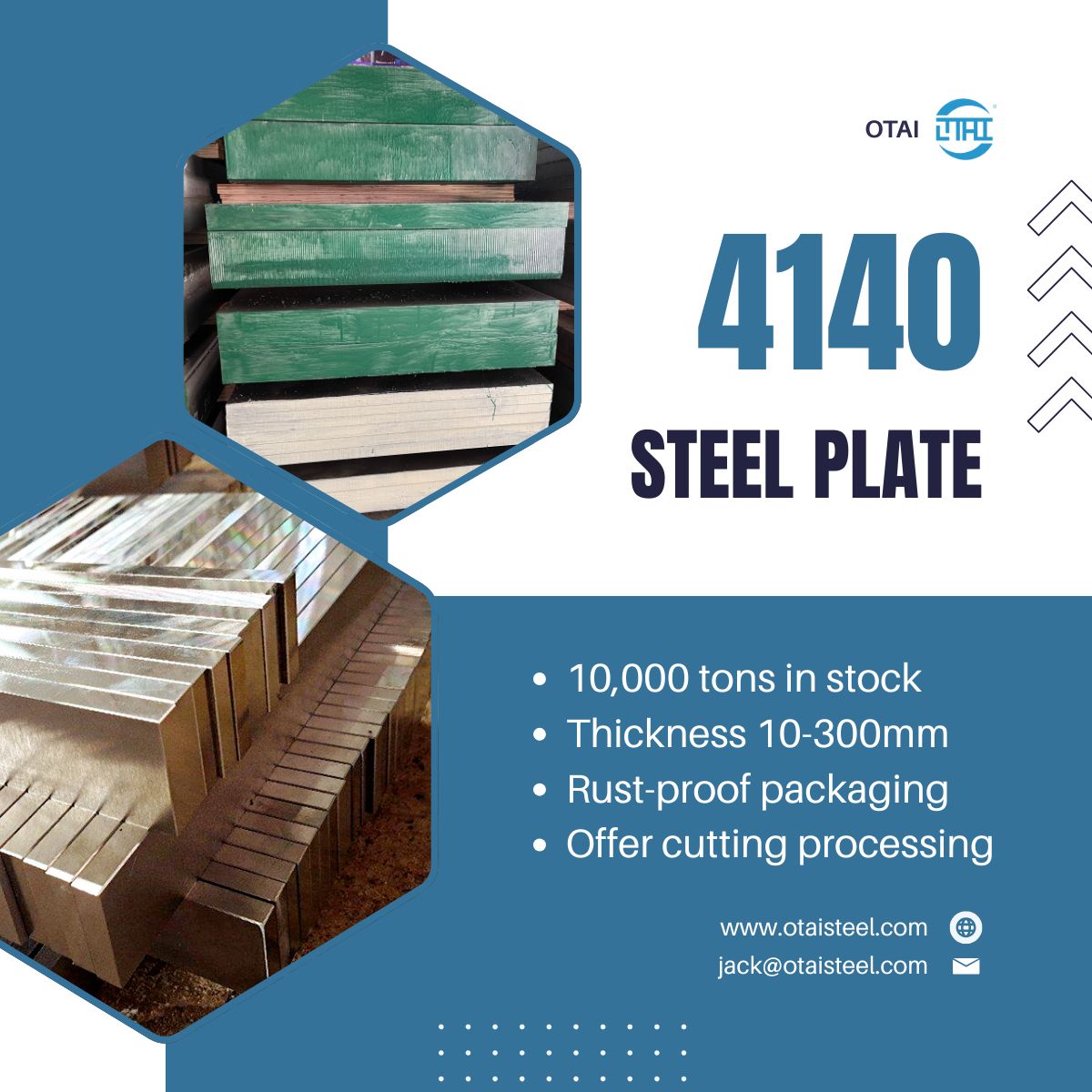
Otai Special Steel is a professional supplier of alloy steel materials, including 4140 steel plates and bars for industrial applications.
- Large inventory: Otai maintains approximately 10,000 tons of steel inventory with different sizes available for customer requirements.
- 4140 steel supply capability: Various thicknesses and dimensions of 4140 alloy steel are available for machining and manufacturing projects.
- Processing services: Cutting, machining support, heat treatment, and customized processing services are available.
- Quality assurance: Ultrasonic testing and third-party inspection can be provided according to customer requirements.
- Export experience: Otai has supplied steel materials to Fortune Global 500 companies and understands strict international standards.
- Professional packaging: Anti-rust packaging, steel strapping, and wooden box packaging ensure safe transportation.
With reliable stock availability and professional technical support, Otai provides suitable 4140 alloy steel solutions for knife makers and industrial customers.
❓ FAQ About 4140 Steel for Knife Making
Q1: Is 4140 steel good for knife making?
Yes. 4140 can make durable knives, especially heavy-duty blades that require excellent toughness and impact resistance.
Q2: Can 4140 steel hold a sharp edge?
4140 can hold an edge reasonably well, but it does not match high-carbon or premium knife steels designed specifically for edge retention.
Q3: What hardness should a 4140 knife have?
A properly heat-treated 4140 knife usually performs well around 45–55 HRC, depending on the application.
Q4: Is 4140 better than 1095 for knives?
Neither steel is universally better. 4140 provides higher toughness, while 1095 usually provides better edge retention.
Q5: Does 4140 steel rust?
Yes. 4140 is not stainless steel, so it requires proper maintenance and surface protection to prevent corrosion.
Q6: Does Otai supply 4140 steel?
Yes. Otai supplies 4140 alloy steel with stock availability, cutting services, heat treatment support, and inspection services.