42CrMo4 Hardness: What Hardness Should You Expect and Specify When Buying?
📑 Table of Contents
- 🔍 1. What Is the Hardness of 42CrMo4 Steel?
- ⚙️ 2. Why 42CrMo4 Hardness Depends on Delivery Condition
- 🔥 3. 42CrMo4 Hardness After Quenching and Tempering
- 📏 4. How Section Size Affects 42CrMo4 Hardness
- 🧪 5. What Chemistry Has to Do with Hardness
- 📋 6. How to Specify 42CrMo4 Hardness When Ordering
- 🔎 7. How to Verify Hardness on the MTC
- 💰 8. Does Higher 42CrMo4 Hardness Increase the Purchase Cost?
- 📦 9. Stock, Cutting and Processing for 42CrMo4
- 🏭 10. 42CrMo4 Supply from Otai Special Steel
- ❓ 42CrMo4 Hardness FAQ
🔍 1. What Is the Hardness of 42CrMo4 Steel?
If you are searching for 42CrMo4 hardness because you are preparing a purchase, the first point to understand is that 42CrMo4 does not have one universal hardness value.
The hardness depends strongly on the condition in which you receive the steel. Annealed 42CrMo4, normalized material, quenched and tempered material, and fully hardened material can show substantially different hardness values even though they all carry the same 42CrMo4 designation.
For this reason, a supplier quotation that simply states “42CrMo4 hardness” without identifying the delivery condition is incomplete for most industrial purchases.
| 42CrMo4 Condition | Typical Hardness Situation | Purchasing Meaning |
|---|---|---|
| Annealed | Relatively low hardness for improved machinability | Suitable when the buyer plans further machining and heat treatment |
| Normalized | Higher hardness and strength than typical annealed material | Useful when the specified delivery condition requires normalized material |
| Quenched and tempered | Commonly supplied with a defined hardness range | Suitable when mechanical properties are required at delivery |
| Hardened | Can reach substantially higher hardness after suitable treatment | Used when high hardness is part of the finished application |
Therefore, before approving a quotation, specify both the grade and the required condition. If your component requires a particular hardness, give the supplier the target range rather than asking for “hard 42CrMo4.”
The useful question is not “How hard is 42CrMo4?” but “What hardness does my required delivery or heat-treatment condition need?”
⚙️ 2. Why 42CrMo4 Hardness Depends on Delivery Condition
42CrMo4 is a chromium-molybdenum alloy steel commonly used for components that require a combination of strength, toughness and hardenability. Its properties change significantly during heat treatment.
Annealed 42CrMo4
Annealing reduces hardness and improves machinability. This condition can make sense when you purchase the steel as a starting material and plan to machine the component before performing your own heat treatment.
In this case, a lower hardness is not a sign of poor quality. It is part of the intended delivery condition.
Quenched and tempered 42CrMo4
Quenching followed by tempering increases strength and hardness while maintaining a useful level of toughness. This condition is widely used for shafts, gears, bolts, axles, connecting components and other mechanical parts.
Depending on the applicable product standard, section size and required mechanical properties, quenched and tempered 42CrMo4 can commonly fall around the 28–36 HRC range for many industrial supply conditions. However, buyers should not treat this range as a universal value for every product.
The exact requirement should come from the relevant standard, purchase specification or component design.
🔥 3. 42CrMo4 Hardness After Quenching and Tempering
When buyers ask about 42CrMo4 hardness, they often mean the hardness after quenching and tempering. This is where the grade develops much of its practical strength and wear resistance.
Typical heat-treatment route
A common heat-treatment sequence includes heating to an austenitizing temperature, quenching, and then tempering. For 42CrMo4, austenitizing temperatures are commonly around 830–870°C, followed by an appropriate quenching process. The exact parameters depend on the product size, furnace conditions, required properties and applicable technical specification.
Tempering then adjusts the balance between hardness, strength and toughness. A lower tempering temperature generally retains more hardness, while a higher tempering temperature can provide a different balance of strength and toughness.
Because the final hardness depends on the complete process, a buyer should not specify only the heating temperature. The supplier or heat-treatment department needs to consider the entire treatment route.
| Heat-Treatment Factor | Effect on Hardness | What Buyers Should Confirm |
|---|---|---|
| Austenitizing temperature | Influences austenite formation and hardenability response | Use the supplier’s grade-specific heat-treatment data |
| Quenching method | Controls cooling rate and resulting hardness | Confirm the appropriate medium for the section size |
| Tempering temperature | Adjusts the final hardness-strength-toughness balance | Specify the required final properties |
| Holding time | Depends on section size and furnace conditions | Follow the applicable heat-treatment procedure |
For precision components, heat treatment also affects distortion and dimensional stability. Consequently, the buyer should consider hardness and dimensional requirements together rather than treating them as separate issues.
📏 4. How Section Size Affects 42CrMo4 Hardness
Even when two pieces use the same 42CrMo4 chemistry and the same heat-treatment cycle, their hardness may differ because of section size.
A small-diameter round bar cools more rapidly throughout its cross-section than a large block or thick plate. A larger section can therefore develop a different hardness distribution between the surface and the center.
Why this matters when ordering
If your application requires a specific mechanical property through a large cross-section, surface hardness alone may not tell you enough about the material.
For example, a large 42CrMo4 component may have a harder surface and a softer center after quenching. The actual result depends on hardenability, cooling conditions, section size and subsequent tempering.
Therefore, when ordering large 42CrMo4 sections, ask the supplier whether the specified mechanical properties apply to the complete section or to a defined test location.
For critical components, additional testing or hardenability information may be appropriate.
Always connect the hardness requirement with the material thickness or diameter.
🧪 5. What Chemistry Has to Do with Hardness
The alloying elements in 42CrMo4 influence hardenability and the response of the steel to heat treatment. Chromium and molybdenum are particularly important because they help the material develop useful hardness at greater section sizes than a simple carbon steel under comparable treatment conditions.
A typical reference composition for 42CrMo4 includes approximately 0.38–0.45% carbon, 0.15–0.40% silicon, 0.60–0.90% manganese, 0.90–1.20% chromium and 0.15–0.30% molybdenum. Exact limits depend on the applicable standard and product specification.
These values should not be confused with a specific mill’s Typical Analysis. The actual heat chemistry should come from the MTC supplied with the material.
Why the MTC matters
If you are buying 42CrMo4 for a heat-treated component, the chemical composition provides traceability for the steel used in production. The MTC can also help your quality department confirm that the material corresponds to the specified grade.
When reviewing the certificate, check:
- Material grade and applicable standard.
- Heat number or batch identification.
- Actual chemical analysis.
- Delivery condition.
- Hardness or mechanical-property results when specified.
- Any additional customer inspection requirements.
This is especially important when comparing 42CrMo4 with related grades such as 4140 or SCM440. Although these grades are commonly considered equivalents or close equivalents in many applications, the exact standard and certification requirements still need confirmation.
📋 6. How to Specify 42CrMo4 Hardness When Ordering
If hardness is important to your application, include it directly in the purchase specification. A supplier should not have to guess whether you need annealed stock for machining or quenched and tempered material for direct component production.
A practical purchasing specification
Your RFQ can include the following information:
- 42CrMo4 grade and applicable standard.
- Product form: plate, round bar or another form.
- Thickness or diameter.
- Required delivery condition.
- Target hardness range.
- Required mechanical properties.
- Dimensional tolerances.
- Surface requirements.
- MTC requirements.
- Ultrasonic testing, if required.
- Third-party inspection, if required.
For example, instead of writing “42CrMo4, hardness required,” a clearer request would identify the product form, dimensions, delivery condition and required hardness range.
This gives the supplier enough information to determine whether existing stock meets the requirement or whether additional heat treatment is necessary.
Do not specify hardness without considering machinability
A higher hardness may sound attractive because it can indicate higher strength and wear resistance. However, excessive hardness can also make machining more difficult.
If your factory needs to turn, mill, drill or thread the material after receipt, the delivery hardness should fit the machining process. For this reason, the correct hardness is the one that matches the finished component and production route—not simply the highest value available.
🔎 7. How to Verify Hardness on the MTC
Once the material arrives, the MTC should provide traceability between the supplied steel and the agreed purchase specification. Depending on the product condition and standard, the certificate may include hardness or mechanical-property results.
Check the hardness scale
Hardness can be reported using different scales, including HRC, HB or HV. These values should not be treated as interchangeable numbers.
| Scale | Typical Use | Buyer Consideration |
|---|---|---|
| HRC | Common for hardened steels | Useful for higher-hardness 42CrMo4 conditions |
| HB | Common for softer and medium-hard materials | Frequently encountered for annealed or supplied structural steel |
| HV | Useful for specific hardness testing requirements | Confirm the specified testing method |
If your purchase specification requires HRC but the supplier provides HB, do not simply treat the numbers as directly equivalent. Use an appropriate conversion standard and confirm that the conversion is valid for the material and hardness range involved.
Inspect critical components carefully
For critical applications, incoming inspection can verify the supplied condition. Hardness testing should follow an appropriate test method and location, particularly for large sections where surface and center properties may differ.
If the order includes special hardness requirements, discuss the testing location and acceptance criteria with the supplier before production.
💰 8. Does Higher 42CrMo4 Hardness Increase the Purchase Cost?
Hardness itself is not normally the only factor determining the price of 42CrMo4. However, a specified heat-treated condition can increase the total purchasing cost because it requires additional processing, testing and quality control.
When comparing quotations, check whether each supplier includes the same condition.
| Quotation Item | Possible Cost Impact |
|---|---|
| Annealed material | Usually avoids final Q&T processing before shipment |
| Quenched and tempered | Includes controlled heat-treatment processing |
| Specified hardness | May require additional testing and process control |
| Precision dimensions | May require additional machining or grinding |
| Inspection | UT or third-party inspection can add cost and lead time |
Therefore, if one supplier quotes 42CrMo4 at a lower price, first check whether both quotations cover the same delivery condition, hardness, dimensions, inspection and processing scope.
Compare the complete delivered specification, not just the price per ton.
📦 9. Stock, Cutting and Processing for 42CrMo4
For industrial buyers, stock availability can reduce lead time when the required 42CrMo4 size and condition already exist in inventory.
However, confirm the actual stock specification rather than asking only whether the supplier “has 42CrMo4.” The available thickness, diameter, condition and quantity all affect whether the material fits your project.
Before placing the order, ask the supplier to confirm:
- Available product form.
- Available thickness or diameter.
- Available quantity.
- Delivery condition.
- Hardness or mechanical-property data.
- Heat number and MTC availability.
- Cutting capability.
- Machining or grinding capability.
- Inspection options.
- Estimated delivery time.
If you require several cut sizes from the same material, provide a cutting list with the RFQ. The supplier can then evaluate whether the available stock can satisfy the complete requirement.
For international purchases, packaging also matters. Appropriate strapping, protective wrapping, anti-rust protection and wooden cases can help protect the steel during transportation, depending on the product and shipping requirements.
🏭 10. 42CrMo4 Supply from Otai Special Steel
For buyers sourcing 42CrMo4 from China, Otai Special Steel combines stock supply with cutting, machining, inspection and export services.
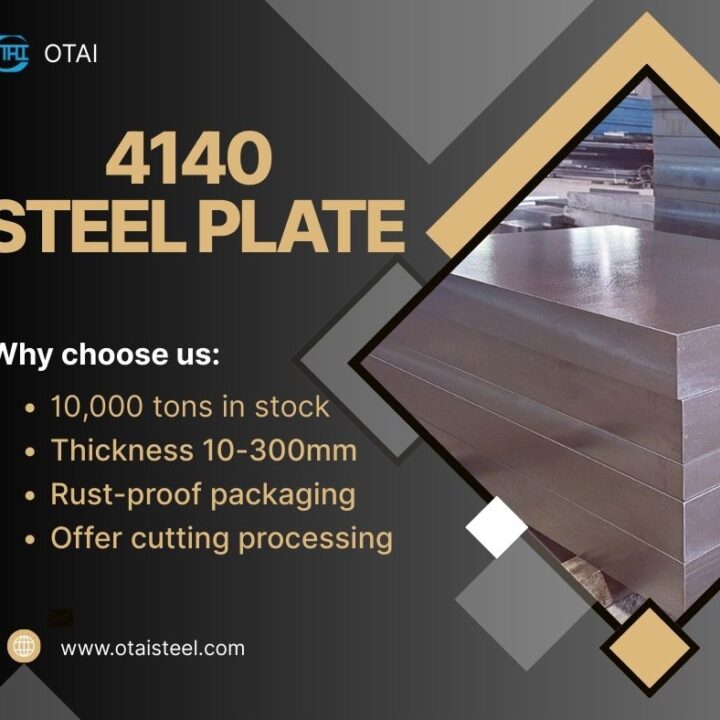
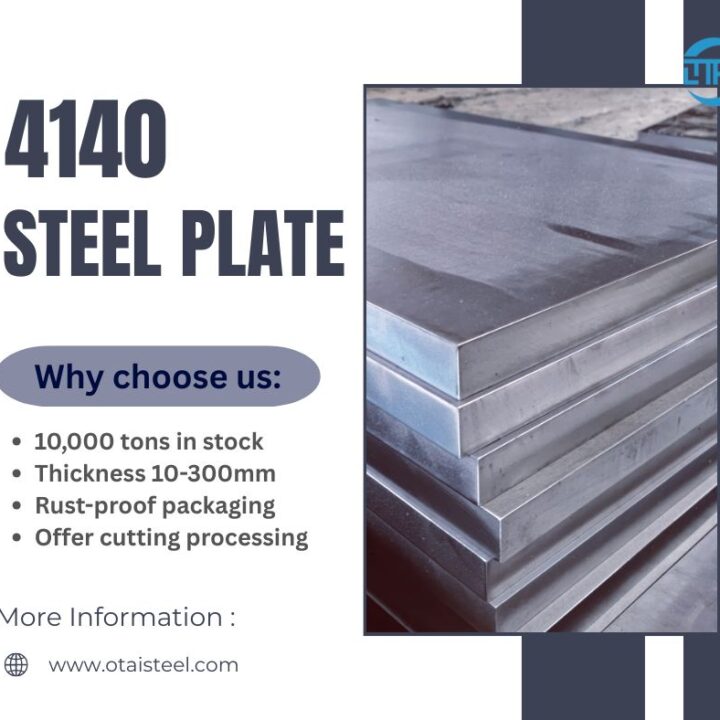
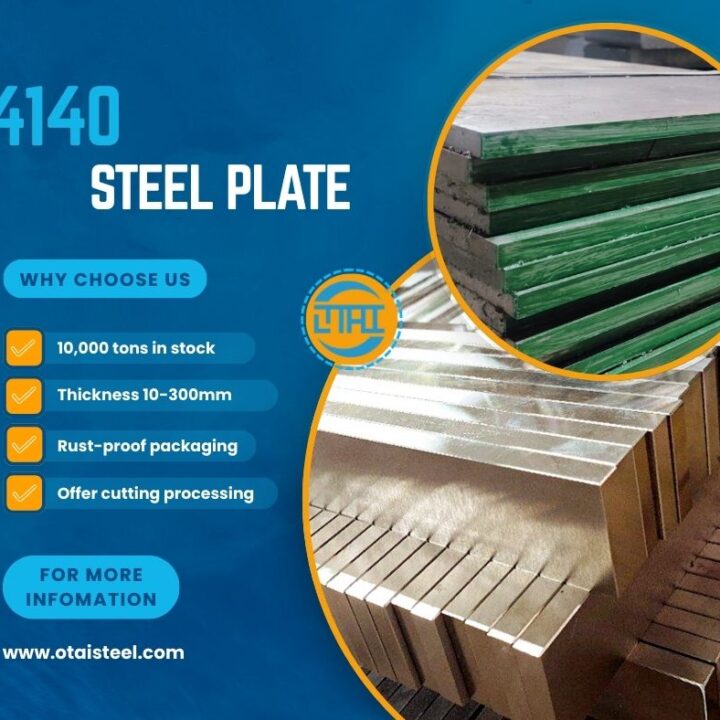
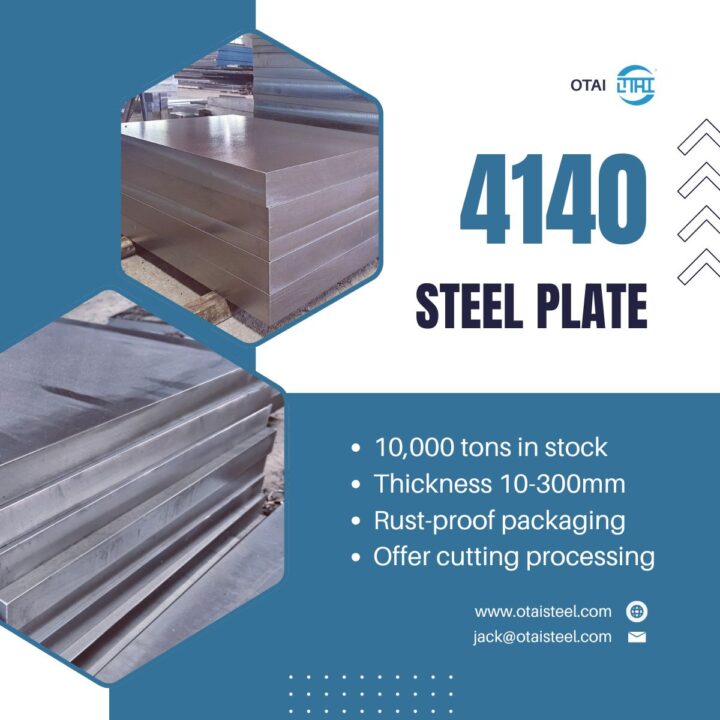
- 📦 42CrMo4 / 4140 / SCM440 steel plate: 4–380 mm thickness in stock.
- 🔥 42CrMo4 / 4140 QT plate: 13–200 mm thickness in stock.
- ⚙️ 42CrMo4 / 4140 / SCM440 round bar: 14–500 mm diameter in stock.
- 🏭 More than 10,000 tons of steel stock across applicable grades and product ranges.
- 🪚 20 saw cutting machines for cutting and material preparation.
- ⚙️ CNC machining and grinding services.
- 📏 Custom dimensions and tolerances according to agreed requirements.
- 🔎 Ultrasonic testing and third-party inspection support.
- 📋 Material testing and MTC documentation support.
- 📦 Export packaging, including strapping, wooden cases and anti-rust protection according to shipment requirements.
- 🌍 Export experience to more than 54 countries since 1999.
- 🤝 One-stop support covering material supply, cutting, processing, inspection and export preparation.
When requesting a 42CrMo4 quotation, provide the required product form, dimensions, quantity, delivery condition and hardness or mechanical-property requirements. This allows the supplier to determine whether existing stock meets your specification or whether additional processing is necessary.
For heat-treated material, it is particularly important to state the required hardness range and applicable standard before the quotation is finalized. That prevents a price comparison between materials with different delivery conditions.
❓ 42CrMo4 Hardness FAQ
1. What is the typical hardness of 42CrMo4?
There is no single hardness value for 42CrMo4. The hardness depends on the delivery condition and heat treatment. Quenched and tempered 42CrMo4 commonly falls around the high-20s to mid-30s HRC range for many industrial conditions, while annealed material has substantially lower hardness.
2. Can 42CrMo4 reach 40 HRC?
42CrMo4 can reach different hardness levels through appropriate heat treatment, and hardness around or above 40 HRC can be achievable depending on the section size and treatment route. The required hardness should be confirmed against the applicable specification and application.
3. What is the hardness of annealed 42CrMo4?
Annealed 42CrMo4 has relatively low hardness compared with quenched and tempered material, which improves machinability. The exact acceptable hardness depends on the applicable product standard and delivery specification.
4. Is 42CrMo4 harder than 4140?
42CrMo4 and AISI 4140 are closely related chromium-molybdenum alloy steels and are commonly compared as corresponding grades. Their actual hardness depends on the product standard, section size and heat-treatment condition rather than the grade name alone.
5. What 42CrMo4 sizes does Otai have in stock?
Otai has 42CrMo4/4140/SCM440 steel plate in 4–380 mm thickness, QT plate in 13–200 mm thickness, and round bar in 14–500 mm diameter in stock. Cutting, CNC machining, grinding and inspection services can also be arranged according to the order requirements.