 16MnCr5 Physical Properties – Density, Thermal Conductivity and Expansion
When engineers select a steel grade for gears, shafts, bearings, and transmission components, they often focus on hardness, strength, and wear resistance. However, the 16MnCr5 physical properties are equally important because they influence machining behavior, heat treatment response, thermal stability, dimensional accuracy, and long-term performance in service.
16MnCr5 is one of the most widely used carburizing steels in Europe and many international markets. Known for its excellent case-hardening capability, this low-alloy chromium-manganese steel combines a hard wear-resistant surface with a tough and durable core. Beyond its mechanical performance, its physical properties play a critical role in determining how components behave during manufacturing and operation.
This article provides a detailed overview of 16MnCr5 material properties, including density, thermal conductivity, thermal expansion coefficient, elastic modulus, specific heat capacity, and electrical resistivity. It also explains how these characteristics affect real industrial applications.
📘 What Are Physical Properties of 16MnCr5?
Physical properties describe how a material behaves under thermal, electrical, magnetic, and environmental conditions. Unlike mechanical properties such as tensile strength and hardness, physical properties generally remain independent of load-bearing performance.
For manufacturers, understanding physical properties helps optimize machining parameters, heat treatment cycles, dimensional tolerances, and product reliability.
In the case of 16MnCr5, these properties make the steel particularly suitable for precision gears, transmission shafts, sprockets, and heavily loaded rotating components.
⚙️ Overview of 16MnCr5 Physical Properties
| Property | Typical Value |
|---|---|
| Density | 7.85 g/cm³ |
| Elastic Modulus | 210 GPa |
| Thermal Conductivity | 42–46 W/m·K |
| Thermal Expansion Coefficient | 11.5–12.5 ×10⁻⁶/K |
| Specific Heat Capacity | 460 J/kg·K |
| Electrical Resistivity | 0.20–0.25 μΩ·m |
These values may vary slightly depending on the exact chemical composition, manufacturing process, and heat treatment condition.
⚖️ Density of 16MnCr5 Steel
The 16MnCr5 density is approximately 7.85 g/cm³, which is similar to most alloy steels used in mechanical engineering.
Density directly influences component weight, rotational inertia, and transportation costs. Designers use density calculations when developing gears, shafts, couplings, and other rotating components.
| Unit | Value |
|---|---|
| g/cm³ | 7.85 |
| kg/m³ | 7850 |
| lb/in³ | 0.284 |
For large gearboxes and industrial transmission systems, accurate density values are essential when calculating total assembly weight and dynamic loads.
📏 Elastic Modulus of 16MnCr5
The 16MnCr5 elastic modulus is approximately 210 GPa.
Elastic modulus measures the stiffness of a material and indicates how much it will deform under load.
A high modulus of elasticity provides several advantages:
- Reduced shaft deflection.
- Improved gear tooth alignment.
- Enhanced dimensional stability.
- Better vibration control.
- Higher precision in power transmission systems.
In gear manufacturing, stiffness is particularly important because excessive deformation can lead to uneven tooth loading, increased wear, and premature failure.
🔥 Thermal Conductivity of 16MnCr5
The 16MnCr5 thermal conductivity typically ranges between 42 and 46 W/m·K.
Thermal conductivity determines how effectively heat moves through the material.
This property is important during:
- Heat treatment operations.
- Carburizing processes.
- High-speed machining.
- Grinding operations.
- High-temperature industrial service.
During carburizing, heat must distribute evenly throughout the component to achieve a uniform case depth. The moderate thermal conductivity of 16MnCr5 helps support consistent heat treatment results.
For machining operations, efficient heat dissipation can reduce tool wear and improve surface quality.
🌡️ Thermal Expansion Coefficient
The 16MnCr5 thermal expansion coefficient is approximately 11.5–12.5 ×10⁻⁶/K.
This value indicates how much the material expands when exposed to increasing temperatures.
| Temperature Range | Expansion Coefficient |
|---|---|
| 20–100°C | 11.5 ×10⁻⁶/K |
| 20–200°C | 12.0 ×10⁻⁶/K |
| 20–300°C | 12.5 ×10⁻⁶/K |
This characteristic is critical when manufacturing precision gears and transmission components because thermal expansion directly affects dimensional accuracy and operating clearances.
“`html id=”16mncr5pp2″
🔥 Specific Heat Capacity of 16MnCr5
The specific heat capacity of 16MnCr5 is approximately 460 J/kg·K. This property describes the amount of heat energy required to raise the temperature of one kilogram of material by one degree Kelvin.
Although this parameter may appear less important than hardness or strength, it plays a major role during heat treatment and thermal processing.
During carburizing, quenching, and tempering, engineers rely on specific heat capacity data to calculate heating times, furnace efficiency, and cooling rates. Accurate control of these factors helps ensure uniform microstructure and consistent mechanical properties throughout the component.
For large gears and shafts, understanding heat absorption behavior is especially important because uneven heating can create internal stresses, distortion, or dimensional inaccuracies.
| Property | Typical Value |
|---|---|
| Specific Heat Capacity | 460 J/kg·K |
| Heat Treatment Relevance | High |
| Influence on Distortion Control | Significant |
⚡ Electrical Resistivity of 16MnCr5
The electrical resistivity of 16MnCr5 generally falls between 0.20 and 0.25 μΩ·m.
Although 16MnCr5 is not normally selected for electrical applications, resistivity data becomes useful in several manufacturing processes.
For example, induction hardening systems rely on electromagnetic fields to generate heat within steel components. Electrical resistivity influences heating efficiency and process control.
Manufacturers producing gears, splines, and shafts often use induction heating to harden localized areas while minimizing distortion in the rest of the component.
| Property | Typical Value |
|---|---|
| Electrical Resistivity | 0.20–0.25 μΩ·m |
| Electrical Conductivity | Moderate |
| Suitability for Induction Heating | Excellent |
📊 Physical Properties vs Mechanical Properties
Many buyers confuse physical properties with mechanical properties. While both are important, they describe different aspects of material performance.
| Physical Properties | Mechanical Properties |
|---|---|
| Density | Yield Strength |
| Thermal Conductivity | Tensile Strength |
| Thermal Expansion | Hardness |
| Specific Heat Capacity | Impact Toughness |
| Electrical Resistivity | Fatigue Strength |
When evaluating 16MnCr5 steel characteristics, engineers must consider both categories. Physical properties affect manufacturing and thermal behavior, while mechanical properties determine load-carrying performance.
⚙️ How Physical Properties Affect Gear Manufacturing
One of the most common applications for 16MnCr5 is gear production. The physical properties of the material directly influence manufacturing efficiency and product quality.
For example, thermal expansion affects dimensional stability during heat treatment. If expansion is not properly controlled, gear teeth may distort, requiring additional grinding operations.
Thermal conductivity impacts how quickly heat spreads during carburizing and quenching. Uniform heat distribution helps achieve consistent case depth and hardness across all gear teeth.
Density influences rotational inertia, which becomes important in high-speed transmissions where balancing and dynamic performance are critical.
Elastic modulus determines how much gear teeth deflect under load. Higher stiffness improves load distribution and reduces localized stress concentrations.
As a result, understanding 16MnCr5 engineering properties allows manufacturers to optimize both production processes and component performance.
🏭 Real Industrial Applications
The combination of physical and mechanical properties makes 16MnCr5 suitable for a wide range of industrial applications.
| Industry | Typical Components | Property Benefit |
|---|---|---|
| Automotive | Transmission gears | Wear resistance and stiffness |
| Industrial Gearboxes | Gear wheels and shafts | Fatigue resistance and dimensional stability |
| Agricultural Machinery | Drive systems | Durability under cyclic loads |
| Mining Equipment | Heavy-duty gears | High surface hardness |
| Machine Building | Pinions and couplings | Reliable heat treatment response |
These applications demonstrate why 16MnCr5 remains one of the most trusted case-hardening steels in global engineering industries.
🏆 Company Advantages – Otai Special Steel
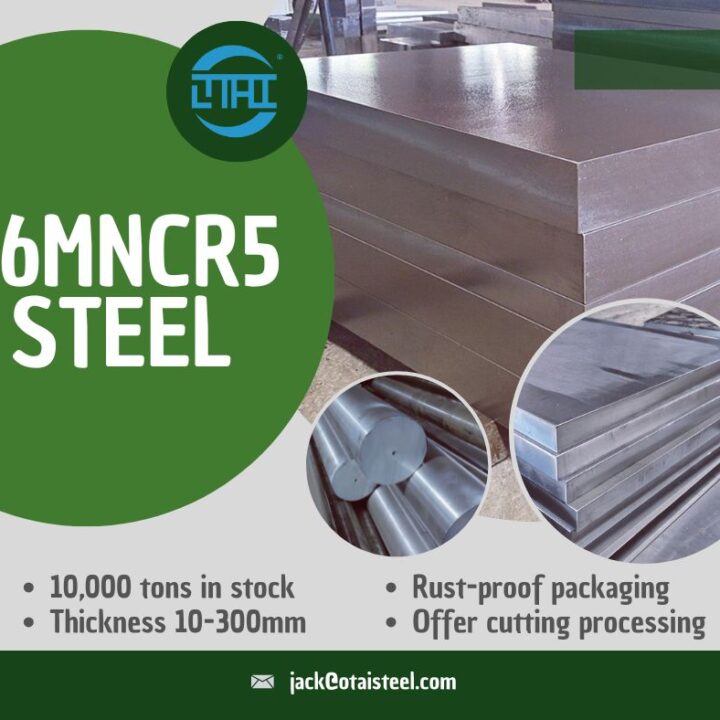
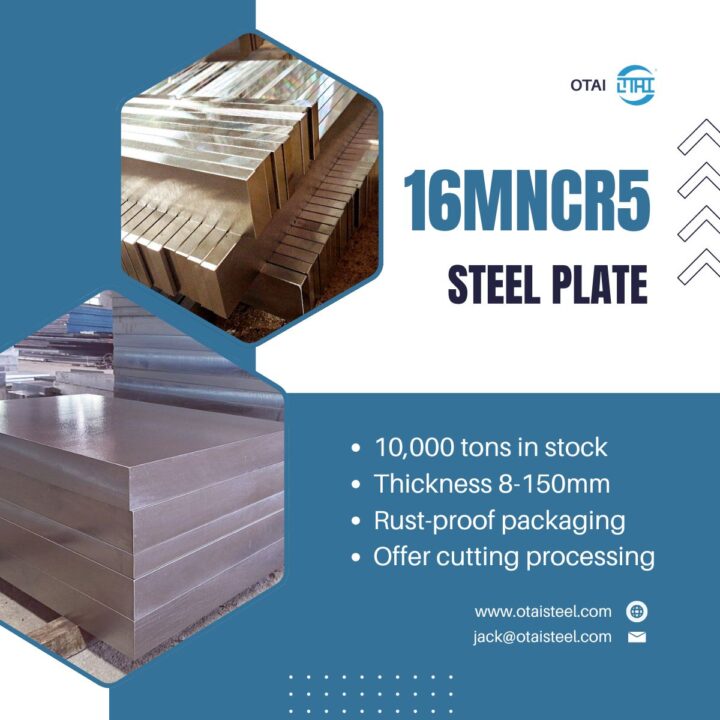
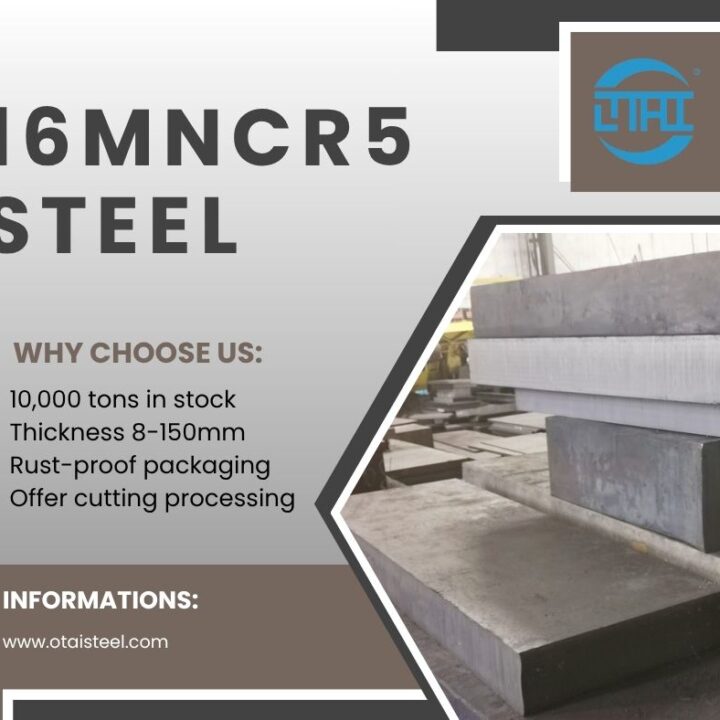
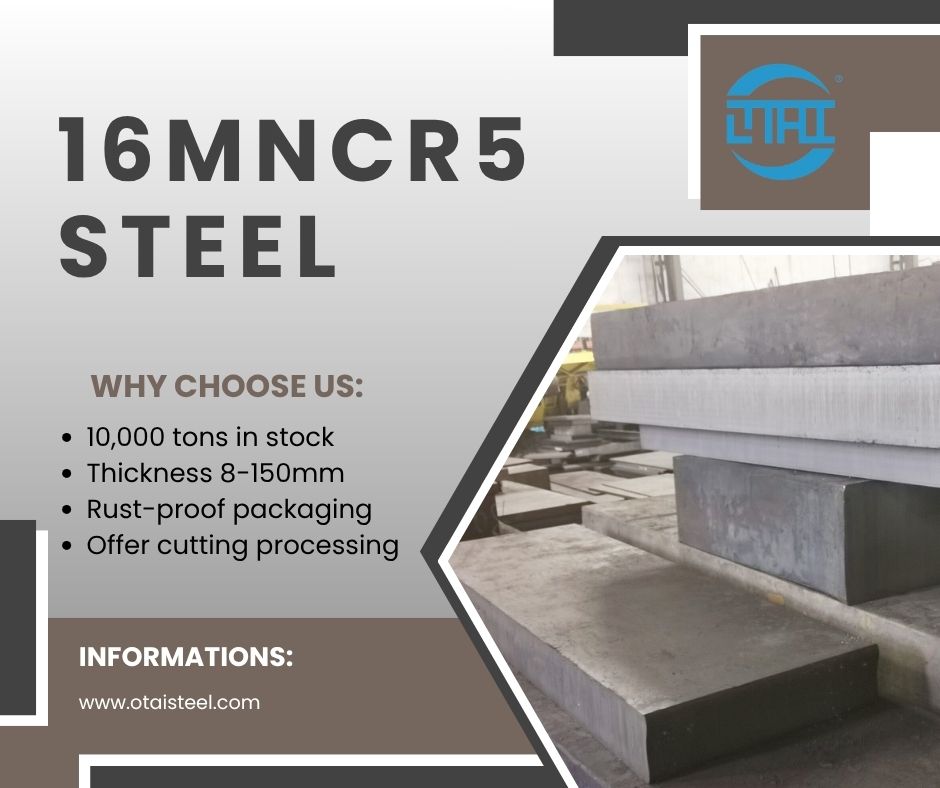
- Professional supplier of 16MnCr5 steel plates, round bars, and forged blocks.
- Sufficient inventory with 8–150 mm thickness plates available in stock.
- More than 10,000 tons of steel inventory available year-round.
- Custom cutting services according to customer drawings and dimensions.
- Heat treatment support including annealing, carburizing, quenching, and tempering.
- Ultrasonic testing (UT) available for internal quality verification.
- Chemical composition and mechanical property testing.
- Third-party inspections such as SGS available upon request.
- Stable export supply chain serving customers worldwide.
- Fast delivery and competitive pricing.
📌 FAQ
Q1: What is the density of 16MnCr5?
A: The density of 16MnCr5 is approximately 7.85 g/cm³ or 7850 kg/m³.
Q2: What is the thermal conductivity of 16MnCr5?
A: It typically ranges between 42 and 46 W/m·K.
Q3: What is the elastic modulus of 16MnCr5?
A: The elastic modulus is approximately 210 GPa.
Q4: Why is thermal expansion important for gears?
A: Thermal expansion affects dimensional accuracy, gear tooth alignment, and heat treatment distortion control.
Q5: Are physical properties affected by carburizing?
A: Physical properties such as density and elastic modulus remain relatively stable, while mechanical properties like hardness and strength change significantly after carburizing and heat treatment.