 Phase Diagram 4140 Steel – Understanding Microstructure and Heat Treatment
The phase diagram of 4140 steel is a critical tool for engineers, metallurgists, and manufacturers working with chromium-molybdenum alloy steel. Understanding the phase transitions in 4140 steel allows precise heat treatment control, ensuring components achieve optimal hardness, strength, and toughness. 4140 steel is widely used for shafts, gears, axles, and high-strength machinery components, where microstructure dictates performance under load and fatigue.
🔍 Overview of 4140 Steel
4140 steel is a low-alloy chromium-molybdenum steel with the following characteristics:
- Good tensile strength and impact resistance
- Excellent hardness potential after quenching and tempering
- Reliable wear and fatigue resistance
- Good machinability in annealed condition
Typical applications include:
- Automotive and aerospace shafts, gears, and pins
- Hydraulic and pneumatic cylinders
- Heavy-duty machinery components
- Industrial rollers and couplings
Its chemical composition allows controlled phase transformations during heat treatment, enabling a balance between surface hardness and core toughness.
Chemical Composition of 4140 Steel
| Element | Content (%) |
|---|---|
| Carbon (C) | 0.38 – 0.43 |
| Silicon (Si) | 0.15 – 0.35 |
| Manganese (Mn) | 0.75 – 1.00 |
| Chromium (Cr) | 0.80 – 1.10 |
| Molybdenum (Mo) | 0.15 – 0.25 |
| Phosphorus (P) | ≤ 0.035 |
| Sulfur (S) | ≤ 0.040 |
Insight: Chromium and molybdenum improve hardness and hardenability, while manganese increases tensile strength and toughness.
📊 Understanding the Phase Diagram
The phase diagram of 4140 steel shows how the steel transforms at different temperatures and carbon content levels. Key phases include:
- Ferrite (α): Soft, ductile phase present at low temperatures.
- Austenite (γ): Face-centered cubic structure forming above the critical temperature (around 727°C for eutectoid steel).
- Cementite (Fe₃C): Hard, brittle phase that contributes to wear resistance.
- Martensite: Hard, supersaturated phase formed by rapid quenching from the austenite region.
| Phase | Temperature Range (°C) | Properties |
|---|---|---|
| Ferrite (α) | < 727 | Soft, ductile, low strength |
| Austenite (γ) | 727 – 900 | High-temperature phase, transforms to martensite upon quenching |
| Cementite (Fe₃C) | Any | Hard and brittle, forms pearlite with ferrite |
| Martensite | After quenching | Very hard, high strength, brittle if untempered |
Engineering Tip: To achieve the desired balance of hardness and toughness, 4140 steel is typically austenitized, quenched, and tempered. Understanding the phase diagram helps optimize quenching temperature and tempering conditions.
🔥 Heat Treatment Based on Phase Diagram
The 4140 phase diagram informs critical temperatures for heat treatment:
| Process | Temperature | Purpose |
|---|---|---|
| Annealing | 830 – 850°C | Soften steel for machining |
| Normalizing | 850 – 900°C | Refine grain structure, improve uniformity |
| Quenching | 820 – 860°C (oil/water) | Transform austenite to martensite for hardness |
| Tempering | 400 – 600°C | Reduce brittleness, achieve target toughness |
Practical Tip: A quench in oil produces slightly lower stresses than water, reducing distortion in long shafts and heavy machinery components.
⚙️ Microstructure and Performance
Understanding the phase diagram helps predict microstructure evolution:
- Annealed 4140: Mixture of ferrite and pearlite for machinability
- Normalized 4140: Uniform ferrite-pearlite, slightly higher strength
- Quenched 4140: Martensitic structure for high hardness
- Tempered 4140: Martensite tempered to balance hardness and toughness
This understanding is essential for automotive gears, hydraulic shafts, and high-speed machinery, where microstructural uniformity prevents fatigue and wear failures.
⚙️ Applications
| Industry | Components | Notes |
|---|---|---|
| Automotive | Shafts, gears, pinions | High tensile strength and fatigue resistance |
| Aerospace | Landing gear, hydraulic cylinders | Balanced toughness and hardness |
| Industrial Machinery | Rollers, couplings | Resists wear and cyclic loads |
| Oil & Gas | Pump shafts, valves | High surface hardness and core toughness |
Case Example: A 4140 quench-tempered shaft can reach hardness of 55–60 HRC while maintaining core toughness >500 MPa, essential for high-speed gearboxes.
🏭 Company Advantages
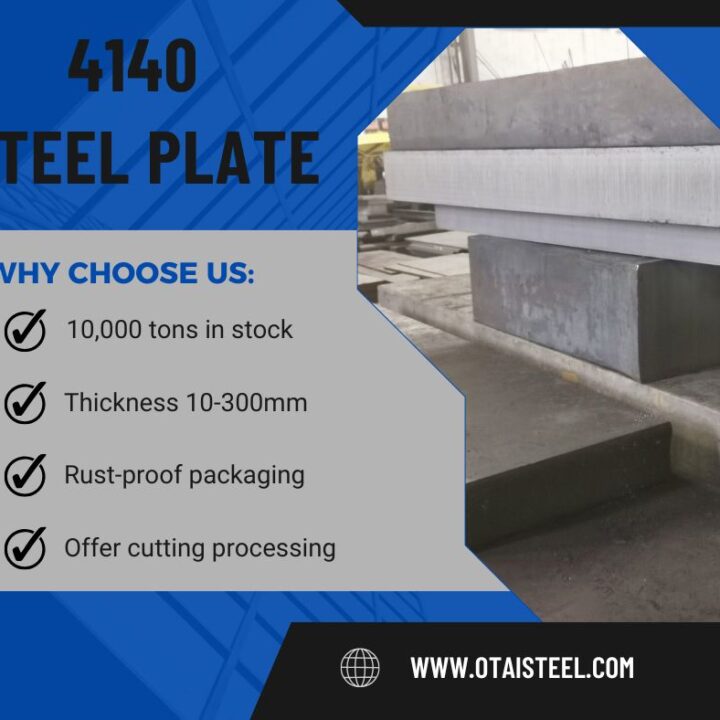
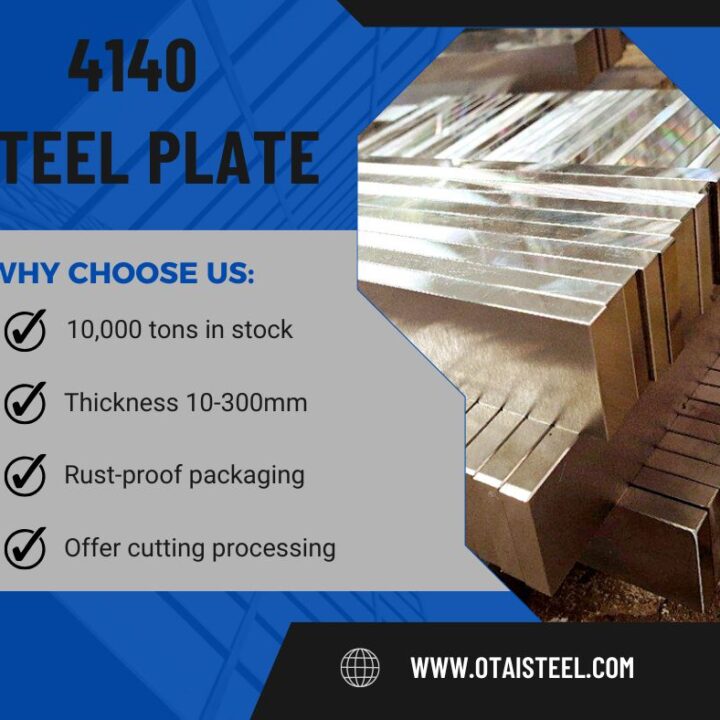
Otai Special Steel provides high-quality 4140 steel with complete services:
- Large inventory and reliable supply
- Custom cutting, heat treatment, and surface finishing
- Ultrasonic testing (UT) and chemical composition verification
- Third-party inspection support (SGS)
- Professional export packaging
We serve automotive, aerospace, industrial, and oil & gas sectors, providing technical support and consistent material performance.
❓ FAQ
Q1: Why is the phase diagram important for 4140 steel?
A1: It shows phase transformations at different temperatures, guiding heat treatment and microstructure control.
Q2: What are the main phases in 4140 steel?
A2: Ferrite, austenite, cementite, and martensite.
Q3: How does the phase diagram affect quenching and tempering?
A3: It determines austenitizing temperature, quenching rates, and tempering range for desired hardness and toughness.
Q4: Can 4140 steel achieve both high hardness and ductility?
A4: Yes, by quenching to form martensite and tempering, achieving a balance between surface hardness and core toughness.
Q5: What components benefit most from phase diagram-guided heat treatment?
A5: Shafts, gears, pinions, hydraulic cylinders, rollers, and pump shafts under high stress or cyclic loads.