 What Does 16MnCr5 Mean? Steel Definition, Composition and Applications
📑 Table of Contents
🔍 1. What Does 16MnCr5 Mean in Steel?
⚙️ 2. Chemical Meaning Behind 16MnCr5
📊 3. 16MnCr5 Chemical Composition and Data Sheet
🔥 4. Heat Treatment Meaning of 16MnCr5
💪 5. Mechanical Properties and Hardness of 16MnCr5
⚖️ 6. 16MnCr5 Equivalent Grades Worldwide
🏭 7. Applications of 16MnCr5 Steel
📦 8. Otai Special Steel Advantages
🔍 1. What Does 16MnCr5 Mean in Steel?
Many engineers search for what does 16MnCr5 mean because this steel grade name contains several important clues about its chemical composition and engineering purpose.
16MnCr5 is a European alloy steel grade mainly used as a carburizing steel for manufacturing gears, shafts, and mechanical transmission components. It belongs to the EN 10084 standard family of case-hardening steels.
The meaning of 16MnCr5 comes from its designation system. Each part of the name represents specific information about the steel:
| Part of Grade Name | Meaning |
|---|---|
| 16 | Approximately 0.16% carbon content |
| Mn | Manganese alloying element |
| Cr | Chromium alloying element |
| 5 | Approximate chromium content factor in the EN naming system |
Therefore, when asking what does 16MnCr5 mean, the simple explanation is:
16MnCr5 means a low-carbon manganese-chromium alloy steel containing about 0.16% carbon, designed mainly for carburizing treatment to create a hard wear-resistant surface with a tough core.
Unlike high-carbon steels that achieve hardness throughout the entire section, 16MnCr5 carburizing steel is designed to provide two different properties:
- Hard surface layer: improves wear resistance and contact fatigue strength.
- Tough inner core: provides impact resistance and prevents cracking.
Basic Characteristics of 16MnCr5 Steel
| Item | Description |
|---|---|
| Steel Grade | 16MnCr5 |
| Standard | EN 10084 |
| Material Type | Case-hardening alloy steel |
| Main Alloy Elements | Manganese and Chromium |
| Main Heat Treatment | Carburizing + quenching |
| Main Applications | Gears, shafts, transmission parts |
The popularity of DIN 16MnCr5 steel comes from its ability to provide excellent surface hardness while maintaining a strong and reliable core structure.
This makes it especially suitable for components that experience repeated contact stress, friction, and mechanical loading.
⚙️ 2. Chemical Meaning Behind 16MnCr5
To fully understand what does 16MnCr5 mean, it is necessary to look at the role of each alloying element.
The chemical design of 16MnCr5 focuses on achieving excellent carburizing performance. The steel contains relatively low carbon content, which allows the core to remain tough after the surface treatment process.
Role of Main Elements in 16MnCr5 Steel
| Element | Function in Steel |
|---|---|
| Carbon (C) | Controls hardness and strength. Lower carbon allows a tough core after carburizing. |
| Manganese (Mn) | Improves hardenability and tensile strength. |
| Chromium (Cr) | Improves wear resistance and surface hardness after carburizing. |
| Silicon (Si) | Acts as a deoxidizer and improves strength. |
| Molybdenum (Mo) | Normally very low or absent in standard 16MnCr5. |
The combination of manganese and chromium makes 16MnCr5 alloy steel a reliable choice for applications requiring both surface durability and core toughness.
Why Is Carbon Content Important in 16MnCr5?
The carbon content of approximately 0.16% is a key reason why this grade performs well as a carburizing steel.
Before carburizing, the steel remains relatively soft and easy to machine. During carburizing, carbon atoms diffuse into the surface layer, creating a high-carbon hardened zone after quenching.
| Steel Condition | Carbon Distribution | Result |
|---|---|---|
| Before Carburizing | Low carbon throughout material | Tough and machinable |
| After Carburizing | High carbon surface + low carbon core | Hard surface and tough core |
| After Quenching | Hardened surface layer | Excellent wear resistance |
This unique structure explains why 16MnCr5 steel meaning is closely related to gears and transmission components.
📊 3.Chemical Composition and Data Sheet
The chemical composition of 16MnCr5 determines its carburizing ability and final mechanical performance. The following data represents typical values according to EN standards.
Typical Chemical Composition of 16MnCr5 Steel
| Element | Typical Content (%) |
|---|---|
| Carbon (C) | 0.14–0.19 |
| Silicon (Si) | ≤0.40 |
| Manganese (Mn) | 1.00–1.30 |
| Chromium (Cr) | 0.80–1.10 |
| Phosphorus (P) | ≤0.025 |
| Sulfur (S) | ≤0.035 |
The balanced chemistry allows 16MnCr5 steel data sheet specifications to meet demanding requirements in automotive and industrial gear manufacturing.
Compared with plain carbon steel, 16MnCr5 provides better hardenability and improved resistance to surface damage.
🔥 4. Heat Treatment Meaning of 16MnCr5
Understanding what does 16MnCr5 mean also requires understanding its heat treatment process. Unlike conventional alloy steels that are mainly hardened throughout the entire section, 16MnCr5 is designed specifically for case hardening.
The main purpose of heat treatment for 16MnCr5 carburizing steel is to create a hard and wear-resistant surface while keeping the internal core tough enough to withstand impact and dynamic loads.
Common Heat Treatment Process of 16MnCr5 Steel
| Process | Temperature Range | Purpose |
|---|---|---|
| Carburizing | 850–950°C | Increase carbon content on the surface layer |
| Quenching | After carburizing | Create high hardness martensitic surface |
| Tempering | Approx. 150–200°C | Reduce internal stress and improve toughness |
| Annealing (before machining) | Approx. 650–700°C | Improve machinability |
How Carburizing Changes 16MnCr5 Performance
The most important feature of 16MnCr5 steel heat treatment is the carburizing process.
During carburizing, carbon atoms penetrate into the surface of the steel. After quenching, the surface becomes very hard, while the core keeps lower carbon content and higher toughness.
| Area | Carbon Level | Mechanical Performance |
|---|---|---|
| Surface Layer | High carbon concentration | High hardness and wear resistance |
| Transition Zone | Medium carbon concentration | Balanced strength |
| Core | Low carbon content | Excellent toughness and impact resistance |
This combination explains why 16MnCr5 case hardening steel is widely used for gears and transmission components.
For example, a gear tooth requires a very hard surface to resist wear, but the center of the gear must remain tough enough to absorb shock loads.
Typical Carburized Layer Depth
| Application | Typical Case Depth |
|---|---|
| Small gears | 0.5–1.0 mm |
| Automotive transmission gears | 1.0–1.5 mm |
| Heavy-duty gears | 1.5–2.0 mm or more |
Choosing the correct carburizing depth depends on component size, loading condition and expected service life.
💪 5. Mechanical Properties and Hardness
The mechanical properties of 16MnCr5 depend on the supply condition and heat treatment process. Before carburizing, the material offers good machinability. After carburizing and quenching, the surface hardness increases significantly.
This balance between machinability and final hardness is one of the main reasons why 16MnCr5 alloy steel is preferred for precision mechanical components.
Mechanical Properties of 16MnCr5 Steel
| Condition | Tensile Strength | Yield Strength | Hardness |
|---|---|---|---|
| Annealed / Soft Condition | Approx. 600–700 MPa | Approx. 350–450 MPa | 170–220 HB |
| Normalized Condition | Approx. 700–850 MPa | Approx. 450–600 MPa | 200–260 HB |
| Carburized + Quenched | High surface strength | High fatigue resistance | 58–62 HRC surface |
16MnCr5 Hardness Characteristics
| Area | Typical Hardness | Main Benefit |
|---|---|---|
| Carburized Surface | 58–62 HRC | Excellent wear resistance |
| Core | 30–45 HRC (depending on treatment) | Good toughness |
| Untreated Material | 170–220 HB | Easy machining |
Advantages of 16MnCr5 Mechanical Performance
- High surface hardness: suitable for gears and wear applications.
- Tough core structure: prevents sudden failure under impact loads.
- Good fatigue resistance: suitable for repeated mechanical stress.
- Excellent dimensional stability: suitable for precision components.
Compared with many general-purpose steels, 16MnCr5 steel hardness after carburizing provides a better combination of surface durability and internal strength.
⚖️ 6. 16MnCr5 Equivalent Grades Worldwide
When international buyers search for what does 16MnCr5 mean, they often need to understand its equivalent materials in different standards.
16MnCr5 is mainly a European designation. Other countries use different naming systems, but some grades provide similar chemical composition and performance.
16MnCr5 Equivalent Material Comparison
| Standard | Equivalent Grade | Country / Region |
|---|---|---|
| EN | 16MnCr5 | Europe |
| DIN | 16MnCr5 / 1.7131 | Germany |
| JIS | SCM415 (similar) | Japan |
| AISI / SAE | 5115 (similar) | USA |
| GB | 15CrMn | China |
16MnCr5 vs 20MnCr5
| Feature | 16MnCr5 | 20MnCr5 |
|---|---|---|
| Carbon Content | Approx. 0.16% | Approx. 0.20% |
| Hardening Ability | Good | Slightly higher |
| Toughness | Excellent | Very good |
| Main Application | Gears and shafts | Higher load gears |
The choice between 16MnCr5 and other carburizing steels depends on component size, required hardness, load conditions and production requirements.
🏭 7. Applications
After understanding what does 16MnCr5 mean, it is easier to understand why this material is widely selected for mechanical transmission components.
The main purpose of 16MnCr5 carburizing steel is to manufacture parts that require a hard wear-resistant surface and a tough internal structure. This makes it especially suitable for components exposed to friction, repeated loading and impact forces.
Because of its excellent carburizing performance, DIN 16MnCr5 steel has become a common material in automotive, machinery and industrial manufacturing.
Common Applications of 16MnCr5 Steel
| Industry | Typical Components | Reason for Selection |
|---|---|---|
| Automotive Industry | Transmission gears, shafts, pinions, sprockets | High surface hardness and fatigue resistance |
| Gear Manufacturing | Helical gears, spur gears, planetary gears | Excellent wear resistance after carburizing |
| Mechanical Engineering | Drive components, bushings, connecting parts | Good combination of strength and toughness |
| Agricultural Machinery | Gearboxes, shafts, rotating parts | Resists repeated mechanical loads |
| Industrial Equipment | Precision transmission components | Stable dimensional performance |
Why Is 16MnCr5 Used for Gear Manufacturing?
Gears require two opposite properties. The tooth surface must be extremely hard to resist wear, while the gear core must remain tough enough to absorb impact.
This is exactly why engineers choose 16MnCr5 gear steel.
| Gear Requirement | How 16MnCr5 Provides It |
|---|---|
| Wear resistance | Carburized surface reaches high hardness |
| Impact resistance | Low-carbon core maintains toughness |
| Fatigue resistance | Strong hardened layer improves contact strength |
| Long service life | Balanced surface and core properties |
Advantages of Using 16MnCr5 Compared with Carbon Steel
Compared with ordinary carbon steels, 16MnCr5 alloy steel provides better performance in demanding mechanical applications.
| Property | Carbon Steel | 16MnCr5 Steel |
|---|---|---|
| Surface Hardness | Limited | Very high after carburizing |
| Wear Resistance | Average | Excellent |
| Core Toughness | Depends on grade | Very good |
| Gear Applications | Limited | Widely used |
For manufacturers producing gears and mechanical transmission parts, selecting the correct carburizing steel can significantly improve component reliability and service life.
This is the practical meaning behind what does 16MnCr5 mean: it represents a carefully designed alloy steel for achieving a hard surface and durable core.
📦 8. Otai Special Steel Advantages
Otai Special Steel supplies 16MnCr5 steel and other alloy steels for customers worldwide who require stable quality, reliable supply and professional material support.
With experience in international steel trading, Otai provides solutions from material selection to processing and export delivery.
Why Choose Otai Special Steel?
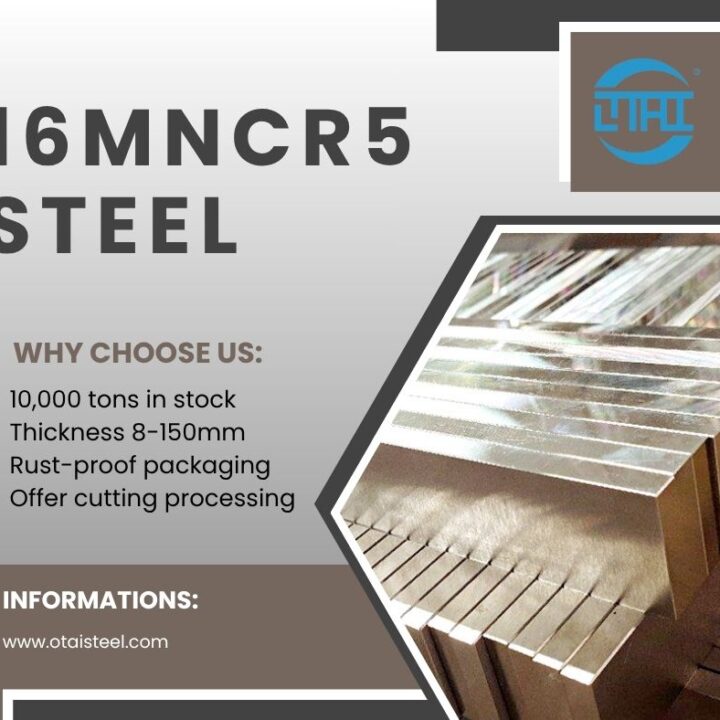
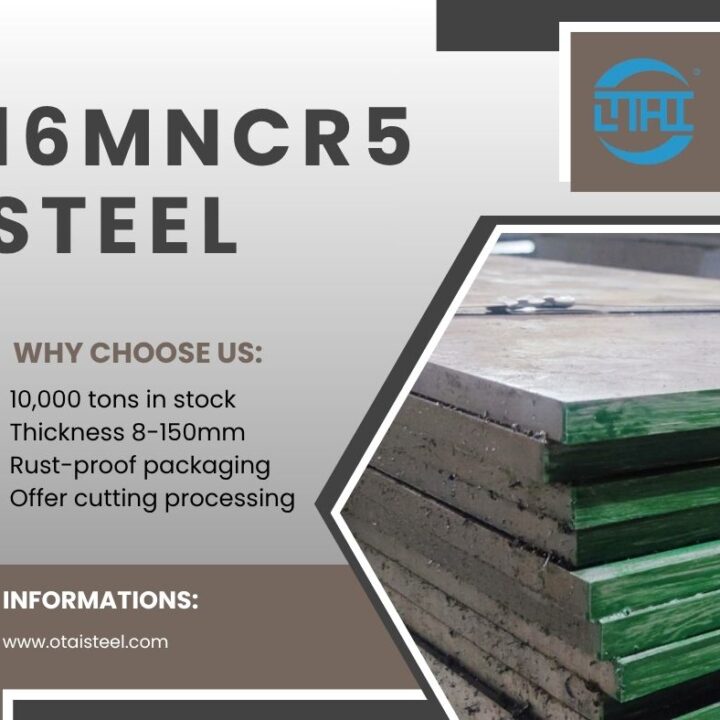
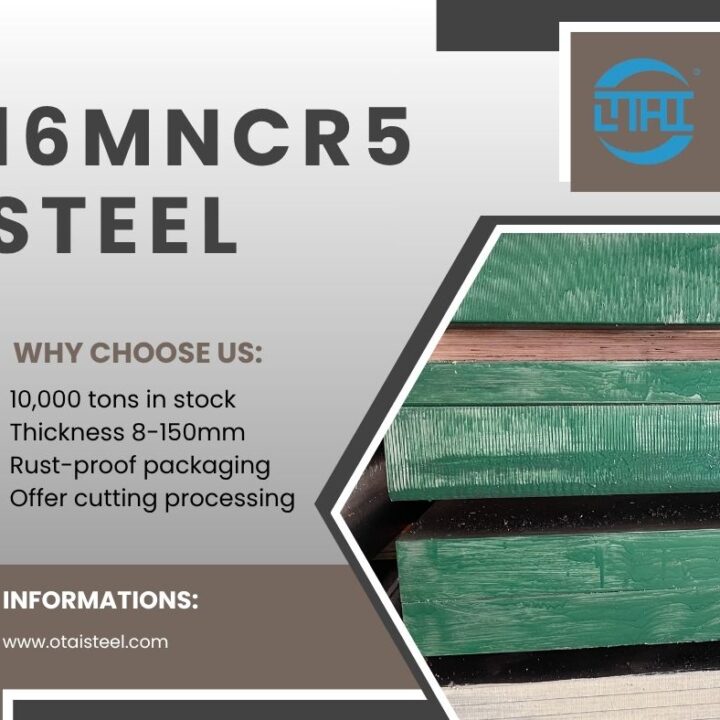
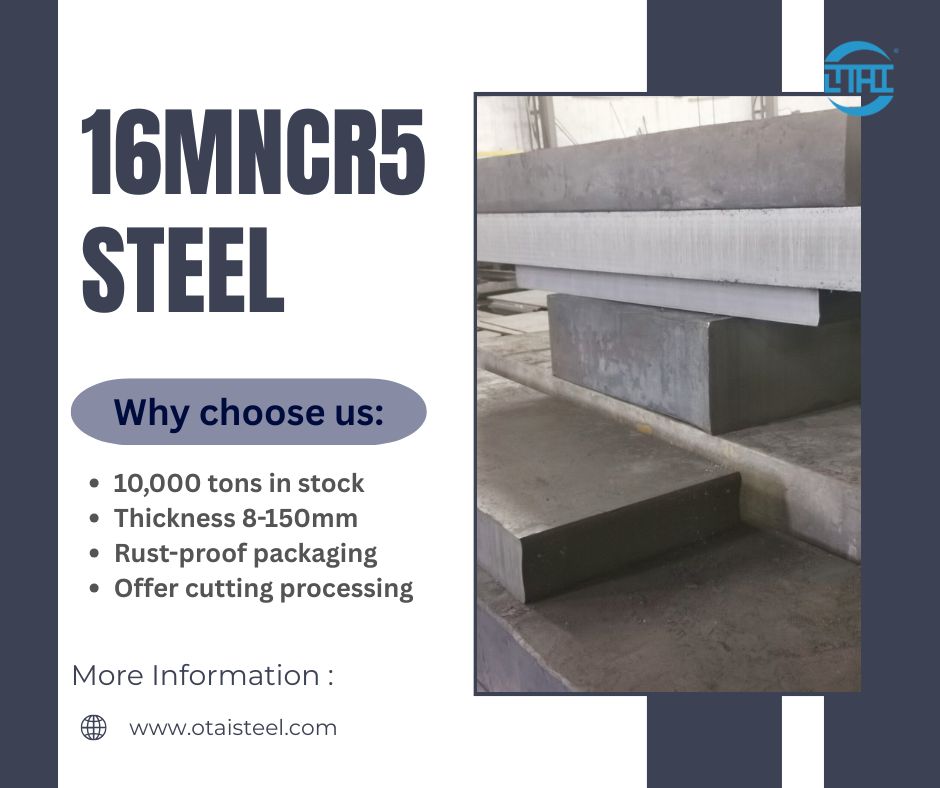
- Stable stock availability: Otai keeps 8–150mm thickness 16MnCr5 steel plates available in stock to support customers with different size requirements.
- Professional alloy steel supply: Provide 16MnCr5 plates and other engineering steels according to customer specifications.
- Cutting and processing service: Customized cutting and preparation according to drawings and project requirements.
- Heat treatment support: Support carburizing, quenching and other related treatment processes.
- Quality inspection: Ultrasonic testing and third-party inspection services are available.
- International export experience: Experienced in supplying steel products for customers with strict technical standards.
- Professional packaging: Anti-rust packaging, steel strapping and wooden box packaging for overseas transportation.
For customers searching for 16MnCr5 steel supplier, Otai provides reliable material solutions based on application requirements, mechanical performance and manufacturing needs.
❓ 9. FAQ
1. What does 16MnCr5 mean?
It means a low-carbon manganese-chromium alloy steel containing approximately 0.16% carbon. It is mainly designed for carburizing treatment to create a hard surface and tough core.
2. What type of steel is 16MnCr5?
It is a case-hardening alloy steel according to EN 10084. It is commonly used for gears, shafts and mechanical transmission components.
3. Is 16MnCr5 the same as 1.7131?
Yes. It is commonly identified as DIN 1.7131. Both designations refer to the same European carburizing steel grade.
4. What hardness can 16MnCr5 achieve after carburizing?
After carburizing and quenching, the surface hardness of 16MnCr5 can typically reach around 58–62 HRC, depending on treatment conditions.
5. What are the main applications of 16MnCr5?
The main applications include gears, shafts, sprockets, transmission parts and other components requiring high wear resistance and fatigue strength.