Skip to Content

Blog Archives

What Does 16MnCr5 Mean?


What Does 16MnCr5 Mean?What Does 16MnCr5 Mean?

🔍 1. True Engineering Meaning of 16MnCr5

To understand what does 16MnCr5 mean, we must go beyond simple definition. 16MnCr5 is a case-hardening alloy steel designed for components that require a hard wear-resistant surface and a tough core after carburizing treatment.

In engineering practice, what does 16MnCr5 mean is not just a material label. It represents a controlled transformation system where mechanical performance is created during heat treatment rather than in the raw state.

This steel is widely used in gears, shafts, and transmission systems because it can form a high-carbon martensitic surface layer while maintaining a ductile inner core capable of absorbing shock and vibration.

So, what does 16MnCr5 mean in real design terms? It means a predictable carburizing response material optimized for fatigue-loaded mechanical systems.

🧪 2. Decoding the 16MnCr5 Naming Logic and Material System

The designation system behind what does 16MnCr5 mean follows EN steel naming rules. Each part of the code reflects chemical intent and engineering behavior.

  • 16: Approx. 0.16% carbon content enabling carburizing capability
  • Mn: Manganese improves hardenability and core toughness
  • Cr: Chromium enhances wear resistance and case depth stability
  • 5: Alloy grouping indicator within EN classification system

This means what does 16MnCr5 mean is directly linked to surface engineering design rather than structural load-bearing bulk strength.

Unlike medium carbon steels, its performance depends heavily on diffusion-based carbon enrichment and phase transformation control.

⚙️ 3. Chemical Composition and Functional Engineering Logic

Element Range Engineering Function
C 0.14–0.19% Controls carburized hardness potential
Mn 0.80–1.10% Improves toughness and hardenability
Cr 0.80–1.10% Enhances wear resistance and diffusion stability
Si ≤0.40% Strength stability and deoxidation
P/S ≤0.035% Controls brittleness and inclusions

The chemical balance explains why what does 16MnCr5 mean is strongly connected to carburizing performance. Low carbon ensures safe diffusion during heat treatment, while Mn and Cr stabilize hardened case formation.

If alloy balance is not controlled, case cracking or uneven hardness distribution may occur, reducing fatigue life significantly.

🔥 4. Carburizing Heat Treatment Mechanism and Case Formation

A critical part of what does 16MnCr5 mean is its response to carburizing. This process introduces carbon into the surface layer at high temperature, creating a gradient structure.

The process is not just heating. It is controlled diffusion followed by phase transformation:

  • Carbon diffusion into austenite phase at 880–950°C
  • Time-controlled case depth formation
  • Oil quenching to form martensite on surface
  • Tempering to reduce residual stress

This creates a hard outer layer and a tough core. The gradient is what gives 16MnCr5 its fatigue resistance under cyclic loads.

If carburizing depth is too shallow, fatigue cracks initiate early. If too deep, core toughness may be reduced. This balance is central to what does 16MnCr5 mean in real engineering design.

🧬 5. Microstructure Evolution and Fatigue Crack Mechanism

Before heat treatment, 16MnCr5 consists of ferrite and pearlite. After carburizing and quenching, the surface transforms into high-carbon martensite while the core remains low-carbon bainite or ferrite-pearlite.

This structural gradient defines the engineering meaning behind what does 16MnCr5 mean.

Fatigue behavior follows a typical mechanism:

  • Crack initiation at surface stress concentration points
  • Micro-crack propagation through hardened layer
  • Slow crack growth in transition zone
  • Final fracture when core can no longer support load

Shot peening or surface polishing can delay crack initiation and significantly improve fatigue life.

🏭 6. Mechanical Performance After Heat Treatment

Property Typical Range
Tensile Strength 600–900 MPa
Yield Strength 400–650 MPa
Surface Hardness 58–62 HRC
Core Hardness 30–45 HRC
Fatigue Resistance High (case dependent)

These values show that what does 16MnCr5 mean cannot be judged without heat treatment condition. Performance is process-driven, not material-fixed.

Engineering selection must always consider case depth, hardness gradient, and loading type.

🚗 7. Industrial Applications and Load Behavior

The practical meaning of what does 16MnCr5 mean becomes clear in rotating and cyclic-loaded systems.

  • Automotive gearbox gears under torsional fatigue
  • Drive shafts under bending stress cycles
  • Pinions with high contact stress
  • Industrial reducers with continuous loading
  • Agricultural machinery with impact + fatigue combination

These components rely on surface hardness for wear resistance and core toughness for impact absorption. Without both, failure occurs prematurely.

🛠 8. Machinability, Manufacturing Strategy and Process Control

In annealed condition, 16MnCr5 has stable machinability, allowing gear cutting, drilling, and shaping before heat treatment.

Manufacturing sequence is critical:

  • Rough machining in soft state
  • Carburizing and quenching
  • Finish grinding after heat treatment

This workflow ensures dimensional accuracy and surface hardness. It also reflects real industrial interpretation of what does 16MnCr5 mean: a process-engineered material system.

🔄 9. Comparison with Engineering Steels and Selection Logic

Steel Grade Strength Type Main Use
16MnCr5 Case hardening Gears
20MnCr5 Higher case depth potential Heavy-duty gears
8620 Balanced carburizing steel Automotive components
4140 Through-hardening alloy steel Shafts and structural parts

This comparison shows that 16MnCr5 is not chosen for maximum strength, but for optimized surface-core performance balance.

🏭 10. Industrial Supply Capability – Otai Special Steel

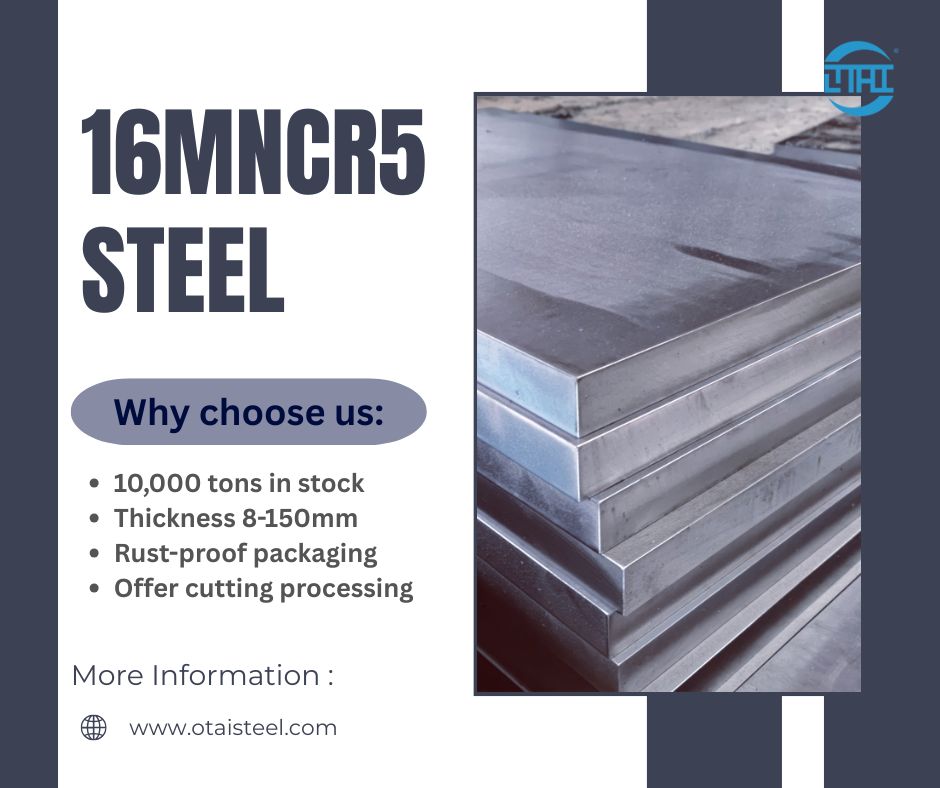
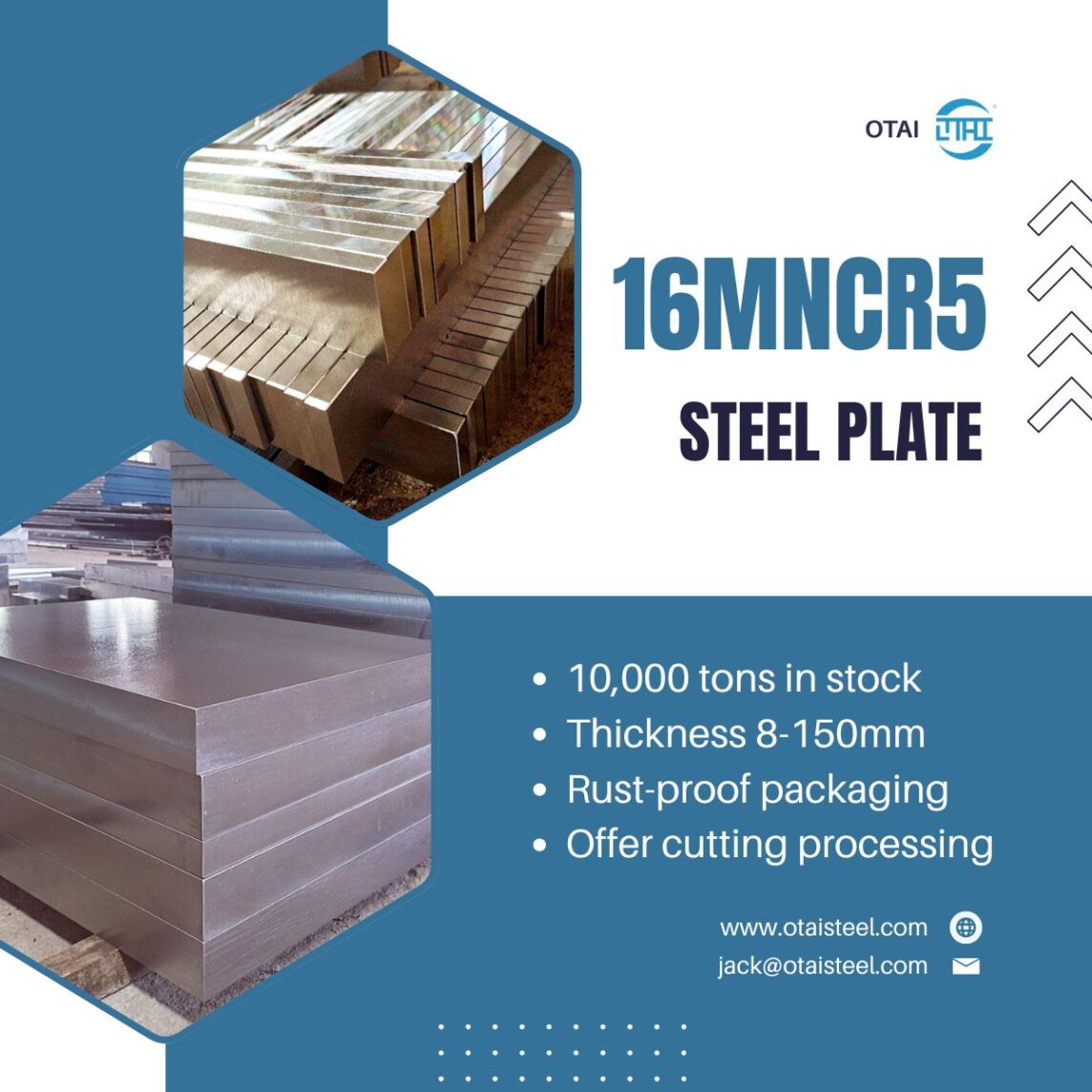
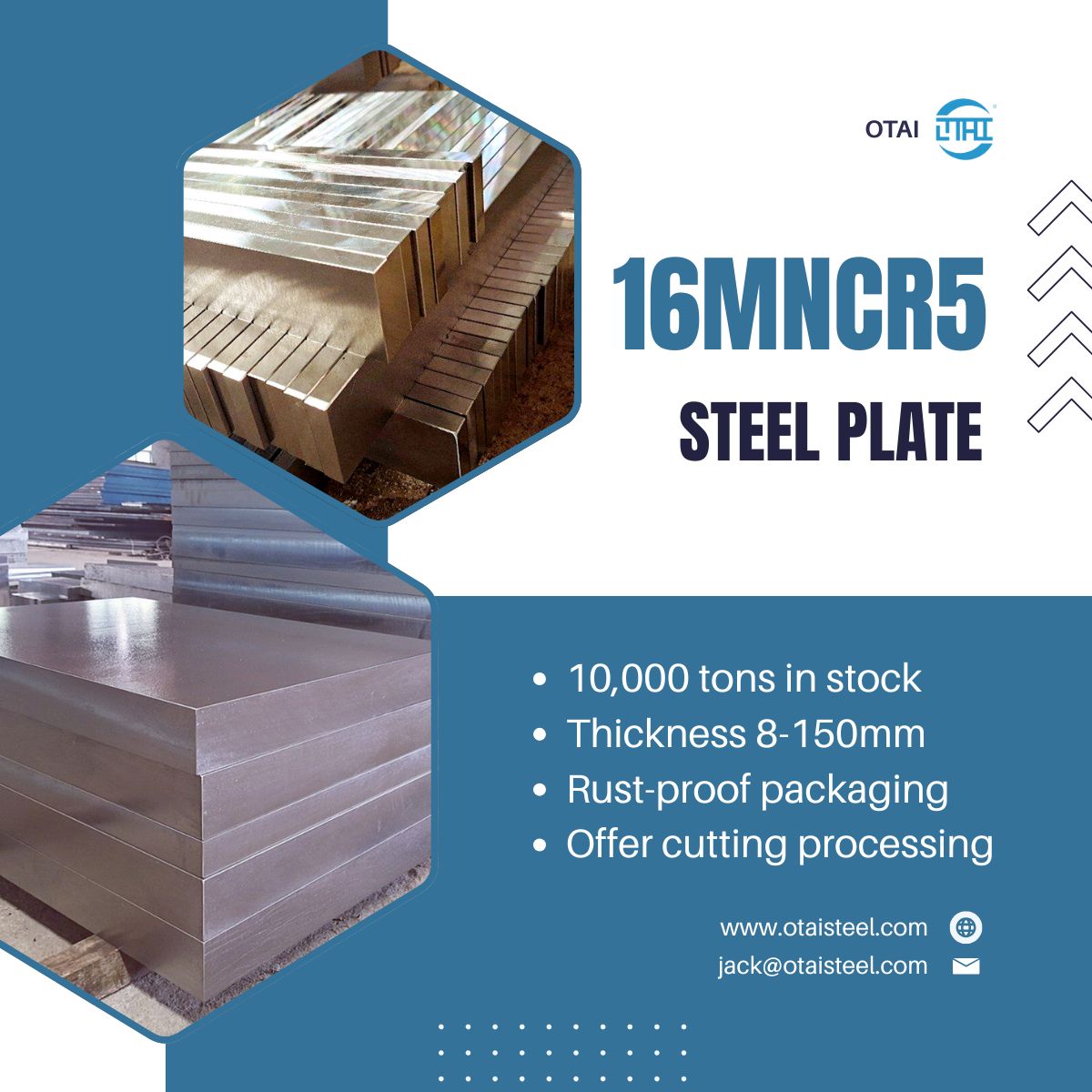
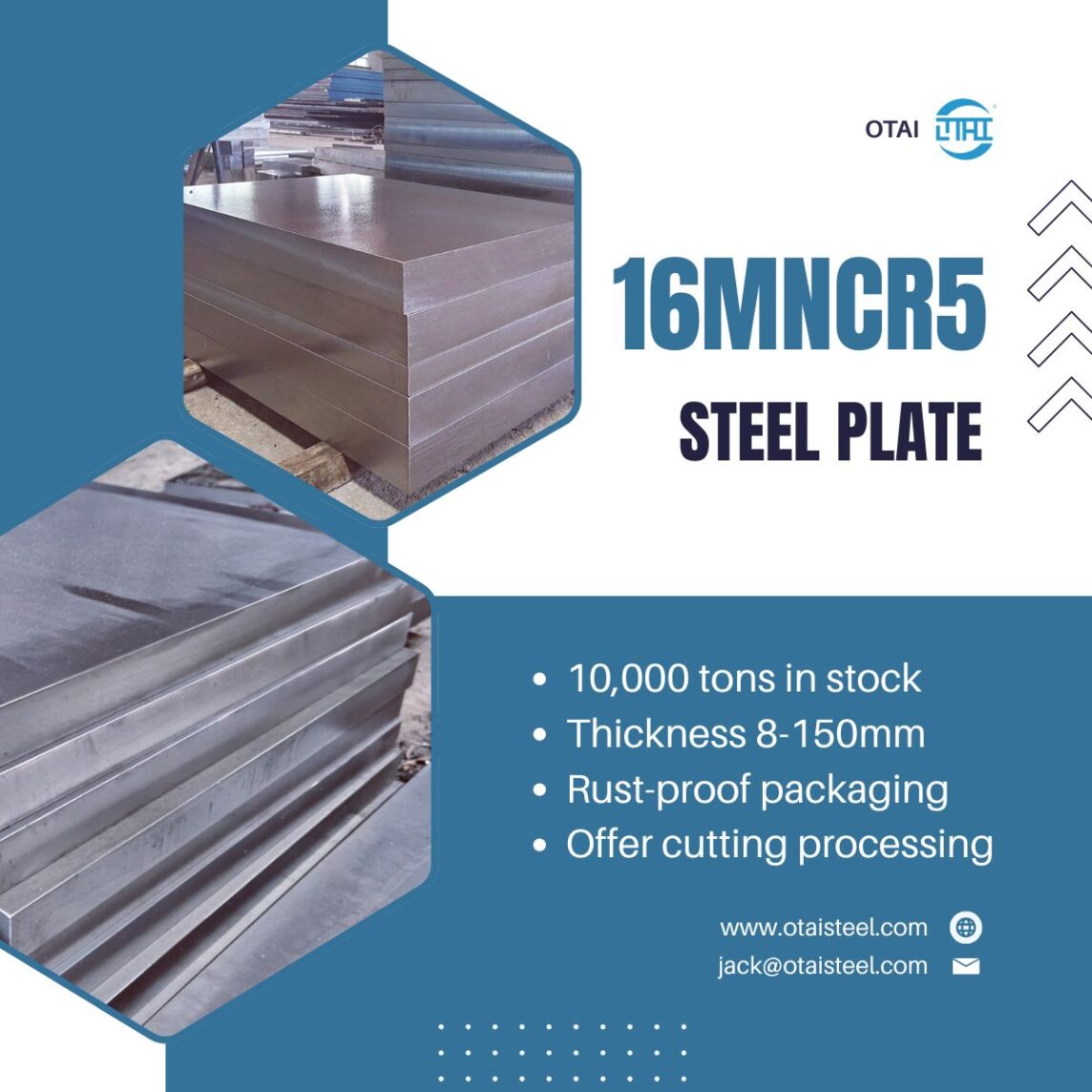
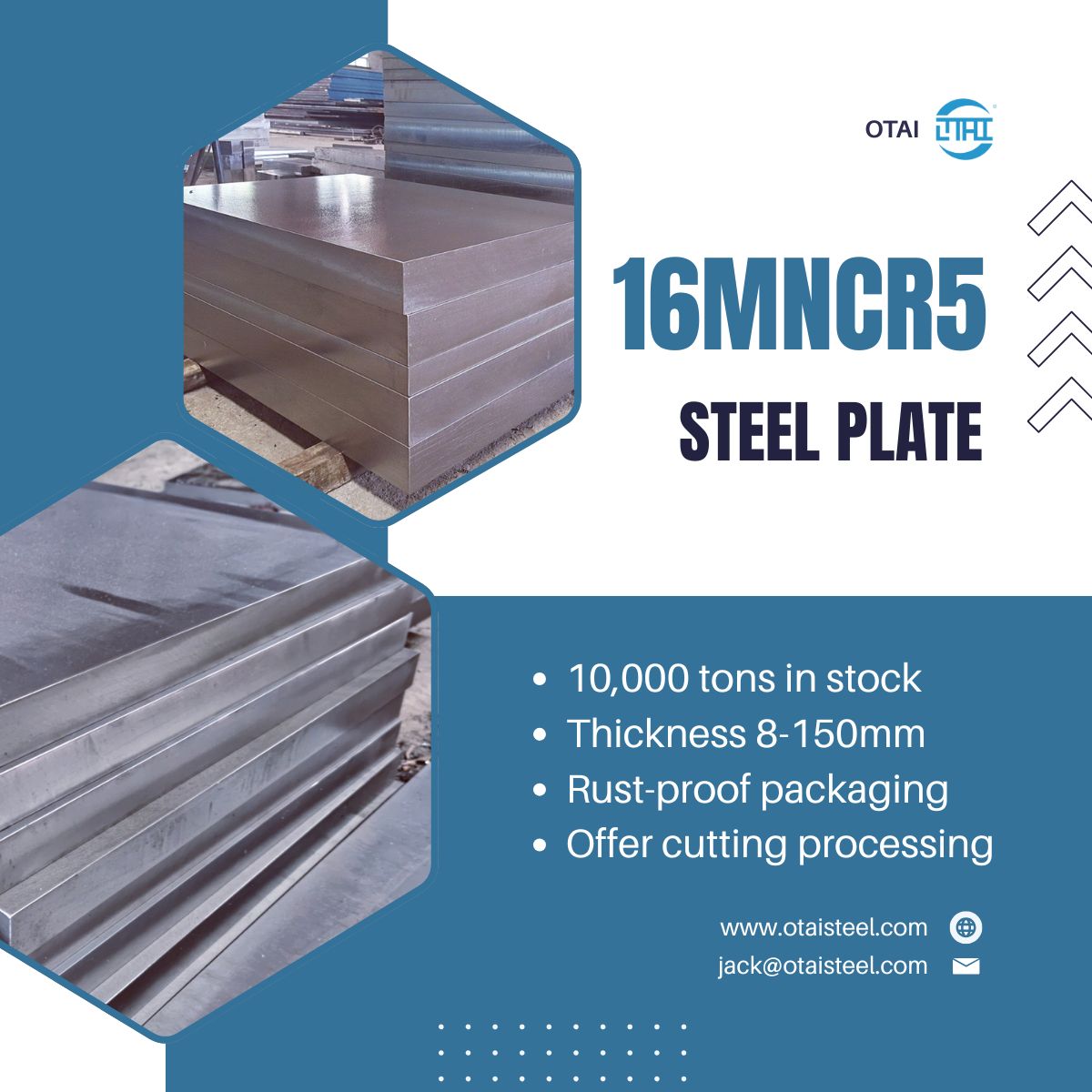
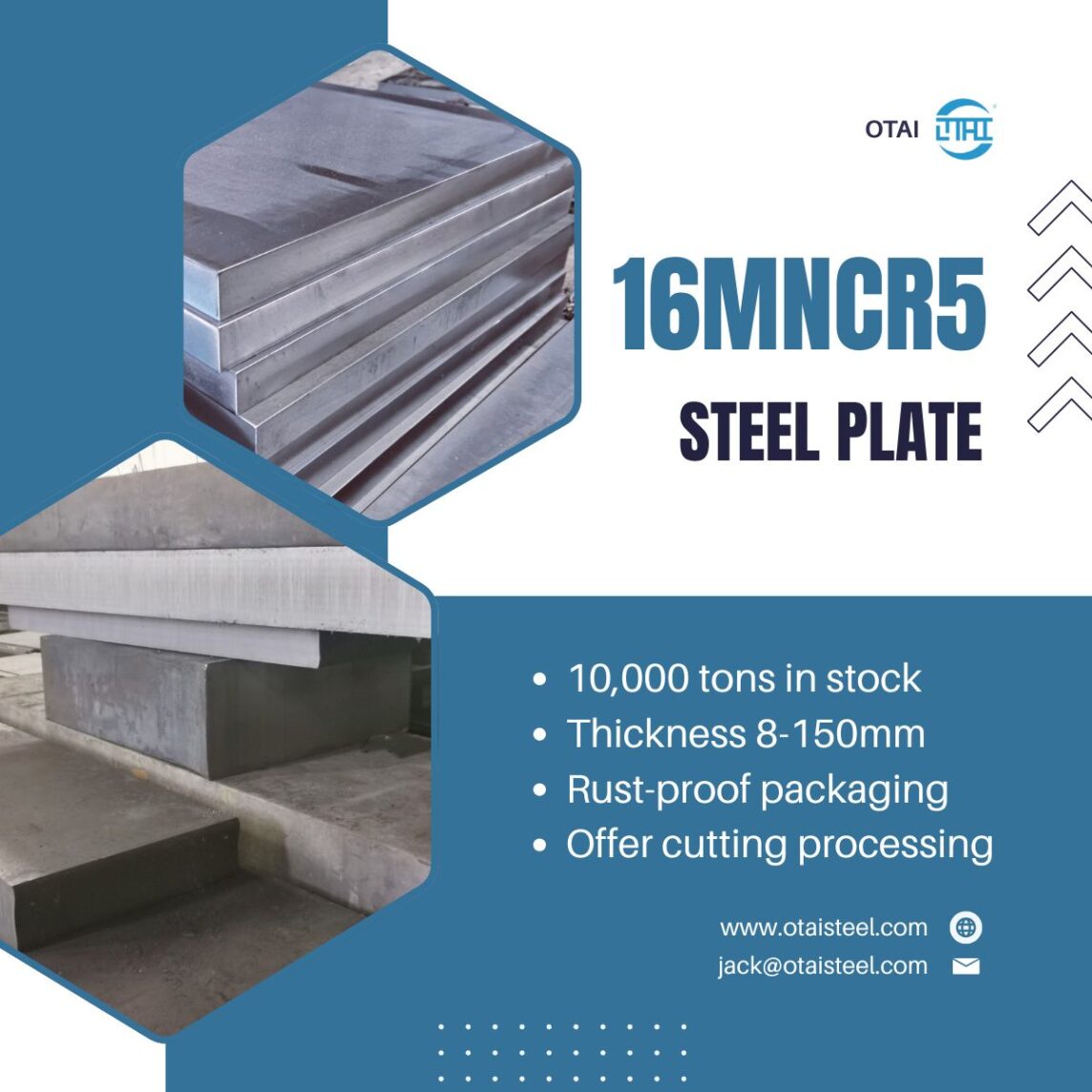
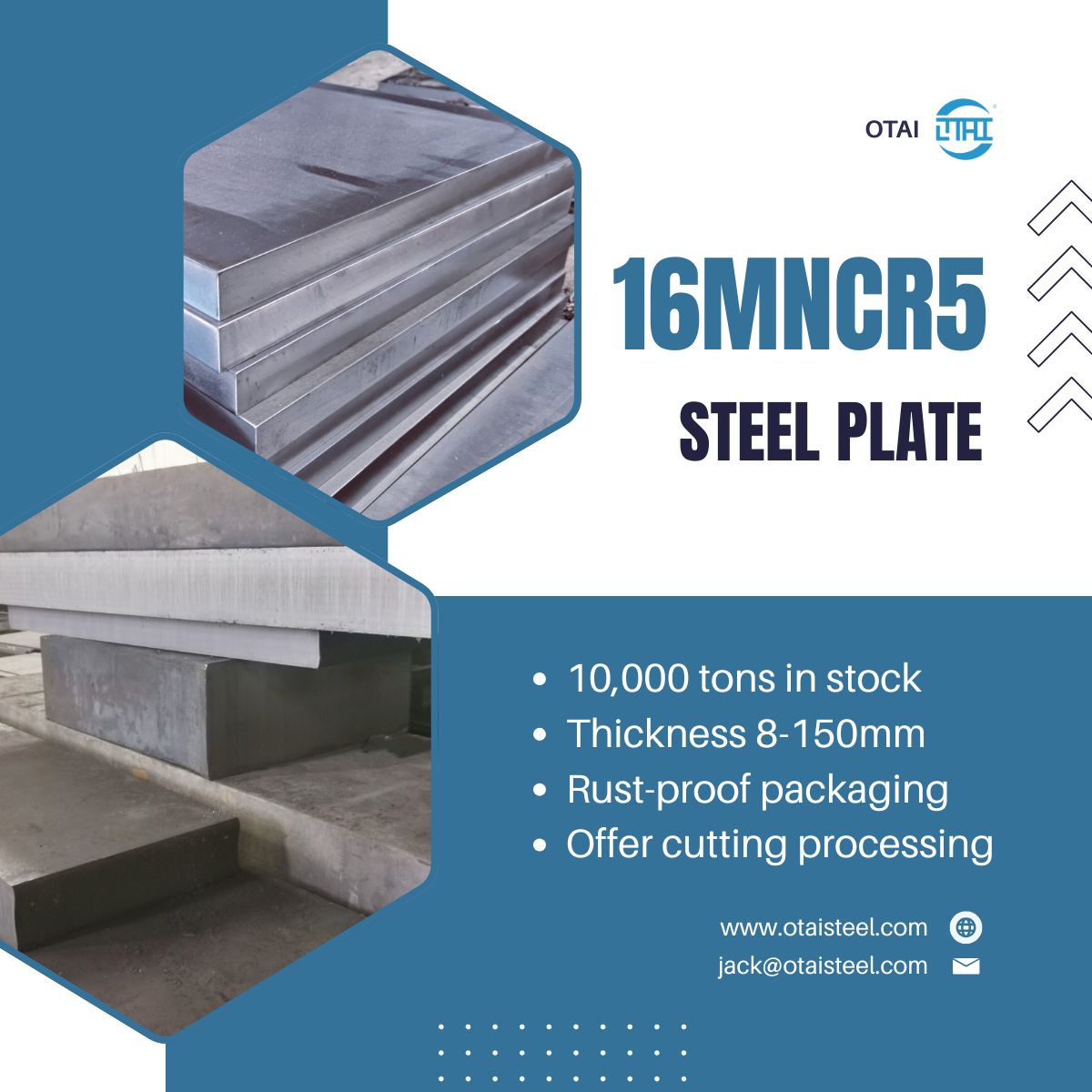
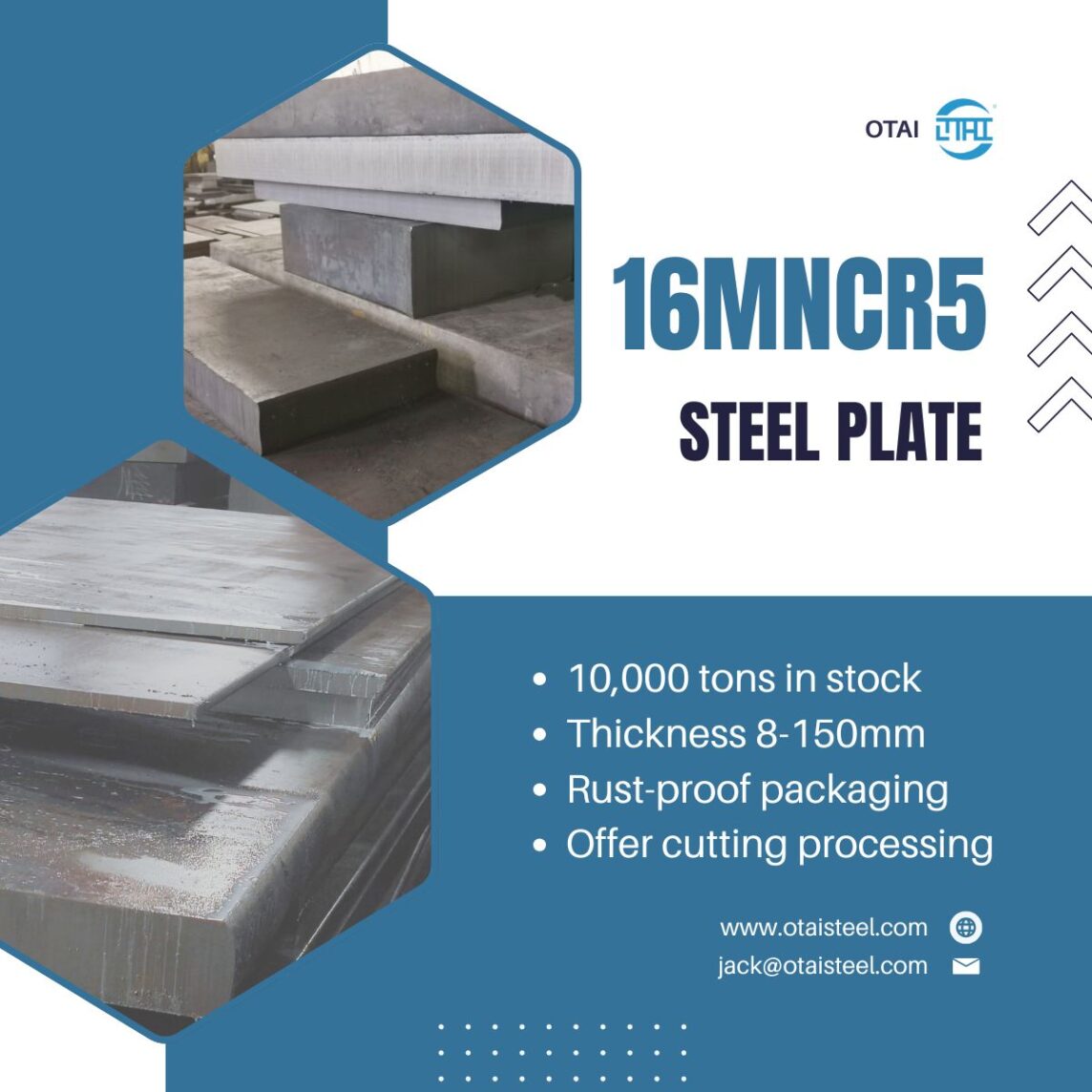
OTAI supplies 16MnCr5 steel with stable inventory, cutting services, and heat treatment support for global customers.

  • 8–150mm thickness plates in stock
  • Large inventory for fast delivery
  • Cutting, heat treatment, machining services
  • Ultrasonic testing and third-party inspection
  • Global export experience

❓ FAQ – What Does 16MnCr5 Mean

Q1: What does 16MnCr5 mean in engineering?
It is a carburizing steel designed for surface hardening and fatigue-loaded components.

Q2: Why is carburizing important?
It creates a hard surface layer while maintaining a tough core structure.

Q3: Is 16MnCr5 a structural steel?
No, it is a case-hardening steel system.

Q4: What controls its performance most?
Heat treatment and case depth control.

Q5: Where is it mainly used?
In gears, shafts, and transmission systems with cyclic loading.

0 0 Continue Reading →

Material Equivalent 16MnCr5: Cross Reference and Engineering Applications


Material Equivalent 16MnCr5: Cross Reference and Engineering ApplicationsMaterial Equivalent 16MnCr5: Cross Reference and Engineering Applications

🔍 1. Introduction to Material Equivalent 16MnCr5

The keyword material equivalent 16MnCr5 refers to the cross-reference understanding of 16MnCr5 steel in different international standards such as ASTM, DIN, SAE, and EN systems. Engineers often need equivalent grades when sourcing materials globally, especially in automotive and mechanical manufacturing industries.

In practical engineering use, the material equivalent 16MnCr5 concept helps buyers identify alternative steels with similar chemical composition, mechanical properties, and heat treatment behavior. This is critical when original EN-grade material is not available in local markets.

The material equivalent 16MnCr5 is widely searched in global procurement because manufacturers want to replace European steel grades with American or Chinese equivalents without affecting performance or safety.

🧪 2. What Does Material Equivalent 16MnCr5 Mean in Engineering Terms?

The material equivalent 16MnCr5 does not refer to a single exact steel grade. Instead, it refers to a group of steels that share similar carburizing behavior, low-carbon base structure, and manganese-chromium alloying system.

In engineering design, equivalence is based on:

  • Chemical composition similarity
  • Heat treatment response
  • Surface hardness after carburizing
  • Core toughness and fatigue resistance

This is why the material equivalent 16MnCr5 concept is more functional than symbolic. Engineers care about performance matching rather than exact naming alignment.

⚙️ 3. Chemical Composition Basis of 16MnCr5 Equivalent Grades

Element Typical Range Engineering Role
C 0.14–0.19% Carburizing response
Mn 0.80–1.10% Core toughness
Cr 0.80–1.10% Wear resistance
Si ≤0.40% Strength stability
P/S ≤0.035% Impurity control

The chemical logic behind the material equivalent 16MnCr5 is simple: low carbon ensures carburizing capability, while manganese and chromium ensure hardenability and surface performance.

Any equivalent steel must maintain similar carbon range and alloy balance to qualify as a true material equivalent 16MnCr5.

🏭 4. Mechanical Properties of 16MnCr5 Equivalent Steels

Property Typical Range
Tensile Strength 600–900 MPa
Yield Strength 400–650 MPa
Core Hardness 30–45 HRC
Surface Hardness 58–62 HRC
Elongation 10–14%
Elastic Modulus ~210 GPa

These mechanical values define the performance baseline of any material equivalent 16MnCr5. Even if chemical composition slightly varies, the final heat-treated performance must remain within this range.

This is especially important in gear manufacturing, where fatigue strength and surface hardness directly affect service life.

🔥 5. Heat Treatment Behavior of Equivalent Materials

A key factor in defining material equivalent 16MnCr5 is its response to carburizing heat treatment. The steel must be able to form a high-carbon surface layer while maintaining a ductile core.

  • Carburizing at 880–950°C
  • Carbon diffusion into surface layer
  • Oil quenching for martensite formation
  • Tempering for stress relief

If a steel cannot achieve similar case depth and hardness profile, it cannot be considered a true material equivalent 16MnCr5.

🧬 6. Microstructure Comparison of Equivalent Grades

The microstructure of material equivalent 16MnCr5 is defined by transformation behavior during heat treatment.

Before carburizing, the structure consists of ferrite and pearlite. After carburizing and quenching, the surface becomes martensitic while the core remains ferrite-bainite.

This gradient structure is essential because it provides:

  • High wear resistance at surface
  • Shock absorption in core
  • Improved fatigue life

🔄 7. Common Material Equivalents of 16MnCr5

Standard Equivalent Grade Notes
EN (Europe) 16MnCr5 Base reference
DIN 16MnCr5 / 1.7131 German classification
SAE/AISI 5115 / 5120 (approx.) Similar carburizing steels
GB (China) 15CrMn / 20CrMn (close) Functional equivalents

These grades are commonly used as material equivalent 16MnCr5 depending on availability and application requirements.

🚗 8. Industrial Applications of Equivalent Steels

The material equivalent 16MnCr5 is widely used in industries where carburized surface performance is critical.

  • Automotive gearbox systems
  • Drive shafts and axle systems
  • Industrial reducers
  • Worm gears and pinions
  • Construction machinery components

In all these applications, the goal of using a material equivalent 16MnCr5 is to ensure stable torque transmission and long fatigue life under cyclic loading.

🛠 9. Machinability and Manufacturing Considerations

One important advantage of material equivalent 16MnCr5 steels is their good machinability in annealed condition.

Manufacturers typically perform rough machining before heat treatment because carburized surfaces become extremely hard afterward.

This production sequence ensures dimensional accuracy and reduces tooling cost while maintaining performance of the final component.

📐 10. Engineering Selection Guidelines

When selecting a material equivalent 16MnCr5, engineers must consider more than just chemical composition.

  • Required case depth after carburizing
  • Fatigue strength under cyclic load
  • Gear contact stress limits
  • Dimensional stability after quenching

A correct selection ensures long-term reliability in mechanical systems and reduces failure risk in high-load environments.

🏭 Company Advantages – Otai Special Steel

OTAI supplies 16MnCr5 and equivalent carburizing steels with stable inventory and processing capability.

  • 8–150mm thickness plates in stock
  • Large inventory for fast delivery
  • Cutting, heat treatment, machining services
  • Ultrasonic testing and third-party inspection
  • Global export experience

❓ FAQ

Q1: What is material equivalent 16MnCr5?
It refers to steels with similar composition and carburizing performance as 16MnCr5.

Q2: Is there a direct exact equivalent?
No single exact match exists, only functional equivalents.

Q3: What is the closest Chinese equivalent?
Common alternatives include 15CrMn and 20CrMn steels.

Q4: Why is equivalence important?
It helps global sourcing when original EN material is unavailable.

Q5: What is the main requirement for equivalence?
Similar carburizing response and mechanical performance after heat treatment.

0 0 Continue Reading →

Material 16MnCr5 Meaning: Complete Engineering and Application Guide

Material 16MnCr5 Meaning: Complete Engineering and Application GuideMaterial 16MnCr5 Meaning: Complete Engineering and Application Guide

🔍 1. Material 16MnCr5 Meaning in Engineering Context

The material 16MnCr5 meaning refers to a low-carbon alloy case hardening steel designed for components that require high surface hardness combined with a tough and ductile core. It is widely used in automotive transmission systems, industrial gearboxes, and precision mechanical structures.

From an engineering perspective, the material 16MnCr5 meaning is not just a chemical definition. It represents a performance-based steel grade optimized for carburizing heat treatment. The key idea is transformation: the material is relatively soft in delivery condition but becomes extremely hard at the surface after heat treatment.

This behavior makes the material 16MnCr5 meaning closely linked to fatigue resistance, contact stress performance, and long-term reliability under cyclic loading conditions.

Engineers choose this steel when they need predictable carburizing depth, stable dimensional control, and a strong balance between hardness and toughness.

🧪 2. Steel Naming Logic Behind 16MnCr5 Meaning

The material 16MnCr5 meaning follows the European EN steel designation system, which directly reflects its chemical composition and design intent.

  • 16 → approximately 0.16% carbon content, indicating low-carbon base structure
  • Mn → manganese improves hardenability and toughness of the core
  • Cr → chromium improves wear resistance and carburizing response
  • 5 → indicates alloy proportion class in EN system grouping

This naming structure explains why the material 16MnCr5 meaning is strongly connected to surface engineering rather than bulk strength design.

Unlike structural steels such as 1045 or 4140, this grade is engineered specifically for case hardening applications where performance is defined after heat treatment rather than in raw condition.

⚙️ 3. Chemical Composition and Metallurgical Design

Element Content (%) Metallurgical Role
C 0.14–0.19 Controls hardness potential after carburizing
Si ≤0.40 Deoxidation and strength stability
Mn 0.80–1.10 Improves hardenability and toughness
Cr 0.80–1.10 Enhances wear resistance and case depth
P ≤0.035 Impurity control
S ≤0.035 Machinability control

This balanced chemical system defines the engineering foundation of the material 16MnCr5 meaning. The relatively low carbon content allows deep carburizing without cracking risk, while chromium ensures stable hardened case formation.

Manganese plays a critical role in maintaining core toughness, especially in thick-section components where internal stress distribution is uneven.

🏭 4. Mechanical Properties and Load Performance Behavior

The mechanical behavior of 16MnCr5 is strongly influenced by heat treatment, which directly defines the real-world interpretation of the material 16MnCr5 meaning.

Property Typical Range Engineering Interpretation
Tensile Strength 600–900 MPa Load carrying capacity
Yield Strength 400–650 MPa Elastic limit stability
Core Hardness 30–45 HRC Impact resistance
Surface Hardness 58–62 HRC Wear resistance layer
Elongation 10–14% Ductility and deformation capacity
Elastic Modulus ~210 GPa Stiffness (unchanged by heat treatment)

The key engineering insight behind the material 16MnCr5 meaning is that strength and hardness are surface-driven, while stiffness remains constant. This makes it highly predictable in structural calculations.

In dynamic systems, this stability ensures consistent gear meshing and reduces vibration-related failure risk.

🔥 5. Heat Treatment Mechanism and Carburizing Process

A central part of the material 16MnCr5 meaning is its carburizing capability. The steel is designed to absorb carbon at high temperature and redistribute it into the surface layer.

  • Carburizing: 880–950°C carbon diffusion stage
  • Holding stage: carbon penetration depth control
  • Oil quenching: martensite transformation on surface
  • Tempering: 150–200°C stress relief and toughness recovery

This process creates a gradient structure that defines the engineering identity of the material 16MnCr5 meaning.

The outer layer becomes high-carbon martensite with extreme hardness, while the core remains low-carbon bainite or ferrite structure, ensuring energy absorption under shock loading.

🧬 6. Microstructure Evolution and Material Transformation

Before heat treatment, the microstructure is mainly ferrite + pearlite. This gives good machinability but limited wear resistance.

After carburizing and quenching, the surface transforms into martensite while the core retains ductile phases. This transformation is the scientific core of the material 16MnCr5 meaning.

The gradient structure improves resistance against:

  • Contact fatigue in gears
  • Surface pitting under rolling load
  • Impact loading in transmission systems

🚗 7. Industrial Applications and Real Engineering Usage

The material 16MnCr5 meaning becomes practical in industrial systems where repeated load cycles and surface wear dominate failure mechanisms.

  • Automotive gearbox gears and pinions
  • Drive shafts and axle components
  • Camshaft systems
  • Industrial reducers and gearboxes
  • Mining machinery transmission parts
  • Agricultural equipment drive systems

In these applications, the steel ensures stable torque transfer and long service life under lubrication and cyclic stress conditions.

🛠 8. Machinability and Manufacturing Strategy

In annealed condition, 16MnCr5 provides good machinability, which is essential for precision gear cutting and shaft turning operations.

Manufacturers typically complete machining before carburizing because the hardened surface becomes extremely difficult to process afterward.

This manufacturing strategy is part of the practical engineering logic behind the material 16MnCr5 meaning.

🔄 9. Comparison with Other Engineering Steels

Steel Grade Carbon Key Feature Application
16MnCr5 0.16% Balanced carburizing steel Standard gears
20MnCr5 0.20% Higher hardness potential Heavy load gears
AISI 8620 0.20% Good toughness balance Automotive parts
4140 0.40% High strength bulk steel Shafts & structural parts

This comparison highlights the positioning of the material 16MnCr5 meaning as a carburizing-optimized steel rather than a bulk-strength alloy.

📐 10. Engineering Design Considerations

Design engineers rely on the material 16MnCr5 meaning when calculating gear tooth stress, shaft deflection, and fatigue life.

Key design factors include:

  • Contact stress distribution on gear surfaces
  • Bending fatigue in rotating shafts
  • Dimensional stability after heat treatment
  • Surface lubrication performance under load

These factors determine whether the material performs reliably in long-term industrial operation.

🏭 Company Advantages – Otai Special Steel

OTAI supplies industrial-grade 16MnCr5 steel with stable stock and processing capability.

  • 8–150mm thickness plates available in stock
  • Large inventory for fast delivery
  • Cutting, heat treatment, machining services
  • Ultrasonic testing and third-party inspection
  • Global export experience

❓ FAQ – Material 16MnCr5 Meaning

Q1: What is material 16MnCr5 meaning?
It refers to a carburizing alloy steel designed for surface hardened mechanical components.

Q2: Why is it widely used in industry?
Because it offers a balance of machinability, carburizing performance, and fatigue resistance.

Q3: Does heat treatment change stiffness?
No, elastic modulus remains nearly constant.

Q4: What are its main applications?
Automotive, industrial gear systems, and heavy machinery components.

Q5: What is the main engineering advantage?
Hard surface combined with tough core structure for long service life.

0 0 Continue Reading →

16MnCr5 Steel Gear – Full Engineering Guide & Industrial Applications

16MnCr5 Steel Gear – Full Engineering Guide & Industrial Applications16MnCr5 Steel Gear – Full Engineering Guide & Industrial Applications

Manufacturers widely use 16MnCr5 steel gear in automotive, industrial machinery, and power transmission systems because it delivers an ideal combination of surface hardness and core toughness. In modern mechanical engineering, this balance is essential because gears must resist both wear and impact under continuous load conditions.

Unlike standard carbon steel gears, 16MnCr5 steel gears rely on carburizing heat treatment to achieve their final performance. Therefore, engineers carefully control processing parameters to ensure consistent hardness depth, dimensional stability, and long fatigue life.

In addition, global demand for high-efficiency transmission systems continues to increase. As a result, 16MnCr5 has become one of the most widely adopted case-hardening steels in gear manufacturing.

🧪 1. Metallurgical Basis of 16MnCr5 Steel Gear Performance

The performance of a 16MnCr5 steel gear is based on its chemical composition, which includes controlled levels of carbon, manganese, and chromium. These elements play different roles in determining hardenability and wear resistance.

Carbon enables surface hardening during carburizing. Meanwhile, chromium improves hardenability and increases resistance to wear and oxidation. In addition, manganese enhances strength and improves deep hardening capability.

Because of this balanced composition, engineers achieve a stable carburized layer while maintaining a ductile core. Therefore, the gear can absorb shock loads without cracking or deformation.

Moreover, metallurgical stability ensures consistent performance during long-term cyclic loading. As a result, 16MnCr5 gears perform reliably in demanding mechanical systems such as gearboxes and differential drives.

In industrial practice, this material is preferred when engineers require both cost efficiency and mechanical reliability in medium-load applications.

🔥 2. Carburizing and Heat Treatment Behavior

Heat treatment is the most critical step in producing a high-performance 16MnCr5 steel gear. First, manufacturers heat the gear to approximately 900°C–950°C. During this stage, carbon atoms diffuse into the surface layer.

Then, the carburized gear is rapidly quenched. This process transforms the outer layer into martensite, which significantly increases hardness and wear resistance. Meanwhile, the core remains relatively soft and tough.

After quenching, tempering is applied to reduce internal stress. In addition, tempering improves structural stability and prevents brittle failure during operation.

As a result, the gear achieves a hardness gradient structure. This gradient is essential because it allows the surface to resist wear while the core absorbs mechanical shock.

Furthermore, precise control of carburizing time and temperature directly influences case depth. Therefore, manufacturers must carefully adjust process parameters based on gear size and load requirements.

In high-end applications, engineers also perform post-heat-treatment grinding to ensure dimensional accuracy and surface finish quality.

⚙️ 3. Mechanical Performance Under Real Working Conditions

A properly processed 16MnCr5 steel gear exhibits excellent mechanical performance under real operating conditions. Surface hardness typically reaches 58–62 HRC, which provides strong resistance to abrasion and contact fatigue.

Meanwhile, the core hardness remains significantly lower. Therefore, the gear maintains toughness and avoids brittle fracture when exposed to shock loads or sudden torque changes.

In addition, the hardness gradient structure improves resistance to pitting failure. Pitting is one of the most common failure modes in gear systems operating under rolling contact stress.

Moreover, 16MnCr5 gears perform well under variable load conditions. Even when torque fluctuates frequently, the material maintains structural stability and dimensional integrity.

Because of these advantages, engineers often select this steel grade for medium-to-high load transmission systems that require long service life without frequent maintenance.

In addition, fatigue resistance plays a major role in extending operational life. Therefore, 16MnCr5 gears are widely used in continuous-duty industrial environments.

🏭 4. Industrial Applications and Engineering Use Cases

Manufacturers apply 16MnCr5 steel gear across multiple industries due to its balanced mechanical properties. In automotive systems, it is widely used in transmission gears, differential systems, and timing mechanisms.

In addition, industrial gearbox manufacturers rely on this material for reducers and heavy-duty drive systems. These applications require stable torque transmission and long operational life.

Furthermore, agricultural machinery uses 16MnCr5 gears because they perform reliably under harsh working environments. Dust, vibration, and irregular load conditions require materials with strong fatigue resistance.

Construction machinery also benefits from this material. Excavators, loaders, and cranes use gears that must withstand high torque and frequent load variation.

Because of its versatility, 16MnCr5 has become a standard engineering material for power transmission systems across global industries.

Moreover, its cost-performance ratio makes it more attractive compared to higher-alloy steels, especially in medium-load applications.

💡 5. Manufacturing Process and Precision Control

Manufacturing a high-quality 16MnCr5 steel gear requires strict process control. First, engineers prepare the raw blank through forging or machining. This ensures material uniformity and structural integrity.

Next, machining operations define the gear geometry. At this stage, dimensional accuracy is critical because any deviation may affect meshing performance and noise levels.

After machining, heat treatment introduces structural changes. However, carburizing also causes volume expansion. Therefore, manufacturers intentionally leave machining allowance before heat treatment.

Following heat treatment, grinding is often required to achieve final precision. This step ensures correct tooth profile and surface finish quality.

In addition, quality inspection plays a key role. Engineers use hardness testing and dimensional measurement to verify performance consistency.

As a result, well-controlled manufacturing processes ensure high reliability and long service life of 16MnCr5 gears.

🏭 Company Advantages – Otai Special Steel

  • 📦 Large stock of alloy steel including 16MnCr5 gear materials
  • ✂️ Cutting, machining, and customization services
  • 🔥 Heat treatment technical support
  • 🔬 Ultrasonic testing (UT) inspection
  • 📦 Export-grade packaging with rust protection
  • 🌍 Stable supply for global gear manufacturers

❓ FAQ – 16MnCr5 Steel Gear

1. Why is 16MnCr5 used for gears?
Because it provides excellent wear resistance and strong core toughness after carburizing.

2. What hardness does it achieve?
Surface hardness typically reaches 58–62 HRC after heat treatment.

3. Is it suitable for high-load gears?
Yes, it performs well in medium to high-load transmission systems.

4. Why is carburizing important?
It creates a hard surface layer while maintaining a tough core.

5. Which industries use it most?
Automotive, machinery, agriculture, and construction equipment industries.

🏁 Conclusion

The 16MnCr5 steel gear remains a widely used engineering solution due to its excellent balance of hardness, toughness, and cost efficiency. Moreover, its carburizing response ensures stable performance in demanding mechanical systems.

Therefore, engineers continue to select this material for gear applications that require durability, reliability, and long service life under real industrial conditions.

0 0 Continue Reading →

16MnCr5 Material Price – Market Trends & Supplier Strategy

16MnCr5 Material Price – Market Trends & Supplier Strategy16MnCr5 Material Price – Market Trends & Supplier Strategy

The 16MnCr5 material price is one of the most important cost considerations in the mechanical engineering and automotive supply chain. Engineers widely use this alloy steel for carburized components such as gears, shafts, pinions, and transmission systems that require a hard wear-resistant surface and a tough core.

Unlike standard carbon steel, the 16MnCr5 material price is not stable or universal. It varies significantly depending on alloy composition, heat treatment condition, dimensional requirements, and global steel market conditions. For industrial buyers, understanding these pricing mechanisms is essential to reduce procurement risk and improve cost efficiency.

This article provides a complete technical and commercial breakdown of how pricing is formed, how it changes, and how buyers can optimize purchasing decisions in real industrial environments.

📊 1. Core Factors That Determine 16MnCr5 Material Price

The 16MnCr5 material price is driven by multiple upstream and downstream factors. Each factor affects production cost, processing complexity, and final market quotation.

Among all variables, alloy composition and heat treatment are the most critical. Chromium and manganese content directly influence hardenability, while carburizing capability determines its industrial value in transmission parts.

In addition, steelmaking route (EAF or BOF), raw material fluctuations, and energy consumption also play important roles in determining base pricing levels.

Pricing Factor Influence on Cost
Raw material cost Primary driver of base price
Alloy content (Cr, Mn) Moderate to high impact
Heat treatment process High impact (carburizing increases cost)
Product size & thickness Thicker sections increase cost
Surface condition Machined surfaces increase cost
Order quantity Bulk orders reduce unit price

🏭 2. Material Condition and Its Direct Price Impact

One of the most important variables affecting 16MnCr5 material price is the delivery condition. The same steel grade can have significantly different pricing depending on whether suppliers deliver it annealed, normalized, or carburized.

Annealed material generally costs the least because it requires minimal processing. However, carburized and quenched material involves multiple thermal cycles, precision control, and longer production time.

Manufacturers typically use pre-hardened or specially processed conditions in high-performance mechanical components where dimensional stability and wear resistance are critical.

Condition Processing Level Price Level
Annealed Low processing Low
Normalized Medium processing Medium
Carburized + quenched High processing High
Pre-hardened / precision Very high processing Highest

In many industrial cases, the 16MnCr5 material price difference between annealed and fully heat-treated material can exceed 30–60% depending on specification requirements.

📦 3. Product Form, Thickness & Manufacturing Complexity

Product geometry plays a major role in determining the 16MnCr5 material price. Plates, bars, and forged blocks require different production routes, resulting in different cost structures.

Thicker sections require longer rolling cycles and more controlled cooling rates to ensure uniform microstructure. Forged products involve additional deformation steps, increasing energy consumption and processing time.

Machined or precision-ground materials add further cost due to additional CNC processing, tolerance control, and inspection requirements.

Form / Thickness Cost Level
Thin plates (8–30 mm) Low
Medium plates (30–80 mm) Medium
Heavy plates (80–150 mm) High
Extra thick (150 mm+) Premium

As thickness increases, the 16MnCr5 material price rises not only due to weight but also due to processing difficulty and quality control requirements.

🌍 4. Global Market Influence on Pricing Behavior

The global steel industry directly affects the 16MnCr5 material price. Since this steel is widely used in automotive and industrial transmission systems, demand fluctuations in these sectors strongly influence market pricing.

Energy costs, iron ore prices, and logistics expenses are major contributors to international price volatility. Shipping cost variations also significantly impact export pricing structures.

Currency exchange rates further influence purchasing decisions, especially for international buyers purchasing in USD or EUR.

Market Factor Impact Level
Raw material price High
Energy cost High
Shipping cost Medium–High
Currency fluctuation Medium

💡 5. Industrial Cost Optimization Strategy

Professional buyers do not only focus on the lowest 16MnCr5 material price, but instead evaluate total lifecycle cost, including machining efficiency, scrap rate, and production time.

Selecting standard sizes close to final dimensions significantly reduces waste and machining time. Bulk purchasing also improves price negotiation power and stabilizes long-term supply.

Working with stockist suppliers reduces lead time and helps maintain consistent production schedules.

Strategy Benefit
Standard size selection Lower machining cost
Bulk purchasing Better price control
Stock supplier cooperation Stable delivery

🏭 6. Company Advantages – Otai Special Steel

  • 📦 Over 10,000 tons of alloy steel inventory in stock
  • 📏 Full range of 16MnCr5 plates and bars available
  • ✂️ Cutting, machining, drilling and processing services
  • 🔥 Heat treatment and technical support available
  • 🔬 Ultrasonic testing (UT) inspection support
  • 📦 Export packaging with anti-rust protection
  • 🌍 Global supply experience across automotive and machinery industries

❓ 7. FAQ – 16MnCr5 Material Price

1. Why does 16MnCr5 material price change frequently?
Because it depends on raw materials, alloy content, and global market demand.

2. Is carburized 16MnCr5 more expensive?
Yes, due to additional heat treatment processes.

3. Does thickness affect price?
Yes, thicker materials increase production cost significantly.

4. How can buyers reduce cost?
Use standard sizes and buy in bulk from stock suppliers.

5. Is 16MnCr5 a high-cost steel?
No, it is a medium-cost alloy steel.

🏁 Conclusion

The 16MnCr5 material price is determined by a combination of technical specifications and global economic conditions. Buyers should evaluate not only unit price but also processing efficiency, material condition, and supplier reliability.

A strategic purchasing approach helps reduce total manufacturing cost while ensuring stable mechanical performance and long-term supply security.

0 0 Continue Reading →

16MnCr5 Material Data Sheet – Technical Specifications

16MnCr5 Material Data Sheet – Technical Specifications16MnCr5 Material Data Sheet – Technical Specifications

A comprehensive 16MnCr5 material data sheet provides engineers, buyers, and manufacturers with the essential technical information required to select the right steel for demanding applications. From chemical composition and mechanical properties to heat treatment recommendations and equivalent grades, a material data sheet serves as the primary technical reference throughout the design and manufacturing process.

16MnCr5 is a low-carbon chromium alloy case-hardening steel widely used in automotive, machinery, mining, and power transmission industries. Its excellent carburizing response enables manufacturers to achieve a hard, wear-resistant surface while maintaining a tough and ductile core. This combination makes it ideal for gears, shafts, pinions, sprockets, and many other heavily loaded mechanical components.

Understanding every section of a 16MnCr5 material data sheet helps engineers compare materials, verify specifications, optimize heat treatment parameters, and ensure that finished components meet performance expectations.

🔵 Overview of 16MnCr5 Steel

16MnCr5 is classified as a carburizing steel under the EN 10084 standard. The relatively low carbon content allows excellent machinability before heat treatment, while chromium and manganese improve hardenability and wear resistance after carburizing and quenching.

Because of its balanced mechanical performance and cost efficiency, 16MnCr5 has become one of the most commonly specified steels for precision transmission components requiring long service life.

Item Description
Steel Grade 16MnCr5
Steel Type Case-hardening alloy steel
Main Standard EN 10084
Typical Applications Gears, shafts, pinions, sprockets

🟢 Chemical Composition

One of the most valuable sections of any 16MnCr5 material data sheet is the chemical composition table. Each alloying element contributes to the steel’s overall performance, influencing hardenability, strength, wear resistance, and heat treatment response.

Element Typical Content (%)
Carbon (C) 0.14–0.19
Silicon (Si) ≤0.40
Manganese (Mn) 1.00–1.30
Phosphorus (P) ≤0.025
Sulfur (S) ≤0.035
Chromium (Cr) 0.80–1.10

🟠 Physical Properties

Besides chemistry, a 16MnCr5 material data sheet also includes important physical properties. These values help engineers perform structural calculations, thermal analysis, and manufacturing process planning.

Property Typical Value
Density 7.85 g/cm³
Young’s Modulus 210 GPa
Poisson’s Ratio 0.28–0.30
Thermal Conductivity Approximately 46 W/m·K
Thermal Expansion Approximately 11.5 × 10⁻⁶ /K

🟣 Mechanical Properties

Mechanical properties vary depending on heat treatment condition, section size, and application requirements. Therefore, engineers should always compare the required performance with the values listed in the official 16MnCr5 material data sheet.

Property Typical Value
Tensile Strength Depends on heat treatment
Yield Strength High after hardening
Surface Hardness 58–62 HRC after carburizing
Core Toughness Excellent
Wear Resistance Excellent

🔷 Heat Treatment Recommendations

Heat treatment is one of the most important sections in a 16MnCr5 material data sheet because it determines the final hardness, wear resistance, and fatigue performance of the steel. Although 16MnCr5 offers good machinability in the annealed condition, it achieves its full potential only after carburizing, quenching, and tempering.

Carburizing enriches the surface with carbon, creating the foundation for a hard martensitic case after quenching. The low-carbon core remains comparatively tough, allowing the finished component to withstand impact loading while the hardened surface resists wear and contact fatigue.

Heat treatment parameters may vary according to component size and application requirements. Manufacturers generally adjust carburizing time to obtain the desired effective case depth while carefully controlling quenching and tempering temperatures to minimize distortion and maintain dimensional accuracy.

Heat Treatment Step Typical Parameter
Carburizing 880–950°C
Quenching Oil quenching
Tempering 150–200°C
Surface Hardness 58–62 HRC

🔴 Equivalent Grades

Another essential section of a 16MnCr5 material data sheet is the equivalent grade comparison. International projects often involve multiple material standards, making cross-reference information valuable during purchasing and engineering design.

Although equivalent grades generally offer similar performance, engineers should always verify the applicable standard and chemical composition before material substitution. Small differences in alloy content or specification limits may influence heat treatment response and final mechanical properties.

Standard Equivalent Grade
EN 16MnCr5
Werkstoff Number 1.7131
DIN 16MnCr5
ISO Comparable Case-Hardening Steel

⚙️ Typical Industrial Applications

The information contained in a 16MnCr5 material data sheet helps engineers determine whether the steel is suitable for specific applications. Thanks to its excellent combination of surface hardness, wear resistance, and core toughness, 16MnCr5 serves a wide range of demanding industries.

Automotive transmissions remain one of the largest application areas, but manufacturers also use the material extensively in industrial gearboxes, agricultural equipment, mining machinery, construction equipment, and precision mechanical systems. Components that experience repeated rolling contact particularly benefit from the carburized surface.

Because of its reliable heat treatment response and excellent fatigue strength, designers frequently specify 16MnCr5 when long service life and dependable performance are critical requirements.

Application Main Advantage
Transmission Gears Excellent wear resistance
Pinions High fatigue strength
Drive Shafts Tough core structure
Sprockets Long service life
Industrial Machinery Reliable mechanical performance

📋 How to Read a 16MnCr5 Material Data Sheet

A technical data sheet contains much more than a list of chemical elements. Engineers typically review several sections before approving a material for production. Chemical composition confirms compliance with the required standard, while physical and mechanical properties help verify design calculations.

Heat treatment recommendations provide guidance for achieving the desired hardness and case depth, while equivalent grade information simplifies international material sourcing. Buyers also use the material data sheet to compare supplier specifications and ensure product consistency across different manufacturing batches.

For critical engineering projects, it is good practice to combine the information in the 16MnCr5 material data sheet with inspection reports, ultrasonic testing results, and third-party certifications whenever available.

Data Sheet Section Purpose
Chemical Composition Verify alloy content
Physical Properties Support engineering calculations
Mechanical Properties Evaluate performance
Heat Treatment Optimize hardness and toughness
Equivalent Grades International material comparison

🏭 Company Advantages – Otai Special Steel

  • 📏 16MnCr5 steel plate thickness range: 8–150mm in stock
  • 📦 Large inventory available for fast delivery worldwide.
  • ✂️ Precision cutting, milling, machining, and customized processing services.
  • 🔥 Professional heat treatment support for customer requirements.
  • 🔬 Ultrasonic testing (UT) and third-party inspection available upon request.
  • 📦 Export-standard packaging, including anti-rust protection, steel strapping, and wooden cases.
  • 🌍 Rich experience supplying manufacturers, distributors, and Fortune Global 500 companies.

❓ FAQ – 16MnCr5 Material Data Sheet

1. What information does a 16MnCr5 material data sheet contain?

A typical data sheet includes chemical composition, physical properties, mechanical properties, heat treatment recommendations, equivalent grades, and common applications.

2. What hardness can 16MnCr5 achieve after carburizing?

The carburized surface generally reaches approximately 58–62 HRC, while the core maintains much higher toughness.

3. What is the material number for 16MnCr5?

The commonly recognized Werkstoff number is 1.7131.

4. Why is a material data sheet important?

It helps engineers verify specifications, compare materials, select suitable heat treatment processes, and ensure the steel meets design requirements.

5. Which industries most commonly use 16MnCr5?

Automotive, industrial machinery, mining equipment, agricultural machinery, construction equipment, and power transmission industries all widely use 16MnCr5.

🏁 Conclusion

A well-prepared 16MnCr5 material data sheet is much more than a specification document. It serves as a practical engineering reference that combines chemical composition, physical properties, mechanical performance, heat treatment recommendations, and equivalent grade information in one place. By understanding each section, engineers can select suitable materials, optimize manufacturing processes, and improve component reliability.

Whether you are designing automotive gears, industrial transmission systems, or heavy-duty machinery, reviewing an accurate 16MnCr5 material data sheet helps ensure that every component achieves the required balance of hardness, toughness, wear resistance, and long-term service performance.

0 0 Continue Reading →

16MnCr5 HRC – Understanding Hardness After Heat Treatment

16MnCr5 HRC – Understanding Hardness After Heat Treatment16MnCr5 HRC – Understanding Hardness After Heat Treatment

The 16MnCr5 HRC value is one of the most important indicators of the steel’s performance after heat treatment. Engineers use the Rockwell Hardness (HRC) scale to evaluate the surface hardness of carburized components and determine whether the material meets the mechanical requirements of gears, shafts, pinions, and other transmission parts.

As a low-carbon case-hardening steel, 16MnCr5 does not achieve its maximum hardness in the supplied condition. Instead, manufacturers improve its properties through carburizing, quenching, and tempering. After these processes, the surface develops a hard martensitic layer while the core remains tough and resistant to impact loads. This combination explains why 16MnCr5 has become one of the most widely used alloy steels for power transmission applications.

Understanding the relationship between hardness, case depth, heat treatment parameters, and service conditions helps engineers optimize component life while reducing maintenance costs and unexpected failures.

🔵 What Does HRC Mean?

HRC stands for Rockwell Hardness C, a measurement commonly used for hardened steels. The test measures the material’s resistance to indentation and provides a quick way to evaluate heat treatment quality.

For 16MnCr5, HRC values mainly represent the hardness of the carburized surface rather than the softer core. Because gears and transmission components experience continuous contact stress, surface hardness often determines wear resistance and fatigue performance.

Hardness Scale Typical Application
HRC Hardened alloy steels
HB Annealed steels
HV Case depth measurement
HRB Soft metals

🟢 Typical 16MnCr5 HRC Values

The final 16MnCr5 HRC depends on the complete heat treatment process. After proper carburizing and quenching, the surface hardness generally reaches a range suitable for demanding wear-resistant applications. The core remains significantly softer, allowing the component to absorb shock loads without brittle fracture.

This hardness profile provides an excellent balance between durability and toughness, making the material ideal for automotive and industrial transmission systems.

Condition Typical Hardness
Annealed 160–220 HB
After Carburizing & Quenching 58–62 HRC
Core Hardness 30–45 HRC
After Tempering Slightly Reduced Surface Hardness

🟠 Why Surface Hardness Matters

Surface hardness directly influences wear resistance, contact fatigue strength, and service life. Components operating under rolling or sliding contact experience continuous friction, making a hard outer layer essential for reliable performance.

A properly controlled 16MnCr5 HRC level helps reduce pitting, abrasive wear, and surface deformation while extending maintenance intervals. At the same time, the tougher core prevents catastrophic failure under repeated impact loading.

Higher Surface Hardness Provides Benefit
Improved Wear Resistance Longer component life
Better Contact Fatigue Strength Reduced pitting
Lower Surface Deformation Improved dimensional stability
Higher Load Capacity Greater reliability

🟣 Heat Treatment and HRC Development

The final 16MnCr5 HRC value develops through a carefully controlled sequence of carburizing, quenching, and tempering. Carburizing enriches the surface with carbon, quenching transforms the structure into hard martensite, and tempering improves toughness while maintaining excellent hardness.

Each stage contributes to the final performance. Even small changes in temperature or holding time can influence hardness, case depth, and dimensional stability. For this reason, manufacturers monitor every stage of the heat treatment process carefully.

Heat Treatment Stage Main Purpose
Carburizing Increase surface carbon
Quenching Form martensite
Tempering Improve toughness
Inspection Verify hardness and quality

🔷 Factors That Affect 16MnCr5 HRC

Although the target 16MnCr5 HRC range is well established, several manufacturing variables determine the final hardness. Engineers must carefully control each stage of production to achieve consistent results across every batch.

Carburizing temperature and holding time determine how much carbon diffuses into the surface. A longer carburizing cycle generally produces a deeper hardened layer, while insufficient carburizing may reduce surface hardness and wear resistance.

Quenching is equally important. Oil quenching remains the preferred method for most 16MnCr5 components because it provides an excellent balance between hardness development and dimensional stability. Improper cooling can lead to insufficient martensite formation, distortion, or even cracking.

Tempering follows quenching to relieve internal stress while preserving most of the surface hardness. Selecting an appropriate tempering temperature helps maintain an ideal combination of hardness and toughness.

Factor Influence on Hardness
Carburizing Time Controls case depth
Carburizing Temperature Affects carbon diffusion
Quenching Medium Determines cooling rate
Tempering Temperature Balances hardness and toughness
Material Quality Ensures consistent heat treatment

🔴 Surface Hardness vs. Core Hardness

One of the greatest advantages of 16MnCr5 is its ability to develop two distinct hardness zones. The carburized surface becomes extremely hard to resist wear, while the lower-carbon core remains tough enough to absorb heavy impact loads.

This combination is essential for gears, pinions, shafts, and other transmission parts that experience repeated rolling contact. If the entire component were hardened to the same level, it would become brittle and much more susceptible to fracture during operation.

The optimized 16MnCr5 HRC profile therefore delivers both durability and reliability. The hard outer case minimizes abrasive wear and pitting, while the tougher core supports the surface layer under heavy mechanical loads.

Region Typical Hardness Main Function
Surface Case 58–62 HRC Wear resistance
Transition Zone 45–55 HRC Load transfer
Core 30–45 HRC Impact toughness

⚙️ Typical Applications Requiring High HRC

A properly controlled 16MnCr5 HRC value is particularly important in applications where components operate under continuous friction or cyclic loading. Automotive gears, industrial gearboxes, agricultural machinery, construction equipment, and mining machinery all rely on hardened surfaces to achieve long service life.

For example, transmission gears experience thousands of rolling contact cycles every minute. High surface hardness significantly reduces adhesive wear, surface fatigue, and micro-pitting, allowing the gearbox to operate efficiently over extended periods.

Similarly, sprockets, cam components, and drive shafts benefit from a carburized case because the hardened surface protects against repeated contact while the tough core absorbs vibration and shock loads.

Component Reason for High Hardness
Automotive Gears Wear resistance
Pinions Rolling contact fatigue
Drive Shafts Surface durability
Sprockets Abrasion resistance
Industrial Gearboxes Long service life

📊 How Is 16MnCr5 Hardness Tested?

Quality control is an essential part of every heat treatment process. Manufacturers verify the final 16MnCr5 HRC using standardized hardness testing equipment to ensure that each batch meets customer specifications.

The Rockwell Hardness C test is the most common method for finished components because it provides fast and repeatable results. In addition, many laboratories use Vickers hardness testing when evaluating case depth or hardness gradients across the carburized layer.

For critical applications, hardness testing is often combined with metallographic examination to confirm the formation of a uniform martensitic microstructure and the required effective case depth.

Testing Method Main Purpose
Rockwell HRC Surface hardness measurement
Vickers HV Case depth evaluation
Brinell HB Annealed material inspection
Metallography Microstructure verification

🏭 Company Advantages – Otai Special Steel

  • 📏 16MnCr5 steel plate thickness range: 8–150mm in stock
  • 📦 Large inventory for fast global delivery.
  • ✂️ Precision cutting, machining, and heat treatment services.
  • 🔬 Ultrasonic testing and third-party inspection available.
  • 📦 Export-standard anti-rust packaging, steel strapping, and wooden cases.
  • 🌍 Extensive experience supplying industrial manufacturers and Fortune Global 500 companies.

❓ FAQ – 16MnCr5 HRC

1. What is the typical 16MnCr5 HRC after heat treatment?

After proper carburizing, quenching, and tempering, the surface hardness typically reaches 58–62 HRC, while the core remains much tougher.

2. Why isn’t the entire component hardened to 60 HRC?

A fully hardened component would become brittle. A tough core helps absorb impact loads and prevents sudden fracture during operation.

3. Does deeper carburizing always produce higher HRC?

Not necessarily. Deeper carburizing increases case depth, but the final hardness also depends on quenching, tempering, and process control.

4. Which hardness test is most commonly used for 16MnCr5?

The Rockwell Hardness C (HRC) test is the standard method for measuring the surface hardness of carburized 16MnCr5 components.

5. Which industries commonly require high 16MnCr5 HRC values?

Automotive manufacturing, industrial gear production, mining equipment, agricultural machinery, and construction equipment all rely on hardened 16MnCr5 components.

🏁 Conclusion

The 16MnCr5 HRC value is a key indicator of the steel’s performance after heat treatment. By combining carburizing, quenching, and tempering, manufacturers create a hard, wear-resistant surface while preserving a tough and durable core. This balance allows 16MnCr5 to perform reliably in demanding applications that involve heavy loads, repeated contact stress, and long operating hours.

Selecting high-quality raw material and applying precise heat treatment controls are equally important for achieving consistent hardness and long service life. When these factors are carefully managed, 16MnCr5 remains one of the most dependable case-hardening steels for modern industrial engineering.

0 0 Continue Reading →

16MnCr5 Heat Treatment Process – How Heat Treatment Improves Strength

16MnCr5 Heat Treatment Process – How Heat Treatment Improves Strength16MnCr5 Heat Treatment Process – How Heat Treatment Improves Strength

The 16MnCr5 heat treatment process plays a vital role in developing the mechanical properties that make this steel a preferred choice for gears, shafts, sprockets, and transmission components. While 16MnCr5 already offers good machinability and alloy hardenability in its supplied condition, heat treatment transforms the material into a high-performance engineering steel capable of handling heavy loads and severe wear conditions.

Manufacturers often use carburizing, quenching, and tempering to create a hard wear-resistant surface while maintaining a strong and ductile core. This unique combination allows components to resist abrasion, contact fatigue, and impact loading over long service periods.

A properly controlled 16MnCr5 heat treatment process not only improves hardness but also increases fatigue strength, dimensional stability, and overall component reliability. These advantages explain why industries such as automotive, agricultural machinery, mining equipment, and industrial power transmission continue to rely on 16MnCr5 steel.

🔵 Overview of 16MnCr5 Steel

16MnCr5 is a low-carbon chromium-manganese alloy steel designed primarily for case hardening applications. The relatively low carbon content keeps the core tough, while the alloying elements improve hardenability and support deep case formation during carburizing.

After a complete 16MnCr5 heat treatment process, the steel develops a hard outer layer and a tough internal structure. This microstructural combination provides excellent performance in components that experience repeated contact stress.

Property Typical Performance
Carburizing Response Excellent
Wear Resistance Excellent
Fatigue Strength High
Core Toughness High
Machinability Good

🟢 Objectives of the 16MnCr5 Heat Treatment Process

Every stage of the 16MnCr5 heat treatment process serves a specific purpose. The overall goal is to maximize wear resistance without sacrificing toughness. Engineers must balance hardness, case depth, residual stress levels, and dimensional accuracy to achieve the desired performance.

For gears and transmission components, the surface must resist wear and pitting while the core absorbs dynamic loads. Heat treatment creates this balance by modifying the steel’s microstructure through controlled heating and cooling cycles.

Heat Treatment Objective Result
Increase Surface Hardness Better wear resistance
Improve Fatigue Strength Longer service life
Maintain Tough Core Higher impact resistance
Optimize Microstructure Stable performance

🟠 Stage 1: Carburizing

Carburizing is the most important step in the 16MnCr5 heat treatment process. During this stage, operators heat the steel in a carbon-rich atmosphere. Carbon atoms diffuse into the surface layer and gradually increase the carbon content near the outside of the component.

The depth of carbon penetration depends on temperature, holding time, and furnace atmosphere control. A deeper carburized layer generally improves wear resistance, but engineers must select the appropriate case depth according to application requirements.

Parameter Typical Range
Carburizing Temperature 880–950°C
Atmosphere Carbon-rich gas
Holding Time Several hours
Main Purpose Increase surface carbon

🟣 Stage 2: Quenching

Following carburizing, quenching converts the high-carbon surface into martensite. This transformation creates the hardness required for demanding wear applications. Oil quenching remains the most common method because it provides a good balance between hardness development and dimensional control.

A properly managed quenching operation forms a uniform hardened case while minimizing distortion. This stage has a major influence on the final effectiveness of the 16MnCr5 heat treatment process.

Quenching Medium Application
Oil Standard industrial use
Polymer Solution Controlled cooling
Special Quench Systems Precision components

🔷 Stage 3: Tempering

Tempering is the final major stage in the 16MnCr5 heat treatment process. After quenching, the surface layer becomes extremely hard, but internal stresses also develop within the material. Tempering reduces these stresses and improves the balance between hardness and toughness.

During tempering, manufacturers reheat the steel to a relatively low temperature and hold it for a controlled period. This treatment stabilizes the martensitic structure and reduces the risk of cracking during service. Engineers often select the tempering temperature according to the required hardness level and application conditions.

For gear manufacturing, a properly tempered component can maintain excellent wear resistance while providing the toughness needed to withstand shock loading and cyclic stress.

Tempering Parameter Typical Range
Tempering Temperature 150–200°C
Holding Time 1–3 Hours
Main Objective Stress Relief
Result Improved Toughness

🔴 Hardness After Heat Treatment

One of the most important outcomes of the 16MnCr5 heat treatment process is the development of a high-hardness surface layer. The carburized case can achieve excellent hardness levels that protect components against wear, abrasion, and surface fatigue.

At the same time, the core remains significantly tougher than the surface. This combination allows the component to handle heavy loads without becoming brittle. As a result, many industries select 16MnCr5 for power transmission parts that operate continuously under demanding conditions.

Property Typical Value
Surface Hardness 58–62 HRC
Core Hardness 30–45 HRC
Wear Resistance Excellent
Fatigue Performance High

⚙️ Effective Case Depth and Performance

Case depth has a direct impact on component performance. Engineers determine the required depth according to the expected load, operating environment, and service life. A deeper case generally improves wear resistance and fatigue performance, but it also increases heat treatment time and production costs.

The 16MnCr5 heat treatment process allows manufacturers to adjust case depth precisely by controlling carburizing temperature and holding time. This flexibility makes the steel suitable for both small precision gears and large industrial transmission components.

Component Type Typical Effective Case Depth
Small Gears 0.5–0.8 mm
Automotive Gears 0.8–1.2 mm
Industrial Gears 1.0–1.5 mm
Heavy-Duty Components 1.2–2.0 mm

📈 Microstructure Developed During Heat Treatment

The microstructure created by the 16MnCr5 heat treatment process determines the final mechanical behavior of the steel. After carburizing and quenching, the outer layer primarily consists of high-carbon martensite. This structure provides exceptional hardness and wear resistance.

The core contains a tougher microstructure with lower carbon content. This internal structure helps absorb impact energy and prevents sudden fracture under heavy loading conditions. Together, these two zones create the performance profile that makes 16MnCr5 one of the most widely used case-hardening steels.

Region Typical Microstructure
Surface Layer High-Carbon Martensite
Transition Zone Mixed Structure
Core Tempered Martensite
Performance Result Hard Surface + Tough Core

🚜 Industrial Applications of Heat-Treated 16MnCr5

A fully optimized 16MnCr5 heat treatment process enables manufacturers to produce highly durable engineering components. The combination of surface hardness, fatigue resistance, and core toughness makes this steel suitable for applications that experience repeated contact loading and severe wear.

Automotive transmissions, agricultural machinery, industrial gearboxes, construction equipment, and mining systems all benefit from heat-treated 16MnCr5 components. Engineers value the material because it offers excellent performance while remaining cost-effective compared with many higher-alloy alternatives.

Application Main Benefit
Gears High Wear Resistance
Pinions Improved Fatigue Strength
Shafts Strong Core Toughness
Sprockets Long Service Life
Transmission Parts Reliable Performance

🏭 Company Advantages – Otai Special Steel

  • 📏 16MnCr5 steel plate thickness range: 8–150mm in stock
  • 📦 Large inventory available for fast delivery
  • ✂️ Precision cutting, machining, and heat treatment services
  • 🔬 Ultrasonic testing and third-party inspection support
  • 📦 Anti-rust packaging, strap packaging, and wooden box packaging available
  • 🌍 Extensive experience serving global industrial customers

❓ FAQ – 16MnCr5 Heat Treatment Process

1. What is the purpose of the 16MnCr5 heat treatment process?

The process improves hardness, wear resistance, fatigue strength, and overall durability while maintaining a tough core structure.

2. Does 16MnCr5 require carburizing?

Yes. Carburizing increases the carbon content at the surface and allows the steel to develop a hard wear-resistant case after quenching.

3. What hardness can 16MnCr5 achieve?

A properly heat-treated component typically reaches a surface hardness of approximately 58–62 HRC.

4. Why is tempering necessary after quenching?

Tempering reduces internal stress, improves toughness, and helps stabilize the microstructure for long-term performance.

5. Which industries commonly use heat-treated 16MnCr5?

Automotive, mining, agriculture, construction equipment, and industrial machinery industries widely use heat-treated 16MnCr5 components.

🏁 Conclusion

The 16MnCr5 heat treatment process combines carburizing, quenching, and tempering to create a unique combination of surface hardness and core toughness. This process significantly improves wear resistance, fatigue strength, and service life, making 16MnCr5 a preferred material for gears, shafts, and other critical transmission components.

By carefully controlling heat treatment parameters, manufacturers can optimize hardness, case depth, and microstructure to meet demanding application requirements. When combined with high-quality material supply and professional processing services, heat-treated 16MnCr5 delivers reliable performance across a wide range of industrial sectors.

0 0 Continue Reading →

16MnCr5 Hardening Process – Heat Treatment Steps for Maximum Performance

16MnCr5 Hardening Process – Heat Treatment Steps for Maximum Performance16MnCr5 Hardening Process – Heat Treatment Steps for Maximum Performance

The 16MnCr5 hardening process plays a critical role in achieving the excellent wear resistance, fatigue strength, and surface hardness that make this steel one of the most popular case-hardening grades in the engineering industry. Manufacturers widely use 16MnCr5 for gears, shafts, pinions, sprockets, and transmission components because it develops a hard surface layer while maintaining a tough core.

Understanding the 16MnCr5 hardening process helps engineers optimize component performance and extend service life. Proper carburizing, quenching, and tempering procedures allow the steel to withstand heavy loads, repeated stress cycles, and abrasive operating conditions.

🔵 What Is 16MnCr5 Steel?

16MnCr5 is a low-alloy case-hardening steel specified under EN 10084. The steel contains carbon, manganese, and chromium, which work together to provide excellent hardenability and wear resistance. Engineers often select this material when they need a hard surface combined with a strong and tough core.

Unlike through-hardening steels, 16MnCr5 develops its best performance after carburizing and case hardening. This characteristic makes it particularly suitable for components exposed to surface wear and dynamic loading.

Property Performance
Carburizing Capability Excellent
Wear Resistance Excellent
Fatigue Strength High
Core Toughness High
Machinability Good

🟢 Why Is the 16MnCr5 Hardening Process Important?

The 16MnCr5 hardening process determines the final hardness profile, wear resistance, and fatigue life of the component. Without proper heat treatment, the steel cannot achieve the performance levels required for demanding industrial applications.

A correctly executed hardening process creates a high-carbon surface layer while preserving a relatively low-carbon core. This structure allows the component to resist wear while absorbing impact loads without cracking.

As a result, gears and transmission components manufactured from 16MnCr5 can operate for long periods under heavy mechanical stress.

Benefit Impact on Performance
Hard Surface Improved wear resistance
Tough Core Better impact resistance
Enhanced Fatigue Strength Longer service life
Stable Microstructure Consistent properties

🟠 Step 1: Carburizing

Carburizing is the first and most important stage of the 16MnCr5 hardening process. During this treatment, manufacturers expose the steel to a carbon-rich atmosphere at elevated temperatures. Carbon atoms diffuse into the surface layer, increasing the carbon concentration near the surface.

This enrichment creates the foundation for a hard wear-resistant case after quenching. Engineers can control case depth by adjusting carburizing temperature and holding time.

Parameter Typical Range
Carburizing Temperature 880–950°C
Holding Time Several hours
Atmosphere Carbon-rich gas
Purpose Increase surface carbon

🟣 Step 2: Quenching

After carburizing, the next stage of the 16MnCr5 hardening process is quenching. Manufacturers rapidly cool the component to transform the carburized surface into martensite. This transformation creates the high hardness required for wear-resistant applications.

The chromium and manganese content in 16MnCr5 improves hardenability, helping the steel achieve a consistent hardened layer. Proper quenching parameters help prevent distortion and ensure uniform properties throughout the case-hardened zone.

Quenching Medium Typical Use
Oil Most common
Polymer Solution Controlled cooling
Special Quench Systems Precision components

🔷 Step 3: Tempering

After quenching, manufacturers normally perform tempering as the final stage of the 16MnCr5 hardening process. Although quenching creates a very hard martensitic structure, it also introduces internal stresses. Tempering reduces these stresses and improves dimensional stability while preserving most of the hardness achieved during quenching.

Engineers carefully select the tempering temperature according to the application requirements. Lower tempering temperatures maintain higher hardness levels, while higher temperatures improve toughness and reduce the risk of cracking. For gears and transmission components, manufacturers often choose a balance between wear resistance and impact strength.

A properly controlled tempering cycle allows the 16MnCr5 hardening process to produce components that combine excellent surface durability with reliable long-term performance.

Tempering Parameter Typical Range
Tempering Temperature 150–200°C
Holding Time 1–3 Hours
Main Purpose Stress Relief
Result Improved Toughness

🔴 Hardness Achieved After the 16MnCr5 Hardening Process

One of the main goals of the 16MnCr5 hardening process is to achieve a hard wear-resistant surface. After carburizing, quenching, and tempering, the surface hardness typically reaches levels suitable for demanding industrial applications.

The hardened case protects the component against abrasion, pitting, and contact fatigue. Meanwhile, the tougher core absorbs shock loads and prevents brittle failure. This combination explains why manufacturers frequently choose 16MnCr5 for high-performance gears and shafts.

Property Typical Value
Surface Hardness 58–62 HRC
Core Hardness 30–45 HRC
Wear Resistance Excellent
Fatigue Resistance High

⚙️ Case Depth Requirements

Case depth is another critical factor in the 16MnCr5 hardening process. The ideal case depth depends on the component size, load conditions, and expected service life. Engineers usually specify a case depth that provides sufficient wear resistance without increasing processing time unnecessarily.

A shallow case may wear out prematurely, while an excessively deep case can increase manufacturing costs. For this reason, heat treatment specialists carefully monitor carburizing parameters to achieve the target depth.

Application Typical Effective Case Depth
Small Gears 0.5–0.8 mm
Automotive Gears 0.8–1.2 mm
Heavy-Duty Gears 1.2–2.0 mm
Industrial Shafts 0.8–1.5 mm

📈 Microstructure After Heat Treatment

The final microstructure developed during the 16MnCr5 hardening process largely determines the material’s performance. After carburizing and quenching, the surface primarily consists of high-carbon martensite. This structure provides exceptional hardness and wear resistance.

The core usually contains lower-carbon martensite, bainite, or tempered structures depending on the exact heat treatment schedule. This microstructural combination creates the ideal balance between strength and toughness.

Region Typical Microstructure
Surface Layer High-Carbon Martensite
Transition Zone Mixed Structure
Core Tempered Martensite
Result Hard Surface + Tough Core

🚜 Applications That Benefit from the 16MnCr5 Hardening Process

The 16MnCr5 hardening process allows manufacturers to produce highly durable components for demanding environments. Industries around the world rely on this heat treatment route because it delivers a combination of wear resistance, fatigue strength, and toughness that few materials can match at a similar cost level.

Automotive transmissions, industrial gearboxes, agricultural machinery, construction equipment, and mining systems frequently use case-hardened 16MnCr5 components. The improved surface hardness extends service life and reduces maintenance requirements.

Component Main Benefit
Gears Wear Resistance
Pinions Contact Fatigue Strength
Shafts Toughness and Durability
Sprockets Extended Service Life
Transmission Parts Load-Carrying Capacity

🏭 Company Advantages – Otai Special Steel

  • 📏 16MnCr5 steel plate thickness range: 8–150mm in stock
  • 📦 Large inventory available for immediate shipment
  • ✂️ Precision cutting, machining, and heat treatment services
  • 🔬 Ultrasonic testing and third-party inspection support
  • 📦 Anti-rust packaging, strap packaging, and wooden box packaging available
  • 🌍 Extensive experience supplying global industrial customers

❓ FAQ – 16MnCr5 Hardening Process

1. What is the purpose of the 16MnCr5 hardening process?

The process increases surface hardness, wear resistance, and fatigue strength while maintaining a tough core.

2. What hardness can 16MnCr5 achieve after hardening?

The surface hardness typically reaches approximately 58–62 HRC after proper carburizing, quenching, and tempering.

3. Is carburizing necessary for 16MnCr5?

Yes. Carburizing enriches the surface with carbon and enables the steel to develop a hard wear-resistant case.

4. Which quenching medium works best for 16MnCr5?

Oil quenching is the most common choice because it provides a good balance between hardness and dimensional control.

5. What industries commonly use hardened 16MnCr5?

Automotive, industrial machinery, mining, agriculture, and power transmission industries widely use hardened 16MnCr5 components.

🏁 Conclusion

The 16MnCr5 hardening process combines carburizing, quenching, and tempering to create a hard wear-resistant surface supported by a strong and tough core. This heat treatment route enables 16MnCr5 to deliver excellent performance in gears, shafts, sprockets, and other power transmission components.

By carefully controlling case depth, hardness, and microstructure, manufacturers can maximize component life and improve reliability in demanding industrial environments. For companies seeking high-quality 16MnCr5 steel plates and professional processing services, choosing an experienced supplier remains a key factor in achieving consistent results.

0 0 Continue Reading →

Buy 16MnCr5 Steel – Choosing the Right Supplier for Quality and Reliability

Buy 16MnCr5 Steel – Choosing the Right Supplier for Quality and ReliabilityBuy 16MnCr5 Steel – Choosing the Right Supplier for Quality and Reliability

If you plan to buy 16MnCr5 steel, selecting the right supplier is just as important as choosing the correct material specification. 16MnCr5 is one of the most widely used case-hardening steels in the world, offering excellent wear resistance, fatigue strength, and carburizing performance.

Companies that buy 16MnCr5 steel often use it for gears, shafts, pinions, sprockets, and transmission components. Because these parts operate under demanding conditions, buyers must ensure that the material meets quality standards and arrives with complete traceability documentation.

Many engineers searching for buy 16MnCr5 steel also look for buy 16MnCr5 steel plate, 16MnCr5 steel supplier, 16MnCr5 steel stockist, 16MnCr5 steel plate supplier, and 16MnCr5 steel plate in stock. Understanding these factors helps reduce procurement risks and improve project efficiency.

🔵 Why Choose 16MnCr5 Steel?

16MnCr5 belongs to the EN 10084 case-hardening steel family. The steel contains carefully balanced levels of carbon, manganese, and chromium. This alloy design allows the material to develop a hard wear-resistant surface while maintaining a tough and durable core.

Manufacturers use 16MnCr5 extensively in automotive transmissions, industrial gearboxes, agricultural equipment, and heavy machinery because it delivers excellent long-term performance.

Property Performance
Carburizing Capability Excellent
Wear Resistance Excellent
Core Toughness High
Fatigue Strength High
Machinability Good

🟢 What to Check Before You Buy 16MnCr5 Steel

Before you buy 16MnCr5 steel, verify several important factors. Material quality, certification, stock availability, and supplier experience can significantly influence project success.

Professional buyers often evaluate suppliers based on inventory levels, processing capabilities, testing services, and delivery performance. Choosing a reliable supplier helps avoid delays and quality issues.

Evaluation Item Importance
Chemical Composition Certification Very High
Mechanical Property Verification Very High
Stock Availability High
Processing Capability High
Delivery Reliability High

🟠 Common Product Forms Available

Companies that buy 16MnCr5 steel can choose from several product forms depending on their manufacturing requirements. Steel plates remain popular because they provide flexibility for machining and custom component production.

Product Form Typical Application
Steel Plate Machined components
Round Bar Shafts and pins
Forged Block Heavy-duty parts
Cut-to-Size Plate Custom manufacturing

🟣 Why Inventory Availability Matters

Inventory availability often determines whether a project stays on schedule. When buyers choose suppliers with sufficient stock, they reduce lead times and improve production planning.

Many companies prefer suppliers that maintain a wide thickness range of 16MnCr5 steel plates because immediate availability minimizes procurement delays and transportation risks.

Benefit Impact
Shorter Lead Time Faster production
Stable Supply Reduced risk
Flexible Quantities Better planning
Quick Delivery Lower downtime


🔷 How to Choose the Right 16MnCr5 Steel Supplier

When you buy 16MnCr5 steel, supplier selection directly affects product quality, delivery performance, and long-term procurement costs. A professional supplier does more than provide material. The supplier also offers technical support, quality documentation, processing services, and stable inventory.

Experienced buyers typically evaluate suppliers based on their stock capacity, inspection procedures, export experience, and ability to meet custom requirements. A supplier with extensive inventory can often shorten lead times and support urgent projects.

Many companies that regularly buy 16MnCr5 steel prefer suppliers that can provide cutting services and complete material traceability. These services simplify manufacturing operations and improve quality control.

Supplier Evaluation Factor Why It Matters
Inventory Capacity Supports faster delivery
Material Certification Ensures compliance
Processing Services Reduces machining workload
Export Experience Improves logistics efficiency
Quality Inspection Reduces risk

🔴 Buy 16MnCr5 Steel vs Alternative Materials

Before they buy 16MnCr5 steel, some engineers compare it with other case-hardening steels. Although several alternatives exist, 16MnCr5 remains one of the most balanced choices for gears and transmission components.

Its combination of wear resistance, fatigue strength, and carburizing response allows manufacturers to achieve excellent performance without significantly increasing production complexity.

Steel Grade Main Advantage Typical Use
16MnCr5 Balanced performance Gears and shafts
20MnCr5 Slightly higher carbon Transmission components
18CrNiMo7-6 Higher load capacity Heavy-duty gearboxes
8620 Popular North American grade Automotive parts

⚙️ Global Demand for 16MnCr5 Steel

Global demand continues to grow as manufacturers expand production of industrial equipment, agricultural machinery, and automotive transmission systems. Companies that buy 16MnCr5 steel value its reliability, long service life, and excellent heat treatment performance.

As industries focus on durability and efficiency, demand for high-quality case-hardening steels remains strong. Buyers often prioritize stable supply chains and inventory availability to avoid production interruptions.

Industry Demand Driver
Automotive Transmission systems
Agriculture Heavy-duty machinery
Mining Wear-resistant components
Industrial Equipment Gear and shaft production
Energy Mechanical transmission parts

📈 Benefits of Buying 16MnCr5 Steel from Stock

Companies that buy 16MnCr5 steel from stock often gain significant advantages. Immediate availability reduces project delays and allows manufacturers to respond quickly to changing production schedules.

Stock material also provides greater flexibility when customers need additional quantities or modified dimensions. This flexibility helps manufacturers maintain efficient operations and improve customer satisfaction.

  • ✔ Faster delivery times
  • ✔ Reduced production delays
  • ✔ Flexible order quantities
  • ✔ Improved inventory planning
  • ✔ Better project scheduling
  • ✔ Lower supply chain risk

🏭 Company Advantages – Otai Special Steel

  • 📏 16MnCr5 steel plate thickness range: 8–150mm in stock
  • 📦 Large inventory available for immediate shipment
  • ✂️ Precision cutting, machining, and heat treatment services
  • 🔬 Ultrasonic testing and third-party inspection support
  • 📦 Anti-rust packaging, strap packaging, and wooden box packaging available
  • 🌍 Extensive experience supplying global industrial customers

❓ FAQ – Buy 16MnCr5 Steel

1. What should I check before buying 16MnCr5 steel?

You should verify chemical composition, certifications, stock availability, and supplier reliability before placing an order.

2. Is 16MnCr5 suitable for gear manufacturing?

Yes. Manufacturers widely use 16MnCr5 for gears because it offers excellent carburizing performance and wear resistance.

3. Can I buy cut-to-size 16MnCr5 steel plates?

Yes. Many suppliers provide precision cutting services according to customer drawings and dimensions.

4. What certifications are commonly available?

Most industrial suppliers offer EN 10204 3.1 certificates, ultrasonic testing reports, and other quality documents.

5. Why do buyers prefer stock material?

Stock material shortens lead times, improves flexibility, and helps manufacturers keep projects on schedule.

🏁 Conclusion

Companies that buy 16MnCr5 steel often prioritize quality, reliability, and inventory availability. This versatile case-hardening steel delivers excellent wear resistance, strong fatigue performance, and outstanding carburizing capability, making it a preferred choice for gears, shafts, and transmission components.

When selecting a supplier, buyers should evaluate inventory capacity, processing capabilities, certification support, and industry experience. A reliable supplier can help reduce procurement risks, improve production efficiency, and ensure long-term project success.

0 0 Continue Reading →