 16MnCr5’s Heat Treatment: Process, Hardness, Carburizing and Applications
📑 Table of Contents
🔍 1. What Is 16MnCr5 Heat Treatment?
🧪 2. Why Does 16MnCr5 Need Heat Treatment?
🔥 3. 16MnCr5 Carburizing Heat Treatment Process
📊 4. 16MnCr5 Hardness Before and After Treatment
⚙️ 5. 16MnCr5 Heat Treatment Steps
🦾 6. Effect of Heat Treatment on Mechanical Properties
🏭 7. 16MnCr5 Heat Treatment for Gears and Shafts
💡 8. How to Select the Right Heat Treatment
🔍 1. What Is 16MnCr5 Heat Treatment?
16MnCr5’s heat treatment is a controlled thermal process used to improve the surface hardness, wear resistance, fatigue performance, and service life of 16MnCr5 steel components. This low-carbon alloy steel belongs to the case-hardening steel family. Therefore, manufacturers usually combine carburizing with quenching and tempering.
The main goal is simple: create a hard and wear-resistant surface while keeping the core tough. This combination makes 16MnCr5 useful for gears, pinions, shafts, sprockets, and other transmission parts.
Unlike medium-carbon steels, 16MnCr5 does not rely on high carbon content throughout the entire section. Instead, its low initial carbon level allows the manufacturer to enrich the surface with carbon during carburizing.
After carburizing, the component enters the hardening stage. The enriched surface transforms into a hard martensitic layer after quenching. Meanwhile, the lower-carbon core remains tougher and more resistant to impact.
This surface-core structure is one of the most important advantages of 16MnCr5. It provides better wear resistance than a soft untreated condition without making the entire component excessively brittle.
| Heat Treatment Stage | Main Purpose | Typical Result |
|---|---|---|
| Preheating | Reduce thermal stress | More uniform heating |
| Carburizing | Increase surface carbon | Carbon-enriched case |
| Quenching | Harden the case | Martensitic surface |
| Tempering | Reduce internal stress | Improved toughness and stability |
| Finishing | Recover dimensional accuracy | Better surface quality |
The exact parameters depend on component size, required case depth, furnace atmosphere, quenching medium, dimensional tolerance, and final hardness requirements.
🧪 2. Why Does 16MnCr5 Need Heat Treatment?
The chemical composition of 16MnCr5 gives it excellent potential for case hardening. However, the steel does not reach its final engineering performance in its untreated condition.
The material contains relatively low carbon, which supports a tough core. At the same time, manganese and chromium improve hardenability. These alloying elements help the material develop the required properties during carburizing and quenching.
The 16MnCr5’s heat treatment process therefore changes the structure of the material rather than simply increasing hardness. The manufacturer controls the surface chemistry first and then uses heat treatment to develop the required microstructure.
For example, a gear tooth experiences repeated contact stress. A soft surface can wear quickly. A very hard but brittle component can crack under impact. 16MnCr5 offers a useful middle ground when the treatment is properly controlled.
Surface Hardness
Carburizing increases the carbon content near the surface. Quenching then allows this region to transform into a hard martensitic structure. The resulting case can resist abrasive and adhesive wear much better than untreated steel.
Core Toughness
The core retains a lower carbon concentration. After suitable hardening, it can maintain better toughness than the carburized surface. This structure helps gears and shafts withstand shock loads.
Fatigue Performance
A properly treated case can also improve resistance to contact fatigue. This benefit matters in gears, where the teeth experience thousands or millions of repeated load cycles during service.
For this reason, 16MnCr5 heat treatment for gears often focuses on case depth, surface hardness, core hardness, distortion control, and final dimensional accuracy rather than hardness alone.
🔥 3. 16MnCr5 Carburizing Heat Treatment Process
Carburizing is the most important stage in the typical 16MnCr5 carburizing heat treatment. During this process, the component stays at an elevated temperature in a carbon-rich atmosphere.
Carbon atoms diffuse into the surface. The longer the component remains under suitable carburizing conditions, the deeper the carbon-enriched layer can become. However, manufacturers must balance treatment time with distortion, grain growth, production cost, and the required case depth.
| Stage | Purpose | Important Control Factors |
|---|---|---|
| Preheating | Bring the component to treatment temperature gradually | Heating rate and thermal stress |
| Carburizing | Enrich the surface with carbon | Temperature, time and carbon potential |
| Diffusion | Control carbon distribution | Time and atmosphere |
| Quenching | Transform the surface into hard martensite | Cooling rate and quenching medium |
| Tempering | Relieve stress and stabilize the structure | Temperature and holding time |
Carburizing Temperature
Industrial carburizing commonly takes place in the austenitic temperature range. The exact temperature depends on the furnace, atmosphere, process route, component geometry, and technical specification.
Manufacturers should not select a temperature only from a generic data sheet. They should also consider the required effective case depth and the risk of grain growth or distortion.
Quenching
After carburizing, the component requires controlled cooling. Oil quenching is common for many applications, although alternative quenching systems may suit specific production requirements.
The quenching rate must produce the required hardness without creating excessive distortion or cracking. Complex gears need especially careful control because thin teeth can respond differently from thicker sections.
Tempering
Low-temperature tempering usually follows quenching. The purpose is not to remove the hardness of the case. Instead, tempering reduces internal stresses and improves dimensional stability.
The exact tempering conditions should follow the required mechanical properties and the applicable material specification.
📊 4. 16MnCr5’s Hardness Before and After Treatment
One of the most common questions about this material concerns 16MnCr5 hardness. The answer depends strongly on the material condition.
A normalized or annealed component has a relatively moderate hardness and remains suitable for machining. After carburizing and quenching, the surface hardness increases dramatically.
| Condition | Surface Condition | Typical Engineering Purpose |
|---|---|---|
| Annealed | Soft and machinable | Machining and forming |
| Normalized | Moderate hardness | Structure refinement and preparation |
| Carburized | Carbon-enriched surface | Preparation for hardening |
| Quenched | High surface hardness | Wear resistance |
| Quenched and tempered | Hard case with improved stability | Final service condition |
For carburized 16MnCr5 components, surface hardness can commonly reach approximately 58–62 HRC after suitable hardening. Actual results depend on the carburizing depth, carbon potential, quenching conditions, component geometry, and subsequent tempering.
The core hardness is lower than the surface hardness. This difference is intentional. The surface needs high hardness and wear resistance. The core needs toughness and resistance to impact.
Case Depth Matters
Hardness alone does not fully describe the performance of a carburized component. Engineers should also specify effective case depth.
A shallow case may wear through too quickly under severe contact. An excessively deep case can increase treatment time and cost without providing a meaningful performance benefit.
Therefore, the correct specification should consider surface hardness, core hardness, effective case depth, dimensional tolerance, and application load together.
⚙️ 5. 16MnCr5 Heat Treatment Steps
A reliable 16MnCr5’s heat treatment route begins before the component enters the furnace. Machining sequence, dimensional allowance, surface condition, and component geometry all influence the final result.
Step 1: Material Preparation
The manufacturer first checks the material certificate, dimensions, surface condition, and chemical composition. Machining allowances should also account for the expected distortion during heat treatment.
Step 2: Preheating
Preheating reduces thermal shock. It helps the component reach the treatment temperature more uniformly, especially when the component has a complex shape.
Step 3: Carburizing
The component enters a controlled carbon-rich atmosphere. Carbon diffuses into the surface and creates the required case-hardening potential.
Step 4: Diffusion or Carbon Adjustment
The process may include a diffusion stage. This step helps control the carbon gradient and reduce excessive surface carbon.
Step 5: Quenching
The component undergoes rapid controlled cooling. The carbon-enriched surface develops a hard martensitic structure.
Step 6: Tempering
Low-temperature tempering reduces residual stresses and improves dimensional stability. It also helps reduce the risk of brittle behavior.
Step 7: Inspection and Finishing
After treatment, manufacturers can inspect hardness, case depth, dimensions, surface quality, and distortion. Grinding may follow when the component requires tight dimensional tolerances.
| Inspection Item | Why It Matters |
|---|---|
| Surface hardness | Confirms wear resistance potential |
| Core hardness | Confirms core strength and toughness |
| Case depth | Confirms the hardened layer thickness |
| Microstructure | Identifies abnormal structures |
| Dimensional inspection | Checks distortion after treatment |
This inspection stage helps prevent a common mistake: judging the treatment only by surface hardness. A component can show acceptable surface hardness but still have an unsuitable case depth or excessive distortion.
🦾 6. Effect of Heat Treatment on Mechanical Properties
The main advantage of 16MnCr5’s heat treatment is the ability to create different properties at different depths of the same component.
The carburized surface develops high hardness. This improves resistance to contact wear and surface fatigue. The core remains relatively tough because it contains less carbon than the enriched surface.
| Property | Untreated Condition | After Carburizing and Hardening |
|---|---|---|
| Surface hardness | Moderate | Very high |
| Wear resistance | Moderate | High to excellent |
| Core toughness | Good | Maintained through suitable treatment |
| Contact fatigue resistance | Limited | Significantly improved |
| Dimensional stability | Generally stable | Requires distortion control |
Wear Resistance
The hard case protects the component from repeated surface contact. This feature makes treated 16MnCr5 suitable for gears and other moving parts.
Impact Resistance
The tough core helps absorb impact energy. This property becomes especially valuable in gears that experience sudden load changes.
Fatigue Resistance
A properly engineered case can improve the resistance of the component to repeated contact stresses. Surface quality and residual stress also influence the final fatigue performance.
Therefore, heat treatment does not simply make 16MnCr5 “harder.” It creates a controlled combination of hardness, toughness, wear resistance, and fatigue performance.
🏭 7. 16MnCr5’s Heat Treatment for Gears and Shafts
Gears are one of the most important applications for 16MnCr5. Gear teeth require high surface hardness because they experience repeated sliding and rolling contact.
At the same time, the gear body needs sufficient toughness. A completely hardened structure could become too brittle for some applications. Carburizing solves this problem by creating a harder surface and a tougher core.
The 16MnCr5’s heat treatment for gears should therefore focus on several factors:
- Required surface hardness
- Effective case depth
- Core hardness
- Gear tooth geometry
- Distortion after quenching
- Final grinding allowance
- Contact fatigue requirements
For shafts, the requirements may differ. Some shafts need a hardened surface in selected areas, while others require a more uniform mechanical property. The appropriate treatment should match the actual load and wear conditions.
| Component | Main Requirement | Typical Treatment Approach |
|---|---|---|
| Gear | Hard surface and tough core | Carburizing + quenching + tempering |
| Pinion | High contact fatigue resistance | Carburizing + hardening |
| Shaft | Wear and mechanical strength | Condition selected according to design |
| Sprocket | Surface wear resistance | Case hardening or suitable surface treatment |
When machining gears before treatment, engineers should leave enough material for final grinding. This allowance helps compensate for dimensional changes caused by carburizing and quenching.
Good furnace control also matters. Uneven temperature or unstable atmosphere conditions can produce inconsistent case depth and hardness. For precision components, process monitoring is therefore just as important as the steel grade itself.
💡 8. How to Select the Right Heat Treatment
Choosing the correct treatment requires more than selecting a standard temperature. Engineers should first define the component’s working conditions.
For example, a gear operating under high contact stress may need a deeper case than a lightly loaded sprocket. A large component may also require different heating and cooling control than a small precision part.
Consider the Application
Start with the actual load, speed, contact pressure, impact level, lubrication condition, and expected service life. These factors determine the required surface and core properties.
Consider the Component Size
Section thickness affects heating, carbon diffusion, cooling, and distortion. Larger sections require more careful process planning.
Consider Dimensional Tolerance
Heat treatment can cause dimensional changes. Precision gears and shafts may need grinding after hardening. Therefore, engineers should include heat-treatment distortion in the original machining plan.
Consider Case Depth
Do not specify only a hardness value. A complete specification should also define the required case depth when the application depends on carburized performance.
| Project Requirement | Recommended Focus |
|---|---|
| High surface wear | Surface hardness and case depth |
| Heavy impact | Core toughness |
| Gear transmission | Case hardness, fatigue resistance and distortion |
| Precision shaft | Dimensional stability and final hardness |
| High production volume | Process consistency and repeatability |
A good 16MnCr5 heat treatment specification should therefore connect the material grade with the component design. This approach provides more reliable results than using a generic heat-treatment schedule for every part.
📦 9. Advantages of Otai Special Steel
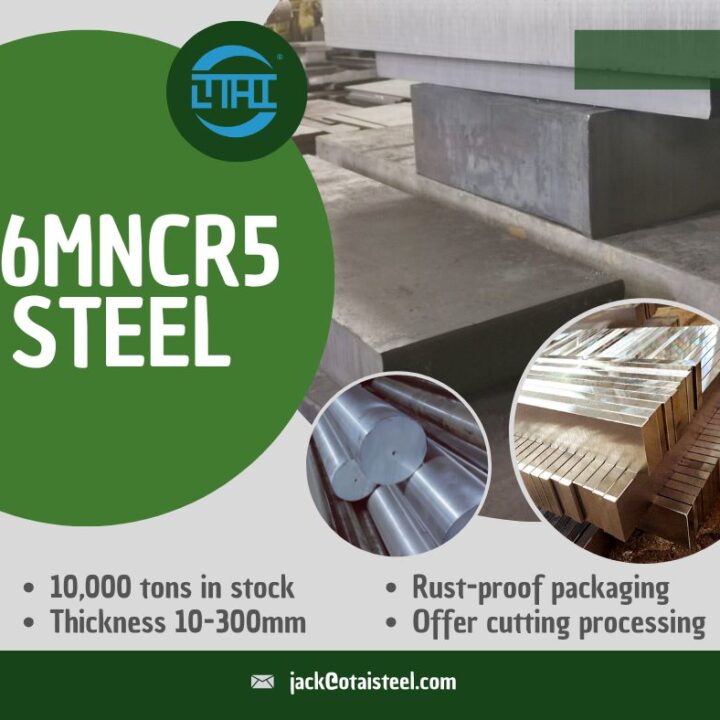
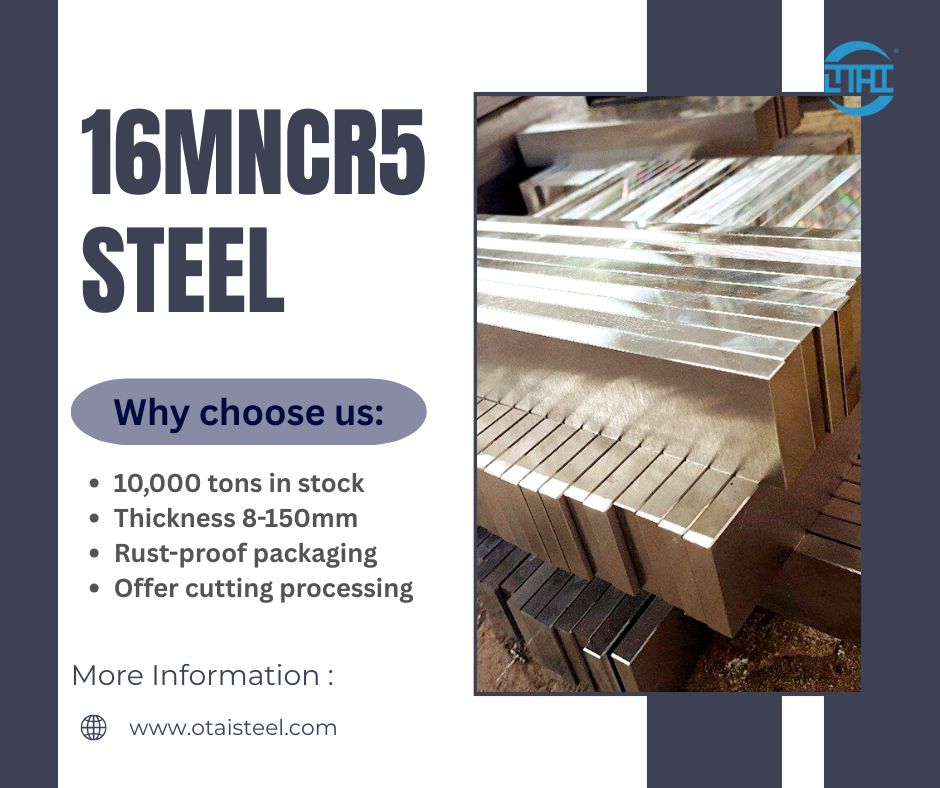
- 16MnCr5 steel plate in stock: Otai Special Steel keeps 16MnCr5 steel plates with thicknesses of 8–150 mm available for industrial orders.
- Cutting service: We can provide cutting according to customer drawings, dimensions, and project requirements.
- Heat treatment support: We can arrange suitable heat-treatment services according to the required material condition and application.
- Quality inspection: Ultrasonic testing and third-party inspection can be arranged for orders with specific quality requirements.
- Export packaging: We provide steel strapping, wooden cases, and anti-rust packaging for international transportation.
- Technical supply experience: Otai Special Steel has supplied steel products to customers with demanding technical requirements, including Fortune Global 500 companies.
For projects involving 16MnCr5 heat treatment, customers can provide the required dimensions, heat-treatment condition, hardness, case depth, application, and quantity. This information helps determine a suitable material and processing route.
❓ 10. FAQ
1. What is the main heat treatment for 16MnCr5?
The most common route uses carburizing followed by quenching and low-temperature tempering. This process creates a hard wear-resistant case while maintaining a tougher core.
2. What hardness can 16MnCr5 reach after heat treatment?
After suitable carburizing and hardening, the surface can commonly reach approximately 58–62 HRC. The actual value depends on the process, case depth, quenching conditions, and final tempering.
3. Is 16MnCr5 suitable for carburizing?
Yes. 16MnCr5 is a classic case-hardening steel. Its relatively low carbon content supports a tough core, while carburizing increases the carbon concentration at the surface.
4. Why is 16MnCr5 used for gears?
Properly treated 16MnCr5 provides a hard surface with good wear and contact-fatigue resistance while retaining useful core toughness. This combination suits gears, pinions, and other transmission components.
5. Does Otai Special Steel have 16MnCr5 plates in stock?
Yes. Otai Special Steel has 16MnCr5 steel plates with thicknesses of 8–150 mm available in stock. Cutting, heat-treatment support, inspection, and export packaging can also be arranged according to project requirements.