 16MnCr5 Chemical Composition: Elements, Properties and Engineering Effects
📑 Table of Contents
🔍 1. What Is the 16MnCr5 Chemical Composition?
📊 3. 16MnCr5 Chemical Composition Table
⚙️ 4. How Each Element Affects 16MnCr5
🔥 5. Chemical Composition and Carburizing
📐 6. 16MnCr5 Chemical vs 20MnCr5 Chemical Composition
🏭 7. How Chemistry Determines Applications
🔍 1. What Is the 16MnCr5 Chemical Composition?
The 16MnCr5 chemical composition gives this alloy steel its characteristic balance of low carbon content, manganese, and chromium. EN 16MnCr5 is a case-hardening steel that engineers commonly select for gears, pinions, shafts, bushings, and other components that need a hard surface with a tough core.
The grade belongs to the European family of low-carbon alloy case-hardening steels. Its chemistry supports carburizing, which increases carbon concentration at the component surface before quenching and tempering.
The name itself provides useful clues. “16” relates approximately to the nominal carbon level, “Mn” identifies manganese as an important alloying element, and “Cr” identifies chromium. The final “5” belongs to the European designation system rather than representing a simple percentage.
Understanding the chemistry matters because each element influences hardenability, strength, toughness, machinability, and heat-treatment response. Therefore, buyers should not evaluate 16MnCr5 only by its carbon percentage.
For procurement, always compare the supplier’s material certificate with the applicable EN specification. Individual heat analysis can vary within the permitted standard limits.
In practical terms, the 16MnCr5 chemical elements work together to create a steel that responds particularly well to carburizing. The relatively low initial carbon level also helps maintain a tough core after surface hardening.
🧪 2. Main Elements in 16MnCr5
Several alloying elements control the performance of 16MnCr5. Carbon, manganese, and chromium play the most important roles, while silicon, phosphorus, and sulfur remain important for processing and material quality.
Carbon (C)
The Carbon is one of the most important elements in 16MnCr5. The grade contains a relatively low carbon level compared with through-hardening alloy steels.
This low-carbon chemistry makes the steel particularly suitable for carburizing. During carburizing, the surface absorbs additional carbon. After quenching, the carbon-enriched layer becomes hard while the lower-carbon core retains useful toughness.
That combination explains why 16MnCr5 works well for gears and transmission components. The surface resists wear, while the core can absorb mechanical loads and impacts.
Manganese (Mn)
Manganese increases strength and contributes to hardenability. It also supports the response of the steel during heat treatment.
The manganese content helps 16MnCr5 develop the desired microstructure after carburizing and quenching. It also contributes to the mechanical strength of the core.
Chromium (Cr)
Chromium improves hardenability and helps the carburized layer develop suitable properties during heat treatment. It also contributes to wear performance indirectly through its effect on the hardened structure.
However, chromium in 16MnCr5 does not make the material stainless. Its concentration remains far below the level typically associated with stainless steel corrosion resistance.
Silicon (Si)
Silicon acts mainly as a deoxidizing and alloying element. The controlled silicon level also influences strength and the overall response of the steel.
Phosphorus and sulfur
Phosphorus and sulfur remain controlled elements. Excessive phosphorus can reduce toughness, while sulfur can improve machinability but may affect other properties when present at higher levels.
For engineering applications, the final composition must remain within the relevant standard limits rather than simply matching a general textbook range.
📊 3. 16MnCr5 Chemical Composition Table
The following table gives commonly referenced EN 16MnCr5 composition ranges. Exact requirements depend on the applicable specification, product form, and supply condition.
| Element | Typical EN Range | Main Function |
|---|---|---|
| Carbon (C) | 0.14–0.19% | Supports carburizing and core toughness |
| Silicon (Si) | ≤ 0.40% | Deoxidation and strength |
| Manganese (Mn) | 1.00–1.30% | Strength and hardenability |
| Chromium (Cr) | 0.80–1.10% | Hardenability and heat-treatment response |
| Phosphorus (P) | ≤ 0.025% | Controlled for toughness and quality |
| Sulfur (S) | ≤ 0.035% | Machinability and cleanliness control |
These values provide a useful reference for understanding 16MnCr5 chemical composition. However, they should not replace the official material standard or mill certificate for a purchasing decision.
Why carbon stays relatively low
A low initial carbon level is essential to the case-hardening concept. The manufacturer can add carbon to the surface during carburizing without making the entire component excessively brittle.
After heat treatment, the result can combine a high-hardness case with a tougher core. This structure provides an excellent balance for components subjected to surface contact stress and repeated loading.
Why chromium matters
Chromium helps the steel harden more effectively during quenching. It becomes particularly useful when manufacturers need consistent case properties across a component section.
At the same time, chromium should not be confused with corrosion resistance. The grade still requires suitable protection when exposed to moisture or corrosive environments.
⚙️ 4. How Each Element Affects 16MnCr5
The performance of 16MnCr5 comes from the interaction between its alloying elements rather than from one element alone. This interaction determines how the steel responds to carburizing, quenching, tempering, machining, and service loading.
| Element | Effect on Heat Treatment | Effect on Service Performance |
|---|---|---|
| Carbon | Controls hardening potential | Supports surface hardness after carburizing |
| Manganese | Improves hardenability | Contributes to core strength |
| Chromium | Improves hardenability | Supports wear-resistant hardened structures |
| Silicon | Influences transformation and strength | Supports general strength |
| Phosphorus | Kept under control | Excess can reduce toughness |
| Sulfur | Influences machinability | Controlled for material quality |
Carbon and surface hardness
The carbon level determines how the steel responds to carburizing. More importantly, the process changes the carbon concentration at the surface rather than simply changing the chemistry of the entire component.
The manufacturer can therefore produce a hard outer layer without sacrificing the toughness of the core. This is one of the most important characteristics of the grade.
Manganese and hardenability
Manganese helps the steel achieve a useful hardened structure during quenching. It also contributes to core strength and supports the overall mechanical balance.
Chromium and hardenability
Chromium works with manganese to improve hardenability. This makes it easier to obtain the desired structure after carburizing and quenching, particularly when the component has a meaningful cross-section.
Impurity control
Phosphorus and sulfur require careful control. Modern steelmaking practices help maintain the cleanliness and consistency needed for demanding mechanical applications.
For critical gears and transmission components, buyers should request a material certificate and verify the actual heat analysis rather than relying only on a generic chemistry table.
🔥 5. Chemical Composition and Carburizing
The relationship between chemistry and carburizing makes 16MnCr5 different from many conventional structural steels. Its initial carbon level allows the surface to receive additional carbon during the carburizing process.
During carburizing, the component remains at an elevated temperature in a carbon-rich environment. Carbon diffuses into the surface. After the desired case depth develops, the component undergoes quenching and tempering.
The resulting microstructure can provide a high-hardness surface and a relatively tough core. Engineers value this combination because gears and shafts often experience high contact stress at the surface while the internal section must withstand impact and bending loads.
Why 16MnCr5 works well for gears
Gear teeth experience repeated contact and sliding. A soft surface would wear quickly, while an excessively brittle component could fail under impact.
The chemistry of 16MnCr5 provides a practical starting point for developing a hardened case. Carburizing then increases surface carbon and enables the required hardness after quenching.
Case depth depends on more than chemistry
The final case depth does not depend only on the nominal chemical composition. Temperature, carburizing time, carbon potential, furnace atmosphere, quenching conditions, and component geometry all influence the final result.
Therefore, a specification for a 16MnCr5 case hardening steel should include the required case depth and hardness when those values are critical to the application.
| Stage | Main Purpose | Result |
|---|---|---|
| Carburizing | Add carbon to the surface | Carbon-enriched case |
| Quenching | Transform the hardened layer | High surface hardness |
| Tempering | Adjust internal stresses and toughness | More stable mechanical properties |
This chemistry-based design is why 16MnCr5 remains popular for transmission and power-transfer components where surface durability matters.
📐 6. 16MnCr5 Chemical vs 20MnCr5 Chemical Composition
16MnCr5 and 20MnCr5 belong to the same general family of case-hardening steels. Their chemical compositions look similar, but their carbon levels differ.
| Element | 16MnCr5 | 20MnCr5 | Engineering Difference |
|---|---|---|---|
| Carbon (C) | Approx. 0.14–0.19% | Approx. 0.17–0.22% | 20MnCr5 has slightly higher carbon |
| Manganese (Mn) | Approx. 1.00–1.30% | Approx. 1.10–1.40% | Similar alloying concept |
| Chromium (Cr) | Approx. 0.80–1.10% | Approx. 1.00–1.30% | Both support hardenability |
| Main purpose | Case hardening | Case hardening | Both suit carburized components |
The exact ranges depend on the applicable standard and product specification. Buyers should always compare the actual certificate requirements rather than selecting a grade from the name alone.
Why choose 16MnCr5?
16MnCr5 provides a well-established combination of low carbon content, manganese, and chromium. It offers a reliable starting chemistry for carburized gears, shafts, pinions, and similar components.
Why choose 20MnCr5?
20MnCr5 has a slightly higher nominal carbon level and may offer a different response to carburizing and heat treatment. Engineers should select between the two based on the required case depth, hardness, core properties, geometry, and applicable specification.
The two grades are related, but they should not automatically be treated as interchangeable. A material substitution should consider both chemistry and the complete heat-treatment procedure.
🏭 7. How Chemistry Determines Applications
The 16MnCr5 chemical composition directly supports the grade’s most important applications. Its low carbon content and alloying elements make it especially useful when engineers need a carburized surface and tough core.
| Application | Required Property | Why 16MnCr5 Chemistry Helps |
|---|---|---|
| Gears | Hard surface and tough core | Low carbon supports carburizing |
| Pinions | Wear and fatigue resistance | Cr and Mn improve hardenability |
| Shafts | Strength and toughness | Balanced alloying supports core properties |
| Bushings | Surface durability | Suitable for case hardening |
| Transmission parts | Contact fatigue resistance | Carburized case provides high surface hardness |
Gears and pinions
Gears need a surface that can withstand repeated contact stress. At the same time, the core must resist cracking and impact. The chemistry of 16MnCr5 provides a strong foundation for achieving this balance through carburizing.
Shafts
Shafts can experience bending, torsion, and fatigue. Depending on their geometry and load conditions, manufacturers can use case hardening to improve surface performance while retaining a tougher internal structure.
Corrosion considerations
Although chromium appears in the chemistry, 16MnCr5 is not a corrosion-resistant stainless steel. Components exposed to moisture should receive appropriate protection such as oil, coating, plating, or controlled environmental protection.
This distinction is especially important when buyers search for 16MnCr5 steel chemical properties. Chemical composition determines many mechanical and heat-treatment characteristics, but it does not automatically determine excellent corrosion resistance.
Machining before heat treatment
The relatively soft condition before carburizing makes the grade suitable for machining. Manufacturers can machine gears and other components before the final hardening stage.
After carburizing and quenching, the surface becomes much harder. Manufacturers therefore need suitable tooling and finishing processes when machining hardened components.
📦 8. Otai Special Steel Advantages
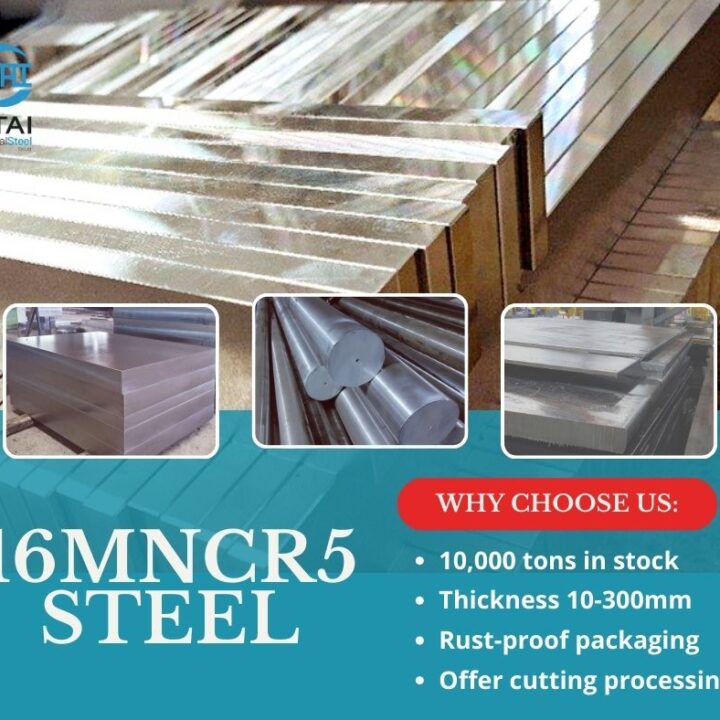
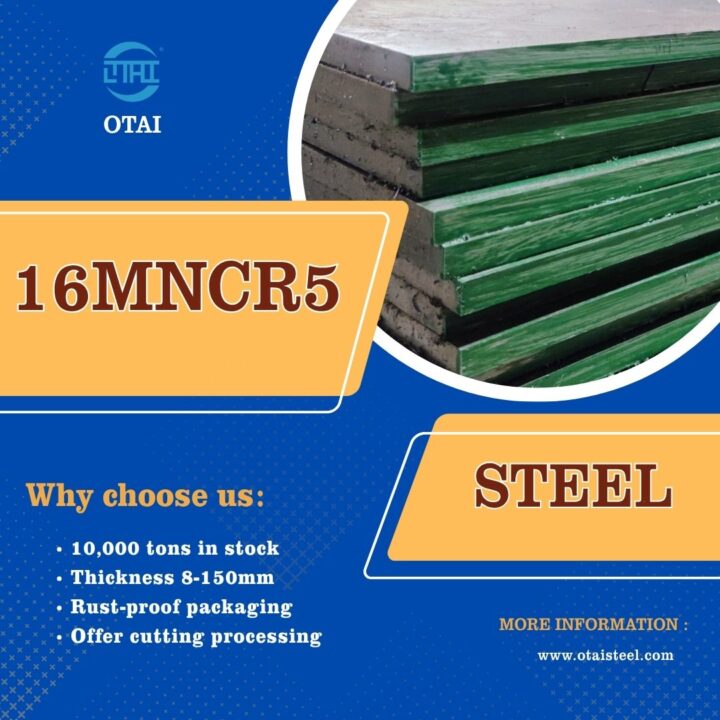
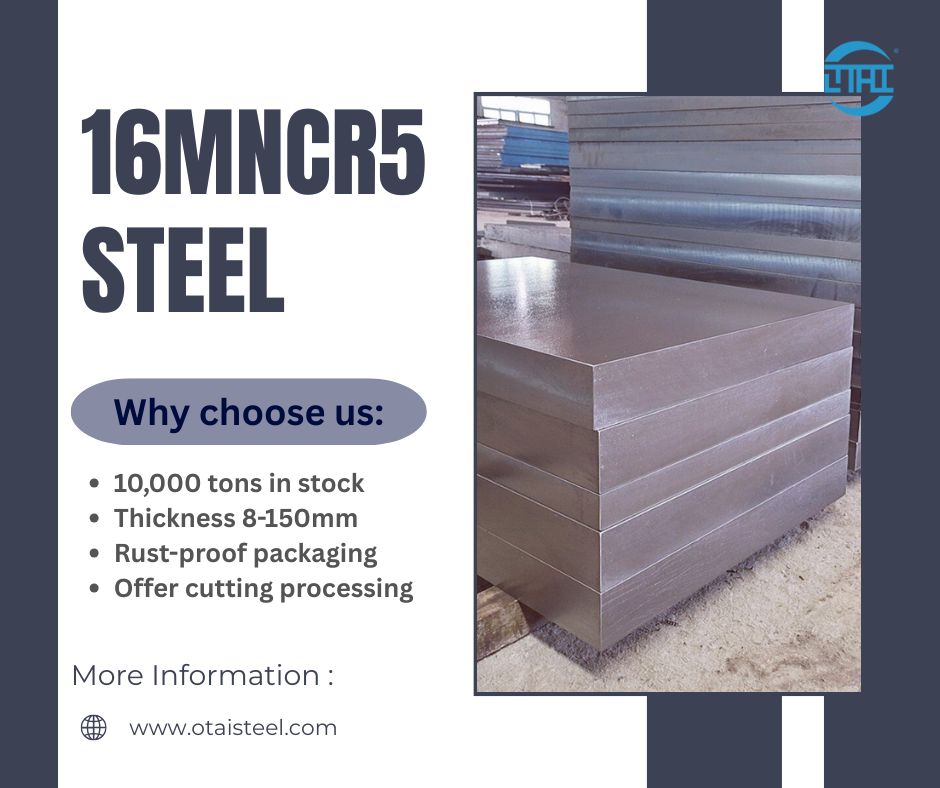
- 16MnCr5 steel plate stock: Otai Special Steel keeps 16MnCr5 steel plate in 8–150 mm thickness available in stock for different engineering projects.
- Different dimensions: We can supply different thicknesses, widths, and lengths according to customer requirements.
- Cutting service: We can arrange cutting to required dimensions before shipment, helping customers reduce preparation work.
- Heat treatment service: Annealing, normalizing, carburizing-related processing, quenching, and tempering can be arranged according to project requirements.
- Quality inspection: Ultrasonic testing and third-party inspection can be arranged for orders with specific quality requirements.
- Export packaging: Steel strapping, wooden cases, and anti-rust packaging help protect products during international transportation.
- International supply experience: Otai Special Steel has supplied steel products to customers with demanding technical requirements, including Fortune Global 500 companies.
If you are sourcing 16MnCr5 steel for gears, shafts, pinions, or other case-hardening components, provide the required dimensions, standard, heat-treatment condition, quantity, and inspection requirements. Otai Special Steel can confirm suitable stock and processing options.
❓ 9. Frequently Asked Questions
1. What is the chemical composition of 16MnCr5?
The main elements include approximately 0.14–0.19% carbon, 1.00–1.30% manganese, and 0.80–1.10% chromium, with controlled levels of silicon, phosphorus, and sulfur. Exact requirements depend on the applicable EN specification.
2. What does the 16 in 16MnCr5 mean?
The “16” refers approximately to the nominal carbon content expressed in hundredths of a percent. The actual specified carbon range remains the correct reference for purchasing and certification.
3. Why does 16MnCr5 have low carbon?
Its relatively low carbon level makes the grade suitable for carburizing. The manufacturer can enrich the surface with carbon and then harden it while keeping the core comparatively tough.
4. Does chromium make 16MnCr5 corrosion resistant?
No. Chromium mainly improves hardenability in this grade. 16MnCr5 does not have the high chromium content and passive surface behavior associated with stainless steels.
5. What thickness of 16MnCr5 steel plate is available from Otai?
Otai Special Steel keeps 16MnCr5 steel plate in 8–150 mm thickness available in stock. Exact availability depends on width, length, quantity, and current inventory.