 4140 Steel Hardness (HRC): Values, Heat Treatment and Applications
📑 Table of Contents
🔍 1. What Is 4140 Steel Hardness (HRC)?
📊 2. 4140 Steel Hardness in Different Conditions
🔥 3. How Heat Treatment Changes 4140 Hardness
⚙️ 4. 4140 Steel Hardness (HRC) After Quenching and Tempering
🧪 5. Factors Affecting 4140 Steel Hardness
🦾 6. 4140 Hardness vs Strength and Wear Resistance
🏭 7. Applications Based on 4140 Hardness
💡 8. How to Specify 4140 Steel Hardness (HRC)
🔍 1. What Is 4140 Steel Hardness (HRC)?
4140 steel hardness (HRC) describes the resistance of 4140 alloy steel to indentation when measured on the Rockwell C scale. The HRC scale is widely used for hardened steels because it provides a practical way to compare hardness after heat treatment.
4140 is a chromium-molybdenum alloy steel with medium carbon content. Its composition allows the material to develop a wide range of hardness levels through heat treatment. Therefore, there is no single HRC value that represents every 4140 steel product.
The hardness depends on the material condition. Annealed 4140 is relatively soft and easy to machine. Quenched and tempered 4140 can reach much higher hardness and strength. Surface hardening can also create a hard outer layer while keeping a tougher interior.
For this reason, buyers should always specify the required condition when asking about 4140 steel hardness in HRC. A statement such as “4140 is 28 HRC” only makes sense when the material condition and treatment are known.
| Material Condition | Typical Hardness Behavior | Main Advantage |
|---|---|---|
| Annealed | Low to moderate hardness | Good machinability |
| Normalized | Moderate hardness | Balanced structure |
| Quenched | High hardness | High strength potential |
| Quenched and tempered | Adjustable HRC level | Strength and toughness balance |
| Induction hardened | Very hard surface | Wear resistance |
The correct hardness target should match the application. A shaft may need high toughness with moderate hardness, while a wear-resistant component may need a much harder surface.
📊 2. 4140 Steel Hardness in Different Conditions
The easiest way to understand 4140 steel hardness (HRC) is to compare the common material conditions. Heat treatment can change the hardness significantly, so the same grade can serve very different applications.
| 4140 Condition | Approximate Hardness | Typical Use |
|---|---|---|
| Annealed | Approximately 180–220 HB | Machining and fabrication |
| Normalized | Approximately 200–240 HB | General engineering |
| Quenched and tempered | Commonly about 28–45 HRC | High-strength components |
| Higher-hardness Q&T condition | Can approach 50 HRC or more | Selected wear-resistant parts |
| Induction hardened surface | Can reach about 50–60 HRC | Wear-prone surfaces |
These values are general engineering references rather than universal specifications. The actual hardness depends on section size, heat-treatment parameters, cooling conditions, tempering temperature, and the applicable material standard.
Annealed 4140 Hardness
Annealed 4140 normally has a hardness that remains suitable for machining. This condition helps manufacturers perform turning, milling, drilling, cutting, and other operations before final heat treatment.
For buyers, annealed material can be useful when they want to machine the component first and perform heat treatment later.
Hardened and Tempered 4140
Quenching increases hardness by creating a martensitic structure. Tempering then reduces some of the brittleness while allowing engineers to select a practical hardness level.
This flexibility is one reason 4140 remains popular for shafts, gears, bolts, axles, and other mechanical components.
🔥 3. How Heat Treatment Changes 4140 Hardness
The 4140 steel hardness HRC value can change dramatically during heat treatment. The process usually includes heating, austenitizing, quenching, and tempering.
Austenitizing
The steel is heated into the austenitic range. The exact temperature depends on the applicable specification and component geometry. Correct heating helps create a suitable structure before quenching.
Quenching
Quenching rapidly cools the steel. This process transforms the austenite into a much harder structure. Oil is commonly used for 4140, although the correct cooling system depends on component size and design.
Tempering
Freshly quenched 4140 can be too hard and brittle for many engineering applications. Tempering reduces internal stresses and improves toughness.
The tempering temperature provides a major control over final hardness. Lower tempering temperatures generally retain more hardness. Higher tempering temperatures generally produce lower hardness and greater toughness.
| Heat Treatment | Hardness Effect | Typical Purpose |
|---|---|---|
| Annealing | Reduces hardness | Improve machinability |
| Normalizing | Moderate hardness | Refine structure |
| Quenching | Strong increase | Develop high hardness |
| Low-temperature tempering | Retains relatively high hardness | Wear and strength applications |
| Higher-temperature tempering | Reduces hardness | Improve toughness |
The important point is that heat treatment should target a property balance rather than maximum hardness. A component that becomes excessively hard may lose the toughness needed to withstand impact and cyclic loading.
⚙️ 4. 4140 Steel Hardness (HRC) After Quenching and Tempering
For many engineering applications, 4140 steel hardness after quenching and tempering falls within a broad range around 28–45 HRC. However, engineers can select different hardness levels by adjusting the tempering process.
| Approx. Hardness | General Property Balance | Potential Applications |
|---|---|---|
| 25–30 HRC | Higher toughness | Heavy-duty shafts and structural components |
| 30–35 HRC | Balanced strength and toughness | General mechanical components |
| 35–40 HRC | Higher strength and wear resistance | Gears, shafts and axles |
| 40–45 HRC | High strength and hardness | Selected high-load components |
| 50+ HRC | Very high hardness | Specialized or surface-hardened applications |
These ranges should not replace a customer’s specification or a certified test result. Actual properties can vary with the section size and treatment process.
Why 35 HRC Is Different from 45 HRC
A 35 HRC component generally provides a stronger balance between toughness and hardness. A 45 HRC component provides greater resistance to indentation and wear but may offer lower impact tolerance.
The correct choice depends on the component. For example, an axle exposed to shock loads may benefit from a lower hardness with better toughness. A wear-prone shaft may benefit from a higher surface hardness.
Therefore, 4140 steel hardness (HRC) should always be selected together with tensile strength, yield strength, impact toughness, fatigue requirements, and operating conditions.
🧪 5. Factors Affecting 4140 Steel Hardness
Several factors influence the final hardness of 4140 steel. Understanding these variables helps buyers choose the right material condition and avoid unrealistic hardness expectations.
1. Section Size
Section size strongly affects cooling during quenching. Small sections usually cool more quickly than large sections. Therefore, a large 4140 bar or plate may not develop the same hardness through the entire cross-section as a smaller component.
2. Quenching Medium
The cooling rate depends on the quenching medium. Oil provides a different cooling rate from water or polymer solutions. The selected medium must match the component’s size, shape, and cracking risk.
3. Tempering Temperature
Tempering temperature has a major effect on final hardness. Lower temperatures usually retain more hardness. Higher temperatures generally reduce hardness while increasing toughness.
4. Initial Microstructure
The condition before hardening also matters. Annealed, normalized, and forged material can respond differently to heat treatment.
5. Alloy Composition
4140 contains chromium and molybdenum. These alloying elements improve hardenability and help the steel develop useful hardness at greater depths than many plain carbon steels.
| Factor | Influence on Hardness |
|---|---|
| Smaller section | Generally supports more uniform hardening |
| Larger section | May reduce center hardness |
| Faster cooling | Greater hardening potential |
| Lower tempering temperature | Higher final hardness |
| Higher tempering temperature | Lower hardness and higher toughness |
For this reason, two pieces of 4140 with the same nominal grade can show different HRC values after heat treatment. The material condition and processing history must always be considered.
🦾 6. 4140 Hardness vs Strength and Wear Resistance
Hardness is closely related to strength, but the two properties are not identical. Increasing 4140 steel hardness generally increases resistance to indentation and can improve wear resistance. However, excessive hardness can reduce toughness.
The same principle applies to tensile and yield strength. Proper heat treatment can raise strength while maintaining enough toughness for demanding mechanical applications.
| Hardness Level | General Trend |
|---|---|
| Low | Better machinability and toughness |
| Medium | Balanced strength and toughness |
| High | Higher wear resistance and strength |
| Very high | Greater hardness but potentially lower impact toughness |
4140 Steel Hardness and Wear Resistance
Higher hardness generally improves resistance to surface indentation and abrasive wear. This makes hardened 4140 useful for shafts, pins, gears, rollers, and other components exposed to repeated contact.
However, wear does not depend on hardness alone. Surface finish, lubrication, contact pressure, temperature, material pairing, and component geometry also affect service life.
4140 Steel Hardness and Toughness
A lower hardness level can provide greater toughness. This balance matters for components exposed to shock loads or sudden changes in force.
For this reason, engineers should not automatically select the highest possible HRC value. Instead, they should determine the minimum hardness that provides sufficient wear and strength while preserving the required toughness.
🏭 7. Applications Based on 4140 Hardness
Different 4140 steel hardness (HRC) levels suit different engineering applications. Manufacturers can select the material condition based on load, wear, impact, and machining requirements.
| Application | Typical Hardness Strategy | Reason |
|---|---|---|
| Heavy-duty shafts | Moderate HRC | Balance strength and toughness |
| Gears | Medium to high hardness | Improve wear resistance |
| Axles | Moderate hardness | Maintain impact resistance |
| Pins | Medium to high hardness | Reduce wear |
| Hydraulic components | Condition-dependent | Balance strength and surface performance |
| Industrial rollers | Higher surface hardness | Improve contact resistance |
4140 is particularly attractive because it supports several treatment routes. A manufacturer can machine annealed material, perform quenching and tempering, and then use surface hardening when the design requires additional wear resistance.
This flexibility allows 4140 to serve many industries, including automotive manufacturing, construction machinery, oil and gas equipment, agricultural machinery, and general mechanical engineering.
4140 Steel for Shafts
Shafts often need a balance between tensile strength and toughness. A moderate quenched-and-tempered hardness can provide a useful combination for torsional and bending loads.
4140 Steel for Gears
4140 can work well for gears when the required hardness and wear resistance fit the design. Surface hardening can further improve the performance of specific gear surfaces.
4140 Steel for Wear Components
Pins, rollers, bushings, and other wear-prone components may benefit from a higher hardness condition or localized induction hardening.
💡 8. How to Specify 4140 Steel Hardness (HRC)
When ordering 4140, customers should specify more than the steel grade. The required hardness can strongly affect the material condition, heat-treatment route, machining sequence, and final inspection.
A clear technical specification should identify the desired hardness range and measurement method. Rockwell C hardness is widely used for hardened 4140, while Brinell hardness may be more practical for softer material conditions.
- 4140 steel grade and applicable standard
- Product form, such as plate or round bar
- Required hardness range
- Heat-treatment condition
- Section dimensions
- Required tensile and yield strength
- Surface-hardening requirements, if applicable
- Inspection and testing requirements
| Specification | Why It Matters |
|---|---|
| HRC range | Defines the required hardness level |
| Heat-treatment condition | Explains how the hardness should be achieved |
| Section size | Influences hardenability and core hardness |
| Tensile strength | Confirms load-bearing capability |
| Yield strength | Confirms resistance to permanent deformation |
If the component needs high surface hardness but a tougher core, induction hardening may provide a better solution than hardening the entire section. If the entire component needs balanced strength, conventional quenching and tempering may be more appropriate.
Therefore, the best 4140 steel hardness (HRC) is not necessarily the highest value. The correct target is the hardness that matches the component’s load, wear, fatigue, impact, and machining requirements.
📦 9. Advantages of Otai Special Steel
- 4140 steel round bar stock: Otai Special Steel keeps 4140 steel round bars with diameters of 14–500 mm available in stock.
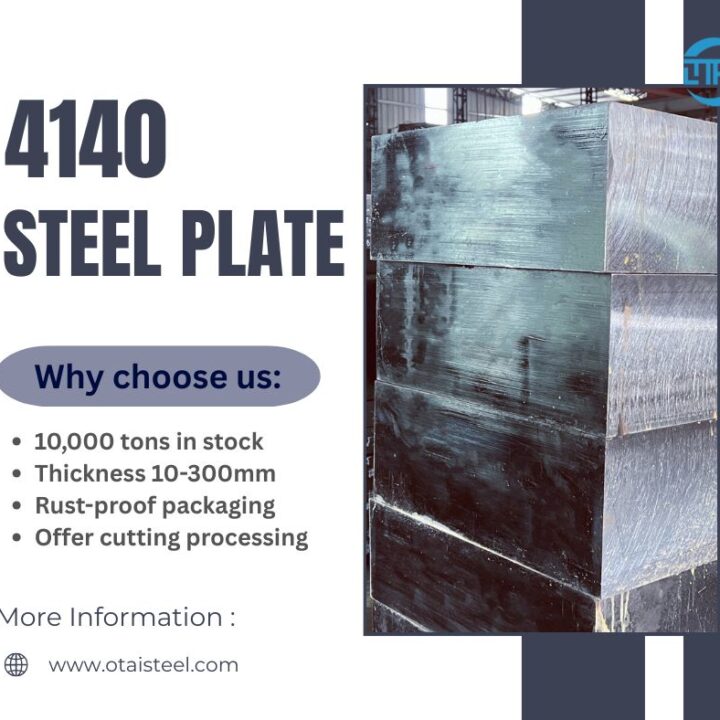
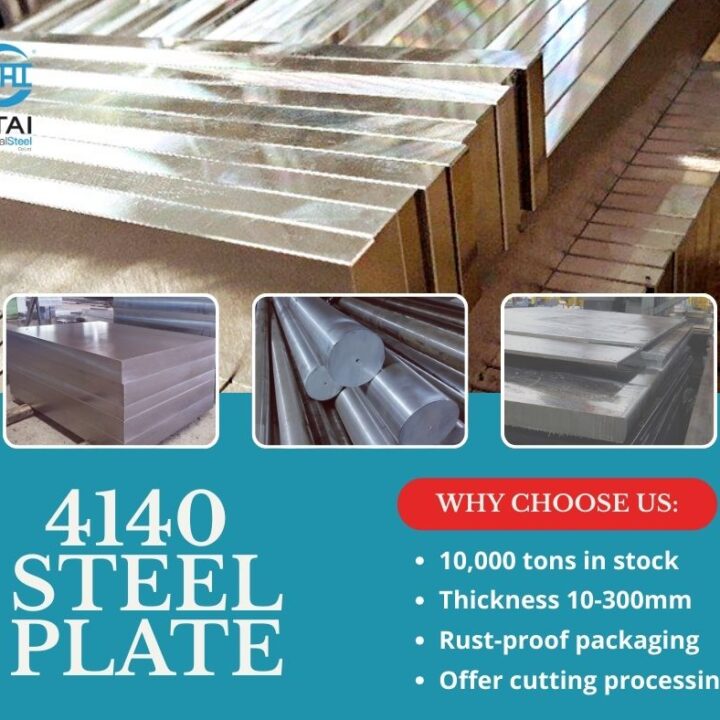
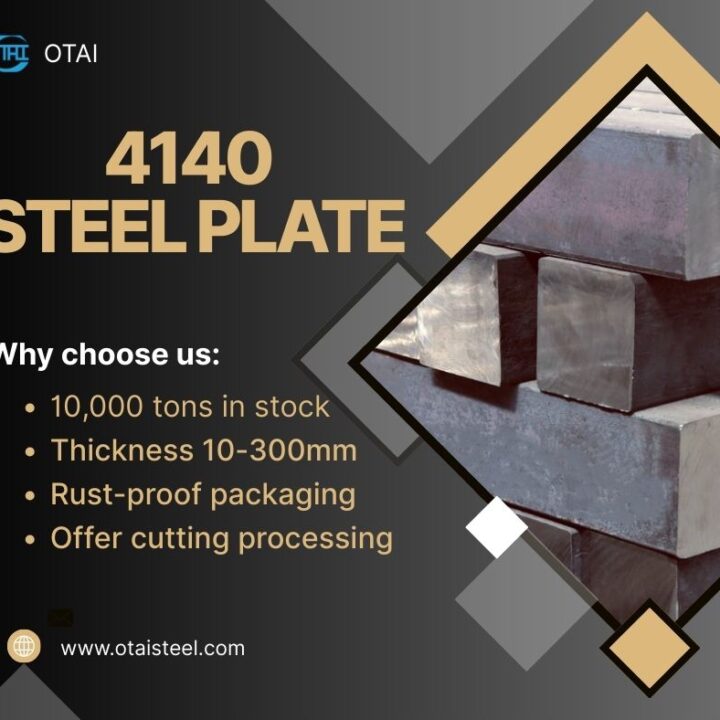
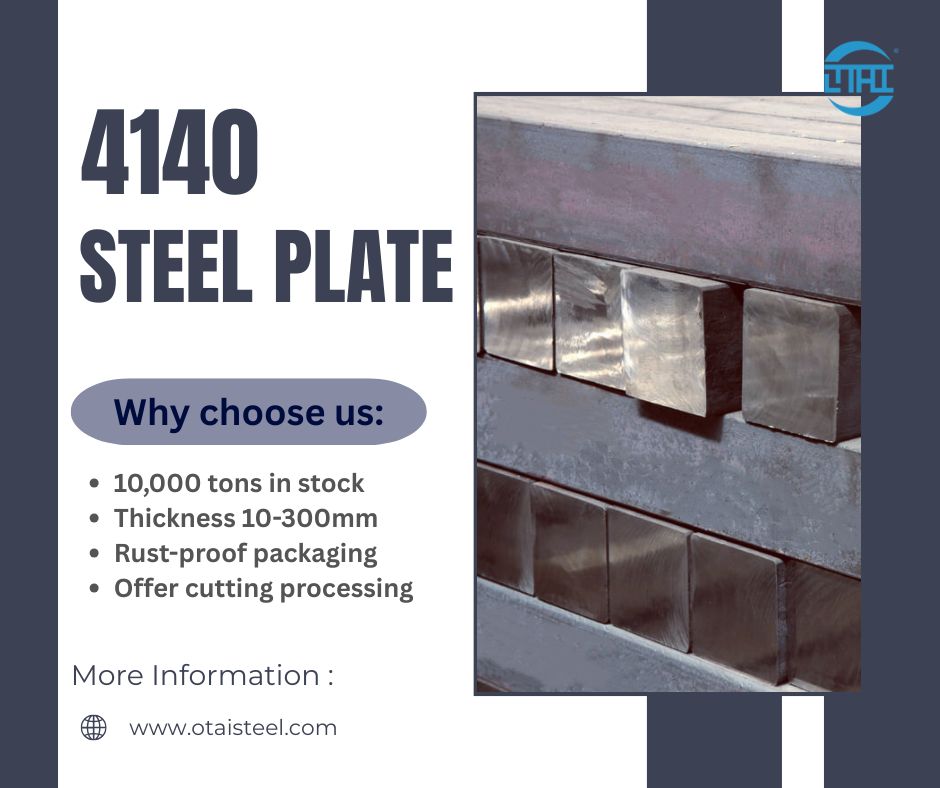
- 4140 steel plate stock: We keep 4140 steel plates with thicknesses of 13–200 mm available in stock for industrial orders.
- Different dimensions: We can supply different diameters, thicknesses, widths, and lengths according to project requirements.
- Cutting service: We can cut 4140 steel according to customer drawings and required dimensions.
- Heat-treatment support: We can arrange suitable annealing, normalizing, quenching, tempering, and surface-hardening services.
- Quality inspection: Ultrasonic testing and third-party inspection can be arranged for orders with specific technical requirements.
- Export packaging: We provide steel strapping, wooden cases, and anti-rust packaging for international transportation.
- Technical supply experience: Otai Special Steel has supplied steel products to customers with demanding technical requirements, including Fortune Global 500 companies.
For projects requiring a specific 4140 steel hardness (HRC), customers can provide the product dimensions, required hardness, heat-treatment condition, application, quantity, and inspection requirements. This information helps us evaluate the appropriate material and processing route.
❓ 10. FAQ
1. What is the typical 4140 steel hardness in HRC?
4140 has no single HRC value. Annealed material is much softer, while quenched and tempered 4140 commonly falls around 28–45 HRC depending on the treatment. Specialized surface hardening can produce substantially higher surface hardness.
2. Can 4140 steel reach 50 HRC?
Yes. Properly treated 4140 can reach around 50 HRC or higher in selected conditions. However, the actual achievable hardness depends on section size, heat-treatment parameters, and the required hardness uniformity.
3. What is the hardness of annealed 4140 steel?
Annealed 4140 is generally measured using the Brinell scale rather than HRC. A typical reference range is approximately 180–220 HB, although the actual value depends on the material specification and condition.
4. Does higher 4140 hardness always mean better performance?
No. Higher hardness can improve wear resistance and strength, but it can also reduce toughness. Engineers should select a hardness level that balances strength, wear resistance, fatigue performance, and impact resistance.
5. What 4140 steel products does Otai Special Steel keep in stock?
Otai Special Steel keeps 4140 steel round bars with diameters of 14–500 mm and 4140 steel plates with thicknesses of 13–200 mm available in stock. Cutting, heat treatment, inspection, and export packaging can also be arranged according to project requirements.