SCM415 vs 16MnCr5: Which Steel Should You Choose?
📑 Table of Contents
🔍 1. SCM415 vs 16MnCr5: What Is the Main Difference?
🧪 2. Chemical Composition Comparison
📊 3. SCM415 vs 16MnCr5 Hardness and Mechanical Properties
🔥 4. Heat Treatment and Carburizing
⚙️ 5. Machinability and Manufacturing
🏭 6. Applications of SCM415 and 16MnCr5
🦾 7. SCM415 vs 16MnCr5 for Gears and Shafts
💡 8. Which Steel Should You Choose?
🔍 1. SCM415 vs 16MnCr5: What Is the Main Difference?
The comparison between SCM415 vs 16MnCr5 is important when selecting a low-carbon alloy steel for carburized components. Both grades are designed for case hardening and can develop a hard, wear-resistant surface with a tougher core.
SCM415 is a Japanese chromium-molybdenum alloy steel commonly specified under JIS G4053. The grade contains relatively low carbon and uses chromium and molybdenum to improve hardenability and heat-treatment performance.
16MnCr5 is a European case-hardening steel commonly identified by the material number 1.7131. Its alloy design combines low carbon with manganese and chromium, making it well suited to carburizing and applications that require surface hardness and core toughness.
At first glance, the two grades appear very similar because manufacturers use both for gears, shafts, pinions, bushings, and other mechanical components. However, their chemical compositions, standards, material availability, and specific heat-treatment requirements differ.
| Feature | SCM415 | 16MnCr5 |
|---|---|---|
| Material system | JIS | EN |
| Material type | Cr-Mo case-hardening steel | Mn-Cr case-hardening steel |
| Carbon level | Low carbon | Low carbon |
| Primary alloying elements | Chromium and molybdenum | Manganese and chromium |
| Typical treatment | Carburizing and quenching | Carburizing and quenching |
| Surface hardness after case hardening | High | High |
| Common applications | Gears, shafts, automotive components | Gears, pinions, shafts, transmission parts |
In practical terms, neither steel is universally better. The right choice depends on the required case depth, core properties, component dimensions, applicable standard, production process, and material availability.
For buyers comparing SCM415 and 16MnCr5, checking the actual material certificate and heat-treatment specification is more reliable than treating the grades as interchangeable.
🧪 2. Chemical Composition Comparison
Chemical composition is one of the clearest ways to understand the difference between these two case-hardening steels. SCM415 relies on chromium and molybdenum, while 16MnCr5 uses manganese and chromium as important alloying elements.
| Element | SCM415 Typical Composition | 16MnCr5 Typical Composition | Main Effect |
|---|---|---|---|
| Carbon (C) | Approx. 0.13–0.18% | Approx. 0.14–0.19% | Supports carburizing and core strength |
| Silicon (Si) | Approx. 0.15–0.35% | Approx. 0.15–0.40% | Strength and deoxidation |
| Manganese (Mn) | Approx. 0.60–0.90% | Approx. 1.00–1.30% | Hardenability and strength |
| Chromium (Cr) | Approx. 0.90–1.20% | Approx. 0.80–1.10% | Hardenability and wear performance |
| Molybdenum (Mo) | Approx. 0.15–0.30% | Usually not a principal alloying addition | Hardenability and temper resistance |
| Nickel (Ni) | Not a principal alloying element | Not a principal alloying element | Generally limited |
The exact chemical limits depend on the applicable standard and product specification. Therefore, buyers should verify the actual heat analysis on the mill test certificate when chemical composition is critical.
SCM415 chemical composition
SCM415 contains low carbon together with chromium and molybdenum. This combination supports hardenability while retaining a relatively low-carbon core before carburizing.
Molybdenum also helps control undesirable effects associated with heat treatment and contributes to the steel’s performance in demanding mechanical applications.
16MnCr5 chemical composition
16MnCr5 contains manganese and chromium as its principal alloying elements. The relatively low carbon content allows the surface to absorb additional carbon during carburizing.
After carburizing and quenching, the carbon-enriched surface can reach high hardness while the core maintains useful toughness.
This makes both grades attractive for case hardening steel applications, although the alloying strategies are not identical.
📊 3. SCM415 vs 16MnCr5 Hardness and Mechanical Properties
Hardness comparisons between SCM415 and 16MnCr5 require careful attention to material condition. Both steels can achieve high surface hardness after carburizing, but the final values depend on carburizing parameters, case depth, quenching, tempering, section size, and testing location.
For this reason, it is not technically accurate to assign one fixed hardness value to either grade regardless of treatment.
| Property | SCM415 | 16MnCr5 |
|---|---|---|
| Base carbon level | Low | Low |
| Carburizing suitability | Excellent | Excellent |
| Surface hardness after carburizing | Very high potential | Very high potential |
| Core toughness | Good to very good | Good to very good |
| Wear resistance after case hardening | Excellent | Excellent |
| Hardenability | Good to very good | Good |
| Typical use | Automotive and mechanical components | Gears and transmission components |
SCM415 hardness
In its carburized condition, SCM415 can develop a hard surface suitable for components exposed to wear and repeated contact stress. The core remains tougher because the original carbon content remains relatively low.
The final hardness profile depends on the carburizing cycle and subsequent quenching process. Engineers should therefore specify the required surface hardness and effective case depth instead of relying only on the steel grade.
16MnCr5 hardness
16MnCr5 follows a similar case-hardening principle. Carburizing enriches the surface with carbon, and quenching converts the enriched layer into a hard martensitic structure.
The core does not receive the same carbon enrichment. As a result, it can retain better toughness and support the hardened surface under impact or cyclic loading.
The 16MnCr5 hardness after carburizing therefore differs substantially from its initial annealed or normalized condition.
Which is harder: SCM415 or 16MnCr5?
Neither grade is automatically harder. When both receive suitable carburizing and hardening treatments, their surface hardness can reach similar high levels. The actual result depends on process parameters and component design.
For engineering decisions, surface hardness alone should not determine the selection. Case depth, core hardness, toughness, distortion control, fatigue requirements, and production cost also deserve attention.
🔥 4. Heat Treatment and Carburizing
Heat treatment is central to the performance of both SCM415 and 16MnCr5. Their low-carbon chemistry makes them particularly suitable for carburizing rather than conventional through-hardening as the primary treatment.
SCM415 heat treatment
A typical SCM415 production route may include annealing or normalizing before machining, followed by carburizing, quenching, and tempering.
During carburizing, the surface absorbs carbon. The subsequent quenching operation transforms the carbon-enriched layer into a hard structure with high wear resistance.
16MnCr5 heat treatment
The typical 16MnCr5 heat treatment route also involves carburizing followed by hardening and tempering. The exact process depends on the required case depth, surface hardness, core properties, and component geometry.
Manufacturers must control heating and cooling carefully because gears and precision transmission parts can experience dimensional changes during carburizing and quenching.
| Heat-Treatment Process | SCM415 | 16MnCr5 |
|---|---|---|
| Annealing | Possible | Possible |
| Normalizing | Possible | Possible |
| Carburizing | Common | Common |
| Quenching | Common after carburizing | Common after carburizing |
| Tempering | Common | Common |
| Induction hardening | Application dependent | Application dependent |
Case depth matters
A deeper case does not automatically mean better performance. Engineers need to select a suitable effective case depth according to tooth geometry, contact stress, loading cycles, and service conditions.
For this reason, buyers ordering either SCM415 or 16MnCr5 for gears should provide a clear heat-treatment specification whenever possible.
The supplier can then evaluate whether the requested material condition and dimensions are appropriate for the planned manufacturing process.
⚙️ 5. Machinability and Manufacturing
Both SCM415 and 16MnCr5 provide good machining potential before final case hardening. This allows manufacturers to perform turning, milling, drilling, broaching, and other operations before carburizing.
Machining SCM415
SCM415 can be machined effectively in suitable untreated or softened conditions. Manufacturers usually complete the majority of dimensional machining before carburizing.
After case hardening, the surface becomes much harder. Finishing operations may therefore require grinding or other processes designed for hardened steel.
Machining 16MnCr5
16MnCr5 also offers practical machinability before carburizing. Manufacturers can machine gears, shafts, and other components before the final heat-treatment stage.
Because carburizing and quenching may produce distortion, manufacturers often leave appropriate machining allowances for final finishing.
| Manufacturing Factor | SCM415 | 16MnCr5 |
|---|---|---|
| Machining before carburizing | Good | Good |
| Turning and drilling | Suitable | Suitable |
| Machining after case hardening | More difficult | More difficult |
| Grinding | Used for hardened surfaces | Common for precision finishing |
| Distortion control | Important | Important |
The choice between the two grades can therefore involve production location as much as material performance. If one grade is readily available from a qualified supplier, that advantage may reduce lead time and simplify procurement.
Buyers should also consider whether the supplier can provide cutting, machining, heat treatment, inspection, and export packaging as part of the same order.
🏭 6. Applications of SCM415 and 16MnCr5
The applications of SCM415 and 16MnCr5 overlap considerably because both grades can provide the hard surface and tough core required by many mechanical components.
| Application | SCM415 | 16MnCr5 |
|---|---|---|
| Automotive gears | Excellent | Excellent |
| Industrial gears | Suitable | Excellent |
| Pinions | Excellent | Excellent |
| Transmission shafts | Suitable | Suitable |
| Bushings | Suitable | Suitable |
| Automotive components | Very common | Common |
| General machinery components | Suitable | Suitable |
SCM415 applications
SCM415 is widely associated with automotive and mechanical components that require carburizing. Typical applications include gears, shafts, pins, bushings, sprockets, and other transmission-related parts.
Its chromium-molybdenum alloy design makes it useful when engineers need reliable hardenability and core performance after case hardening.
16MnCr5 applications
Common 16MnCr5 applications include gears, pinions, transmission components, shafts, bushings, and machine parts exposed to repeated contact or wear.
European machinery manufacturers frequently select this grade because its EN specification provides a familiar material designation for many industrial applications.
SCM415 vs 16MnCr5 for gears
Both grades can work very well for gears. The better option depends on the applicable design standard, required mechanical properties, manufacturing location, heat-treatment capability, and material availability.
If a project already specifies JIS SCM415, switching to 16MnCr5 should not happen simply because the chemical compositions appear similar. Engineers should review the complete material specification and validate the substitution.
🦾 7. SCM415 vs 16MnCr5 for Gears and Shafts
Gears and shafts place different demands on steel. Gear teeth experience repeated contact stress and wear, while shafts may need a broader combination of tensile strength, toughness, fatigue resistance, and surface durability.
For carburized gears
Both SCM415 and 16MnCr5 can provide excellent performance in carburized gear applications. The carburized layer gives the tooth surface high hardness and wear resistance.
At the same time, the lower-carbon core helps the component resist impact and cyclic loading. This combination is one of the major reasons case-hardening steels remain important in gear manufacturing.
For shafts
The choice becomes more application-specific for shafts. If the shaft requires a hardened surface together with a tough core, either grade may be suitable depending on the design.
However, engineers should distinguish a carburized shaft from a shaft that requires high uniform hardness throughout its cross-section. Medium-carbon steels such as 4140 may be more appropriate for the latter requirement.
| Requirement | SCM415 | 16MnCr5 |
|---|---|---|
| Carburized gears | Excellent | Excellent |
| Wear-resistant surface | Excellent after treatment | Excellent after treatment |
| Tough core | Good to very good | Good to very good |
| Automotive transmission parts | Very suitable | Very suitable |
| European-standard projects | Requires specification review | Natural choice |
| Japanese-standard projects | Natural choice | Requires specification review |
The SCM415 vs 16MnCr5 for gears comparison therefore comes down to more than hardness. Material standards, heat-treatment requirements, component geometry, quality control, and supply conditions all influence the final decision.
💡 8. Which Steel Should You Choose?
There is no universal winner in the SCM415 vs 16MnCr5 comparison. Both are capable case-hardening steels, but the correct grade depends on the project’s technical and commercial requirements.
Choose SCM415 when:
- Your drawing or specification requires JIS SCM415.
- The component requires carburizing and high surface hardness.
- You are manufacturing automotive or transmission components based on Japanese specifications.
- You need a chromium-molybdenum case-hardening steel.
- Your existing heat-treatment process is already qualified for SCM415.
Choose 16MnCr5 when:
- Your project follows EN material specifications.
- You need a commonly used European case-hardening steel.
- The component requires carburizing, high surface hardness, and a tough core.
- You are manufacturing gears, pinions, shafts, or transmission components.
- You need convenient sourcing of 16MnCr5 from an experienced alloy-steel supplier.
| Project Requirement | Potential Choice |
|---|---|
| JIS specification | SCM415 |
| EN specification | 16MnCr5 |
| Carburized gears | Both can be suitable |
| Automotive components | Both can be suitable |
| European machinery project | 16MnCr5 |
| Japanese machinery project | SCM415 |
| Existing qualified heat-treatment process | Use the specified grade |
Before changing from one grade to another, engineers should compare chemical composition, hardenability, case depth, core hardness, tensile requirements, dimensional tolerances, heat-treatment parameters, and applicable standards.
For buyers searching for an SCM415 equivalent to 16MnCr5, the important point is that similarity does not automatically mean full interchangeability. A material substitution should receive engineering approval before production.
📦 9. Otai Special Steel Advantages
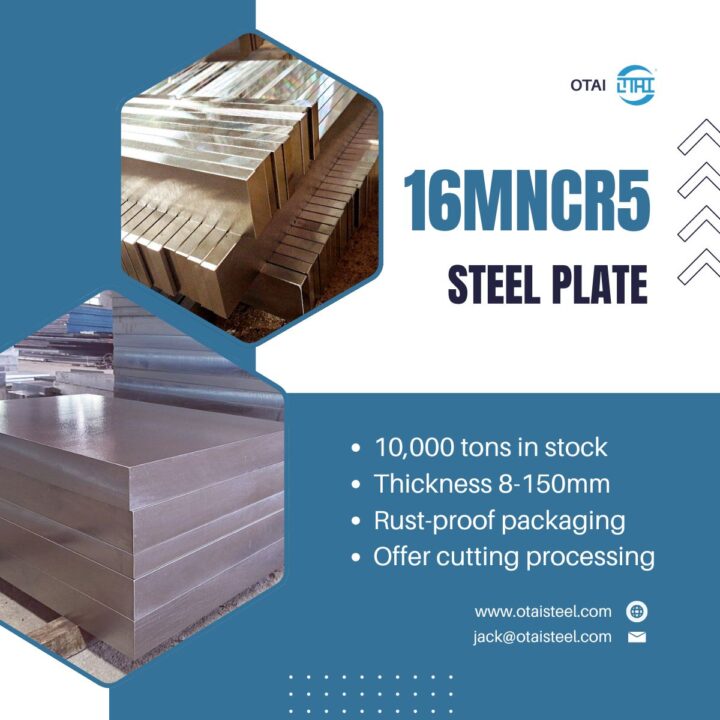
- 16MnCr5 steel plate stock: Otai Special Steel provides 16MnCr5 steel plates with thicknesses from 8–150 mm available in stock for different industrial applications.
- Large inventory: We maintain sufficient stock of different sizes to support industrial orders and faster shipment.
- Precision cutting: We can cut steel according to customer drawings, specified dimensions, and project requirements.
- Machining service: Additional machining can be arranged when customers require customized or semi-finished components.
- Heat treatment: Annealing, normalizing, quenching, tempering, and other suitable heat-treatment services can be arranged according to customer requirements.
- Quality inspection: Ultrasonic testing and third-party inspection support are available for orders with specific quality requirements.
- Export packaging: Anti-rust packaging, steel strapping, and wooden cases help protect steel products during international transportation.
- International supply experience: Otai Special Steel supplies tool steel and alloy steel to international industrial customers with demanding technical requirements, including Fortune Global 500 companies.
If you are comparing SCM415 vs 16MnCr5 for a specific project, provide the required grade, dimensions, quantity, heat-treatment condition, inspection requirements, and application. Otai Special Steel can help confirm suitable 16MnCr5 material and processing options.
❓ 10. Frequently Asked Questions
1. Is SCM415 the same as 16MnCr5?
No. SCM415 and 16MnCr5 are different alloy steel grades covered by different material standards. However, both are low-carbon case-hardening steels and share several applications, including gears, shafts, and transmission components.
2. What is the main difference between SCM415 and 16MnCr5?
SCM415 is a JIS chromium-molybdenum case-hardening steel, while 16MnCr5 is an EN manganese-chromium case-hardening steel. Their alloying systems and applicable specifications are different.
3. Is 16MnCr5 equivalent to SCM415?
They can be considered comparable for some applications, but they should not be treated as automatically interchangeable. Engineers should compare the complete chemical, mechanical, heat-treatment, and dimensional requirements before approving a substitution.
4. Which is better for gears, SCM415 or 16MnCr5?
Both can perform well in carburized gear applications. SCM415 may be preferred for projects following Japanese specifications, while 16MnCr5 is a common choice for projects following European EN specifications.
5. Can Otai Special Steel supply 16MnCr5?
Yes. Otai Special Steel provides 16MnCr5 steel plates with thicknesses from 8–150 mm available in stock. Cutting, machining, heat treatment, ultrasonic testing, third-party inspection support, and export packaging can also be arranged according to customer requirements.