SCM440 Steel: Properties, Heat Treatment, Hardness & Applications
📑 Table of Contents
🔍 1. What Is SCM440 Steel?
SCM440 is a chromium-molybdenum alloy structural steel designed for mechanical components that need strength, toughness, and good hardenability. The JIS system places this grade among alloy steels for machine structural applications.
Its carbon content sits near 0.4%, while chromium and molybdenum improve hardenability and heat-treatment response. As a result, engineers can develop a strong combination of surface hardness and core strength when they select the right heat-treatment condition.
For buyers, the grade name alone does not define the final performance. Annealed, normalized, and quenched-and-tempered material can show significantly different hardness, strength, machinability, and service behavior.
SCM440 suits components that need higher strength and hardenability than ordinary carbon structural steel, especially when the design includes heat treatment.
Where Does SCM440 Perform Well?
Common applications include shafts, gears, pins, couplings, spindles, high-strength bolts, hydraulic components, and heavy machinery parts. The material also works well with surface hardening processes when the application needs a harder working surface.
For example, a shaft may require high tensile strength and fatigue resistance, while a gear may need stronger surface wear resistance. Engineers can adjust the final balance through quenching, tempering, induction hardening, or other suitable processes.
SCM440 and International Grade Comparisons
International buyers often compare SCM440 with AISI/SAE 4140 and EN 42CrMo4 because these grades share a similar chromium-molybdenum alloy concept. However, different standards can define different chemical limits, mechanical requirements, testing methods, and delivery conditions.
When replacing one international grade with another, compare the governing standard, chemistry, heat-treatment condition, mechanical properties, dimensions, and inspection requirements instead of relying only on the grade name.
🧪 2. SCM440 Chemical Composition
The chemical composition gives SCM440 its characteristic combination of strength and hardenability. Carbon provides the foundation for hardness and strength. Chromium improves hardenability and wear resistance, while molybdenum supports hardening response and tempering resistance.
| Element | Typical Range | Main Function |
|---|---|---|
| C | 0.38–0.43% | Strength and hardness |
| Si | 0.15–0.35% | Deoxidation and strengthening |
| Mn | 0.60–0.90% | Hardenability and strength |
| Cr | 0.90–1.20% | Hardenability and wear resistance |
| Mo | 0.15–0.30% | Hardenability and tempering resistance |
| Ni | ≤0.25% | Alloying and residual control |
| Cu | ≤0.30% | Residual/alloying control |
| P | ≤0.030% | Controlled impurity |
| S | ≤0.030% | Controlled impurity |
The exact chemical limits depend on the applicable product standard and specification. Therefore, buyers should check the material certificate when chemistry matters to the final component.
Carbon plays a particularly important role in the final hardness. Increasing carbon within the specified range can support higher hardness, while the chromium-molybdenum combination helps the steel develop a more consistent hardened structure through larger sections.
Section size also matters. A chemical composition may meet the grade requirement, yet a large section can still develop different surface and core properties after quenching because the cooling rate changes with distance from the surface.
For critical components, chemical analysis should form part of the material acceptance process. Buyers can then compare the actual heat number with the agreed specification rather than depending on a generic grade description.
⚙️ 3. SCM440 Mechanical Properties
Mechanical properties depend strongly on the delivery condition and heat-treatment cycle. Consequently, buyers should always identify the required condition when they request mechanical data.
| Condition | Tensile Strength | Yield Strength | Hardness |
|---|---|---|---|
| Annealed | Approx. 650–800 MPa | — | HB 187–229 |
| Q&T reference condition | ≥980 MPa | ≥835 MPa | HB 285–352 |
| Q&T, tempering around 550°C | Approx. 1000–1100 MPa | Approx. 850–950 MPa | HB 293–331 |
| Lower-temperature tempering reference | Approx. 1350–1500 MPa | Approx. 1200–1400 MPa | Approx. 40–45 HRC |
These figures provide useful reference points, but they do not guarantee the result for every product. Section size, quenching conditions, tempering temperature, furnace control, and test location can change the final values.
Strength Versus Toughness
Higher strength does not always mean better performance. A component that experiences impact or cyclic loading may need more toughness instead of maximum hardness.
For this reason, engineers normally select a heat-treatment condition according to the actual service load. A shaft may require a balanced Q&T condition, while a wear-prone surface may need an additional hardening process.
Why Section Size Matters
Thick SCM440 plate and large-diameter round bar require particular attention during quenching. The surface cools faster than the center, so the final microstructure can vary across the section.
When a project has a critical core-hardness or mechanical-property requirement, the buyer should specify the section size, heat-treatment condition, and test location together.
🔥 4. SCM440 Heat Treatment
Heat treatment controls the balance between hardness, strength, toughness, and machinability. SCM440 responds well to quenching and tempering because its chromium and molybdenum content improves hardenability.
A common hardening reference uses 830–880°C followed by oil quenching, while tempering commonly falls around 530–630°C for a balanced mechanical condition.
| Process | Reference Temperature | Cooling Method | Main Purpose |
|---|---|---|---|
| Annealing | Around 830°C | Furnace cooling | Reduce hardness and improve machinability |
| Normalizing | 830–880°C | Air cooling | Refine and homogenize the structure |
| Quenching | 830–880°C | Oil cooling | Increase hardness and strength |
| Tempering | 530–630°C | Controlled cooling | Improve toughness and adjust hardness |
How Long Should SCM440 Stay at Temperature?
Soaking time often causes confusion because no single holding time works for every size. Furnace type, heating rate, section thickness, loading arrangement, and temperature uniformity all affect the required time.
As an experimental reference, one published SCM440 induction-hardening study heated 15 mm specimens to 860°C and held them for 1 hour before quenching. The researchers then tempered the specimens at 600°C for 1 hour.
That experiment does not provide a universal production recipe. A 15 mm laboratory specimen and a 150 mm industrial plate will not heat and cool in the same way.
For production heat treatment, determine the soaking time from the actual section size, furnace characteristics, heating rate, and required final properties rather than applying a fixed time-per-millimeter rule.
Quenching and Tempering Sequence
During hardening, the furnace brings the material into the austenitizing range. After sufficient heating and soaking, the operator quenches the steel in oil to form a hard structure.
Tempering follows the quench. The process reduces brittleness and adjusts the final balance between strength and toughness.
A lower tempering temperature generally retains more hardness and strength. A higher tempering temperature normally increases toughness while reducing hardness.
Induction Hardening
Induction hardening offers another route when a component needs a hard surface but a tougher core. The process rapidly heats the surface and then quenches it, creating a hardened layer without hardening the entire cross-section to the same degree.
Research on SCM440 has reported surface microhardness around 764 HV0.3 under specific induction-hardening conditions. Industrial results can vary according to frequency, heating temperature, heating time, cooling method, prior microstructure, and target case depth.
📏 5. SCM440 Hardness
Hardness often becomes the first technical question during material selection because it affects machining, wear resistance, strength, and final component performance.
Annealed SCM440 typically measures HB 187–229, while quenched-and-tempered material commonly reaches HB 285–352 in reference conditions.
Lower-temperature tempering can produce higher hardness. Some reference data place SCM440 around 40–45 HRC after Q&T with a lower tempering temperature.
Induction hardening can raise surface hardness further. Depending on the process, industrial SCM440 components can reach approximately HRC 50–55 at the hardened surface.
Which Hardness Should Buyers Specify?
The correct hardness depends on the application. A component that requires easy machining may need annealed material, whereas a high-load shaft may need Q&T material.
Surface wear introduces another consideration. In that situation, engineers may choose Q&T material followed by induction hardening rather than simply increasing the hardness of the entire component.
When ordering SCM440, specify the hardness scale, target range, test location, and delivery condition instead of giving only a single hardness number.
For example, “35 HRC” does not explain whether the requirement applies to the surface, core, incoming material, or finished component. A complete specification removes that ambiguity.
Machining requirements also influence the choice. Annealed SCM440 normally provides better machinability than hardened material, so manufacturers often machine the blank before final heat treatment.
🌎 6. SCM440 Equivalent Grades
SCM440 frequently appears alongside AISI 4140 and EN 42CrMo4 in international sourcing. These grades share a similar Cr-Mo alloy concept and often serve comparable mechanical applications.
| Standard | Related Grade | Typical Market Use |
|---|---|---|
| JIS | SCM440 | Japanese alloy structural steel |
| AISI / SAE | 4140 | American and international applications |
| EN / DIN | 42CrMo4 / 1.7225 | European engineering applications |
| GB | 42CrMo | Chinese machinery and engineering applications |
The similarity between these grades does not mean that every specification matches. Standards can differ in chemistry limits, mechanical testing, product dimensions, heat-treatment requirements, and acceptance criteria.
For international procurement, the safest approach starts with the customer’s governing standard. Engineers can then compare the candidate grades against the actual drawing, material specification, and test requirements.
Before approving an SCM440 equivalent, compare chemistry, standard, delivery condition, mechanical properties, dimensions, hardness, and inspection requirements.
This process becomes particularly important for safety-critical components or large-volume production. A small difference in specification can create problems during machining, heat treatment, or final inspection.
🏭 7. SCM440 Applications
SCM440 works across many mechanical applications because engineers can adjust its properties through heat treatment. The right selection depends on load, fatigue, impact, wear, dimensions, and manufacturing route.
| Application | Main Reason for Selection |
|---|---|
| Drive shafts | Strength, toughness and hardenability |
| Gears | Heat-treatment response and wear resistance |
| High-strength bolts | High mechanical strength |
| Pins and couplings | Load-bearing capacity and toughness |
| Spindles | Strength and dimensional performance |
| Hydraulic components | Strength and machining flexibility |
| Heavy machinery parts | Balanced strength and toughness |
SCM440 for Shafts and Pins
Shafts and pins often experience repeated mechanical loading. Engineers therefore look beyond tensile strength and consider fatigue resistance, toughness, surface condition, and dimensional stability.
A suitable Q&T condition can provide the required bulk strength. When the surface faces additional wear, induction hardening can further improve surface performance.
SCM440 for Gears and Machinery Parts
Gears require careful attention to surface hardness, contact stress, core toughness, and manufacturing method. SCM440 can support applications that use through hardening or surface hardening, depending on the design.
For heavy machinery, the material offers a useful compromise between strength and machinability. The final specification should still reflect the actual load and service environment rather than simply copying a material used on another machine.
SCM440 does not suit every application. For components that require a deep carburized case, for example, engineers may prefer a dedicated carburizing grade. Material selection should follow the failure mode and manufacturing route.
📐 8. SCM440 Steel Plate Sizes & Processing
Stock size can directly influence material cost, machining allowance, and delivery time. Buyers can often reduce waste by choosing a stock dimension close to the finished part size.
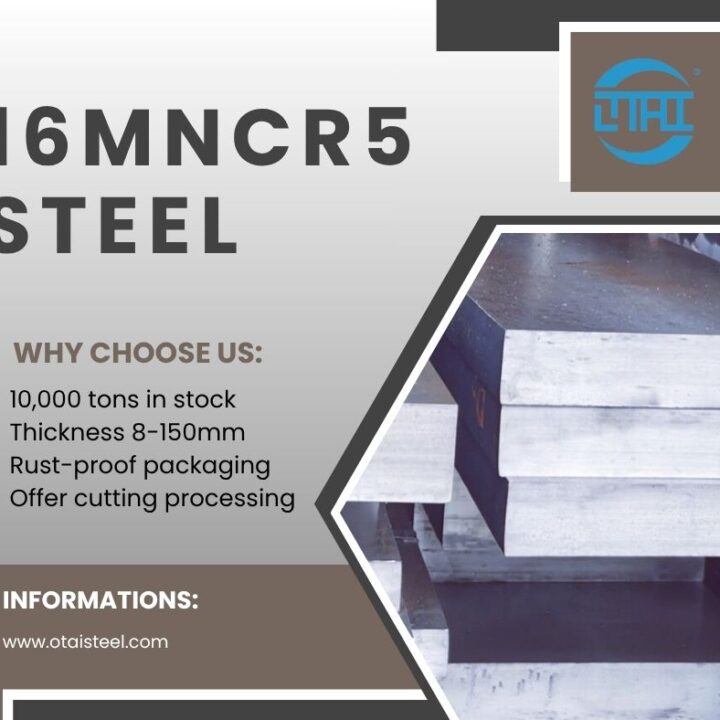
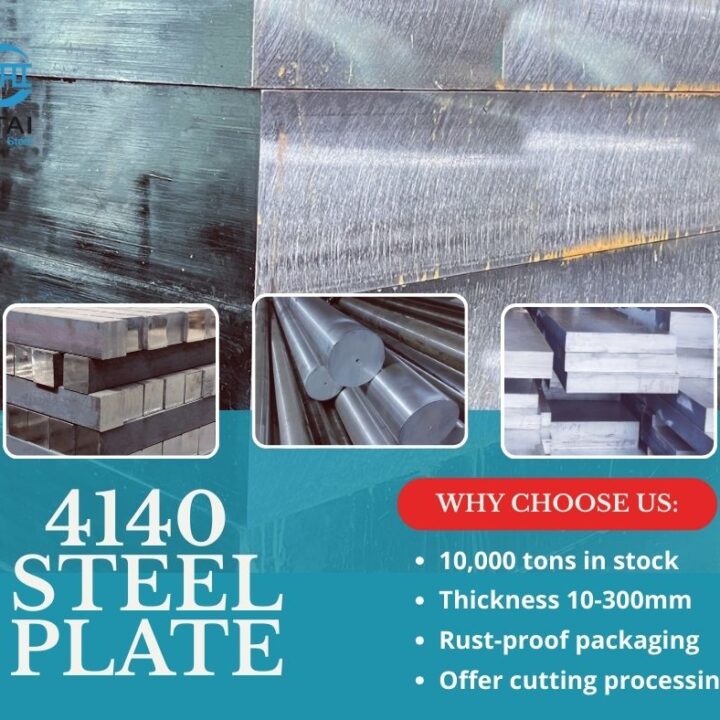
Otai supplies SCM440 steel plate in thicknesses from 4–380 mm and SCM440 round bar in diameters from 14–500 mm. The company also offers SCM440 Q&T plate in the 13–200 mm thickness range.
| Product | Stock Range | Processing Options |
|---|---|---|
| SCM440 steel plate | 4–380 mm | Saw cutting, CNC and grinding |
| SCM440 Q&T plate | 13–200 mm | Cutting and customized processing |
| SCM440 round bar | Ø14–500 mm | Saw cutting, CNC and grinding |
Cutting and Custom Sizes
When customers provide the finished component dimensions, the supplier can evaluate a practical raw-material size and machining allowance. That approach can reduce unnecessary material removal at the customer’s workshop.
For rectangular components, saw cutting can produce individual blanks before shipment. Round bar can also be cut to approximate finished lengths when the customer’s production process benefits from pre-cut material.
CNC, Grinding and Heat Treatment
Some projects require more than raw steel. CNC machining, grinding, heat treatment, inspection, and packaging can form part of a one-stop supply arrangement.
If your project has strict final dimensions or tolerances, provide the finished drawing together with the steel grade and raw-material specification so the supplier can plan the correct machining allowance.
For thick SCM440 plate, buyers should also discuss flatness, dimensional tolerance, heat-treatment condition, and inspection requirements before production or cutting.
🛒 9. How to Choose SCM440 for Your Project
Material selection becomes easier when buyers start with the finished component and work backward toward the raw material. This method connects the steel specification with the actual manufacturing process.
Step 1: Confirm the Grade and Standard
Start with the drawing or technical specification. Confirm whether the project calls for JIS SCM440 or another international grade such as AISI 4140 or EN 42CrMo4.
Do not approve a substitute grade from the name alone; compare the applicable standard and technical requirements first.
Step 2: Select the Delivery Condition
Next, determine whether you will machine the material before heat treatment or purchase Q&T material for direct use or final machining.
Annealed SCM440 generally offers better machinability. Q&T material provides higher strength and may reduce the amount of downstream heat treatment.
Step 3: Define the Hardness
Identify the target hardness and the location where the supplier or inspector should measure it. Surface hardness and core hardness can have very different meanings for the same component.
If the application requires a hard surface and tough core, discuss induction hardening or another suitable surface treatment rather than simply requesting a very high bulk hardness.
Step 4: Confirm Dimensions and Tolerance
Provide the required plate thickness, width, length, or round-bar diameter. For processed material, include the finished dimensions and machining allowance.
Large sections deserve additional attention because heat treatment can produce different properties between the surface and center.
Step 5: Define Inspection Requirements
Critical projects may require chemical analysis, tensile testing, hardness testing, dimensional inspection, ultrasonic testing, or third-party inspection.
Put the inspection standard and acceptance criteria on the purchase order so both sides work from the same technical requirements.
Step 6: Compare the Supplier’s Total Service
Price per ton matters, but it does not represent the entire purchasing cost. Stock availability, cutting, machining, heat treatment, tolerance control, documentation, packaging, and export experience can all affect the final result.
For recurring projects, a consistent purchasing specification can also simplify future orders. Keeping the grade, standard, size, condition, inspection, and packaging requirements clear reduces technical misunderstandings between buyer and supplier.
🏢 10. Otai Special Steel Advantages
- SCM440 steel plate stock: SCM440 plate is available in thicknesses from 4–380 mm.
- SCM440 Q&T plate: Quenched-and-tempered SCM440 plate is available in 13–200 mm thickness.
- SCM440 round bar stock: Round bar is available from Ø14–500 mm.
- 10,000+ tons of stock: Large inventory supports project and regular purchasing requirements.
- 20 saw cutting machines: Multiple cutting machines support different sizes and order quantities.
- CNC & grinding: Processing services help customers obtain material closer to production requirements.
- Custom size & tolerance: Otai can arrange cutting and processing according to customer specifications.
- One-stop service: Cutting, machining, heat treatment, inspection, and packaging can be coordinated through one supplier.
- Global export experience: Otai has exported steel to 54+ countries since 1999.
For overseas buyers, this combination of stock and processing capability can simplify sourcing. Customers can discuss the required SCM440 grade, size, condition, tolerance, inspection, and processing before shipment.
That approach can also reduce the need to coordinate several separate suppliers. For projects that require cut-to-size material or additional processing, a single supply chain can make communication and quality control easier.
❓ FAQ
1. What is SCM440 steel?
SCM440 is a chromium-molybdenum alloy structural steel under the JIS system. Engineers commonly select it for shafts, gears, pins, couplings, high-strength bolts, spindles, and other mechanically loaded components.
2. What is the hardness of SCM440?
Annealed SCM440 typically measures HB 187–229, while quenched-and-tempered material commonly reaches HB 285–352 in reference conditions. The actual hardness depends on the heat-treatment condition, section size, and applicable specification.
3. What temperature is used for SCM440 heat treatment?
A common hardening reference uses 830–880°C followed by oil quenching, while tempering commonly falls around 530–630°C. The operator should determine the actual soaking time and cooling conditions from the section size and required properties.
4. Is SCM440 the same as 4140?
SCM440 and AISI/SAE 4140 belong to a closely related chromium-molybdenum alloy steel family and often serve similar applications. However, their standards can specify different chemistry, mechanical properties, dimensions, and inspection requirements.
5. What should I specify when buying SCM440?
Specify the grade, standard, dimensions, delivery condition, heat-treatment requirement, hardness or mechanical properties, tolerance, inspection requirements, and quantity. Add cutting dimensions, machining allowance, surface requirements, and packaging details when the supplier will provide processing.