42CrMo4 Steel Equivalent: Grades, Properties & Applications
📑 Table of Contents
🔍 1. What Is 42CrMo4 Steel?
42CrMo4 is a chromium-molybdenum alloy steel widely used for high-strength mechanical components. The grade belongs to the EN steel system and commonly appears under material number 1.7225.
Its combination of carbon, chromium, and molybdenum gives the material good hardenability, strength, toughness, and resistance to mechanical loading. Engineers often choose it for components that need stronger performance than ordinary carbon steel can provide.
For procurement teams, the important point is that 42CrMo4 does not have one fixed hardness or strength value. The final properties depend on the delivery condition, section size, and heat-treatment cycle.
42CrMo4 is a strong choice when a mechanical component needs a good balance of strength, toughness, and hardenability rather than maximum hardness alone.
Why Do Buyers Search for a 42CrMo4 Equivalent?
International projects often use different steel standards. A European drawing may specify 42CrMo4, while a supplier or customer’s local market may commonly stock AISI 4140, SAE 4140, SCM440, or another related Cr-Mo alloy steel.
That situation creates a practical sourcing question: can another grade replace 42CrMo4 without affecting the component?
The answer requires more than matching the grade names. Buyers should compare chemical composition, standard requirements, heat-treatment condition, mechanical properties, dimensions, hardness, and inspection criteria.
42CrMo4 vs Similar Cr-Mo Steels
42CrMo4, AISI 4140, and JIS SCM440 share a similar alloy concept. They contain approximately 0.4% carbon together with chromium and molybdenum, so engineers frequently use them for comparable applications.
However, similar chemistry does not automatically make two grades technically identical. Each standard can define its own composition limits, mechanical requirements, product forms, and testing conditions.
For a replacement decision, treat AISI 4140 or SCM440 as closely related grades rather than assuming they are automatically identical to EN 42CrMo4.
🌎 2. 42CrMo4 Steel Equivalent Grades
The most common international comparisons involve 42CrMo4, AISI 4140, and JIS SCM440. These grades occupy a similar position in mechanical engineering and often appear in shafts, gears, bolts, axles, and heavy-duty machinery.
| Standard | Related Grade | Material Number / Designation | Typical Market |
|---|---|---|---|
| EN | 42CrMo4 | 1.7225 | Europe |
| AISI / SAE | 4140 | 4140 | USA and international markets |
| JIS | SCM440 | SCM440 | Japan and Asian markets |
| GB | 42CrMo | 42CrMo | China |
Among these grades, AISI 4140 provides one of the most common alternatives in international purchasing. SCM440 also provides a close comparison for buyers working with Japanese specifications.
Is 42CrMo4 the Same as 4140?
42CrMo4 and AISI 4140 have very similar alloy chemistry and commonly serve the same types of mechanical applications. Nevertheless, the standards do not use exactly the same specification system.
The actual interchangeability depends on the customer’s drawing and governing material standard. For non-critical parts, a close chemistry and suitable mechanical condition may support substitution. Safety-critical components require a more detailed technical comparison.
Is 42CrMo4 the Same as SCM440?
SCM440 and 42CrMo4 also have closely related chromium-molybdenum chemistry. Both grades support high-strength mechanical applications and respond well to quenching and tempering.
Even so, buyers should not treat the two designations as interchangeable without checking the applicable standard. The safest approach compares the actual material certificate with the customer’s specification.
For international sourcing, 4140 and SCM440 are commonly considered close equivalents, but the final substitution should follow the customer’s technical approval.
🧪 3. 42CrMo4 Chemical Composition
The chemical composition explains why 42CrMo4 performs well under demanding mechanical loads. Carbon supports strength and hardness, while chromium and molybdenum improve hardenability.
| Element | Typical EN 42CrMo4 Range | Engineering Role |
|---|---|---|
| C | 0.38–0.45% | Strength and hardness |
| Si | ≤0.40% | Deoxidation and strengthening |
| Mn | 0.60–0.90% | Strength and hardenability |
| Cr | 0.90–1.20% | Hardenability and wear resistance |
| Mo | 0.15–0.30% | Hardenability and tempering resistance |
| P | ≤0.025% | Controlled impurity |
| S | ≤0.035% | Controlled impurity |
Exact limits can vary with the product standard, product form, and revision of the specification. Therefore, buyers should use the governing EN specification when they need certification-level confirmation.
Why Chromium and Molybdenum Matter
Chromium increases hardenability, allowing the steel to develop useful hardened properties beyond the immediate surface. Molybdenum supports hardenability and helps the material retain a useful strength level after tempering.
This alloy combination makes 42CrMo4 particularly useful for larger mechanical components. Nevertheless, section thickness still affects the final structure because the center cools more slowly during quenching.
For buyers comparing an equivalent grade, chemical composition provides the first screening step. Mechanical properties and heat-treatment results must follow before the supplier can confirm suitability.
⚙️ 4. 42CrMo4 Mechanical Properties
Mechanical properties vary according to the delivery condition and product size. Quenched-and-tempered 42CrMo4 generally provides much higher strength than annealed material.
| Property | Typical Q&T Reference | Why It Matters |
|---|---|---|
| Tensile strength | Approx. 900–1100 MPa | Resistance to tensile loading |
| Yield strength | Approx. 700–950 MPa | Resistance to permanent deformation |
| Elongation | Approx. 10–15% | Ductility |
| Hardness | Commonly around 28–36 HRC | Strength, wear and machining balance |
These values serve as general engineering references rather than a universal certificate requirement. The actual specification can produce different minimum values according to section size and heat-treatment condition.
Strength and Toughness Balance
A component rarely needs the highest possible strength in every situation. Excessive hardness can reduce toughness and make machining more difficult.
For shafts, axles, and heavily loaded machinery parts, engineers usually seek a controlled balance between strength and toughness. Quenching followed by tempering provides a practical way to achieve that balance.
Effect of Section Size
Large-diameter bars and thick plates can show different properties between the surface and center after quenching. The surface loses heat faster, while the core cools more slowly.
If the component has a critical core-property requirement, specify the section size and test location together with the mechanical-property requirement.
🔥 5. 42CrMo4 Heat Treatment
Heat treatment determines much of the final performance of 42CrMo4. The material responds particularly well to quenching and tempering, which allows engineers to adjust hardness, strength, and toughness for different components.
A common hardening reference heats 42CrMo4 to about 820–860°C, followed by oil quenching, and then tempers the material according to the required final properties.
| Process | Typical Reference | Cooling | Purpose |
|---|---|---|---|
| Annealing | Around 680–720°C | Furnace cooling | Improve machinability and reduce hardness |
| Normalizing | Around 840–880°C | Air cooling | Refine the structure |
| Hardening | Around 820–860°C | Oil quenching | Increase strength and hardness |
| Tempering | Commonly 540–680°C | Controlled cooling | Improve toughness and set final hardness |
How Long Should 42CrMo4 Stay at Heat-Treatment Temperature?
Soaking time depends on the actual section size, furnace design, heating rate, load arrangement, and temperature uniformity. A simple fixed “one hour per certain thickness” rule cannot safely cover every production condition.
For example, a small laboratory specimen reaches the target temperature much faster than a large industrial plate. The center of a thick section needs additional time to reach a uniform temperature.
Determine the actual holding time from the section size and furnace process rather than applying one universal time-per-millimeter formula.
Quenching and Tempering
During hardening, the furnace heats the material into the austenitizing range. After sufficient soaking, the operator transfers the steel to the quenching medium.
Oil quenching provides a practical balance between cooling speed and cracking risk for many 42CrMo4 applications. However, the correct quenching method depends on geometry, section size, equipment, and the required properties.
Tempering follows quenching. A lower tempering temperature generally retains more hardness and strength, while a higher temperature usually increases toughness and reduces hardness.
Induction Hardening
When a component needs a hard working surface and a tougher core, induction hardening can provide a useful solution. The process heats the surface rapidly and then cools it to create a hardened layer.
This approach works well for selected shafts, gears, pins, and wear-prone components. The final surface hardness and case depth depend on frequency, heating parameters, quenching, material condition, and component geometry.
📏 6. 42CrMo4 Hardness
Hardness provides a quick way to evaluate the condition of 42CrMo4, but the number only becomes meaningful when the buyer also identifies the delivery and heat-treatment condition.
Annealed material normally has a much lower hardness than quenched-and-tempered material. Q&T processing can produce a broad hardness range depending on tempering temperature and section size.
For many Q&T applications, 42CrMo4 falls roughly in the 28–36 HRC range, while the exact target should come from the component specification.
| Condition | Approximate Hardness | Typical Purchasing Purpose |
|---|---|---|
| Annealed | Approx. HB 200–250 | Machining before final heat treatment |
| Q&T, moderate tempering | Approx. 28–36 HRC | General high-strength components |
| Higher-temperature tempering | Lower hardness | Higher toughness requirements |
| Surface hardened | Can exceed 50 HRC at the surface | Wear and contact-stress applications |
What Hardness Should You Order?
The answer depends on the finished part. A manufacturer that plans extensive machining may prefer annealed material. Another customer may need Q&T material because the component requires high strength before final assembly.
Surface wear creates a different requirement. Engineers may use Q&T material and then apply induction hardening to obtain a harder surface without making the entire cross-section excessively hard.
When purchasing 42CrMo4, specify the hardness range, hardness scale, test position, and delivery condition rather than giving only a single hardness number.
🏭 7. 42CrMo4 Applications
42CrMo4 serves many demanding mechanical applications because engineers can tailor its properties through heat treatment. The grade works particularly well when components face high loads, repeated stress, impact, or surface wear.
| Application | Why Engineers Select 42CrMo4 |
|---|---|
| Shafts | High strength, toughness and fatigue performance |
| Gears | Good hardenability and wear resistance |
| Axles | Load-bearing capacity and toughness |
| High-strength bolts | High tensile and yield strength |
| Pins and couplings | Strength and resistance to repeated loading |
| Hydraulic components | Strength and heat-treatment flexibility |
| Heavy machinery | Balanced strength and toughness |
42CrMo4 for Shafts and Axles
Shafts and axles often experience bending, torsion, impact, and cyclic loading. For that reason, engineers normally consider both strength and toughness rather than focusing on hardness alone.
Q&T 42CrMo4 can provide a useful combination of bulk strength and toughness. Surface hardening may add wear resistance when the design requires a harder contact area.
42CrMo4 for Gears and Pins
Gears and pins can experience concentrated contact stress. A suitable heat-treatment condition can improve surface performance while maintaining adequate core toughness.
However, 42CrMo4 does not automatically replace every carburizing steel. Components that require a deep carburized case may perform better with a dedicated case-hardening grade.
42CrMo4 in Heavy Machinery
Heavy machinery components often require a material that can tolerate high mechanical loads without becoming excessively brittle. The Cr-Mo alloy system makes 42CrMo4 useful for this type of service.
The final selection should still consider the component geometry, service temperature, loading pattern, fatigue requirements, manufacturing process, and inspection standard.
📐 8. 42CrMo4 Steel Plate Sizes & Processing
For overseas buyers, stock dimensions can affect both project cost and lead time. Selecting a raw size close to the finished component can reduce machining waste and shorten production preparation.
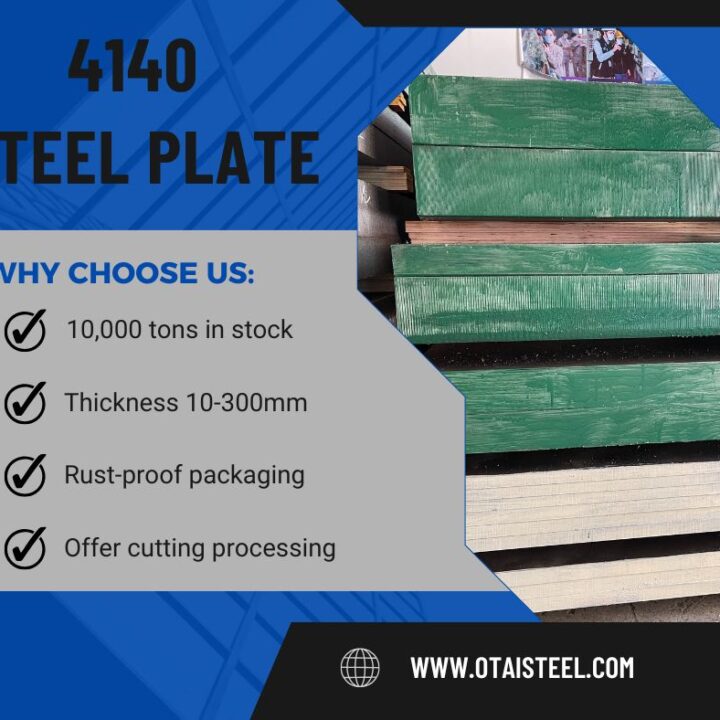
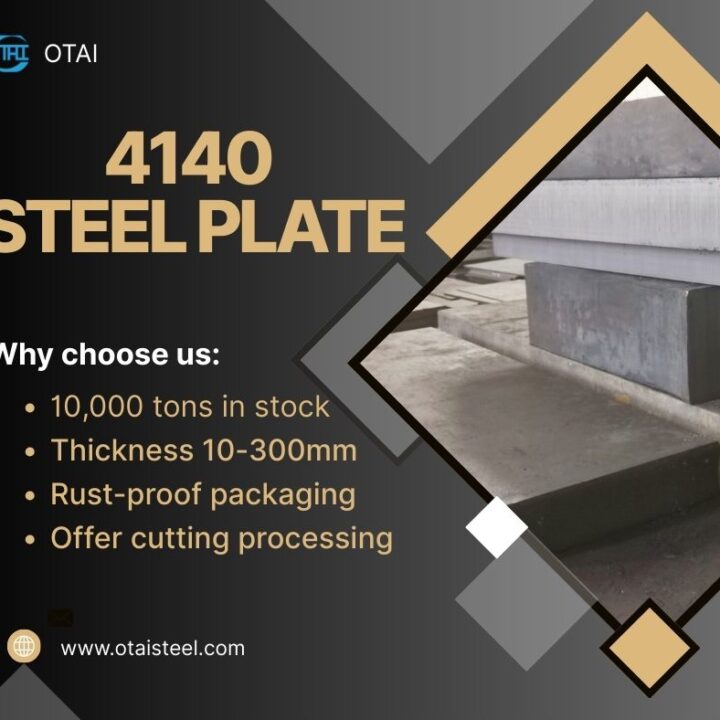
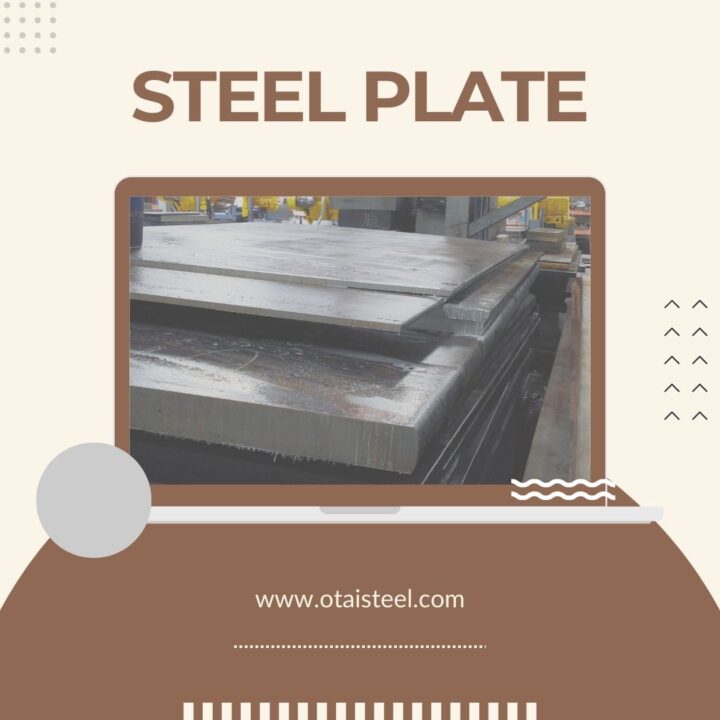
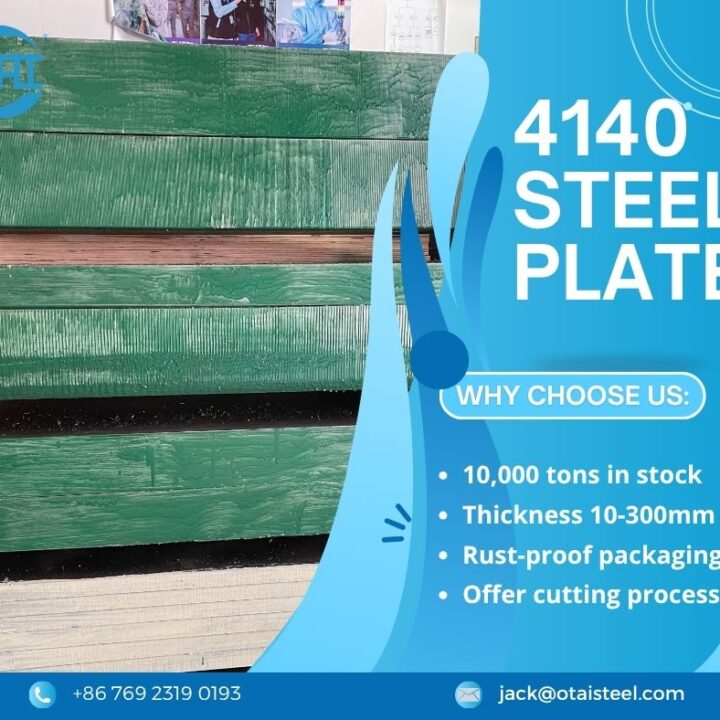
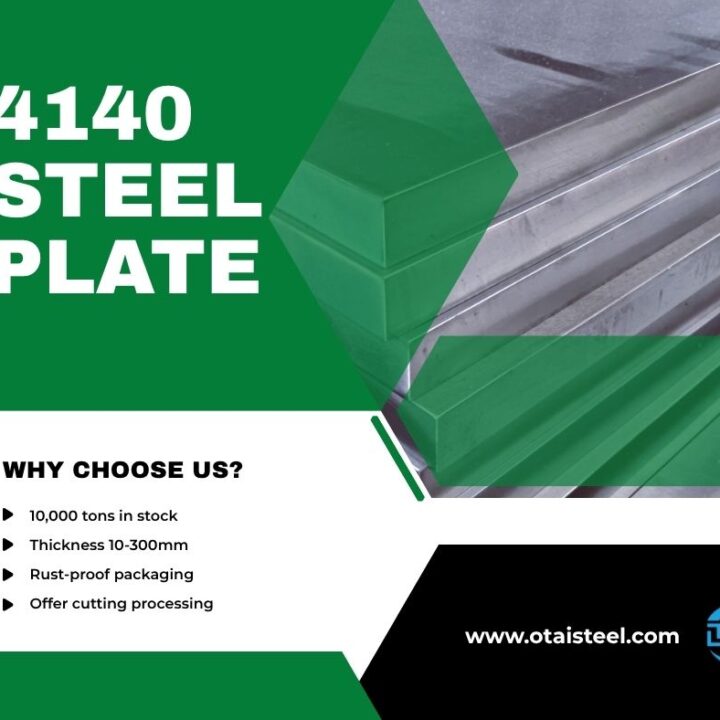
Otai supplies 42CrMo4-related Cr-Mo steel products in a wide range of sizes. Current stock information includes steel plate from 4–380 mm thickness, Q&T plate from 13–200 mm thickness, and round bar from 14–500 mm diameter.
| Product | Stock Range | Available Processing |
|---|---|---|
| 42CrMo4 steel plate | 4–380 mm | Saw cutting, CNC and grinding |
| 42CrMo4 Q&T plate | 13–200 mm | Cutting and customized processing |
| 42CrMo4 round bar | Ø14–500 mm | Saw cutting, CNC and grinding |
Why Cut-to-Size Material Matters
Customers who purchase raw stock for CNC machining often need additional material allowance for the manufacturing process. Buying a practical stock size can simplify workshop preparation and reduce unnecessary cutting work.
Saw cutting can produce individual blanks according to the customer’s required dimensions. CNC machining and grinding can take the material closer to the final component dimensions when the project requires additional processing.
Large and Thick Sections
Thick plate and large round bar require more attention during heat treatment. The center of a large section does not cool at the same rate as the surface, so buyers should discuss the required mechanical properties before placing the order.
For large 42CrMo4 sections, confirm the final heat-treatment condition, hardness location, dimensional tolerance, and inspection requirement before production.
🛒 9. How to Choose a 42CrMo4 Equivalent
Choosing an equivalent grade should start with the finished component rather than the steel designation. This approach helps procurement teams avoid accepting a technically similar material that does not satisfy the actual drawing.
Step 1: Check the Governing Standard
Confirm whether the drawing specifies EN 42CrMo4, 1.7225, AISI 4140, SCM440, or another designation. The standard determines the chemical and mechanical requirements that the supplier must meet.
Start with the customer’s governing standard before approving any equivalent grade.
Step 2: Compare Chemical Composition
Check carbon, chromium, molybdenum, manganese, silicon, phosphorus, and sulfur. Similar chemistry provides a useful starting point, but it does not prove complete equivalence.
For critical projects, compare the actual material certificate with the required chemical limits rather than relying on a generic online comparison chart.
Step 3: Confirm Mechanical Properties
Review tensile strength, yield strength, elongation, reduction of area, impact requirements, and hardness where applicable.
Delivery condition matters here. Annealed material and Q&T material can show very different results even when they carry the same grade designation.
Step 4: Match the Heat Treatment
Determine whether the customer plans to heat treat the material after machining or wants Q&T material from the supplier. The answer affects hardness, machinability, dimensional stability, and final production cost.
If the customer requires surface hardening, define the target surface hardness and case depth rather than simply requesting “hardened steel.”
Step 5: Confirm Size and Inspection
Dimensions, tolerance, ultrasonic testing, hardness testing, tensile testing, and third-party inspection can all affect the purchasing specification.
Before approving a 42CrMo4 equivalent, compare grade, standard, chemistry, dimensions, delivery condition, mechanical properties, hardness, inspection, and quantity.
Step 6: Evaluate the Supplier’s Service
Price is only one part of the purchasing decision. Stock availability, cutting, machining, grinding, heat treatment, inspection, packaging, and export experience can influence the real project cost and lead time.
A supplier that can coordinate several steps can also reduce communication between different subcontractors. This becomes particularly useful when the buyer needs custom sizes or additional processing before shipment.
🏢 10. Otai Special Steel Advantages
- 42CrMo4-related Cr-Mo steel plate stock: Plate is available in thicknesses from 4–380 mm.
- Q&T plate: Quenched-and-tempered plate is available in the 13–200 mm thickness range.
- Round bar stock: Round bar is available from Ø14–500 mm.
- 10,000+ tons of stock: Large inventory supports both project orders and regular industrial purchasing.
- 20 saw cutting machines: Multiple cutting machines support different dimensions and order quantities.
- CNC & grinding: Processing services can bring raw material closer to production requirements.
- Custom size & tolerance: Cutting and processing can follow customer drawings and technical requirements.
- One-stop service: Cutting, machining, heat treatment, inspection, and packaging can be coordinated through one supplier.
- Global export experience: Otai has exported steel to 54+ countries since 1999.
For international buyers comparing a 42CrMo4 steel equivalent, supplier capability matters as much as the nominal grade. Otai can support customers who need stock material, cut-to-size products, machining, heat treatment, inspection, and export packaging.
Clear communication at the quotation stage also helps avoid mistakes. Buyers can provide the required standard, size, condition, tolerance, hardness, inspection, and quantity so the supplier can match the material to the actual project.
❓ FAQ
1. What is the closest 42CrMo4 steel equivalent?
AISI 4140 and JIS SCM440 are the most commonly compared international equivalents to 42CrMo4. They have closely related chromium-molybdenum chemistry and serve many of the same mechanical applications, but buyers should verify the governing standard before substitution.
2. Is 42CrMo4 the same as AISI 4140?
42CrMo4 and AISI 4140 have very similar chemistry and engineering uses, but they do not automatically have identical specifications. Compare chemical limits, mechanical properties, heat-treatment condition, dimensions, and inspection requirements before approving 4140 as a substitute.
3. Is 42CrMo4 the same as SCM440?
SCM440 is another closely related Cr-Mo alloy steel and often serves similar applications. However, the JIS and EN standards use different specification systems, so the buyer should confirm the actual technical requirements before treating SCM440 as a direct replacement.
4. What is the hardness of 42CrMo4?
Q&T 42CrMo4 commonly falls around 28–36 HRC in many engineering applications, while annealed material generally has much lower hardness. The exact value depends on section size, tempering condition, product standard, and the required specification.
5. What should I check before buying a 42CrMo4 equivalent?
Check the standard, chemical composition, dimensions, delivery condition, mechanical properties, hardness, heat-treatment requirement, inspection, and quantity. For processed material, also specify cutting dimensions, machining allowance, tolerance, surface requirements, and packaging.