 16MnCr5 Material Data Sheet – Technical Specifications
A comprehensive 16MnCr5 material data sheet provides engineers, buyers, and manufacturers with the essential technical information required to select the right steel for demanding applications. From chemical composition and mechanical properties to heat treatment recommendations and equivalent grades, a material data sheet serves as the primary technical reference throughout the design and manufacturing process.
16MnCr5 is a low-carbon chromium alloy case-hardening steel widely used in automotive, machinery, mining, and power transmission industries. Its excellent carburizing response enables manufacturers to achieve a hard, wear-resistant surface while maintaining a tough and ductile core. This combination makes it ideal for gears, shafts, pinions, sprockets, and many other heavily loaded mechanical components.
Understanding every section of a 16MnCr5 material data sheet helps engineers compare materials, verify specifications, optimize heat treatment parameters, and ensure that finished components meet performance expectations.
🔵 Overview of 16MnCr5 Steel
16MnCr5 is classified as a carburizing steel under the EN 10084 standard. The relatively low carbon content allows excellent machinability before heat treatment, while chromium and manganese improve hardenability and wear resistance after carburizing and quenching.
Because of its balanced mechanical performance and cost efficiency, 16MnCr5 has become one of the most commonly specified steels for precision transmission components requiring long service life.
| Item | Description |
|---|---|
| Steel Grade | 16MnCr5 |
| Steel Type | Case-hardening alloy steel |
| Main Standard | EN 10084 |
| Typical Applications | Gears, shafts, pinions, sprockets |
🟢 Chemical Composition
One of the most valuable sections of any 16MnCr5 material data sheet is the chemical composition table. Each alloying element contributes to the steel’s overall performance, influencing hardenability, strength, wear resistance, and heat treatment response.
| Element | Typical Content (%) |
|---|---|
| Carbon (C) | 0.14–0.19 |
| Silicon (Si) | ≤0.40 |
| Manganese (Mn) | 1.00–1.30 |
| Phosphorus (P) | ≤0.025 |
| Sulfur (S) | ≤0.035 |
| Chromium (Cr) | 0.80–1.10 |
🟠 Physical Properties
Besides chemistry, a 16MnCr5 material data sheet also includes important physical properties. These values help engineers perform structural calculations, thermal analysis, and manufacturing process planning.
| Property | Typical Value |
|---|---|
| Density | 7.85 g/cm³ |
| Young’s Modulus | 210 GPa |
| Poisson’s Ratio | 0.28–0.30 |
| Thermal Conductivity | Approximately 46 W/m·K |
| Thermal Expansion | Approximately 11.5 × 10⁻⁶ /K |
🟣 Mechanical Properties
Mechanical properties vary depending on heat treatment condition, section size, and application requirements. Therefore, engineers should always compare the required performance with the values listed in the official 16MnCr5 material data sheet.
| Property | Typical Value |
|---|---|
| Tensile Strength | Depends on heat treatment |
| Yield Strength | High after hardening |
| Surface Hardness | 58–62 HRC after carburizing |
| Core Toughness | Excellent |
| Wear Resistance | Excellent |
🔷 Heat Treatment Recommendations
Heat treatment is one of the most important sections in a 16MnCr5 material data sheet because it determines the final hardness, wear resistance, and fatigue performance of the steel. Although 16MnCr5 offers good machinability in the annealed condition, it achieves its full potential only after carburizing, quenching, and tempering.
Carburizing enriches the surface with carbon, creating the foundation for a hard martensitic case after quenching. The low-carbon core remains comparatively tough, allowing the finished component to withstand impact loading while the hardened surface resists wear and contact fatigue.
Heat treatment parameters may vary according to component size and application requirements. Manufacturers generally adjust carburizing time to obtain the desired effective case depth while carefully controlling quenching and tempering temperatures to minimize distortion and maintain dimensional accuracy.
| Heat Treatment Step | Typical Parameter |
|---|---|
| Carburizing | 880–950°C |
| Quenching | Oil quenching |
| Tempering | 150–200°C |
| Surface Hardness | 58–62 HRC |
🔴 Equivalent Grades
Another essential section of a 16MnCr5 material data sheet is the equivalent grade comparison. International projects often involve multiple material standards, making cross-reference information valuable during purchasing and engineering design.
Although equivalent grades generally offer similar performance, engineers should always verify the applicable standard and chemical composition before material substitution. Small differences in alloy content or specification limits may influence heat treatment response and final mechanical properties.
| Standard | Equivalent Grade |
|---|---|
| EN | 16MnCr5 |
| Werkstoff Number | 1.7131 |
| DIN | 16MnCr5 |
| ISO | Comparable Case-Hardening Steel |
⚙️ Typical Industrial Applications
The information contained in a 16MnCr5 material data sheet helps engineers determine whether the steel is suitable for specific applications. Thanks to its excellent combination of surface hardness, wear resistance, and core toughness, 16MnCr5 serves a wide range of demanding industries.
Automotive transmissions remain one of the largest application areas, but manufacturers also use the material extensively in industrial gearboxes, agricultural equipment, mining machinery, construction equipment, and precision mechanical systems. Components that experience repeated rolling contact particularly benefit from the carburized surface.
Because of its reliable heat treatment response and excellent fatigue strength, designers frequently specify 16MnCr5 when long service life and dependable performance are critical requirements.
| Application | Main Advantage |
|---|---|
| Transmission Gears | Excellent wear resistance |
| Pinions | High fatigue strength |
| Drive Shafts | Tough core structure |
| Sprockets | Long service life |
| Industrial Machinery | Reliable mechanical performance |
📋 How to Read a 16MnCr5 Material Data Sheet
A technical data sheet contains much more than a list of chemical elements. Engineers typically review several sections before approving a material for production. Chemical composition confirms compliance with the required standard, while physical and mechanical properties help verify design calculations.
Heat treatment recommendations provide guidance for achieving the desired hardness and case depth, while equivalent grade information simplifies international material sourcing. Buyers also use the material data sheet to compare supplier specifications and ensure product consistency across different manufacturing batches.
For critical engineering projects, it is good practice to combine the information in the 16MnCr5 material data sheet with inspection reports, ultrasonic testing results, and third-party certifications whenever available.
| Data Sheet Section | Purpose |
|---|---|
| Chemical Composition | Verify alloy content |
| Physical Properties | Support engineering calculations |
| Mechanical Properties | Evaluate performance |
| Heat Treatment | Optimize hardness and toughness |
| Equivalent Grades | International material comparison |
🏭 Company Advantages – Otai Special Steel
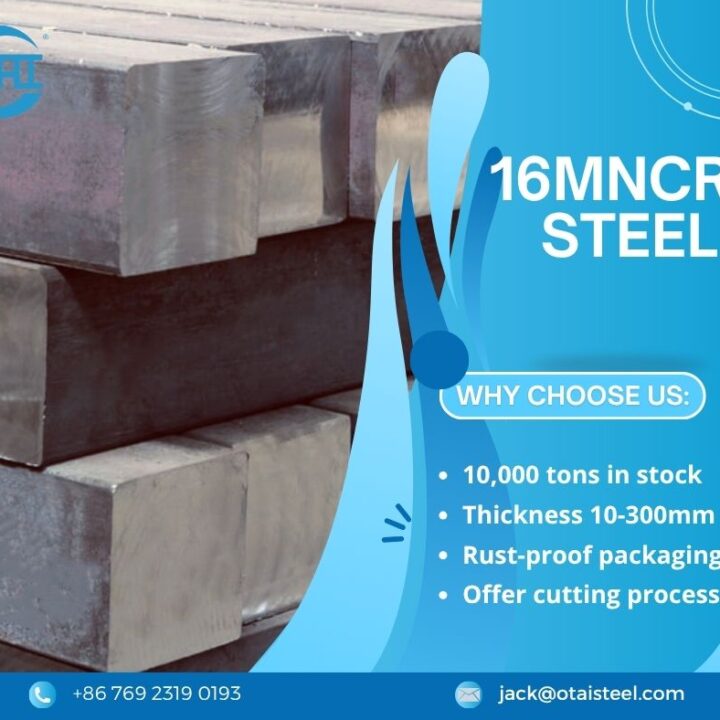
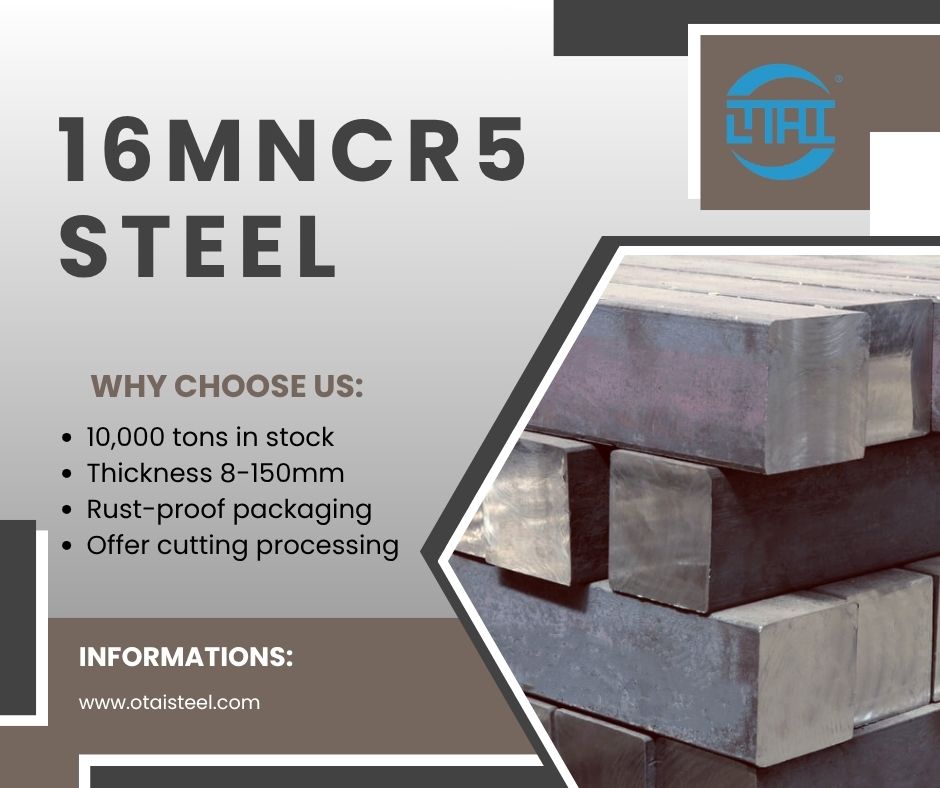
- 📏 16MnCr5 steel plate thickness range: 8–150mm in stock
- 📦 Large inventory available for fast delivery worldwide.
- ✂️ Precision cutting, milling, machining, and customized processing services.
- 🔥 Professional heat treatment support for customer requirements.
- 🔬 Ultrasonic testing (UT) and third-party inspection available upon request.
- 📦 Export-standard packaging, including anti-rust protection, steel strapping, and wooden cases.
- 🌍 Rich experience supplying manufacturers, distributors, and Fortune Global 500 companies.
❓ FAQ – 16MnCr5 Material Data Sheet
1. What information does a 16MnCr5 material data sheet contain?
A typical data sheet includes chemical composition, physical properties, mechanical properties, heat treatment recommendations, equivalent grades, and common applications.
2. What hardness can 16MnCr5 achieve after carburizing?
The carburized surface generally reaches approximately 58–62 HRC, while the core maintains much higher toughness.
3. What is the material number for 16MnCr5?
The commonly recognized Werkstoff number is 1.7131.
4. Why is a material data sheet important?
It helps engineers verify specifications, compare materials, select suitable heat treatment processes, and ensure the steel meets design requirements.
5. Which industries most commonly use 16MnCr5?
Automotive, industrial machinery, mining equipment, agricultural machinery, construction equipment, and power transmission industries all widely use 16MnCr5.
🏁 Conclusion
A well-prepared 16MnCr5 material data sheet is much more than a specification document. It serves as a practical engineering reference that combines chemical composition, physical properties, mechanical performance, heat treatment recommendations, and equivalent grade information in one place. By understanding each section, engineers can select suitable materials, optimize manufacturing processes, and improve component reliability.
Whether you are designing automotive gears, industrial transmission systems, or heavy-duty machinery, reviewing an accurate 16MnCr5 material data sheet helps ensure that every component achieves the required balance of hardness, toughness, wear resistance, and long-term service performance.