 4140 Steel vs 42CrMo: Composition, Properties and Practical Differences
📑 Table of Contents
🔍 1. 4140 Steel vs 42CrMo: Are They the Same?
🧪 2. Chemical Composition Comparison
📊 3. 4140 Steel vs 42CrMo Properties
🔥 4. Heat Treatment and Hardness
⚙️ 5. Machinability, Strength and Toughness
🏭 6. Applications: Which Steel Should You Choose?
🌎 7. Standards, Equivalents and Material Selection
🔍 1. 4140 Steel vs 42CrMo: Are They the Same?
When engineers compare 4140 steel vs 42CrMo, they often ask whether the two grades are interchangeable. In many applications, they provide very similar performance. However, they do not represent exactly the same specification.
4140 is a chromium-molybdenum alloy steel commonly specified under ASTM and AISI/SAE systems. 42CrMo is a chromium-molybdenum alloy structural steel commonly associated with European and Chinese standards, depending on the exact designation.
Both grades contain carbon, chromium and molybdenum. This alloy combination gives them good strength, hardenability, toughness and fatigue resistance after suitable heat treatment.
The important point is that 4140 and 42CrMo are similar alloy steels, not automatically identical grades. Chemical limits, product standards, delivery conditions and mechanical requirements can differ.
For a simple shaft, gear component or mechanical part, an engineer may find either grade suitable. For a critical component, however, the buyer should verify the exact specification before making a substitution.
Why Are They Often Compared?
The main reason is their similar alloy design. Both steels target applications that require more strength and hardenability than plain carbon steels can provide.
They can also undergo similar heat-treatment routes, including annealing, normalizing, quenching and tempering. Depending on the section size and heat-treatment condition, both can achieve high strength and hardness.
This makes them popular choices for shafts, bolts, gears, axles, machinery components and other parts exposed to heavy mechanical loads.
Still, engineers should avoid using an equivalence chart as the only basis for material substitution. The applicable standard and actual chemical composition should always control the final decision.
🧪 2. Chemical Composition Comparison
Chemical composition provides the first useful comparison between 4140 and 42CrMo. Carbon controls the basic hardening response, while chromium and molybdenum improve hardenability and contribute to strength.
| Element | 4140 | 42CrMo | General Effect |
|---|---|---|---|
| Carbon (C) | Approx. 0.38–0.43% | Approx. 0.38–0.45% | Hardness and strength |
| Silicon (Si) | Approx. 0.15–0.35% | Approx. 0.17–0.37% | Strength and deoxidation |
| Manganese (Mn) | Approx. 0.75–1.00% | Approx. 0.50–0.80% | Hardenability and strength |
| Chromium (Cr) | Approx. 0.80–1.10% | Approx. 0.90–1.20% | Hardenability and wear resistance |
| Molybdenum (Mo) | Approx. 0.15–0.25% | Approx. 0.15–0.25% | Hardenability and temper resistance |
| Nickel (Ni) | Usually residual / limited | Usually limited | Not a primary alloying element |
The exact limits depend on the applicable standard. For example, SAE 4140 under ASTM/AISI systems and 42CrMo under GB or EN-related specifications should not be compared using approximate chemistry alone.
Carbon
Carbon gives both steels their ability to develop high hardness after quenching. Their carbon contents sit in a similar range, which contributes to their comparable heat-treatment response.
Chromium
Chromium improves hardenability. It allows the steel to harden more effectively through a larger section than a plain carbon steel with similar carbon content.
Molybdenum
Molybdenum is especially important in these alloy steels. It improves hardenability and helps the material maintain useful strength during tempering.
This combination explains why both materials can perform well in heavy-duty mechanical components.
However, the differences in manganese, chromium and other permitted elements can influence the final response. Therefore, the best practice is to compare the actual mill certificate against the required specification.
📊 3. 4140 Steel vs 42CrMo Properties
The most important difference in 4140 steel vs 42CrMo properties usually appears when engineers evaluate the grades in a specific heat-treated condition.
Both materials can achieve high tensile strength and yield strength after quenching and tempering. However, the final values depend heavily on section size, tempering temperature, cooling conditions and the applicable product standard.
| Property | 4140 | 42CrMo | Practical Comment |
|---|---|---|---|
| Steel type | Cr-Mo alloy steel | Cr-Mo alloy steel | Very similar alloy family |
| Hardenability | Good | Good to very good | Depends on section and chemistry |
| Strength after Q&T | High | High | Heat treatment has major influence |
| Toughness | Good | Good | Depends on heat treatment and cleanliness |
| Fatigue resistance | Good | Good | Surface condition matters significantly |
| Wear resistance | Good after hardening | Good after hardening | Hardness strongly affects performance |
| Machinability | Good in annealed condition | Good in annealed condition | Hardness increases machining difficulty |
Strength
4140 and 42CrMo can both reach high strength levels after quenching and tempering. This makes them suitable for heavily loaded shafts, bolts, gears and machinery components.
The final strength does not come from the chemical composition alone. Heat-treatment parameters can change the microstructure and therefore the mechanical properties.
Toughness
Both steels can provide a useful combination of strength and toughness. This balance makes them more versatile than many higher-carbon steels.
For components exposed to impact or fluctuating loads, toughness becomes especially important. Engineers should therefore evaluate impact testing where the application requires it.
Fatigue Performance
The 4140 steel fatigue strength and corresponding performance of 42CrMo depend strongly on surface finish, residual stress, inclusions, geometry and heat treatment.
A smooth, properly heat-treated component can perform very differently from a component with machining marks, sharp stress concentrations or poor surface quality.
🔥 4. Heat Treatment and Hardness
Heat treatment plays a central role when comparing 4140 steel vs 42CrMo hardness. Both grades can move from a relatively machinable condition to a much harder and stronger condition through controlled thermal processing.
Annealing
Annealing lowers hardness and improves machinability. Manufacturers often supply alloy steel in an annealed or soft condition when customers need to machine complex shapes before final hardening.
Normalizing
Normalizing refines the microstructure and can improve uniformity. It can also prepare the material for subsequent machining or quenching and tempering.
Quenching and Tempering
Quenching produces a hard martensitic structure. Tempering then reduces brittleness and adjusts the final strength and toughness.
The selected tempering temperature has a major effect on the final hardness. A lower tempering temperature generally maintains higher hardness, while a higher temperature generally produces lower hardness with improved toughness.
| Condition | Relative Hardness | Machinability | Typical Purpose |
|---|---|---|---|
| Annealed | Low | Good | Machining and forming |
| Normalized | Moderate | Moderate | Microstructure refinement |
| Quenched | High | Low | Maximum hardening response |
| Quenched and tempered | Controlled | Moderate to low | Engineering components |
4140 Hardness
The hardness of 4140 varies significantly with condition. Annealed material is much softer than quenched and tempered 4140.
This explains why specifications should always include the delivery condition. Saying “4140 hardness” without identifying the condition does not provide enough information for material selection.
42CrMo Hardness
42CrMo also develops substantially higher hardness after quenching. The final hardness depends on the exact specification, section size and tempering schedule.
For this reason, engineers should compare hardness values only when the two grades have undergone comparable heat treatment.
⚙️ 5. Machinability, Strength and Toughness
Material selection becomes easier when engineers consider how the steel behaves throughout manufacturing rather than only looking at final mechanical properties.
Machinability
4140 and 42CrMo are relatively easy to machine when supplied in a suitable annealed condition. Cutting becomes more difficult as hardness increases.
For CNC machining, the supplier should provide a material condition that matches the customer’s production process. Starting with excessively hard material can increase tool wear, cutting temperature and machining cost.
The 4140 steel machinability advantage becomes particularly useful when customers need to machine large alloy steel plates or blocks before final heat treatment.
Strength
Both grades provide significantly higher strength than ordinary carbon steels after appropriate heat treatment.
This makes them suitable for components where a combination of tensile strength, yield strength and fatigue resistance matters.
Toughness
Toughness becomes increasingly important as strength increases. A very hard steel can become less forgiving under impact or stress concentration.
Quenching and tempering allows engineers to find a suitable balance. Instead of maximizing hardness, the heat-treatment engineer selects a condition that matches the actual service environment.
Wear Resistance
Neither 4140 nor 42CrMo is primarily a tool steel. However, both can provide good wear resistance when properly hardened.
For severe sliding wear, engineers may prefer a dedicated tool steel or surface-hardening treatment. For general mechanical wear combined with high structural strength, Cr-Mo alloy steels remain highly practical.
| Performance Factor | 4140 | 42CrMo |
|---|---|---|
| Machinability in annealed condition | Good | Good |
| High-strength capability | Excellent | Excellent |
| Toughness | Good | Good |
| Hardenability | Good | Good to very good |
| General wear resistance | Good after heat treatment | Good after heat treatment |
The practical winner therefore depends on the application. In many cases, the difference between the two grades matters less than the quality of the heat treatment, steel cleanliness, dimensional accuracy and surface condition.
🏭 6. Applications: Which Steel Should You Choose?
Both 4140 and 42CrMo serve a wide range of mechanical applications. The correct selection depends on the governing standard and the component’s performance requirements.
| Application | 4140 | 42CrMo | Selection Consideration |
|---|---|---|---|
| Machine shafts | Excellent | Excellent | Compare standard and mechanical requirements |
| Heavy-duty bolts | Excellent | Excellent | Heat treatment is critical |
| Gears | Very suitable | Very suitable | Surface hardness and toughness matter |
| Axles | Excellent | Excellent | Fatigue performance matters |
| Hydraulic components | Very suitable | Very suitable | Strength and dimensional stability |
| Oil and gas components | Widely used | Widely used | Project specification controls |
4140 for Shafts and Machinery
4140 has become a widely recognized engineering alloy steel for shafts, axles, pins, gears and machinery components. Its broad availability under ASTM and SAE systems also makes it convenient for international sourcing.
It is particularly useful when the customer needs a combination of strength, toughness and heat-treatment flexibility.
42CrMo for Heavy Mechanical Components
42CrMo is widely used for mechanical components that require high strength and good hardenability. Typical applications include shafts, gears, connecting components, heavy machinery parts and high-load structures.
For Chinese-standard projects, 42CrMo can offer a convenient material choice because it is widely available in the domestic supply chain.
Which One Is Better?
There is no universal winner in the 4140 steel vs 42CrMo comparison.
Choose 4140 when the project follows an ASTM/AISI/SAE specification or when international sourcing requires the 4140 designation.
Choose 42CrMo when the engineering specification requires the relevant 42CrMo standard or when the project uses a supply chain based around that grade.
If both grades satisfy the design requirements, availability, certification, dimensions, heat treatment and total production cost can help determine the final choice.
🌎 7. Standards, Equivalents and Material Selection
International buyers often compare 4140 and 42CrMo because they work with different standards. However, the word “equivalent” requires careful use.
| Grade | Common Standard System | Material Family | Typical Use |
|---|---|---|---|
| 4140 | ASTM / AISI / SAE | Cr-Mo alloy steel | High-strength machinery components |
| 42CrMo | GB / EN-related designations depending on specification | Cr-Mo alloy steel | Heavy-duty mechanical components |
| 42CrMo4 | EN 10083 | Cr-Mo alloy steel | European high-strength components |
It is also important to distinguish 42CrMo from 42CrMo4. Although the names look similar, the exact standard, chemical limits and certification requirements determine whether a grade satisfies a particular engineering specification.
4140 vs 42CrMo4
4140 and 42CrMo4 are often discussed together because their alloy systems and applications are very similar. However, engineers should compare the exact chemical ranges and product standard before calling them interchangeable.
For export orders, the customer’s drawing or purchase specification should remain the primary reference.
How to Choose the Right Grade
Before purchasing, provide the supplier with:
- Required steel grade and standard.
- Plate, bar, block or forged product form.
- Required dimensions.
- Delivery condition.
- Heat-treatment requirements.
- Mechanical property requirements.
- Ultrasonic testing requirements, if applicable.
- Third-party inspection requirements, if applicable.
- Application and component information.
This information helps prevent an incorrect substitution. It also allows the supplier to recommend a suitable material when the requested grade has limited availability.
For buyers searching for 4140 steel vs 42CrMo equivalent, the safest approach is therefore to compare the full specification instead of relying on the grade name alone.
📦 8. Otai Special Steel Advantages
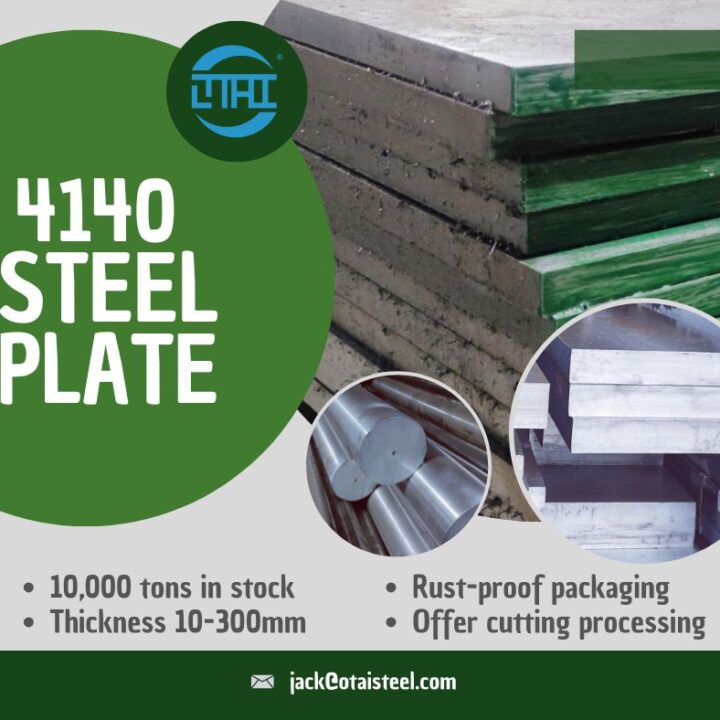
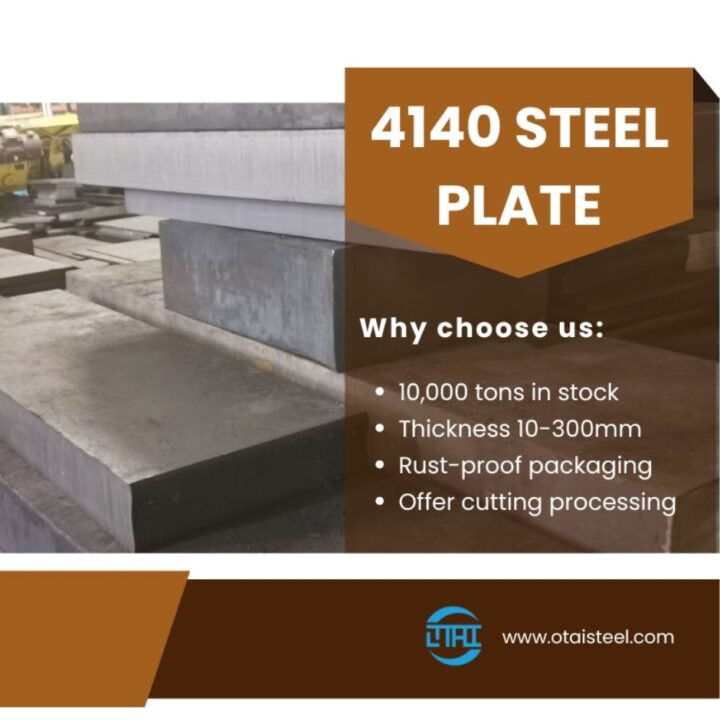
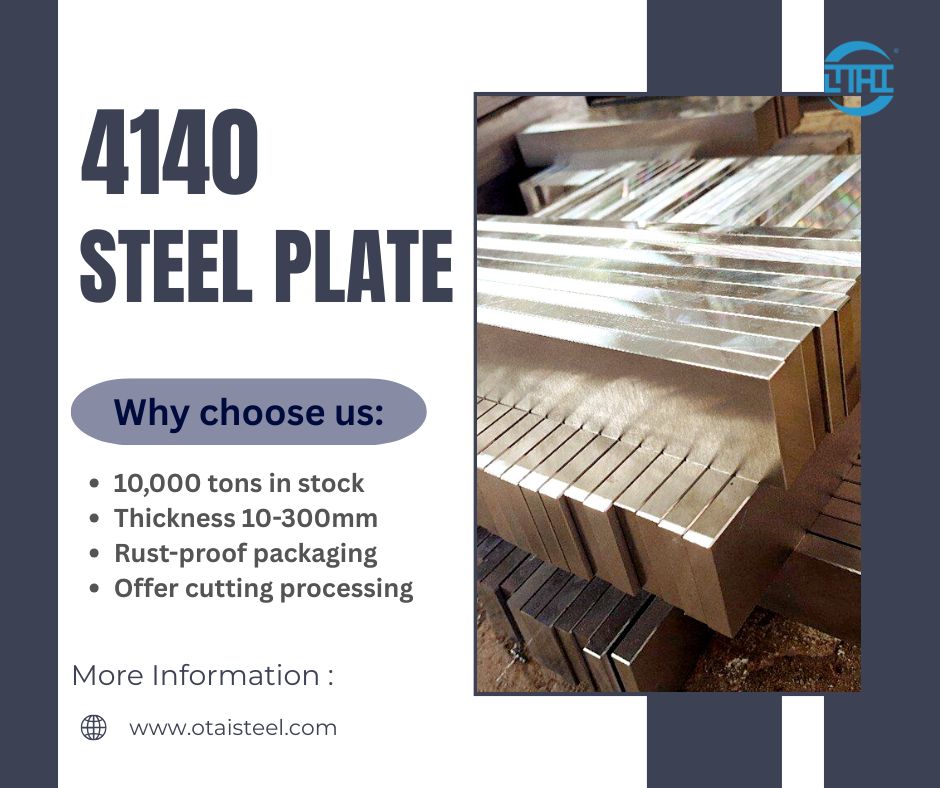
Otai Special Steel supplies 4140 alloy steel plates and supports customers with cutting, heat treatment and export preparation services.
- Large inventory: Otai maintains approximately 10,000 tons of steel inventory and keeps different sizes available for customers.
- 4140 stock: Different thicknesses and dimensions of 4140 alloy steel plates can be supplied according to current inventory.
- Cutting service: We can cut plates according to customer drawings and required dimensions.
- Heat treatment: Annealing, hardening, tempering and other processing services can be arranged according to project requirements.
- Quality control: Ultrasonic testing and third-party inspection can be arranged for demanding orders.
- Export packaging: Steel strapping, wooden cases and anti-rust packaging help protect the material during transportation.
- International experience: Otai has supplied steel to customers with demanding technical requirements, including Fortune Global 500 companies.
If you are comparing 4140 steel vs 42CrMo for a specific project, provide the required standard, dimensions, delivery condition and mechanical requirements. Otai can help evaluate the suitable material and supply condition.
❓ 9. Frequently Asked Questions
1. Is 4140 the same as 42CrMo?
No. They are very similar chromium-molybdenum alloy steels, but they belong to different specification systems and their chemical limits may differ. Engineers should verify the exact standard before treating them as interchangeable.
2. Which is stronger, 4140 or 42CrMo?
Neither grade is universally stronger. Both can achieve high strength after quenching and tempering. The final mechanical properties depend on chemistry, section size and heat-treatment parameters.
3. Is 42CrMo4 equivalent to 4140?
42CrMo4 and 4140 have very similar alloy systems and applications, so engineers often compare them. However, they are not automatically identical specifications. The exact standard and chemical limits should be checked before substitution.
4. Which is better for shafts, 4140 or 42CrMo?
Both can perform very well in shaft applications. 4140 is convenient for ASTM/AISI/SAE-based projects, while 42CrMo can be practical for projects using the relevant GB-based supply system. The required mechanical properties should determine the final selection.
5. Can I replace 42CrMo with 4140?
In many general engineering applications, 4140 can be considered as a potential substitute. However, approval should depend on the original specification, chemical composition, mechanical properties, heat treatment and application requirements.