Is 16MnCr5 Stainless Steel? Composition, Properties, Classification and Applications
📑 Table of Contents
🔍 1. Is 16MnCr5 Stainless Steel?
🧪 2. Chemical Composition of 16MnCr5
📊 3. 16MnCr5 Properties and Classification
🔥 4. Why 16MnCr5 Is Different from Stainless Steel
⚙️ 5. 16MnCr5 Heat Treatment and Surface Hardening
🛠️ 6. Corrosion Resistance and Machinability
🏭 7. Common Applications of 16MnCr5
💡 8. 16MnCr5 vs Stainless Steel: Which Should You Choose?
🔍 1. Is 16MnCr5 Stainless Steel?
Is 16MnCr5 stainless steel? No. 16MnCr5 is not a stainless steel. It is a low-carbon alloy case-hardening steel commonly used for gears, shafts, pinions, and other components that need a hard wear-resistant surface and a tough core.
The confusion often comes from the alloying elements in its name. 16MnCr5 contains manganese and chromium, but the chromium content is far below the level normally associated with stainless steel. Stainless steels generally require a much higher chromium content, commonly around 10.5% or more, to develop the chromium-rich passive surface that provides their characteristic corrosion resistance.
16MnCr5 belongs to a completely different material family. It is a carburizing steel designed primarily for mechanical performance rather than corrosion resistance. Its relatively low carbon content makes the steel suitable for carburizing, while its alloying elements support hardenability and core strength.
In contrast, stainless steel focuses strongly on resistance to oxidation and corrosion. Grades such as 304 and 316 contain substantial chromium and use alloying systems specifically designed for corrosion-resistant service.
This distinction matters when selecting material for an engineering project. If the component needs a hard gear surface and a strong, tough core, 16MnCr5 can be an excellent choice. If the component must resist moisture, chemicals, salt, or atmospheric corrosion, a suitable stainless steel may be more appropriate.
| Feature | 16MnCr5 | Typical Stainless Steel |
|---|---|---|
| Steel category | Case-hardening alloy steel | Corrosion-resistant alloy steel |
| Chromium content | Approximately 1% | Usually at least about 10.5% |
| Carbon content | Low | Depends strongly on grade |
| Main purpose | Hard surface and tough core | Corrosion resistance and mechanical performance |
| Typical treatment | Carburizing and hardening | Grade-dependent heat treatment |
| Typical applications | Gears, shafts, pinions | Food, chemical, architectural and industrial equipment |
Therefore, the answer to “is 16MnCr5 stainless steel?” is clearly no. 16MnCr5 is an alloy case-hardening steel, and engineers should select it according to mechanical and wear requirements rather than stainless-steel corrosion performance.
🧪 2. Chemical Composition of 16MnCr5
The chemical composition of 16MnCr5 explains why this material performs well in case-hardening applications. The grade contains low carbon together with manganese and chromium. These elements help create the combination of a hard surface and a strong core after carburizing and heat treatment.
| Element | Typical Content | Primary Function |
|---|---|---|
| Carbon (C) | Approx. 0.14–0.19% | Supports carburizing and core properties |
| Manganese (Mn) | Approx. 1.00–1.30% | Improves strength and hardenability |
| Chromium (Cr) | Approx. 0.80–1.10% | Improves hardenability and wear performance |
| Silicon (Si) | Approx. 0.40% | Deoxidation and strengthening |
| Phosphorus (P) | Max. 0.035% | Controlled to maintain material quality |
| Sulfur (S) | Max. 0.035% | Controlled according to specification |
The exact chemical limits depend on the applicable standard and product specification. Buyers should therefore check the material certificate when they require confirmation of the actual heat analysis.
Why does 16MnCr5 contain chromium?
Chromium plays an important role in hardenability. It helps the steel develop suitable hardness at greater depths during hardening. However, its concentration remains much lower than the chromium level used in stainless steels.
This is one of the easiest ways to understand the difference between 16MnCr5 alloy steel and stainless steel. Chromium alone does not make a steel stainless. The amount of chromium and the overall alloy system determine the material’s classification and corrosion behavior.
Why is the carbon content relatively low?
The low carbon level gives 16MnCr5 good suitability for carburizing. During carburizing, the surface absorbs additional carbon. The manufacturer can then harden the enriched surface while retaining a comparatively tough low-carbon core.
This process creates the performance profile required by many gears and transmission components. The surface resists contact wear, while the core provides support against impact and repeated loading.
Consequently, the 16MnCr5 chemical composition supports mechanical durability rather than the corrosion resistance associated with stainless steel.
📊 3. 16MnCr5 Properties and Classification
To understand 16MnCr5 properties, it is important to look beyond its chemical composition. The material is designed for engineering components that require surface hardness, wear resistance, fatigue performance, and core toughness after suitable treatment.
| Property | 16MnCr5 | Engineering Significance |
|---|---|---|
| Steel type | Low-carbon alloy case-hardening steel | Suitable for carburized components |
| Surface hardness after carburizing | Can become very high | Improves wear and contact-fatigue resistance |
| Core hardness | Lower than the carburized case | Maintains toughness and load support |
| Hardenability | Good | Supports controlled hardening |
| Wear resistance | Very good after case hardening | Useful for gears and pinions |
| Corrosion resistance | Limited | Requires protection in corrosive environments |
The term “stainless steel” describes a family of steels that provide significantly improved corrosion resistance because of their high chromium content and suitable alloy design. 16MnCr5 does not meet that general classification.
Instead, 16MnCr5 is normally selected when the engineer needs a controlled hardness profile. The surface can become very hard, while the core remains tougher than a fully hardened high-carbon steel of similar surface hardness.
Is 16MnCr5 a carbon steel?
16MnCr5 is better described as a low-carbon alloy case-hardening steel rather than a simple carbon steel. Manganese and chromium contribute significantly to its performance.
The grade is also associated with the European designation system and is commonly identified as 1.7131. The exact product standard should always be confirmed before material substitution.
For buyers searching for 16MnCr5 steel properties, the key point is that its performance changes substantially after carburizing and hardening. Therefore, the delivery condition and final heat-treatment condition should always be specified when comparing material data.
🔥 4. Why 16MnCr5 Is Different from Stainless Steel
The biggest difference between 16MnCr5 and stainless steel comes from their design objectives. Engineers develop 16MnCr5 primarily for mechanical components that need a hardened surface. Stainless steels focus on corrosion resistance while also providing different levels of strength, toughness, and wear resistance depending on the grade.
| Material Characteristic | 16MnCr5 | Stainless Steel |
|---|---|---|
| Corrosion resistance | Limited | Generally high |
| Chromium level | About 1% | Typically 10.5% or higher |
| Carburizing suitability | Excellent | Not the normal purpose |
| Gear applications | Excellent | Grade dependent |
| Outdoor corrosion exposure | Requires protection | Often more suitable |
| Primary performance target | Case hardness and core toughness | Corrosion resistance and grade-specific properties |
For example, a gearbox operating in a controlled industrial environment may benefit from 16MnCr5 because gear teeth need high surface hardness and good fatigue resistance. On the other hand, equipment exposed continuously to seawater may require an appropriate stainless steel because corrosion resistance becomes a major design requirement.
This difference also affects maintenance. Unprotected 16MnCr5 can develop rust when exposed to moisture and oxygen. Manufacturers may therefore use oil, coatings, plating, painting, controlled storage, or other corrosion-protection methods.
Stainless steel does not mean “immune to every form of corrosion.” Different stainless grades provide different levels of resistance, and some environments can still cause pitting, crevice corrosion, or stress corrosion cracking.
Therefore, when asking “is 16MnCr5 stainless steel?”, the correct answer remains no. It should not be selected as a direct replacement for stainless steel simply because it contains chromium.
⚙️ 5. 16MnCr5 Heat Treatment and Surface Hardening
Heat treatment is one of the main reasons manufacturers choose 16MnCr5. Unlike stainless steel, which often serves corrosion-resistant applications, 16MnCr5 can undergo carburizing to create a high-hardness working surface.
The typical process begins with machining the component in a relatively softer condition. The manufacturer then carburizes the surface at an elevated temperature. During this stage, carbon diffuses into the outer layer of the steel.
After carburizing, the component undergoes hardening and tempering. The final result is a hardened case supported by a tougher core.
| Process | Purpose | Typical Result |
|---|---|---|
| Annealing | Improve machinability and reduce hardness | Softer structure |
| Carburizing | Increase carbon content at the surface | Carbon-enriched case |
| Quenching | Harden the carburized layer | High surface hardness |
| Tempering | Reduce stresses and adjust properties | Improved service stability |
| Grinding | Achieve final dimensional accuracy | Precision finished surface |
The exact heat-treatment parameters depend on the component size, required case depth, furnace conditions, quenching medium, and final hardness requirements. Engineers should therefore establish the process according to the applicable specification and component design.
Why carburizing matters
Carburizing changes the surface chemistry rather than simply hardening the original low-carbon steel. This approach allows manufacturers to obtain a combination that would be difficult to achieve through simple through-hardening.
The hard case provides resistance against abrasive wear, contact fatigue, and repeated tooth loading. Meanwhile, the lower-carbon core retains better toughness and can absorb service loads.
This makes 16MnCr5 case hardening particularly useful for gears, pinions, sprockets, and other components with repeated surface contact.
🛠️ 6. Corrosion Resistance and Machinability
The corrosion behavior of 16MnCr5 differs significantly from stainless steel. Because 16MnCr5 contains only a relatively small amount of chromium, it does not form the same protective passive layer that characterizes stainless steel.
As a result, 16MnCr5 corrosion resistance is limited. The steel can rust when exposed to moisture, humidity, salt, or other corrosive conditions without suitable protection.
This does not make 16MnCr5 unsuitable for industrial use. It simply means that the material requires an appropriate corrosion-control strategy when the service environment demands it.
| Factor | 16MnCr5 | Typical Stainless Steel |
|---|---|---|
| Resistance to atmospheric moisture | Limited without protection | Generally better |
| Resistance to salt exposure | Low without protection | Grade dependent, often better |
| Need for corrosion protection | Often required | Usually lower |
| Machinability | Good in suitable soft condition | Depends strongly on grade |
| Pre-hardening machining | Common | Grade dependent |
From a manufacturing perspective, 16MnCr5 can provide good machinability before carburizing. Manufacturers can machine the gear or shaft close to the required dimensions before the final hardening stages.
After case hardening, finishing operations such as grinding may become necessary. This approach allows manufacturers to combine efficient pre-treatment machining with a high-performance finished surface.
Therefore, 16MnCr5 machinability can be an important advantage during production, especially for high-volume gear manufacturing.
🏭 7. Common Applications of 16MnCr5
16MnCr5 is widely associated with components that experience surface contact, friction, repeated loading, and wear. Its case-hardening capability makes it especially useful for transmission and mechanical power-transfer components.
| Application | Why 16MnCr5 Is Used |
|---|---|
| Gears | High surface hardness and good core toughness |
| Pinions | Good resistance to contact wear |
| Shafts | Strong core with hardened working surfaces |
| Sprockets | Suitable for repeated surface loading |
| Transmission components | Good combination of wear resistance and toughness |
| Machine components | Versatile case-hardening performance |
The most common use of 16MnCr5 is in gear manufacturing. Gear teeth experience repeated contact stress, so manufacturers need a surface that can resist wear and fatigue. At the same time, the core must remain tough enough to support the tooth under dynamic loads.
The grade can also work well for pinions and other transmission parts. These components often require a carefully controlled hardness profile rather than extremely high hardness throughout the entire cross-section.
For general machinery, engineers may select 16MnCr5 when the design benefits from case hardening. However, the material should not replace stainless steel where corrosion resistance represents the primary requirement.
When selecting 16MnCr5 for gears, buyers should consider case depth, surface hardness, core hardness, component size, dimensional tolerances, heat-treatment capability, and final finishing requirements.
💡 8. 16MnCr5 vs Stainless Steel: Which Should You Choose?
The correct material depends on what the component needs to accomplish. Neither 16MnCr5 nor stainless steel is universally better. They solve different engineering problems.
Choose 16MnCr5 when:
- You need a case-hardening steel for gears or pinions.
- You require a hard, wear-resistant working surface.
- The component needs a tough and supportive core.
- The application involves repeated contact loading.
- Corrosion resistance is not the primary design requirement.
- You can apply suitable heat treatment and corrosion protection.
Choose stainless steel when:
- The component faces moisture or corrosive environments.
- Resistance to rust is an important service requirement.
- The application involves food, chemical, marine, or outdoor exposure.
- The selected stainless grade provides the required strength and corrosion resistance.
- Maintenance and long-term corrosion protection are major considerations.
| Requirement | Recommended Material |
|---|---|
| Carburized gears | 16MnCr5 |
| Carburized pinions | 16MnCr5 |
| High wear resistance after case hardening | 16MnCr5 |
| Moisture-resistant equipment | Suitable stainless steel |
| Food-processing equipment | Suitable stainless steel |
| Chemical processing equipment | Suitable stainless steel |
| General transmission components | 16MnCr5, depending on design |
For buyers searching “is 16MnCr5 stainless steel”, the most important takeaway is simple: 16MnCr5 is not stainless steel. It is a low-carbon alloy case-hardening steel designed for mechanical durability, while stainless steels use much higher chromium levels to provide corrosion resistance.
If the main requirement is gear performance, surface hardness, wear resistance, and core toughness, 16MnCr5 can be an excellent engineering material. If the component must withstand aggressive corrosion, engineers should select a stainless grade that matches the actual environment.
Material selection should also consider dimensions, heat treatment, surface hardness, core properties, machining requirements, operating temperature, corrosion exposure, and total manufacturing cost. A clear specification helps prevent an unsuitable material substitution.
📦 9. Otai Special Steel Advantages
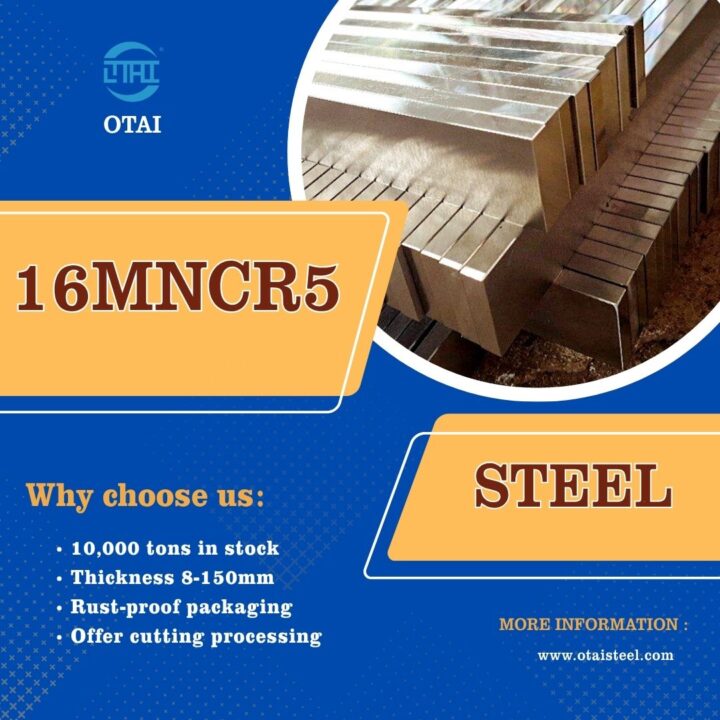
- 16MnCr5 steel plate stock: Otai Special Steel maintains 16MnCr5 steel plates in 8–150 mm thickness available in stock.
- Different dimensions: We can supply different thicknesses, widths, lengths, and other dimensions according to project requirements.
- Cutting service: We can arrange cutting according to customer drawings and specified dimensions.
- Heat treatment: Annealing, normalizing, quenching, tempering, and other heat-treatment services can be arranged according to requirements.
- Quality inspection: Ultrasonic testing and third-party inspection can be arranged for orders with specific quality requirements.
- Export packaging: Steel strapping, wooden cases, and anti-rust packaging help protect steel products during international transportation.
- International supply experience: Otai Special Steel has supplied steel products to customers with demanding technical requirements, including Fortune Global 500 companies.
If you need 16MnCr5 steel for gears, shafts, pinions, or other engineering components, provide the required dimensions, condition, heat-treatment requirements, and quantity. Otai Special Steel can help confirm suitable material and processing options.
❓ 10. Frequently Asked Questions
1. Is 16MnCr5 stainless steel?
No. 16MnCr5 is a low-carbon alloy case-hardening steel, not stainless steel. It contains chromium, but its chromium content is far below the level normally required for stainless steel classification.
2. What type of steel is 16MnCr5?
16MnCr5 is a low-carbon alloy case-hardening steel. It is commonly used for gears, pinions, shafts, and transmission components that require a hard surface and tough core.
3. Does 16MnCr5 rust?
Yes. 16MnCr5 does not provide stainless-steel-level corrosion resistance. Without suitable protection, it can rust when exposed to moisture, humidity, salt, or corrosive environments.
4. Why is 16MnCr5 used for gears?
16MnCr5 responds well to carburizing. The process can create a hard, wear-resistant surface while maintaining a tougher core, making the grade suitable for gears and other components exposed to repeated contact loading.
5. What is the chromium content of 16MnCr5?
16MnCr5 typically contains approximately 0.80–1.10% chromium, depending on the applicable specification. This level improves hardenability but does not make the material stainless steel.