 16MnCr5 Gear: Why This Carburizing Steel Is Ideal for High-Performance Gears
📑 Table of Contents
🔍 1. What Is 16MnCr5 Gear Steel?
⚙️ 2. Why Choose 16MnCr5 for Gear Manufacturing?
🧪 3. Chemical Composition and Carburizing Performance
🔥 4. 16MnCr5 Gear Heat Treatment Process
📊 5. 16MnCr5 Mechanical Properties for Gears
⚖️ 6. 16MnCr5 vs Other Gear Steels
🏭 7. Gear Applications and Material Selection
🏢 Otai Special Steel Advantages
❓ FAQ About 16MnCr5 Gear Steel
🔍 1. What Is 16MnCr5 Gear Steel?
When engineers search for 16MnCr5 gear, they are usually looking for a reliable carburizing steel that can provide high surface hardness, excellent wear resistance, and sufficient core toughness for demanding gear applications.
16MnCr5 is a low-carbon alloy steel defined under the EN 10084 standard. It is one of the most commonly used case-hardening steels in European mechanical manufacturing.
The main advantage of this steel is its ability to create a very hard surface layer after carburizing while maintaining a strong and ductile core.
This combination makes it especially suitable for gears that experience repeated contact stress, friction, impact loads, and fatigue during operation.
Unlike high-carbon steels that provide hardness throughout the entire section, 16MnCr5 uses a carburizing process to achieve a hard outer layer while preserving internal toughness.
Therefore, DIN 16MnCr5 gear steel is widely selected for automotive gears, industrial transmission systems, and precision mechanical components.
Basic Information About 16MnCr5 Gear Material
| Item | Description |
|---|---|
| Steel Grade | 16MnCr5 |
| Material Number | 1.7131 |
| Standard | EN 10084 |
| Steel Type | Case hardening alloy steel |
| Main Alloy Elements | Manganese (Mn) and Chromium (Cr) |
| Main Application | Gears, shafts, transmission components |
Why Is 16MnCr5 Suitable for Gear Manufacturing?
| Requirement for Gear Steel | Performance of 16MnCr5 |
|---|---|
| Surface hardness | Excellent after carburizing treatment |
| Wear resistance | High resistance against friction damage |
| Core toughness | Maintains impact resistance after treatment |
| Fatigue resistance | Suitable for repeated loading conditions |
| Machinability | Good before carburizing |
A high-quality gear material must balance hardness and toughness. The structure of 16MnCr5 provides this balance, which explains why it remains popular in modern gear manufacturing.
⚙️ 2. Why Choose 16MnCr5 for Gear Manufacturing?
Gear components operate under complex mechanical conditions. During service, gears experience sliding friction, contact pressure, vibration, and cyclic stress.
For this reason, manufacturers need a steel grade that provides both a hard surface and a tough internal structure.
16MnCr5 carburizing steel for gears meets these requirements by using a low-carbon alloy design that responds effectively to carburizing treatment.
Key Advantages of 16MnCr5 Gear Steel
| Advantage | Engineering Benefit |
|---|---|
| Carburizing capability | Creates a hard and wear-resistant surface |
| Low carbon core | Maintains toughness and impact resistance |
| Chromium addition | Improves hardenability and durability |
| Manganese addition | Enhances strength and structural stability |
| Stable mechanical properties | Suitable for precision gear components |
Common Problems with Poor Gear Materials
| Problem | Possible Result |
|---|---|
| Insufficient surface hardness | Accelerated wear and shorter service life |
| Poor toughness | Cracks under impact loads |
| Low fatigue resistance | Premature gear failure |
| Unstable structure | Dimensional changes during operation |
By selecting proper 16MnCr5 gear material, manufacturers can improve component reliability and reduce maintenance requirements.
🧪 3. Chemical Composition and Carburizing Performance
The chemical composition of 16MnCr5 plays an important role in determining its carburizing performance and final gear properties.
The controlled carbon content allows the steel core to remain tough, while manganese and chromium improve hardenability during heat treatment.
Typical Chemical Composition of 16MnCr5 Steel
| Element | Typical Content | Function |
|---|---|---|
| Carbon (C) | 0.14–0.19% | Provides carburizing response and core toughness |
| Manganese (Mn) | 1.00–1.30% | Improves strength and hardenability |
| Chromium (Cr) | 0.80–1.10% | Improves wear resistance |
| Silicon (Si) | ≤0.40% | Supports steel deoxidation |
| Phosphorus (P) | ≤0.025% | Controlled to maintain toughness |
| Sulfur (S) | ≤0.035% | Controlled for quality stability |
How Chemical Composition Influences Gear Performance
- Carbon controls the ability to form a hardened carburized layer.
- Chromium improves wear resistance and hardenability.
- Manganese increases strength and improves heat treatment response.
- Low impurity levels help maintain fatigue resistance.
The carefully balanced composition makes 16MnCr5 a dependable choice for manufacturers producing gears that require long service life and stable performance.
🔥 4. 16MnCr5 Gear Heat Treatment Process
The performance of a gear depends not only on the steel grade but also on the heat treatment process. For 16MnCr5 gear heat treatment, carburizing, quenching, and tempering are the key steps used to achieve the required surface hardness and core toughness.
Because 16MnCr5 is a low-carbon carburizing steel, it is designed to develop a hard external layer while maintaining a tough internal structure.
This combination allows gears to resist wear on the tooth surface while absorbing impact loads through the stronger core.
Main Heat Treatment Steps for 16MnCr5 Gears
| Process | Typical Temperature | Purpose |
|---|---|---|
| Carburizing | 850–950°C | Increase carbon content on the surface layer |
| Quenching | After carburizing | Create high surface hardness |
| Tempering | Low temperature tempering | Reduce stress and improve toughness |
| Final Inspection | According to requirements | Verify hardness and quality |
1. Carburizing Process for 16MnCr5 Gear Steel
Carburizing is the most important treatment for 16MnCr5 gears. During this process, carbon atoms diffuse into the surface layer of the steel.
After carburizing, the gear surface contains higher carbon content than the original material, allowing it to achieve very high hardness after quenching.
| Carburizing Feature | Effect on Gear Performance |
|---|---|
| Hard surface layer | Improves wear resistance |
| Tough core | Improves impact resistance |
| Controlled case depth | Matches different gear requirements |
| Uniform carbon distribution | Improves fatigue performance |
2. Quenching and Tempering
After carburizing, quenching transforms the surface structure into a high-hardness martensitic structure.
Tempering is then applied to reduce internal stress and improve the reliability of the final gear component.
| Treatment | Main Effect |
|---|---|
| Quenching | Provides high surface hardness and wear resistance |
| Tempering | Improves toughness and dimensional stability |
Typical Properties After 16MnCr5 Gear Heat Treatment
| Property | Typical Value |
|---|---|
| Surface Hardness | 58–62 HRC |
| Core Hardness | 30–45 HRC |
| Case Depth | 0.8–1.5 mm (depending on requirement) |
| Wear Resistance | Excellent |
| Fatigue Performance | Very Good |
A properly controlled heat treatment process allows 16MnCr5 gears to achieve a long service life even under heavy mechanical loads.
📊 5. 16MnCr5 Mechanical Properties for Gears
The 16MnCr5 steel mechanical properties determine how well the material performs during gear operation.
For gear manufacturing, engineers usually consider tensile strength, yield strength, elongation, hardness, impact resistance, and fatigue behavior together.
Typical Mechanical Properties of 16MnCr5 Steel
| Property | Typical Value | Importance for Gears |
|---|---|---|
| Tensile Strength | 800–1100 MPa | Provides structural strength |
| Yield Strength | 500–800 MPa | Resistance against permanent deformation |
| Elongation | 10–15% | Indicates core ductility |
| Surface Hardness | 58–62 HRC | Improves wear resistance |
| Impact Toughness | Good | Supports shock loading |
Relationship Between Mechanical Properties and Gear Performance
| Mechanical Property | Gear Benefit |
|---|---|
| High Surface Hardness | Reduces tooth wear |
| Good Core Toughness | Prevents cracking under impact |
| Balanced Strength | Supports long-term operation |
| Suitable Elongation | Improves deformation resistance |
This balanced performance is one reason why DIN 16MnCr5 gear steel remains a popular choice for precision gear manufacturing.
⚖️ 6. 16MnCr5 vs Other Gear Steels
Engineers often compare 16MnCr5 with other carburizing steels when selecting materials for gears.
The most common comparisons include 20MnCr5 and SAE 8620 because they have similar applications in automotive and industrial gear manufacturing.
16MnCr5 vs 20MnCr5 Gear Steel
| Property | 16MnCr5 | 20MnCr5 |
|---|---|---|
| Standard | EN 10084 | EN 10084 |
| Carbon Content | 0.14–0.19% | 0.17–0.22% |
| Hardening Ability | Very Good | Very Good |
| Surface Hardness After Carburizing | 58–62 HRC | 58–62 HRC |
| Main Difference | Better balance of toughness and machining | Slightly higher carbon content |
16MnCr5 vs SAE 8620 Gear Steel
| Property | 16MnCr5 | SAE 8620 |
|---|---|---|
| Steel Type | European carburizing steel | American carburizing steel |
| Carbon Content | 0.14–0.19% | 0.18–0.23% |
| Nickel Content | No nickel addition | Contains nickel |
| Core Toughness | Very Good | Excellent |
| Common Use | European gear manufacturing | Automotive and aerospace gears |
The best choice depends on gear design, operating environment, availability, and required mechanical performance.
🏭 7. Gear Applications and Material Selection Guide
The excellent balance of hardness, toughness, and fatigue resistance makes 16MnCr5 gear steel suitable for many mechanical transmission applications.
Modern gear systems require materials that can withstand high contact pressure, repeated loading, friction, and changing operating conditions. For these reasons, manufacturers often select carburizing steels instead of conventional carbon steels.
The combination of a hard carburized surface and a tough internal structure allows 16MnCr5 gears to achieve long service life in demanding environments.
Common Applications of 16MnCr5 Gear Steel
| Application Area | Typical Components | Main Performance Requirement |
|---|---|---|
| Automotive Transmission | Transmission gears, differential gears, pinions | High wear resistance and fatigue strength |
| Industrial Gear Systems | Reduction gears, drive gears, gear wheels | Stable operation under continuous loads |
| Agricultural Machinery | Drive gears and mechanical transmission parts | Impact resistance and durability |
| Construction Equipment | Heavy-duty gears and shafts | Resistance to shock loading |
| General Mechanical Engineering | Sprockets, rotating components | Good machinability and strength balance |
Why 16MnCr5 Is Suitable for Automotive Gears
Automotive gears operate under frequent acceleration, deceleration, and torque changes. These conditions create high stress on gear teeth.
A suitable gear material must prevent surface damage while maintaining enough internal toughness to avoid sudden failure.
| Gear Failure Risk | How 16MnCr5 Helps |
|---|---|
| Tooth surface wear | Carburized surface provides high hardness |
| Pitting damage | Improved fatigue resistance after heat treatment |
| Gear tooth cracking | Tough core absorbs impact energy |
| Deformation under load | Good yield strength supports stability |
Material Selection Factors for 16MnCr5 Gear Production
| Selection Factor | Why It Matters |
|---|---|
| Gear Size | Larger gears require stable mechanical properties throughout the section |
| Operating Load | Higher loads require better toughness and fatigue resistance |
| Heat Treatment Method | Determines final hardness and performance |
| Machining Requirements | Affects manufacturing efficiency and cost |
| Quality Requirements | Ensures reliability for critical components |
16MnCr5 Gear Manufacturing Process
A typical production process for 16MnCr5 gears includes several important steps to achieve accurate dimensions and reliable performance.
| Manufacturing Step | Purpose |
|---|---|
| Material Selection | Choose suitable 16MnCr5 gear material according to requirements |
| Machining | Create accurate gear geometry |
| Carburizing | Increase surface carbon content |
| Quenching and Tempering | Improve hardness and toughness |
| Grinding and Inspection | Achieve precision and quality control |
A properly controlled manufacturing process ensures that 16MnCr5 gears can provide reliable performance throughout their service life.
🏢 Otai Special Steel Advantages
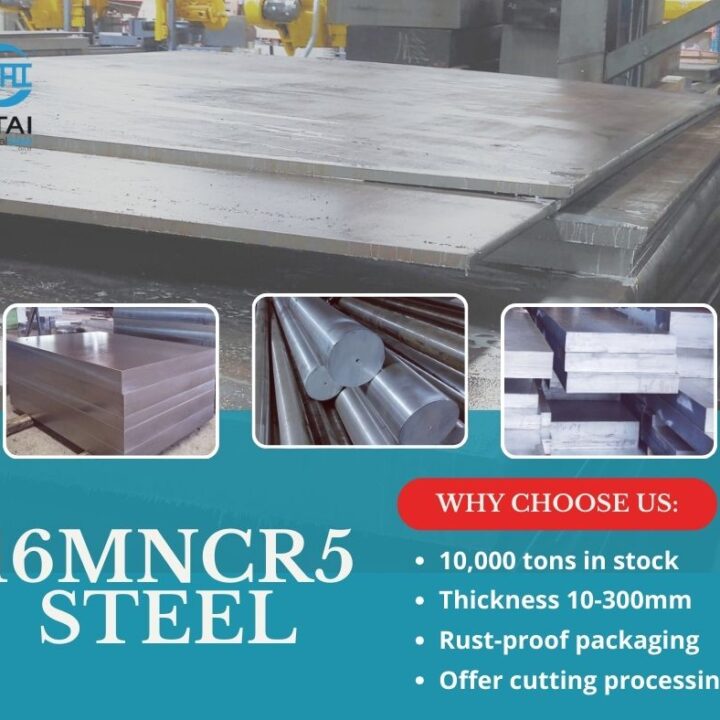
Otai Special Steel supplies high-quality 16MnCr5 materials for gear manufacturers and mechanical engineering customers worldwide.
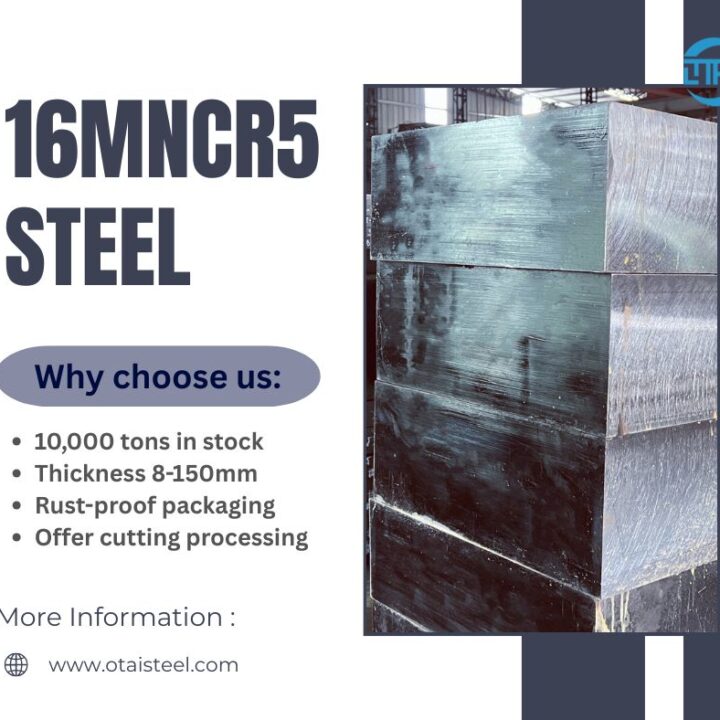
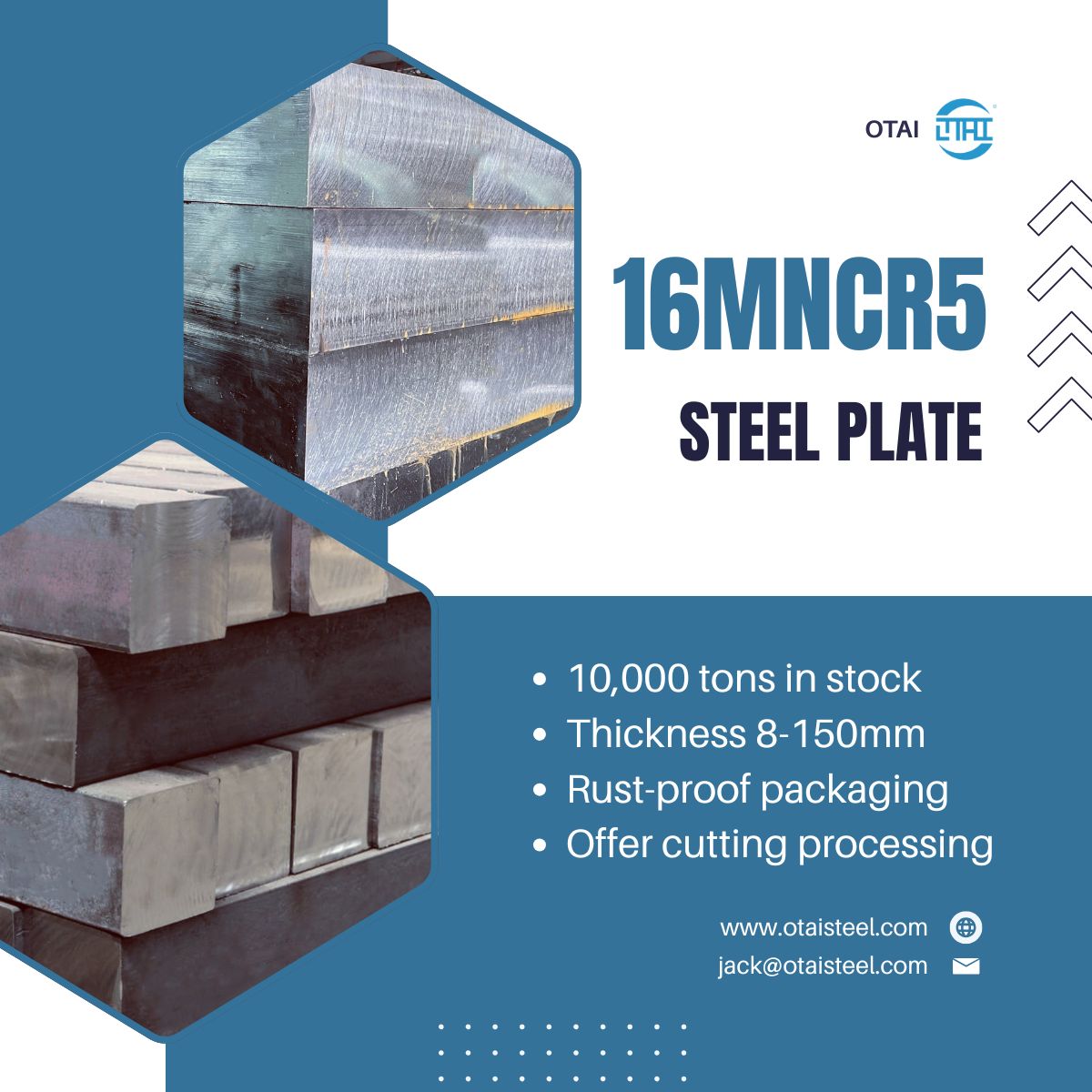
- Stock availability: Otai keeps 8–150mm thickness 16MnCr5 steel plates available in stock to support fast delivery and different production requirements.
- Customized processing: Cutting, machining, and size customization services are available according to customer drawings and specifications.
- Heat treatment support: Professional heat treatment solutions can be arranged, including carburizing, quenching, and tempering.
- Quality inspection: Ultrasonic testing and third-party inspection services are available for customers requiring strict quality assurance.
- International supply experience: Otai has experience supplying alloy steels to global customers with demanding technical standards.
- Safe packaging: Anti-rust packaging, steel strapping, and wooden box packaging ensure reliable international transportation.
With stable inventory, technical support, and professional processing services, Otai helps customers obtain reliable 16MnCr5 gear material for automotive and industrial applications.
❓ FAQ About 16MnCr5 Gear Steel
Q1: Why is 16MnCr5 used for gears?
16MnCr5 is used for gears because it provides a hard wear-resistant surface after carburizing while maintaining a tough core that can withstand impact loads.
Q2: What is the hardness of a carburized 16MnCr5 gear?
A carburized 16MnCr5 gear usually achieves a surface hardness of approximately 58–62 HRC, depending on the heat treatment process.
Q3: What is the difference between 16MnCr5 and 20MnCr5 gear steel?
Both are carburizing steels. 20MnCr5 contains slightly higher carbon, while 16MnCr5 provides an excellent balance of toughness, machinability, and gear performance.
Q4: Is 16MnCr5 suitable for automotive gears?
Yes. 16MnCr5 is widely used for automotive transmission gears, differential gears, and other components requiring high fatigue resistance.
Q5: What heat treatment does 16MnCr5 gear steel require?
Typical treatment includes carburizing, quenching, and tempering to achieve a hard surface and tough core structure.
Q6: Does Otai supply DIN 16MnCr5 gear steel?
Yes. Otai supplies 16MnCr5 steel with stock availability, cutting services, heat treatment support, and quality inspection options.