 Normalized 4140 Steel Microstructure: Structure, Formation and Mechanical Performance
📑 Table of Contents
🔍 1. What Is Normalized 4140 Steel Microstructure?
⚙️ 2. Formation Process of Normalized 4140 Steel Microstructure
🧪 3. Chemical Composition Influence on Microstructure
🔥 4. Normalized 4140 Steel Heat Treatment Process
📊 5. Mechanical Properties of Normalized 4140 Steel
⚖️ 6. Microstructure Comparison of Different 4140 Conditions
🏢 Otai Special Steel Advantages
❓ FAQ About Normalized 4140 Steel Microstructure
🔍 1. What Is Normalized 4140 Steel Microstructure?
When engineers search for normalized 4140 steel microstructure, they usually want to understand how the internal structure of AISI 4140 changes after normalizing treatment and how these changes affect performance.
4140 steel is a chromium-molybdenum alloy steel widely used for shafts, gears, bolts, pressure components, and heavy-duty mechanical parts.
The microstructure of normalized 4140 steel mainly consists of a refined mixture of ferrite and pearlite. This structure provides a balanced combination of strength, toughness, and machinability.
Compared with untreated or as-rolled material, the normalized structure has more uniform grain distribution and improved internal consistency.
The purpose of normalizing is not only to increase strength but also to remove internal stresses and refine the grain structure created during previous manufacturing processes.
Basic Information About 4140 Steel
| Item | Description |
|---|---|
| Steel Grade | AISI 4140 |
| Steel Type | Chromium-molybdenum alloy steel |
| Carbon Content | Approximately 0.38–0.43% |
| Main Alloy Elements | Chromium (Cr) and Molybdenum (Mo) |
| Heat Treatment | Normalizing, quenching, tempering |
| Main Applications | Shafts, gears, bolts, machine components |
What Does Normalizing Do to 4140 Steel?
Normalizing is a heat treatment process where 4140 steel is heated above its critical temperature and then cooled in air.
During this process, the steel undergoes phase transformation. The original coarse grains become finer, producing a more stable and uniform microstructure.
| Before Normalizing | After Normalizing |
|---|---|
| Possible uneven grain structure | Refined and more uniform grains |
| Higher internal stress | Reduced residual stress |
| Less consistent mechanical properties | More stable performance |
| Possible coarse ferrite and pearlite | Fine ferrite and pearlite structure |
The refined structure created by normalizing improves the overall reliability of 4140 steel components.
⚙️ 2. Formation Process of Normalized 4140 Steel Microstructure
The formation of 4140 steel normalized microstructure depends on heating temperature, holding time, cooling rate, and chemical composition.
During normalizing, the steel passes through different metallurgical stages that control grain refinement and phase transformation.
Microstructure Transformation During Normalizing
| Stage | Microstructural Change |
|---|---|
| Heating | Ferrite and pearlite transform into austenite |
| Holding | Austenite grains become more uniform |
| Air Cooling | Formation of refined ferrite and pearlite |
| Final Structure | Balanced ferrite-pearlite microstructure |
Ferrite and Pearlite Structure in Normalized 4140 Steel
The typical 4140 steel ferrite pearlite structure provides a good balance between strength and ductility.
| Phase | Characteristics | Effect on Performance |
|---|---|---|
| Ferrite | Soft and ductile iron phase | Improves toughness and machinability |
| Pearlite | Layered ferrite and cementite structure | Improves strength and hardness |
The proportion and distribution of ferrite and pearlite directly influence the final mechanical properties of normalized 4140 steel.
Why Grain Refinement Matters
Grain refinement is one of the main benefits of normalizing treatment.
| Microstructure Feature | Engineering Benefit |
|---|---|
| Fine grain size | Improves strength and toughness |
| Uniform grain distribution | Provides stable mechanical properties |
| Reduced defects | Improves fatigue resistance |
For industrial components, a consistent microstructure helps reduce the risk of unexpected failure during service.
🧪 3. Chemical Composition Influence on Microstructure
The chemical composition of 4140 steel determines its transformation behavior and final microstructure after normalizing.
Chromium and molybdenum are especially important because they improve hardenability and strengthen the steel structure.
Typical Chemical Composition of AISI 4140 Steel
| Element | Typical Content | Influence on Microstructure |
|---|---|---|
| Carbon (C) | 0.38–0.43% | Controls hardness and pearlite formation |
| Chromium (Cr) | 0.80–1.10% | Improves hardenability and strength |
| Molybdenum (Mo) | 0.15–0.25% | Improves toughness and heat resistance |
| Manganese (Mn) | 0.75–1.00% | Improves strength and hardenability |
| Silicon (Si) | 0.15–0.35% | Supports deoxidation |
Role of Alloy Elements in Normalized 4140 Steel
- Carbon increases strength by promoting pearlite formation.
- Chromium improves wear resistance and hardening response.
- Molybdenum increases toughness and reduces temper brittleness.
- Manganese supports uniform transformation during cooling.
The balanced alloy design allows 4140 steel to achieve reliable mechanical performance after normalizing treatment.
🔥 4. Normalized 4140 Steel Heat Treatment Process
The normalized 4140 steel heat treatment process is designed to refine the internal structure, reduce manufacturing stress, and create a stable ferrite-pearlite microstructure.
Unlike quenching and tempering, normalizing uses air cooling instead of rapid cooling. This creates a balanced structure with improved machinability and predictable mechanical properties.
For many engineering applications, normalized 4140 steel provides an excellent starting condition before further machining or additional heat treatment.
Typical Normalizing Process of 4140 Steel
| Processing Step | Typical Condition | Purpose |
|---|---|---|
| Heating | Approximately 830–870°C | Transform ferrite and pearlite into austenite |
| Holding | According to material thickness | Ensure complete temperature uniformity |
| Cooling | Air cooling | Form refined ferrite and pearlite |
| Final Condition | Normalized structure | Improve strength, toughness, and machinability |
Why Normalizing Is Used for 4140 Steel
| Purpose | Effect on Material |
|---|---|
| Grain refinement | Creates finer and more uniform grains |
| Stress relief | Reduces internal manufacturing stress |
| Structure improvement | Provides stable ferrite-pearlite distribution |
| Machining improvement | Makes cutting and processing easier |
| Property consistency | Improves batch-to-batch reliability |
Microstructure Changes During Normalizing
The main difference between untreated and normalized 4140 steel is the refinement of the internal structure.
| Condition | Typical Microstructure | Performance Feature |
|---|---|---|
| As Rolled 4140 | Possible coarse ferrite and pearlite | Less uniform properties |
| Normalized 4140 | Fine ferrite and pearlite | Better balance of strength and toughness |
| Quenched 4140 | Martensitic structure | Very high hardness |
| Tempered 4140 | Tempered martensite | High strength with improved toughness |
The refined AISI 4140 steel microstructure after normalizing provides a reliable foundation for many industrial components.
📊 5. Mechanical Properties of Normalized 4140 Steel
The mechanical properties of normalized 4140 steel are directly related to its ferrite-pearlite structure.
The refined grain structure improves strength while maintaining sufficient ductility for machining and fabrication processes.
Typical Normalized 4140 Steel Properties
| Property | Typical Value | Influence of Microstructure |
|---|---|---|
| Tensile Strength | Approximately 850–1000 MPa | Related to pearlite content and grain size |
| Yield Strength | Approximately 600–700 MPa | Improved by grain refinement |
| Elongation | 15–20% | Supported by ferrite phase |
| Hardness | 240–300 HB | Controlled by ferrite-pearlite ratio |
| Impact Toughness | Good | Supported by uniform structure |
Relationship Between Microstructure and Mechanical Properties
| Microstructure Feature | Mechanical Effect |
|---|---|
| Fine Ferrite Grains | Improves toughness and ductility |
| Pearlite Distribution | Improves strength and hardness |
| Uniform Grain Structure | Improves consistency and fatigue resistance |
| Reduced Internal Stress | Improves dimensional stability |
These characteristics make 4140 normalized steel properties suitable for components requiring both strength and machinability.
⚖️ 6. Microstructure Comparison of Different 4140 Conditions
The final performance of 4140 steel depends heavily on its heat treatment condition. Different processes create different microstructures and mechanical behaviors.
As Rolled vs Normalized vs Quenched & Tempered 4140
| Condition | Microstructure | Main Characteristics |
|---|---|---|
| As Rolled 4140 | Coarse ferrite and pearlite | Economical but less uniform |
| Normalized 4140 | Fine ferrite and pearlite | Balanced strength and machinability |
| Quenched 4140 | Martensite | High hardness but lower ductility |
| Tempered 4140 | Tempered martensite | High strength and improved toughness |
When to Choose Normalized 4140 Steel?
| Application Requirement | Recommended Condition |
|---|---|
| Easy machining | Normalized 4140 |
| General mechanical parts | Normalized 4140 |
| High wear resistance | Quenched and tempered 4140 |
| Maximum strength | Heat-treated 4140 |
For manufacturers who need stable processing performance before final fabrication, normalized 4140 is often an ideal material condition.
🏭 7. Industrial Applications of Normalized 4140 Steel Microstructure
The refined normalized 4140 steel microstructure provides a balanced combination of strength, toughness, and machinability. Therefore, normalized 4140 steel is widely used in mechanical components that require reliable performance before final machining or additional heat treatment.
Unlike fully hardened conditions, normalized 4140 maintains better ductility and easier processing characteristics. This makes it suitable for manufacturers who need to machine complex shapes before applying final surface treatments.
Common Applications of Normalized 4140 Steel
| Industry | Typical Components | Reason for Using Normalized 4140 |
|---|---|---|
| Automotive Manufacturing | Drive shafts, axles, connecting components | Good strength and fatigue resistance |
| Heavy Equipment | Hydraulic parts, pins, shafts | High toughness under impact loads |
| Oil and Gas Equipment | Pressure components, drilling parts | Reliable strength and durability |
| Machine Building | Gears, rollers, machine frames | Good machinability and stability |
| Tool Manufacturing | Fixtures, holders, tooling components | Balanced hardness and toughness |
Advantages of Normalized 4140 Steel for Machining
Many manufacturers choose normalized 4140 steel because the refined microstructure improves processing performance.
| Machining Factor | Effect of Normalized Structure |
|---|---|
| Cutting Performance | More consistent material response during machining |
| Dimensional Accuracy | Reduced internal stress helps maintain stability |
| Surface Quality | Uniform structure improves machining results |
| Processing Reliability | Lower risk of unexpected deformation |
Normalized 4140 Steel vs Direct Hardened Material
| Feature | Normalized 4140 | Hardened 4140 |
|---|---|---|
| Microstructure | Ferrite + pearlite | Martensite / tempered martensite |
| Machinability | Better | Lower |
| Hardness | Medium | Higher |
| Toughness | Good | Depends on tempering condition |
| Main Use | Machined parts and pre-treatment condition | High-strength final components |
The correct condition depends on the final application. Normalized 4140 is often selected when manufacturers need a balance between machining efficiency and mechanical performance.
🔬 8. How Microstructure Affects 4140 Steel Performance
The internal structure of steel determines how it behaves under different working conditions. The 4140 steel normalized microstructure directly affects strength, toughness, wear resistance, and service life.
| Microstructure Factor | Performance Influence |
|---|---|
| Grain Size | Smaller grains improve strength and toughness |
| Ferrite Content | Improves ductility and machinability |
| Pearlite Content | Improves hardness and strength |
| Uniform Distribution | Improves fatigue resistance and reliability |
A controlled microstructure helps manufacturers produce components with consistent mechanical performance. This is especially important for safety-critical parts exposed to repeated loading.
🏢 Otai Special Steel Advantages
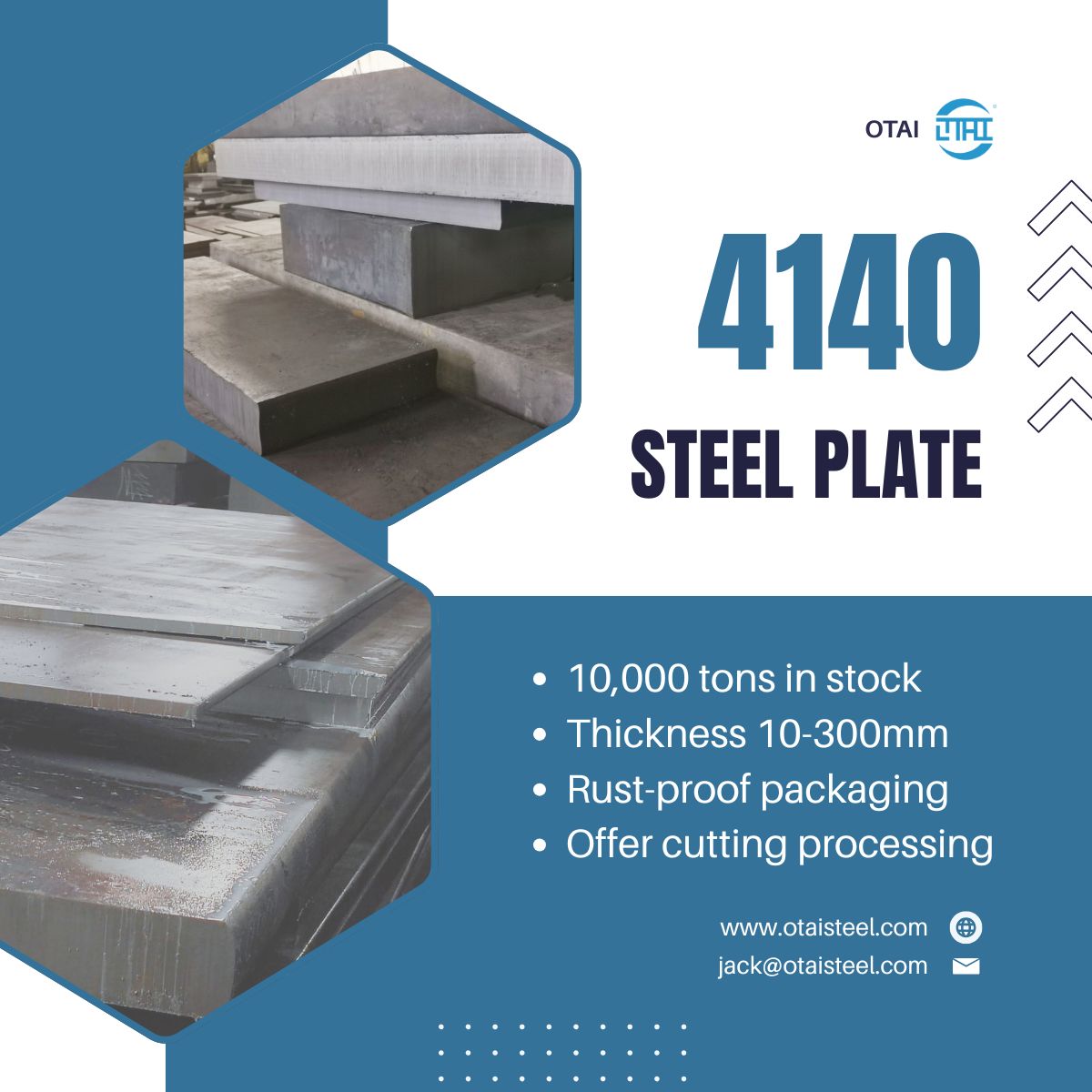
Otai Special Steel supplies high-quality AISI 4140 alloy steel plates and supports customers with professional processing and international supply experience.
- Large inventory: Otai maintains around 10,000 tons of steel inventory with different sizes available in stock to support fast delivery.
- Wide size availability: Various thicknesses and dimensions of 4140 steel plates are available for different engineering requirements.
- Processing service: Cutting, machining, surface processing, and customized size services are available according to customer drawings.
- Heat treatment support: Professional heat treatment solutions can be arranged, including normalizing, quenching, and tempering.
- Quality assurance: Ultrasonic testing and third-party inspection services are available for customers requiring strict quality control.
- International experience: Otai has supplied alloy steels to global customers with demanding technical requirements.
- Safe packaging: Anti-rust packaging, steel strapping, and wooden box packaging ensure reliable transportation.
With stable stock availability and technical support, Otai helps customers obtain reliable normalized 4140 steel microstructure performance for industrial applications.
❓ FAQ About Normalized 4140 Steel Microstructure
Q1: What is the microstructure of normalized 4140 steel?
The typical normalized 4140 steel microstructure consists of refined ferrite and pearlite, providing a balance of strength, toughness, and machinability.
Q2: Why is 4140 steel normalized?
4140 steel is normalized to refine grain structure, reduce internal stress, improve consistency, and enhance machining performance.
Q3: What is the difference between normalized and quenched 4140 steel?
Normalized 4140 contains ferrite and pearlite, while quenched 4140 mainly contains martensite, resulting in higher hardness but lower machinability.
Q4: How does normalizing affect 4140 steel properties?
Normalizing improves grain refinement, mechanical stability, toughness, and machining performance.
Q5: Is normalized 4140 steel good for machining?
Yes. The refined ferrite-pearlite structure provides better machinability compared with fully hardened 4140 steel.
Q6: Does Otai supply normalized 4140 steel?
Yes. Otai supplies 4140 alloy steel plates with inventory, cutting service, heat treatment support, and inspection options.