 Material Equivalent 16MnCr5: Cross Reference and Engineering Applications
🔍 1. Introduction to Material Equivalent 16MnCr5
The keyword material equivalent 16MnCr5 refers to the cross-reference understanding of 16MnCr5 steel in different international standards such as ASTM, DIN, SAE, and EN systems. Engineers often need equivalent grades when sourcing materials globally, especially in automotive and mechanical manufacturing industries.
In practical engineering use, the material equivalent 16MnCr5 concept helps buyers identify alternative steels with similar chemical composition, mechanical properties, and heat treatment behavior. This is critical when original EN-grade material is not available in local markets.
The material equivalent 16MnCr5 is widely searched in global procurement because manufacturers want to replace European steel grades with American or Chinese equivalents without affecting performance or safety.
🧪 2. What Does Material Equivalent 16MnCr5 Mean in Engineering Terms?
The material equivalent 16MnCr5 does not refer to a single exact steel grade. Instead, it refers to a group of steels that share similar carburizing behavior, low-carbon base structure, and manganese-chromium alloying system.
In engineering design, equivalence is based on:
- Chemical composition similarity
- Heat treatment response
- Surface hardness after carburizing
- Core toughness and fatigue resistance
This is why the material equivalent 16MnCr5 concept is more functional than symbolic. Engineers care about performance matching rather than exact naming alignment.
⚙️ 3. Chemical Composition Basis of 16MnCr5 Equivalent Grades
| Element | Typical Range | Engineering Role |
|---|---|---|
| C | 0.14–0.19% | Carburizing response |
| Mn | 0.80–1.10% | Core toughness |
| Cr | 0.80–1.10% | Wear resistance |
| Si | ≤0.40% | Strength stability |
| P/S | ≤0.035% | Impurity control |
The chemical logic behind the material equivalent 16MnCr5 is simple: low carbon ensures carburizing capability, while manganese and chromium ensure hardenability and surface performance.
Any equivalent steel must maintain similar carbon range and alloy balance to qualify as a true material equivalent 16MnCr5.
🏭 4. Mechanical Properties of 16MnCr5 Equivalent Steels
| Property | Typical Range |
|---|---|
| Tensile Strength | 600–900 MPa |
| Yield Strength | 400–650 MPa |
| Core Hardness | 30–45 HRC |
| Surface Hardness | 58–62 HRC |
| Elongation | 10–14% |
| Elastic Modulus | ~210 GPa |
These mechanical values define the performance baseline of any material equivalent 16MnCr5. Even if chemical composition slightly varies, the final heat-treated performance must remain within this range.
This is especially important in gear manufacturing, where fatigue strength and surface hardness directly affect service life.
🔥 5. Heat Treatment Behavior of Equivalent Materials
A key factor in defining material equivalent 16MnCr5 is its response to carburizing heat treatment. The steel must be able to form a high-carbon surface layer while maintaining a ductile core.
- Carburizing at 880–950°C
- Carbon diffusion into surface layer
- Oil quenching for martensite formation
- Tempering for stress relief
If a steel cannot achieve similar case depth and hardness profile, it cannot be considered a true material equivalent 16MnCr5.
🧬 6. Microstructure Comparison of Equivalent Grades
The microstructure of material equivalent 16MnCr5 is defined by transformation behavior during heat treatment.
Before carburizing, the structure consists of ferrite and pearlite. After carburizing and quenching, the surface becomes martensitic while the core remains ferrite-bainite.
This gradient structure is essential because it provides:
- High wear resistance at surface
- Shock absorption in core
- Improved fatigue life
🔄 7. Common Material Equivalents of 16MnCr5
| Standard | Equivalent Grade | Notes |
|---|---|---|
| EN (Europe) | 16MnCr5 | Base reference |
| DIN | 16MnCr5 / 1.7131 | German classification |
| SAE/AISI | 5115 / 5120 (approx.) | Similar carburizing steels |
| GB (China) | 15CrMn / 20CrMn (close) | Functional equivalents |
These grades are commonly used as material equivalent 16MnCr5 depending on availability and application requirements.
🚗 8. Industrial Applications of Equivalent Steels
The material equivalent 16MnCr5 is widely used in industries where carburized surface performance is critical.
- Automotive gearbox systems
- Drive shafts and axle systems
- Industrial reducers
- Worm gears and pinions
- Construction machinery components
In all these applications, the goal of using a material equivalent 16MnCr5 is to ensure stable torque transmission and long fatigue life under cyclic loading.
🛠 9. Machinability and Manufacturing Considerations
One important advantage of material equivalent 16MnCr5 steels is their good machinability in annealed condition.
Manufacturers typically perform rough machining before heat treatment because carburized surfaces become extremely hard afterward.
This production sequence ensures dimensional accuracy and reduces tooling cost while maintaining performance of the final component.
📐 10. Engineering Selection Guidelines
When selecting a material equivalent 16MnCr5, engineers must consider more than just chemical composition.
- Required case depth after carburizing
- Fatigue strength under cyclic load
- Gear contact stress limits
- Dimensional stability after quenching
A correct selection ensures long-term reliability in mechanical systems and reduces failure risk in high-load environments.
🏭 Company Advantages – Otai Special Steel
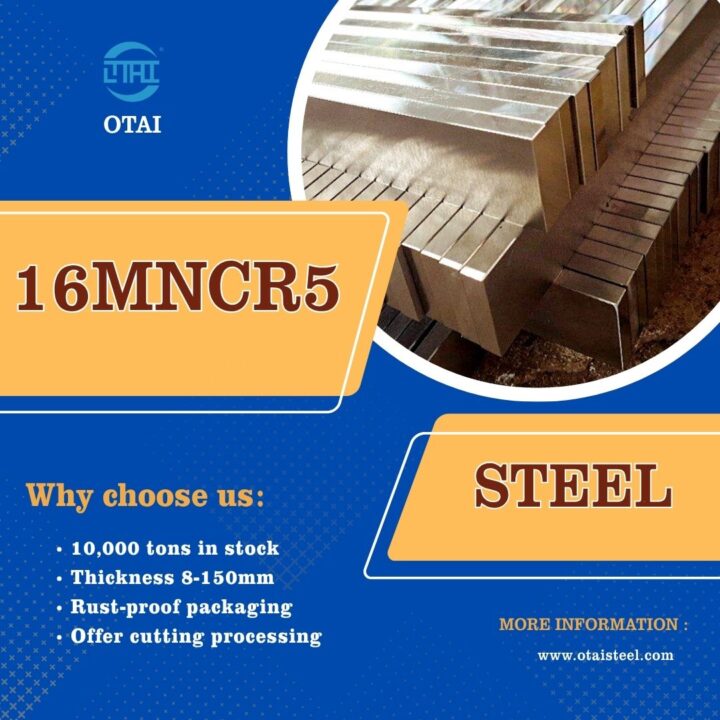
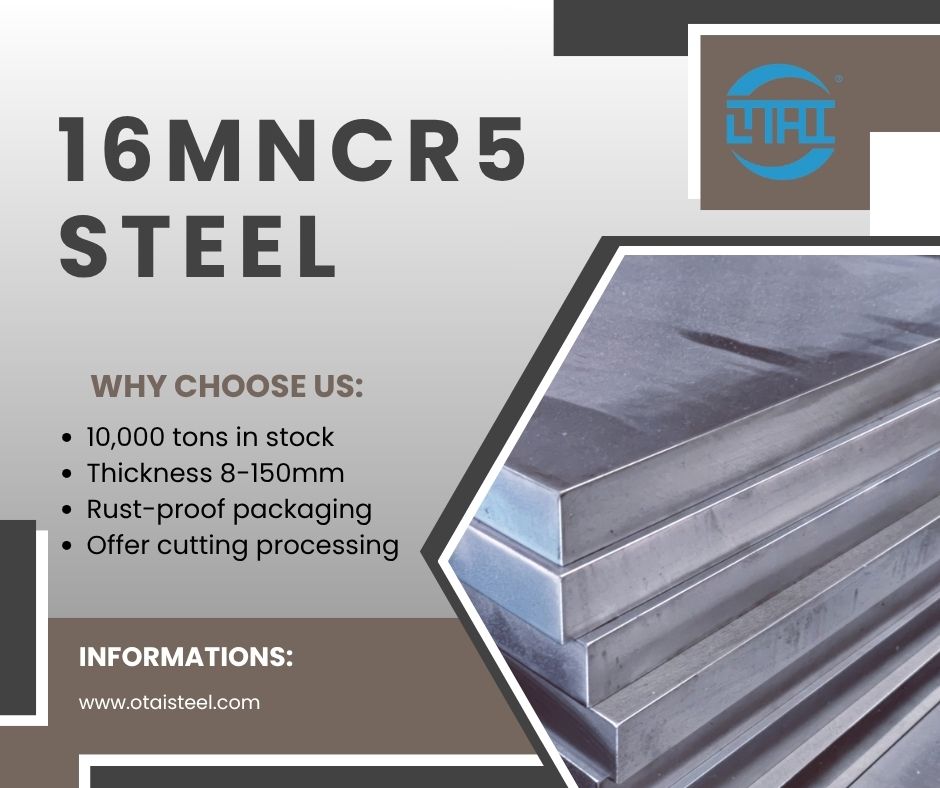
OTAI supplies 16MnCr5 and equivalent carburizing steels with stable inventory and processing capability.
- 8–150mm thickness plates in stock
- Large inventory for fast delivery
- Cutting, heat treatment, machining services
- Ultrasonic testing and third-party inspection
- Global export experience
❓ FAQ
Q1: What is material equivalent 16MnCr5?
It refers to steels with similar composition and carburizing performance as 16MnCr5.
Q2: Is there a direct exact equivalent?
No single exact match exists, only functional equivalents.
Q3: What is the closest Chinese equivalent?
Common alternatives include 15CrMn and 20CrMn steels.
Q4: Why is equivalence important?
It helps global sourcing when original EN material is unavailable.
Q5: What is the main requirement for equivalence?
Similar carburizing response and mechanical performance after heat treatment.