 16MnCr5 vs 4140 – Key Differences in Composition and Industrial Applications
When engineers search for 16MnCr5 vs 4140, they are usually comparing two popular alloy steels used in mechanical manufacturing.
Although both materials contain chromium and provide excellent mechanical performance, they are designed for completely different engineering purposes.
📑 Table of Contents
🔍 1. 16MnCr5 vs 4140: Basic Difference Between Two Alloy Steels
🧪 2. Chemical Composition Comparison of 16MnCr5 and 4140
⚙️ 3. Mechanical Properties and Heat Treatment Differences
📊 4. 16MnCr5 vs 4140 Performance Comparison Table
🔩 5. Carburizing Steel vs Through-Hardening Steel: Different Design Concepts
🏭 6. Industrial Applications of 16MnCr5 and 4140 Steel
📌 7. Which Steel Should You Choose: 16MnCr5 or 4140?
🌍 8. International Standards and Equivalent Grades
🏭 Otai Special Steel Advantages
🔍 1. 16MnCr5 vs 4140: Basic Difference Between Two Alloy Steels
The main difference between 16MnCr5 and 4140 comes from their carbon content and intended heat treatment method.
Both are alloy steels, but they solve different engineering problems.
| Feature | 16MnCr5 | 4140 |
|---|---|---|
| Steel Type | Case-hardening alloy steel | Chromium-molybdenum alloy steel |
| Carbon Level | Low carbon | Medium carbon |
| Main Alloy Elements | Manganese + Chromium | Chromium + Molybdenum |
| Heat Treatment | Carburizing | Quenching and tempering |
| Main Advantage | Hard surface and tough core | High strength and toughness |
| Typical Use | Gears and transmission parts | Shafts and heavy-duty components |
16MnCr5 Characteristics
16MnCr5 belongs to European case-hardening steels.
Its low carbon content allows manufacturers to increase carbon concentration only at the surface through carburizing.
After heat treatment, the material develops:
- Very hard external layer
- Excellent wear resistance
- Tough internal structure
- Good fatigue performance
This makes it ideal for parts that experience repeated contact stress.
Typical examples include:
- Automotive gears
- Gear wheels
- Transmission shafts
- Pinions
4140 Steel Characteristics
4140 steel is one of the most widely used chromium-molybdenum alloy steels worldwide.
The higher carbon content allows the material to achieve high hardness and strength after heat treatment.
Important properties include:
- High tensile strength
- Excellent toughness
- Good fatigue resistance
- Good wear resistance
Common applications include:
- Shafts
- Heavy machinery components
- High-strength bolts
- Pressure-related mechanical parts
Therefore, when comparing 4140 steel vs 16MnCr5 application, the key question is not which steel is stronger, but which steel matches the working condition.
A gear requiring a hard surface usually benefits from 16MnCr5, while a shaft requiring high overall strength usually benefits from 4140.
🧪 2. Chemical Composition Comparison of 16MnCr5 and 4140
Chemical composition is one of the most important differences between 16MnCr5 and 4140.
The alloy elements determine hardenability, strength, toughness, and heat treatment response.
| Element | 16MnCr5 | 4140 |
|---|---|---|
| Carbon (C) | 0.14–0.19% | 0.38–0.43% |
| Silicon (Si) | ≤0.40% | 0.15–0.35% |
| Manganese (Mn) | 1.00–1.30% | 0.75–1.00% |
| Chromium (Cr) | 0.80–1.10% | 0.80–1.10% |
| Molybdenum (Mo) | Usually not added | 0.15–0.25% |
| Nickel (Ni) | Usually not added | Small amount |
Carbon Content Difference
The biggest chemical difference between the two grades is carbon content.
16MnCr5 contains approximately 0.16% carbon, which is why it is suitable for carburizing.
4140 contains approximately 0.40% carbon, allowing it to achieve high hardness throughout the material after quenching and tempering.
| Carbon Level | Effect |
|---|---|
| Low Carbon (16MnCr5) | Better toughness and carburizing ability |
| Medium Carbon (4140) | Higher strength after heat treatment |
Alloy Element Difference
Chromium exists in both grades, but the alloy design purpose is different.
In 16MnCr5, chromium improves:
- Carburized layer performance
- Wear resistance
- Hardenability
In 4140, chromium combined with molybdenum improves:
- Through-hardening ability
- High-temperature strength
- Fatigue resistance
This chemical difference explains why 16MnCr5 and 4140 show different behavior after heat treatment.
⚙️ 3. Mechanical Properties and Heat Treatment Differences
The performance difference between 16MnCr5 vs 4140 hardness mainly comes from their different heat treatment methods.
16MnCr5 is designed to create different properties between the surface and the core.
4140 is designed to achieve a more uniform strength level across the entire section.
| Property | 16MnCr5 | 4140 |
|---|---|---|
| Heat Treatment | Carburizing + quenching | Quenching + tempering |
| Surface Hardness | 58–62 HRC after carburizing | 50–55 HRC after hardening |
| Core Toughness | Excellent | Excellent |
| Tensile Strength | Approximately 600–900 MPa | Approximately 900–1100 MPa |
| Wear Resistance | Very high after carburizing | High |
16MnCr5 Heat Treatment
The typical process includes:
| Process | Purpose |
|---|---|
| Carburizing | Add carbon to surface layer |
| Quenching | Create hard martensitic structure |
| Tempering | Reduce stress and improve toughness |
4140 Heat Treatment
4140 usually uses:
- Quenching
- Tempering
- Stress relieving when required
This creates a strong and tough structure throughout the steel section.
For this reason:
- 16MnCr5 is preferred for surface wear applications.
- 4140 is preferred for high-strength structural applications.
The correct choice depends on whether the component needs a hard surface or high overall strength.
📊 4. 16MnCr5 vs 4140 Performance Comparison Table
A detailed comparison helps engineers understand why these two steels are selected for different mechanical applications.
Although both grades provide excellent strength and durability, their performance advantages appear in different working environments.
| Performance | 16MnCr5 | 4140 | Better Choice |
|---|---|---|---|
| Surface Hardness | Very high after carburizing | High after quenching and tempering | 16MnCr5 |
| Core Strength | Good toughness | Higher overall strength | 4140 |
| Wear Resistance | Excellent with hardened surface | Good | 16MnCr5 |
| Impact Resistance | Excellent | Excellent | Similar |
| Fatigue Resistance | Excellent for contact stress | Excellent for structural loads | Application dependent |
| Machinability Before Treatment | Good | Good | Similar |
| Large Section Strength | Limited compared with 4140 | Excellent | 4140 |
Hardness Comparison
Many engineers search for 16MnCr5 vs 4140 hardness because hardness directly affects wear resistance and service life.
However, hardness values should be evaluated together with the application environment.
| Condition | 16MnCr5 | 4140 |
|---|---|---|
| Before Heat Treatment | Soft and easy to machine | Medium strength condition |
| After Heat Treatment | Hard surface with tough core | High strength throughout section |
| Typical Hardness Range | 58–62 HRC surface | 28–55 HRC depending on treatment |
The important point is that 16MnCr5 achieves hardness mainly on the surface, while 4140 achieves strength through the whole material thickness.
Strength Comparison
4140 generally provides higher tensile strength because it contains more carbon and molybdenum.
This makes it suitable for components exposed to heavy loads, bending stress, and mechanical shock.
16MnCr5 focuses more on balancing:
- Surface wear resistance
- Contact fatigue performance
- Core toughness
Therefore, selecting between these grades requires understanding the actual failure mode of the component.
If failure is caused by surface wear, 16MnCr5 is often the better option.
If failure is caused by high tensile stress or bending load, 4140 may provide better performance.
🔩 5. Carburizing Steel vs Through-Hardening Steel: Different Design Concepts
The fundamental difference between 16MnCr5 and 4140 is their steel design philosophy.
16MnCr5 belongs to carburizing steels, while 4140 belongs to through-hardening alloy steels.
What Is Carburizing Steel?
Carburizing steel is designed to create a high-carbon surface layer while maintaining a low-carbon core.
The process changes only the surface characteristics.
| Layer | Characteristic |
|---|---|
| Surface Layer | High hardness and excellent wear resistance |
| Core Area | Tough and impact-resistant |
This structure is ideal for gears because gear teeth experience repeated surface contact.
During operation:
- The surface resists wear.
- The core absorbs impact loads.
- The component achieves longer service life.
What Is Through-Hardening Steel?
4140 is a typical through-hardening steel.
After quenching and tempering, the entire cross-section achieves improved strength.
| Feature | 4140 Performance |
|---|---|
| Strength Distribution | More uniform throughout the section |
| Main Advantage | High tensile strength and toughness |
| Typical Components | Shafts, bolts, structural parts |
Why Are They Not Direct Replacements?
Although both steels are strong alloy materials, they are not direct substitutes.
Replacing 16MnCr5 with 4140 may create problems in gear applications because the surface hardness mechanism is different.
Replacing 4140 with 16MnCr5 may reduce overall strength in heavily loaded structural components.
The correct choice depends on:
- Load direction
- Wear conditions
- Contact pressure
- Required service life
- Heat treatment capability
Understanding these differences helps manufacturers avoid incorrect material selection.
🏭 6. Industrial Applications of 16MnCr5 and 4140 Steel
The application differences between 16MnCr5 and 4140 are mainly determined by their mechanical characteristics.
Both materials are widely used in engineering industries, but they serve different purposes.
Applications of 16MnCr5 Steel
16MnCr5 is widely selected for components requiring a hard surface and strong core.
| Industry | Components | Reason for Selection |
|---|---|---|
| Automotive | Transmission gears, pinions | Excellent wear resistance and fatigue performance |
| Mechanical Equipment | Gear wheels, shafts | Good toughness after carburizing |
| Industrial Machinery | Reduction gears | Long service life under contact stress |
| Agricultural Equipment | Drive components | Good impact resistance |
Common 16MnCr5 components include:
- Gear teeth
- Pinions
- Transmission parts
- Drive shafts
- Mechanical couplings
Applications of 4140 Steel
4140 is widely used where high strength and toughness are required.
| Industry | Components | Reason for Selection |
|---|---|---|
| Automotive | Axles, shafts | High strength and fatigue resistance |
| Heavy Machinery | Machine parts | Excellent load-bearing ability |
| Oil and Gas Equipment | High-strength components | Good toughness and durability |
| Manufacturing | Tool holders and fixtures | Good mechanical performance |
Typical 4140 components include:
- Drive shafts
- Heavy-duty bolts
- Couplings
- Machine frames
- High-strength mechanical parts
Industry Selection Summary
| Requirement | Recommended Steel |
|---|---|
| Gear surface wear resistance | 16MnCr5 |
| High strength shaft | 4140 |
| Carburized transmission parts | 16MnCr5 |
| Heavy mechanical loading | 4140 |
The choice between these materials should always follow the actual working condition rather than only comparing strength values.
📌 7. Which Steel Should You Choose: 16MnCr5 or 4140?
Choosing between 16MnCr5 vs 4140 depends on the working environment, component design, and required performance.
Neither steel is universally better. Each grade provides advantages for different engineering applications.
Choose 16MnCr5 When You Need:
- A hard wear-resistant surface
- Excellent contact fatigue resistance
- A tough inner core
- Carburizing treatment capability
- Long service life for gear components
Typical examples include automotive gears, gear wheels, pinions, and transmission parts.
Choose 4140 When You Need:
- High overall strength
- Excellent tensile performance
- Strong resistance against bending loads
- Good toughness in large sections
- Quenching and tempering treatment
Typical examples include shafts, bolts, machine components, and heavy-duty mechanical parts.
| Working Condition | Recommended Material | Reason |
|---|---|---|
| Gear teeth with repeated contact | 16MnCr5 | Carburized surface provides excellent wear resistance |
| High-load rotating shaft | 4140 | Higher strength throughout the section |
| Transmission components | 16MnCr5 | Good balance of hardness and toughness |
| Heavy mechanical structures | 4140 | Better load-bearing capability |
| Precision components requiring stable dimensions | Both grades | Depends on processing requirements |
Cost and Processing Considerations
Material selection should also consider manufacturing processes.
16MnCr5 usually requires carburizing, which adds an additional heat treatment step but provides superior surface performance.
4140 can often achieve the required properties through conventional quenching and tempering.
| Factor | 16MnCr5 | 4140 |
|---|---|---|
| Machining Before Heat Treatment | Good | Good |
| Heat Treatment Complexity | Higher due to carburizing | Moderate |
| Surface Wear Performance | Excellent | Good |
| Structural Strength | Good | Excellent |
Engineers should select the steel grade according to the actual failure risk of the component.
For wear-related failures, 16MnCr5 is often the preferred solution.
For strength-related failures, 4140 is usually more suitable.
🌍 8. International Standards and Equivalent Grades
When purchasing alloy steel internationally, customers often compare different standards to find suitable alternatives.
For 16MnCr5 equivalent material and 4140 equivalent grades, buyers should check chemical composition, mechanical properties, and application requirements.
| Grade | Standard | Equivalent / Similar Grade |
|---|---|---|
| 16MnCr5 | EN 10084 | 1.7131 |
| 16MnCr5 | China | 16CrMn |
| 16MnCr5 | USA Similar Grade | 5120 |
| 4140 | ASTM A29 / SAE | 42CrMo4 (European Similar Grade) |
| 4140 | China | 42CrMo |
| 4140 | Japan | SCM440 |
16MnCr5 Equivalent Grades
Common alternatives for 16MnCr5 include:
- 1.7131
- 16CrMn
- SAE 5120
- Similar carburizing steels
These materials share similar applications, especially for gears and mechanical transmission parts.
4140 Equivalent Grades
Common alternatives for 4140 include:
- 42CrMo4
- SCM440
- 42CrMo
These grades belong to chromium-molybdenum alloy steels with similar mechanical characteristics.
| Comparison | 16MnCr5 | 4140 |
|---|---|---|
| Main Standard | EN 10084 | ASTM / SAE |
| Material Number | 1.7131 | Not applicable |
| Steel Type | Carburizing steel | Cr-Mo alloy steel |
| Main Application | Gears | High-strength parts |
Although equivalent grades may appear similar, direct replacement should always be confirmed according to project specifications.
🏭 Otai Special Steel Advantages
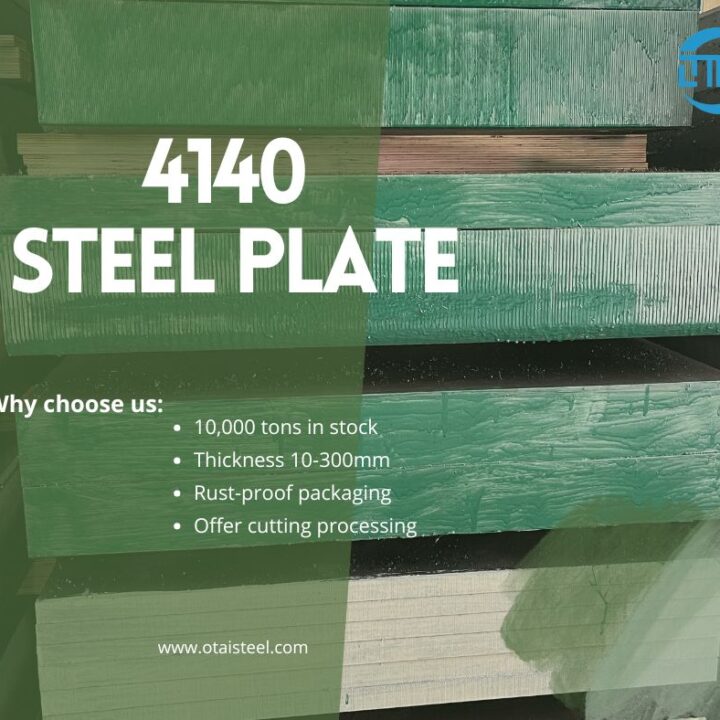
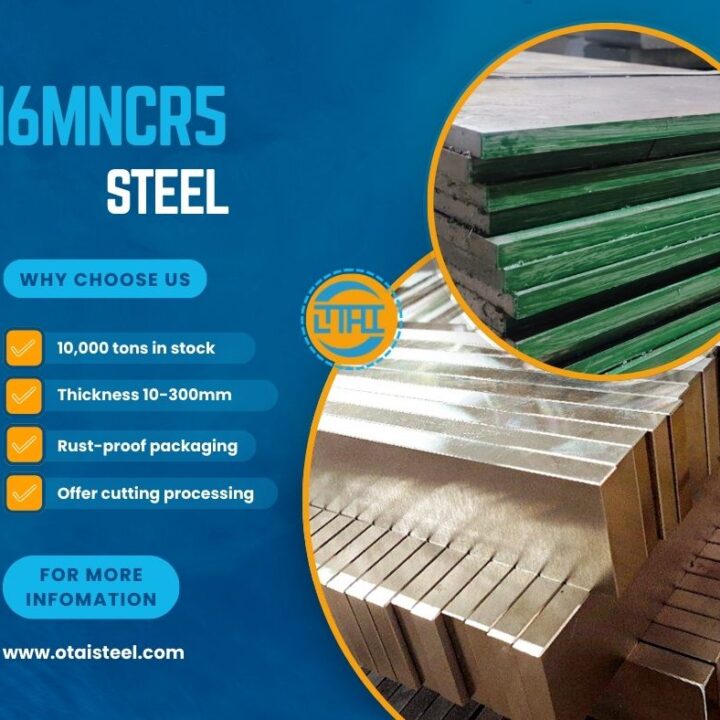
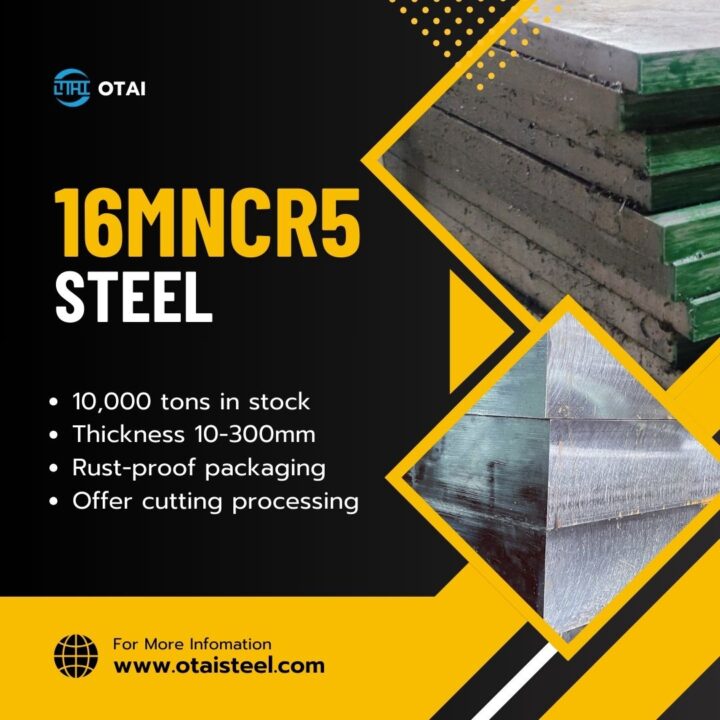
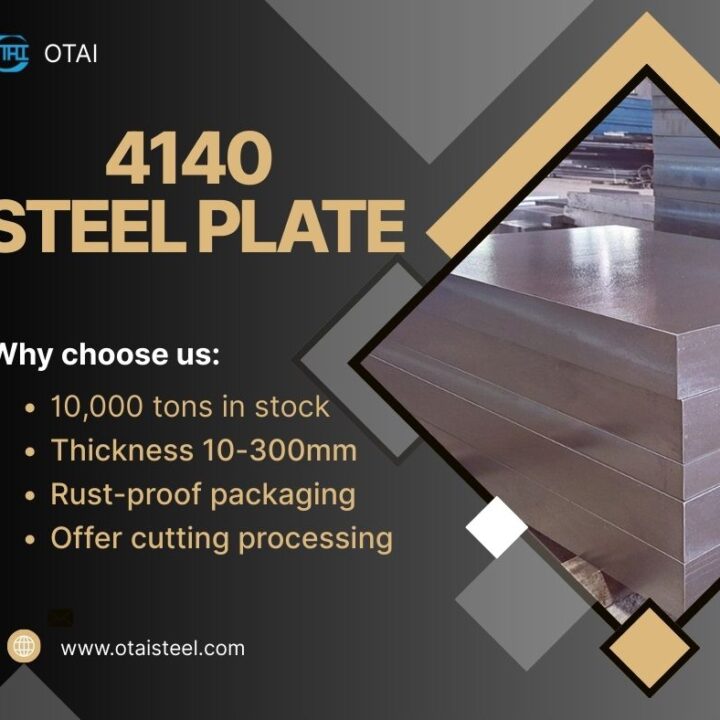
Otai Special Steel supplies alloy steel products including 16MnCr5 and 4140 steel for customers worldwide.
With experience in international steel supply, Otai helps customers select suitable materials for gears, shafts, and mechanical components.
- Large inventory: Otai maintains approximately 10,000 tons of steel inventory with different sizes available to support urgent production requirements.
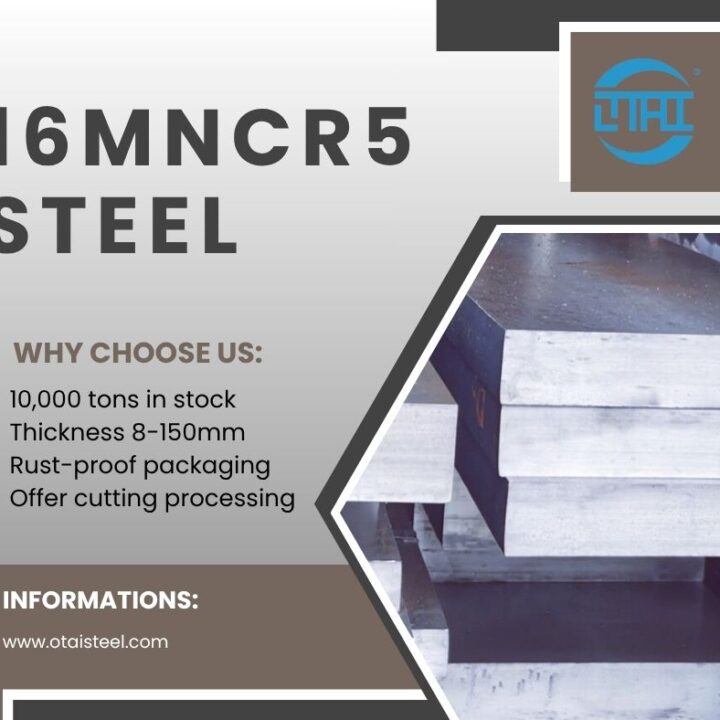
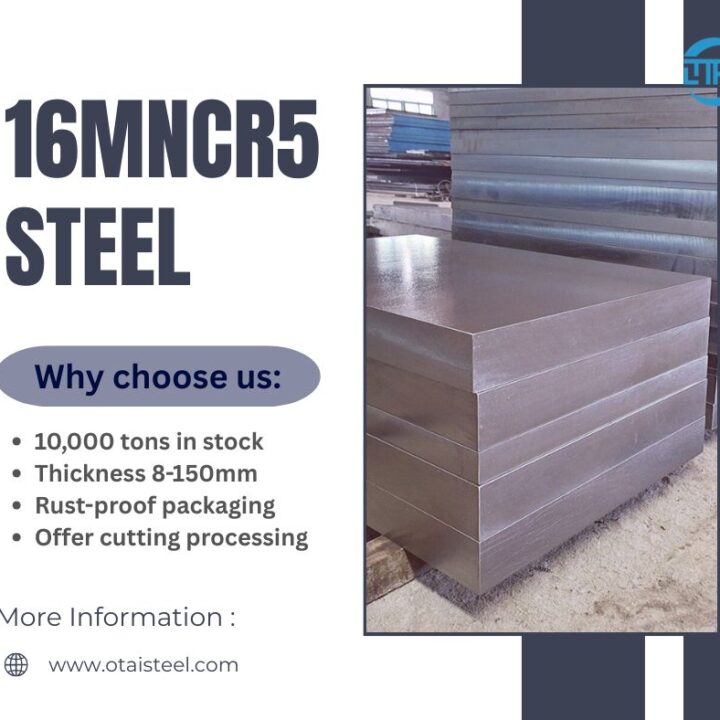
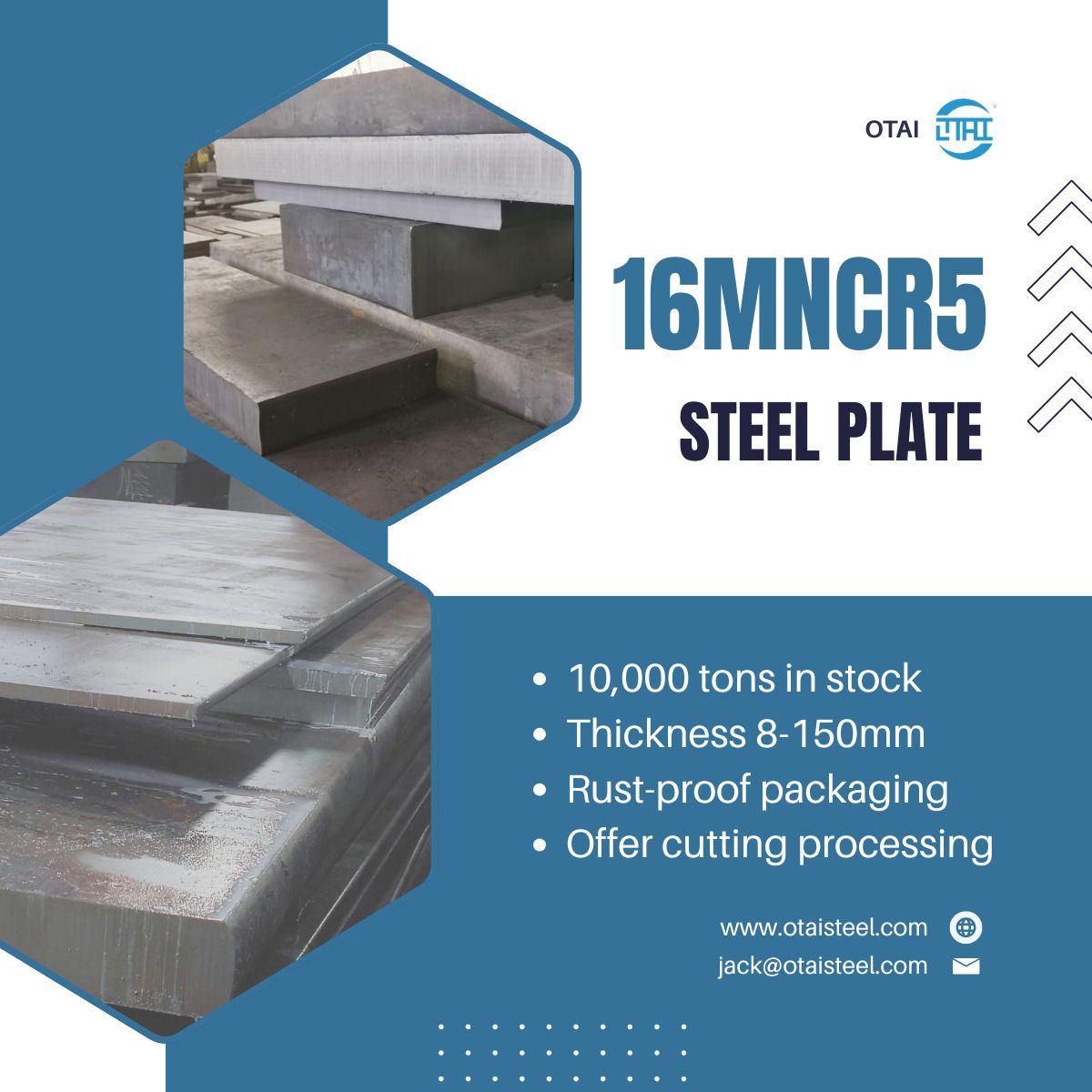
- 16MnCr5 stock availability: Otai keeps 8–150mm thickness plates available in stock for customers requiring 16MnCr5 steel products.
- Customized processing service: Provides cutting, machining support, and customized dimensions according to customer drawings.
- Quality assurance: Provides ultrasonic testing and third-party inspection services according to customer requirements.
- Export packaging: Provides anti-rust packaging, steel strapping packaging, and wooden box packaging for international transportation.
Whether customers need 4140 alloy steel properties or 16MnCr5 carburizing steel, Otai provides technical support and reliable material solutions.
❓ FAQ – 16MnCr5 vs 4140
Q1: What is the main difference between 16MnCr5 and 4140?
16MnCr5 is a carburizing steel designed for hard surfaces and tough cores, while 4140 is a chromium-molybdenum alloy steel designed for high overall strength.
Q2: Is 16MnCr5 stronger than 4140?
Not necessarily. 4140 generally provides higher tensile strength, while 16MnCr5 provides better surface hardness after carburizing.
Q3: Can 4140 replace 16MnCr5?
In some applications, yes, but they are not direct replacements. Gear components usually require the carburizing performance of 16MnCr5.
Q4: Can 16MnCr5 replace 4140 steel?
Usually not for high-strength shafts or heavy-load components because 4140 provides higher through-section strength.
Q5: Which steel is better for gears, 16MnCr5 or 4140?
16MnCr5 is generally preferred for gears because carburizing creates a hard wear-resistant surface with a tough core.