41Cr4 Thermal Expansion: How Much Does Steel Expand When Heated?
📑 Table of Contents
- 🔍 What Is Thermal Expansion in 41Cr4 Steel?
- 📊 What Is the Thermal Expansion Coefficient of 41Cr4?
- 🌡️ How Does Temperature Affect 41Cr4 Thermal Expansion?
- 📐 How Can Engineers Calculate 41Cr4 Thermal Expansion?
- ⚙️ How Does Thermal Expansion Affect 41Cr4 Components?
- 🏭 Does Heat Treatment Affect 41Cr4 Thermal Expansion?
- 🔧 How Can Manufacturers Control Thermal Expansion Problems?
- 📋 What Should Buyers Check When Sourcing 41Cr4 Steel?
- 🏢 Company Advantages
- ❓ Frequently Asked Questions
Temperature changes can affect the dimensions of steel components, even when the material remains below its transformation or heat-treatment temperatures. For manufacturers working with 41Cr4 steel, this behavior matters during machining, assembly, operation, and dimensional inspection. A shaft that fits correctly at room temperature may develop a different clearance when it heats up. Likewise, a machined component may show dimensional changes if inspection takes place before the material reaches a stable temperature.
41Cr4 is a chromium-alloyed engineering steel commonly used for mechanical components such as shafts, axles, and gears. Its thermal expansion behavior helps engineers estimate how much a component will grow or shrink as its temperature changes. However, a reliable calculation requires more than choosing one coefficient from a general material table. Engineers must consider the temperature interval, original dimensions, material condition, and actual operating environment.
This article explains the thermal expansion coefficient of 41Cr4, provides reference data at different temperatures, and demonstrates how to calculate dimensional changes. It also discusses practical considerations for machining, component design, heat treatment, and steel procurement.
🔍 What Is Thermal Expansion in 41Cr4 Steel?
Understanding thermal expansion
Thermal expansion describes the dimensional change that occurs when a material’s temperature changes. Most steel components expand when heated and contract when cooled. This happens because temperature affects the movement and average spacing of atoms within the material.
For 41Cr4 steel, engineers commonly evaluate thermal expansion through its coefficient of linear thermal expansion. This coefficient estimates how much a material’s length changes for each degree of temperature change. Manufacturers use it to predict dimensional variations in shafts, plates, gears, and other mechanical components.
For example, a long 41Cr4 shaft will generally experience a greater absolute length change than a short shaft made from the same material under the same temperature change. The material’s expansion behavior may be similar, but the longer component has more length over which expansion can occur.
Linear expansion and volumetric expansion
Engineers normally use linear thermal expansion when calculating changes in a component’s length, diameter, or thickness. Volumetric expansion considers the combined dimensional change in three directions. For a material that expands uniformly in all directions, engineers can estimate its volumetric expansion coefficient as approximately three times its linear coefficient.
However, actual components may not expand freely. Fixtures, joints, fasteners, and neighboring materials can restrict movement. These constraints may create thermal stresses even when the material’s natural expansion is predictable.
Why does 41Cr4 thermal expansion matter?
Thermal expansion becomes important whenever component dimensions influence performance. A small dimensional change may affect a precision shaft’s bearing fit, a gear assembly’s clearance, or the alignment of connected machine parts.
For procurement teams, this means that selecting 41Cr4 by grade alone is not enough for every application. The buyer should also communicate operating temperatures, dimensional tolerances, delivery condition, and any special requirements for thermal stability. These details help the supplier provide material in a condition suitable for the customer’s manufacturing process.
📊 What Is the Thermal Expansion Coefficient of 41Cr4?
Reference values at different temperatures
The thermal expansion coefficient of 41Cr4 changes with temperature. A technical data sheet published by Lucefin provides reference values for the grade over a temperature range from 100°C to 600°C. The figures below are expressed in millionths per kelvin (10⁻⁶ K⁻¹). The data represents mean expansion coefficients relative to a 20°C reference temperature, rather than a separate instantaneous coefficient at each listed temperature.
| Final temperature | Mean thermal expansion coefficient | Reference temperature |
|---|---|---|
| 100°C | 11.1 × 10⁻⁶ K⁻¹ | 20°C |
| 200°C | 12.1 × 10⁻⁶ K⁻¹ | 20°C |
| 300°C | 12.9 × 10⁻⁶ K⁻¹ | 20°C |
| 400°C | 13.5 × 10⁻⁶ K⁻¹ | 20°C |
| 500°C | 13.9 × 10⁻⁶ K⁻¹ | 20°C |
| 600°C | 14.1 × 10⁻⁶ K⁻¹ | 20°C |
These values are useful engineering references, not guaranteed measurements for every 41Cr4 product. The published data also identifies the coefficient as a mean value over the interval beginning at 20°C. Engineers should use the correct reference interval when applying the figures in a calculation.
Why does the coefficient increase with temperature?
The reference data shows a gradual increase in the mean coefficient as the final temperature rises. For example, the listed value changes from 11.1 × 10⁻⁶ K⁻¹ at 100°C to 13.5 × 10⁻⁶ K⁻¹ at 400°C.
This means engineers should avoid using one room-temperature approximation for every high-temperature calculation. A coefficient that works for a small temperature rise may produce a less accurate estimate over a much wider temperature interval.
Mean coefficient versus instantaneous coefficient
A mean coefficient describes the average expansion behavior over a defined temperature interval. An instantaneous or differential coefficient describes the local expansion rate at a particular temperature. These values are related, but they are not interchangeable.
When a datasheet reports mean coefficients relative to 20°C, use those values for calculations that begin at 20°C and end at the corresponding listed temperature. For calculations between two other temperatures, engineers need suitable interval data or a validated temperature-dependent material model. Simply selecting the coefficient at the final temperature may not provide the correct average for that different interval.
🌡️ How Does Temperature Affect 41Cr4 Thermal Expansion?
Heating causes dimensional growth
When a 41Cr4 component heats up, its dimensions generally increase. The amount of growth depends on the original size, temperature change, and applicable expansion coefficient. A small temperature increase may produce only a minor dimensional change, but repeated heating or a large temperature difference can create a measurable effect.
Consider a shaft installed in a machine that operates at an elevated temperature. As the shaft heats, its diameter and length increase. If the surrounding housing expands at a different rate, the clearance between the two components can change. Engineers must therefore consider both materials rather than calculating the shaft’s expansion in isolation.
Cooling causes contraction
When 41Cr4 steel cools, it generally contracts toward its original dimensions, assuming no permanent deformation or metallurgical transformation occurs. This behavior matters during manufacturing because a component measured immediately after machining may not have the same dimensions once it reaches the inspection room’s stable temperature.
For precision parts, manufacturers should allow the workpiece and measuring equipment to reach a consistent temperature before final inspection. Otherwise, temperature differences between the part, gauge, and reference standard can affect the measurement result.
Temperature gradients can create uneven expansion
A component does not always heat uniformly. For example, one end of a shaft may be closer to a heat source, while the other end remains cooler. Different sections then expand by different amounts. This uneven expansion can cause distortion, bending, or additional thermal stress when the component cannot move freely.
Thick plates and large machined parts may also take longer to reach a uniform temperature than smaller components. Therefore, engineers should consider heating rate, cooling rate, component geometry, and the location of temperature measurements.
Temperature range determines the calculation method
For a relatively small temperature change, a suitable mean coefficient may provide a practical estimate. For a wide temperature range, engineers should use temperature-dependent data that matches the actual interval. They should also consider whether the material approaches a temperature at which its microstructure or phase condition may change.
Thermal expansion calculations are most reliable when the material remains in a stable phase and experiences no significant permanent deformation. If the process involves high-temperature treatment, transformation effects and residual stresses require separate consideration.
📐 How Can Engineers Calculate 41Cr4 Thermal Expansion?
Use the linear expansion formula
Engineers can estimate the change in length of a freely expanding 41Cr4 component with the following formula:
ΔL = L₀ × α × ΔT
Where:
- ΔL: Change in length.
- L₀: Original length before heating or cooling.
- α: Mean coefficient of linear thermal expansion for the relevant temperature interval.
- ΔT: Temperature change, calculated as final temperature minus initial temperature.
Keep the units consistent. If the original length is in millimeters and the coefficient is expressed in K⁻¹, the calculated length change will also be in millimeters. A temperature difference of 1°C has the same numerical size as a temperature difference of 1 K.
Example: A 1,000 mm 41Cr4 shaft heated to 200°C
Assume a 41Cr4 shaft has an initial length of 1,000 mm at 20°C. Its temperature rises to 200°C. The reference mean coefficient for this interval is 12.1 × 10⁻⁶ K⁻¹.
The temperature change is:
ΔT = 200 − 20 = 180°C
Substitute the values into the formula:
ΔL = 1,000 × 12.1 × 10⁻⁶ × 180
ΔL = 2.178 mm
The estimated length at 200°C is therefore:
1,000 + 2.178 = 1,002.178 mm
This example assumes uniform temperature, free expansion, and no permanent dimensional change. Actual components may behave differently if fixtures, adjoining parts, temperature gradients, or metallurgical changes restrict or alter their movement.
Example: Diameter expansion of a 100 mm component
The same formula can estimate diameter changes. Suppose a 41Cr4 cylindrical component has an initial diameter of 100 mm at 20°C and reaches 200°C. Using the same mean coefficient:
ΔD = 100 × 12.1 × 10⁻⁶ × 180
ΔD = 0.2178 mm
The estimated diameter becomes approximately 100.218 mm under the stated assumptions. This change may be significant for a precision fit, even though the absolute increase appears small.
How should engineers handle other temperature intervals?
If a component heats from 100°C to 300°C, the coefficient referenced to 20°C cannot simply be treated as the mean coefficient for that 100–300°C interval. Engineers should obtain appropriate interval data or calculate the dimensional difference from compatible expansion data referenced to the same baseline.
For critical applications, use the material supplier’s validated technical data or an engineering calculation based on the relevant test method. Do not treat an illustrative calculation as a guaranteed production tolerance.
⚙️ How Does Thermal Expansion Affect 41Cr4 Components?
Shafts and rotating parts
41Cr4 is commonly used for engineering components that need a combination of strength and toughness after suitable heat treatment. Shafts and rotating parts are examples where dimensional stability matters. As operating temperature rises, a shaft may expand in both length and diameter.
Designers should consider the shaft’s bearing arrangement, support locations, operating speed, and temperature distribution. If the assembly prevents natural expansion, thermal stress may develop. A suitable clearance or axial movement arrangement can help accommodate dimensional changes.
Gears and transmission components
Gears require controlled tooth geometry and appropriate clearance for reliable operation. Temperature changes can affect gear dimensions and the relationship between mating components. If two connected parts expand differently, backlash and contact conditions may change.
Engineers should evaluate the complete assembly, including the gear material, housing, shaft, lubrication system, and operating temperature. The thermal expansion coefficient of 41Cr4 is one input in this assessment, not a complete prediction of gear performance.
Press fits and interference fits
Press-fit assemblies depend on controlled dimensional differences between mating components. Manufacturers sometimes use temperature changes during assembly to expand or contract parts temporarily. However, the final interference must account for the dimensions after both components return to their operating or reference temperature.
When using 41Cr4 in an interference fit, engineers should calculate the expansion of both mating parts. If the hub and shaft use different materials, their coefficients may differ. The assembly temperature, initial dimensions, surface finish, and required interference all influence the final fit.
Precision machining and inspection
Thermal expansion also affects machining accuracy. Cutting operations generate heat, and large workpieces may retain temperature differences after machining. If a part undergoes final measurement while it is still warm, the measured size may not represent its dimensions at the agreed reference temperature.
Manufacturers should control workshop temperature where practical, allow components to stabilize before precision inspection, and use calibrated measuring instruments. These steps help distinguish actual machining errors from temporary thermal dimensional changes.
🏭 Does Heat Treatment Affect 41Cr4 Thermal Expansion?
Separate reversible expansion from permanent dimensional change
Ordinary thermal expansion is generally reversible: a component expands as it heats and contracts as it cools. Heat treatment, however, can produce additional dimensional changes that do not disappear simply by returning the material to room temperature.
During hardening and tempering, 41Cr4 experiences changes in microstructure and internal stress. Depending on the treatment route, section size, cooling conditions, and starting condition, these effects may cause distortion or dimensional variation. Engineers should not attribute every post-treatment size change to the ordinary thermal expansion coefficient.
Quenching and tempering considerations
Quenching involves heating steel to a specified austenitizing temperature and then cooling it under controlled conditions. This process changes the microstructure and can introduce residual stresses. Tempering follows quenching to adjust the balance of hardness, strength, and toughness.
For 41Cr4 components, the selected process should match the material specification and application. Large or complex components may experience uneven cooling, which can increase the risk of distortion. Machining allowance and process sequencing should therefore account for the expected dimensional changes.
Why should manufacturers measure after treatment?
When a component requires tight dimensional tolerances, manufacturers should verify its dimensions after the relevant heat-treatment and stabilization stages. If final grinding or finishing follows heat treatment, the process plan should account for material removal and any remaining dimensional movement.
Buyers should also clarify whether the supplier delivers 41Cr4 in an annealed, normalized, or quenched-and-tempered condition. The delivery condition affects how the customer should plan machining, further heat treatment, and final inspection.
Request application-specific technical advice
A general thermal expansion table cannot predict all dimensional changes during a complete heat-treatment cycle. For critical parts, engineers should consider material condition, geometry, furnace uniformity, heating and cooling rates, and the specified acceptance criteria. The heat-treatment provider may also recommend trial processing or dimensional checks for complex components.
🔧 How Can Manufacturers Control Thermal Expansion Problems?
Include temperature in dimensional planning
Manufacturers should identify the temperature at which a component’s dimensions matter most. A drawing may specify dimensions at a standard inspection temperature, while the part operates at a much higher temperature. Engineers should distinguish these two conditions during design and production planning.
For components with tight fits, calculate the expected dimensional change over the operating temperature range. If the assembly contains several materials, evaluate the expansion of each part and the resulting clearance or interference.
Use appropriate machining and inspection procedures
Machining accuracy improves when manufacturers control heat generation and allow workpieces to stabilize before final measurement. Practical measures include:
- Using suitable cutting parameters to avoid unnecessary heat buildup.
- Allowing large components to cool evenly after machining.
- Checking that the workpiece and measuring equipment are at compatible temperatures.
- Performing final dimensional inspection after required heat treatment and stabilization.
- Recording the inspection temperature when tight tolerances make it relevant.
Plan for thermal movement in the assembly
Designers can reduce thermal stress by allowing components to expand where the assembly permits movement. Depending on the application, this may involve suitable clearances, sliding supports, expansion allowances, or a different arrangement of locating and floating bearings.
However, extra clearance is not always the correct solution. Excessive movement can cause vibration, misalignment, noise, or reduced positioning accuracy. Engineers must balance thermal movement against the assembly’s mechanical requirements.
Confirm material and process consistency
Manufacturers should use the specified 41Cr4 grade and delivery condition consistently. Changes in material source, product size, heat-treatment route, or machining sequence can affect production results. Traceable MTC records and documented process controls help identify the source of unexpected dimensional variation.
For critical components, a trial run can help validate the expected thermal behavior and machining allowance before full production. This is especially useful when the component has complex geometry, close tolerances, or a demanding operating temperature range.
📋 What Should Buyers Check When Sourcing 41Cr4 Steel?
Confirm the grade and applicable standard
41Cr4 is a chromium-alloyed engineering steel identified by the material number 1.7035 in relevant European material references. Buyers may also encounter related designations such as AISI/SAE 5140. Although these grades are commonly treated as comparable, buyers should verify the applicable chemical composition, mechanical requirements, product form, and standard before accepting an equivalent.
For international procurement, the purchase order should identify the required standard and edition rather than relying only on a grade name. This helps prevent confusion when suppliers and customers use different national specifications.
Specify dimensions and delivery condition
Buyers should provide the required thickness, width, length, quantity, and dimensional tolerances. For precision components, it is also useful to explain the machining allowance and final dimensional requirements. The supplier can then confirm whether available stock and cutting services suit the project.
Delivery condition deserves equal attention. Annealed material, normalized material, and quenched-and-tempered material may require different manufacturing plans. If the component will operate at elevated temperatures, communicate the expected temperature range so the engineering team can assess material suitability.
Review the MTC and inspection requirements
The MTC should identify the supplied grade, heat number, chemical composition, and relevant test information. Buyers should check that the certificate corresponds to the material being shipped. Where the application requires specific mechanical properties, hardness, or additional inspection, state the acceptance criteria in the purchase order.
Thermal expansion data is normally a reference physical property rather than a routine batch acceptance result on every steel certificate. If a project requires measured thermal expansion values or a specific test method, buyers should agree on that requirement with the supplier before production.
Compare suppliers beyond the quoted price
A suitable steel supplier should provide more than a grade name and a price per ton. Buyers should assess stock availability, dimensional accuracy, cutting capability, material traceability, inspection support, packaging, and export experience.
For example, a supplier with suitable plate stock and cutting facilities may help reduce material waste and simplify the customer’s production preparation. Clear communication about tolerances and delivery condition can also prevent costly changes after the order has been placed.
For product information, buyers can review OTAI’s 5140 alloy steel product page. When sourcing 41Cr4 or a comparable 5140 grade, confirm the exact specification, stock condition, and current availability with the sales team before ordering.
🏢 Company Advantages
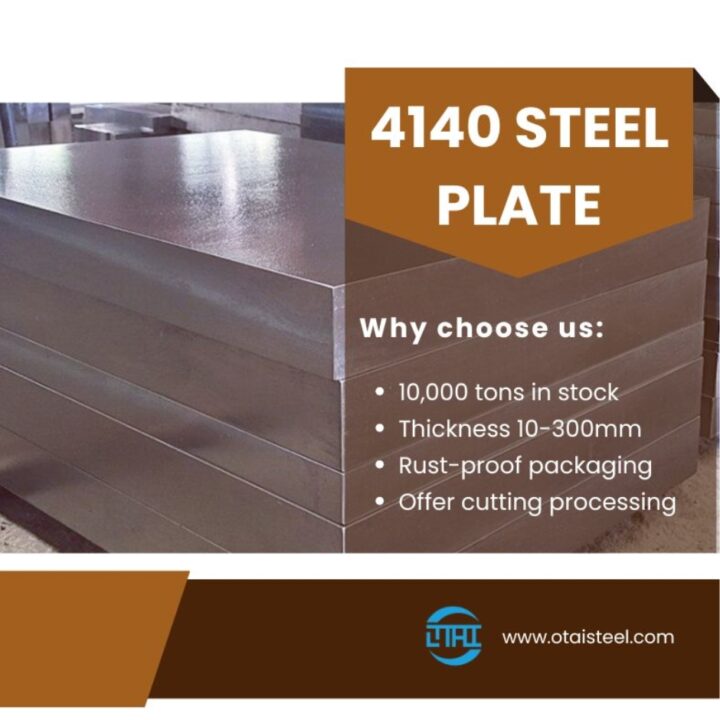
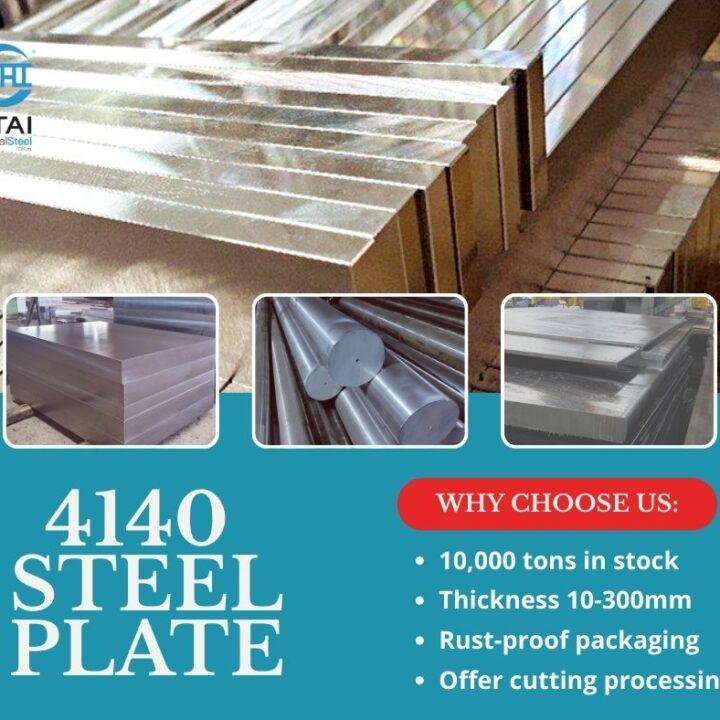
- 41Cr4 / 5140 steel plate stock: Plate thickness range of 4–300 mm, subject to current inventory confirmation.
- Large stock capacity: More than 10,000 tons of steel stock across the company’s product range.
- Cutting capability: 20 saw cutting machines support customized dimensions and order-based cutting.
- Machining services: CNC machining and grinding help customers prepare steel for subsequent manufacturing processes.
- Customized tolerances: Support for customer-specific dimensions, cutting requirements, and tolerance needs.
- Quality support: Material documentation, quality checks, ultrasonic testing, and third-party inspection support can be arranged according to order requirements.
- Export packaging: Rust-prevention measures, secure bundling, and wooden cases are available according to shipment requirements.
- International experience: Exporting steel products to customers in more than 54 countries since 1999.
- One-stop service: Support covering material selection, cutting, machining, inspection coordination, packaging, and export arrangements.
- Global customer experience: Experience supplying international industrial customers, including major multinational companies.
When requesting a quotation for 41Cr4 or 5140 steel, provide the required standard, plate dimensions, delivery condition, quantity, and inspection requirements. OTAI can help confirm suitable stock, cutting options, documentation, and export arrangements for your project.
❓ Frequently Asked Questions
1. What is the thermal expansion coefficient of 41Cr4 steel?
One published 41Cr4 technical data sheet reports mean thermal expansion coefficients of 11.1 × 10⁻⁶ K⁻¹ at 100°C, 12.1 × 10⁻⁶ K⁻¹ at 200°C, and 13.5 × 10⁻⁶ K⁻¹ at 400°C, all referenced to 20°C. These are reference values, not guaranteed measurements for every product or material condition.
2. How much does a 1-meter 41Cr4 steel bar expand when heated?
The amount depends on the final temperature and the applicable mean expansion coefficient. For example, a 1,000 mm bar heated from 20°C to 200°C expands by approximately 2.178 mm when using a mean coefficient of 12.1 × 10⁻⁶ K⁻¹. This calculation assumes uniform heating and unrestricted expansion.
3. Does 41Cr4 expand more at higher temperatures?
Its mean thermal expansion coefficient generally increases across the temperature range shown in the published reference data. Therefore, engineers should use temperature-appropriate values for calculations rather than applying one coefficient to every operating condition.
4. Does heat treatment change the dimensions of 41Cr4 steel?
Yes. Quenching and tempering can cause dimensional changes through microstructural transformation, residual stress, and distortion. These effects differ from ordinary reversible thermal expansion. Manufacturers should check dimensions after the required heat-treatment and stabilization stages.
5. Is 41Cr4 thermal expansion important for precision-machined components?
Yes. Temperature-related dimensional changes can affect shaft diameters, bearing fits, gear clearances, press fits, and inspection results. Manufacturers should consider the reference temperature, operating temperature, component dimensions, and expansion of mating materials when designing and machining precision parts.