16MnCr5 Uses in Industry: How to Select Steel for Case-Hardened Parts
📑 Table of Contents
- 📋 What Is 16MnCr5 Steel Used For?
- ⚙️ Why 16MnCr5 Suits Case-Hardened Components
- 🚗 16MnCr5 Uses in Automotive and Transmission Parts
- 🏭 Applications in Industrial Machinery and Equipment
- 🔥 Carburizing, Case Depth, and Surface Hardness
- 📊 Chemical Composition and Material Properties
- ⚖️ How to Select 16MnCr5 for Your Application
- 💰 Purchasing 16MnCr5 Steel Plate for Industrial Projects
- 🏢 Why Source 16MnCr5 from Otai Special Steel?
- ❓ Frequently Asked Questions
16MnCr5 uses are closely linked to components that need a hard, wear-resistant surface while retaining a comparatively tough core. This European case-hardening steel is commonly selected for gears, pinions, shafts, and other mechanical parts exposed to contact stress, friction, and repeated loading.
However, selecting 16MnCr5 involves more than identifying a suitable application. Engineers and industrial buyers must also consider the component geometry, carburizing requirements, effective case depth, core properties, machining allowance, and material certification. This article explains where 16MnCr5 is commonly used and how to evaluate whether it fits your manufacturing and procurement requirements.
📋 What Is 16MnCr5 Steel Used For?
16MnCr5 is a low-carbon manganese-chromium alloy steel designed primarily for case hardening. It is commonly associated with European material number 1.7131 and the EN 10084 case-hardening steel specification. Its relatively low carbon content supports a tough core, while carburizing can increase the carbon content near the surface to enable high surface hardness after suitable hardening treatment.
This combination makes 16MnCr5 useful for mechanical components that must resist surface wear while carrying loads through the body of the part.
Common industrial applications
- Gears and pinions: Components that experience repeated tooth contact, friction, and localized loading.
- Gear shafts and transmission parts: Parts that need a wear-resistant surface and a core capable of carrying mechanical loads.
- Pins and bushes: Components exposed to contact, movement, or repeated mechanical interaction, when the design and treatment are suitable.
- Camshafts and drive components: Selected parts that need controlled surface properties and adequate core strength.
- Automotive and machinery components: Engineered parts where case hardening forms part of the specified manufacturing route.
Why the application matters
These uses share a common requirement: the surface and core do different jobs. The surface may need resistance to wear, indentation, and contact fatigue, while the core must support the applied load without becoming excessively brittle.
Nevertheless, 16MnCr5 is not automatically suitable for every highly loaded component. Section size, loading conditions, impact requirements, required case depth, and the heat-treatment process all influence the final performance. A gear used under severe loads may need a different grade or hardenability level from a smaller, less demanding component.
For procurement, start with the drawing and performance requirements. Then confirm whether the specified material condition and available product form support the intended manufacturing process.
⚙️ Why 16MnCr5 Suits Case-Hardened Components
The main reason manufacturers choose 16MnCr5 is its response to case-hardening treatment. Instead of requiring the entire component to have the same high hardness, the process develops a hardened surface layer while retaining a comparatively lower-carbon core.
Hard surface, tough core
During carburizing, the component is exposed to a carbon-rich atmosphere at elevated temperature. Carbon diffuses into the surface region, creating a higher-carbon layer. The part then undergoes the specified hardening treatment, followed by tempering where required.
The treated surface can achieve high hardness and improved resistance to adhesive and abrasive wear. Meanwhile, the lower-carbon core can retain a useful combination of strength and toughness. The exact results depend on the material, component geometry, treatment parameters, and quality-control requirements.
Why this combination matters in service
Consider a gear tooth. Its working surface experiences repeated contact with another tooth, while the tooth body must transmit torque and withstand bending loads. A suitable case-hardening process helps the surface resist damage without requiring the entire component to have the same hardness as the case.
Similar principles apply to selected shafts, pins, and other moving components. Their surfaces may experience friction or contact stress, while the core must continue to support the load.
Case hardening is not the same as through hardening
With case hardening, the objective is to create a defined surface layer with a different carbon content and hardness profile from the core. Through hardening, by contrast, aims to harden a greater proportion of the section, subject to the material’s hardenability and component size.
These processes serve different design purposes. If a component requires high hardness throughout its section, the engineering team should verify whether 16MnCr5 and the proposed treatment can meet that requirement. Its primary role is case hardening, not replacing every through-hardening alloy steel.
🚗 16MnCr5 Uses in Automotive and Transmission Parts
Automotive engineering and power transmission are important application areas for 16MnCr5. Many transmission components experience repeated contact, sliding, torque, and cyclic loading. Case hardening can help provide the surface characteristics these parts require, provided that the steel and heat-treatment process meet the design specification.
Gears and pinions
Gears transfer motion and torque through contact between their teeth. The contact surfaces must withstand repeated loading and resist wear, while the tooth body must carry bending stresses. 16MnCr5 can be considered for suitable gears and pinions that require a hardened case and a comparatively tough core.
When selecting material for gear production, buyers should not focus on grade alone. The module, tooth geometry, component dimensions, loading conditions, required hardness profile, and effective case-hardening depth can all influence material selection. More heavily loaded gears or larger sections may require a different hardenability level or another alloy grade.
Gear shafts and drive components
Selected gear shafts and drive components combine rotating motion with contact or bending loads. A case-hardened surface may help resist wear in specified areas, while the core supports the component during operation.
However, not every shaft needs case hardening. If the main requirement is high strength throughout the section, an alternative steel and heat-treatment route may be more appropriate. The design specification should identify whether surface hardening, through hardening, or another treatment is required.
Automotive production considerations
Series production requires repeatable material and heat-treatment results. Variations in incoming material, machining allowance, carburizing conditions, and quenching can affect distortion and final dimensions.
For this reason, automotive and transmission buyers should agree on the material standard, delivery condition, traceability, and inspection requirements before production. If the component has tight dimensional limits after hardening, the manufacturing plan should also account for distortion and any final grinding or finishing operations.
🏭 Applications in Industrial Machinery and Equipment
Beyond automotive applications, 16MnCr5 can be used in selected industrial machinery components where a hard surface and a tougher core are beneficial. Suitability depends on the actual loading conditions and the properties required after heat treatment.
Machine elements exposed to wear
Pins, selected bushes, drive elements, and other contact components may benefit from case hardening when their surfaces experience friction or repeated mechanical contact. The process can help improve surface durability, but the design must still account for lubrication, alignment, contact pressure, and operating conditions.
A material grade cannot compensate for poor component geometry or an unsuitable lubrication system. Engineers should evaluate the complete component design rather than expecting case hardening alone to prevent every type of wear or failure.
Camshafts and precision mechanical parts
Selected camshafts and precision mechanical parts may require localized wear resistance. Where 16MnCr5 is specified, the manufacturing route should define the areas to be hardened and the acceptable properties after treatment.
For components with complex shapes, the heat-treatment process can affect dimensional stability. Machining allowance, distortion control, and final inspection therefore become important parts of the production plan.
When another grade may be more appropriate
16MnCr5 is not a universal solution for all machinery parts. Applications involving very large sections, unusually high core-strength requirements, severe impact loading, or demanding hardenability requirements may need another grade.
For example, some larger or more heavily loaded transmission components may require a case-hardening steel with a different alloying system or hardenability profile. The choice should follow the applicable engineering specification, rather than a general assumption that one case-hardening grade fits all gear and shaft applications.
For buyers, the most useful step is to provide the supplier with the drawing, material specification, required delivery condition, and any heat-treatment requirements. This helps determine whether the available 16MnCr5 product is suitable for the intended manufacturing route.
🔥 Carburizing, Case Depth, and Surface Hardness
The final properties of 16MnCr5 components depend strongly on the case-hardening process. The steel grade provides the starting material, but the heat-treatment procedure determines the resulting surface and core characteristics. Buyers should therefore define the required finished-part properties instead of specifying only the steel grade.
Understand effective case-hardening depth
Case-hardening depth describes how far the hardened region extends from the surface into the component. Effective case-hardening depth is determined using a specified hardness criterion and test method. It is not simply the visible depth of a treated layer.
A shallow case may be adequate for one component, while another may need a deeper hardened zone because of contact stress, geometry, or expected service life. The appropriate value depends on the engineering design and applicable specification.
Surface hardness and core properties
Surface hardness is important for resistance to wear and contact damage, but it does not describe the complete component. Core strength, toughness, residual stress, and the hardness transition beneath the surface also influence performance.
Excessively focusing on surface hardness can create an incomplete acceptance specification. For demanding applications, define the required surface hardness, effective case depth, core properties, and relevant inspection methods. The heat-treatment provider can then assess the process needed to meet those requirements.
Heat-treatment control and dimensional changes
Carburizing and quenching can cause distortion. The amount depends on component geometry, material condition, furnace loading, temperature control, quenching practice, and other process variables. Precision parts may therefore require machining allowance and a planned finishing operation after heat treatment.
Do not apply one universal temperature-and-time recipe to every 16MnCr5 component. The treatment schedule should be developed for the component and the required case profile by a qualified heat-treatment provider.
What buyers should confirm
- Whether the component requires carburizing, carbonitriding, or another specified process.
- Target surface hardness and the applicable test method.
- Required effective case-hardening depth and acceptance criteria.
- Any core-hardness, core-strength, or impact-toughness requirements.
- Dimensional tolerances after heat treatment and any finishing allowance.
- Inspection reports and traceability required for approval.
These details help align the incoming steel, production process, and final inspection. They also reduce the risk of disputes caused by an order that names the grade but leaves the finished-part requirements unclear.
📊 Chemical Composition and Material Properties
Reviewing the basic material data helps buyers confirm that 16MnCr5 is the intended grade. Commonly referenced composition limits are associated with EN 10084, but the exact specification and edition stated in the purchase order must govern acceptance.
Commonly referenced chemical composition
| Element | Commonly referenced range or limit, wt.% | Relevance |
|---|---|---|
| Carbon (C) | 0.14–0.19 | Supports surface carbon enrichment during case hardening while maintaining a relatively low-carbon core. |
| Manganese (Mn) | 1.00–1.30 | Contributes to strength and hardenability. |
| Silicon (Si) | Common maximum: 0.40 | Contributes to deoxidation and material behavior. |
| Chromium (Cr) | 0.80–1.10 | Supports hardenability and heat-treatment response. |
| Phosphorus (P) | Common maximum: 0.025 | Verify the applicable standard limit. |
| Sulfur (S) | Common maximum: 0.035 | Verify the applicable standard limit and any special machinability requirements. |
Note: These figures are general reference values, not a substitute for the exact standard requirements or the actual heat analysis. Always check the material certificate for the supplied batch.
Separate standard limits from actual test results
Standard limits define the permitted composition. A mill’s typical analysis describes representative material and does not guarantee every heat. The actual chemical analysis on the material test certificate (MTC) records the reported results for the identified batch.
For procurement approval, compare the actual analysis with the applicable standard limits. Do not use a typical analysis as the sole basis for accepting or rejecting a shipment.
Delivery condition and hardness
16MnCr5 may be supplied in different conditions, depending on the product and purchase requirements. For example, soft-annealed material is often selected to support machining before the final case-hardening operation. Other delivery conditions may be appropriate when the specification requires them.
Hardness values are meaningful only when the delivery condition, test method, and acceptance range are clear. A hardness figure for annealed stock should not be confused with the surface hardness expected after carburizing and hardening.
When purchasing material for a finished component, verify both the incoming-material requirements and the final-part requirements. These are related, but they are not the same specification.
⚖️ How to Select 16MnCr5 for Your Application
Choosing 16MnCr5 should begin with the finished component rather than the steel catalogue. A correct selection connects the operating requirements to the material grade, heat-treatment plan, dimensions, and inspection criteria.
Use an application-based selection checklist
| Decision factor | Questions to answer | Why it matters |
|---|---|---|
| Loading conditions | Will the part face contact stress, bending, impact, or cyclic loads? | Helps establish strength and toughness requirements. |
| Surface performance | What wear resistance, hardness, and case depth are required? | Defines the surface-hardening objective. |
| Section size | What are the component dimensions and thickest sections? | Influences hardenability, treatment response, and distortion. |
| Manufacturing route | Will machining occur before or after heat treatment? | Affects delivery condition and machining allowance. |
| Quality requirements | Which certificates and inspection reports are mandatory? | Supports traceability and acceptance. |
Consider the alternatives carefully
Other case-hardening grades may suit similar components, but differences in carbon content, alloying elements, hardenability, and standard requirements can affect performance. Do not approve an alternative solely because a supplier lists it as equivalent.
Compare the relevant material standards, actual chemical analysis, required case depth, core properties, and final-part acceptance criteria. For components controlled by customer drawings or regulated quality systems, obtain formal approval before changing the specified grade.
Define the requirement before requesting a quotation
A clear purchase specification should state the grade, standard, product form, dimensions, delivery condition, quantity, and documentation requirements. If the steel will be carburized after machining, include the relevant finished-part requirements or reference the controlled drawing and heat-treatment specification.
This approach helps suppliers quote the right material and reduces the risk of purchasing stock that does not suit the manufacturing process.
💰 Purchasing 16MnCr5 Steel Plate for Industrial Projects
For industrial buyers, material suitability is only one part of the purchasing decision. Actual stock availability, cutting requirements, dimensional tolerances, certification, packaging, and lead time can all influence the total cost and delivery schedule.
Confirm the required plate dimensions
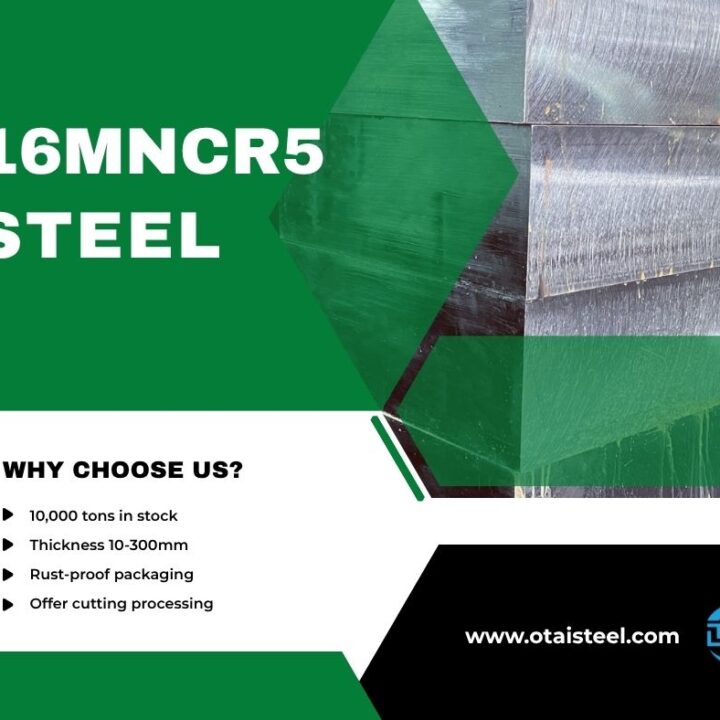
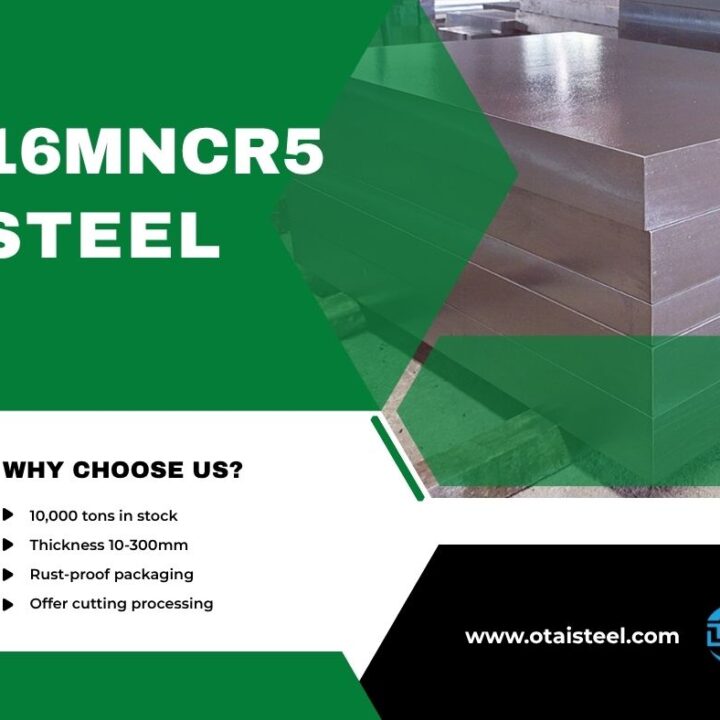
Otai’s stated stock range for 16MnCr5 steel plate is 8–150 mm in thickness. This range can help buyers identify a potential supply option, but it does not mean every thickness or quantity is available at all times. Confirm the actual size, stock condition, quantity, and delivery schedule for your order.
If you need cut blanks, provide the required thickness, width, length, tolerance, and machining allowance. A suitable cutting plan can help reduce unnecessary material loss, but the final benefit depends on the component geometry and production process.
Check the complete quotation
- Grade and applicable standard.
- Plate thickness, width, length, and required tolerances.
- Delivery condition and any additional processing requirements.
- Material test certificate and traceability requirements.
- Any required dimensional checks or nondestructive testing.
- Packaging, corrosion protection, shipping marks, and destination.
- Quantity, lead time, and agreed delivery terms.
Compare total procurement cost
A lower unit price may not result in a lower delivered cost if the material requires additional cutting, inspection, or processing. Compare quotations on the same technical basis, including the delivery condition and documentation required.
For international shipments, confirm the packaging and marking requirements before dispatch. If third-party inspection or ultrasonic testing is required, specify the scope and acceptance criteria early so the supplier can plan the inspection before shipment.
Use the official product page
For product information, visit Otai’s official 16MnCr5 case-hardening steel page. Use it as a starting point, then confirm the current stock dimensions, delivery condition, certification, and order-specific requirements with the supplier.
🏢 Why Source 16MnCr5 from Otai Special Steel?
Otai Special Steel supplies alloy steel and tool steel to international industrial customers. For buyers sourcing 16MnCr5, the team can discuss plate availability, cutting requirements, documentation, and export preparation according to the needs of the project.
- 16MnCr5 plate stock: Stated thickness range of 8–150 mm. Confirm actual availability, quantity, condition, and delivery schedule before ordering.
- International export experience: Exporting to more than 54 countries since 1999.
- Stock capability: More than 10,000 tons of steel stock across the company’s product range, subject to grade and size availability.
- Cutting equipment: 20 saw-cutting machines support material preparation and cutting services.
- Machining support: CNC machining and grinding options can be discussed for orders requiring further processing.
- Customized dimensions: Buyers can request specific sizes and tolerances for review against the available material and processing route.
- Quality documentation: Material certificates and traceability requirements can be discussed for the order specification.
- Additional inspection: Ultrasonic testing and third-party inspection can be arranged where applicable and agreed in advance.
- Export packaging: Bundling, wooden-crate, and anti-rust packaging options can be specified according to shipment requirements.
- Coordinated service: Material supply, cutting, machining, and related processing requirements can be reviewed together to support industrial procurement.
When requesting a quotation, provide the grade, required dimensions, quantity, delivery condition, intended application, and inspection requirements. If the material will be used for case-hardened components, include the relevant drawing or final-part specification so the supply requirements can be reviewed accurately.
Visit the official 16MnCr5 product page to review the product information, then contact Otai to confirm current availability and the requirements for your order.
❓ Frequently Asked Questions
1. What are the main uses of 16MnCr5 steel?
16MnCr5 is commonly used for case-hardened gears, pinions, gear shafts, pins, and selected machinery components. It is suited to applications that require a wear-resistant surface and a comparatively tough core after suitable heat treatment. The final selection depends on the component’s loading conditions and specified properties.
2. Why is 16MnCr5 used for gears?
Gears often need resistance to repeated contact and wear while maintaining enough core strength and toughness to carry torque and bending loads. Carburizing and subsequent hardening can develop a hard surface layer on 16MnCr5. The required case depth, hardness profile, and core properties must match the gear design.
3. Does 16MnCr5 need carburizing before use?
Carburizing is a common treatment for 16MnCr5 when the component requires a hardened case. However, the appropriate treatment depends on the design and material specification. The required surface hardness, effective case depth, and core properties should be defined before the heat-treatment process is selected.
4. Is 16MnCr5 suitable for highly loaded components?
It can suit many engineering components, but suitability depends on section size, loading conditions, required hardenability, and final mechanical properties. Very large or heavily loaded components may require another grade or a different hardenability level. Engineering requirements should determine the choice.
5. What 16MnCr5 plate thicknesses does Otai supply?
Otai’s stated 16MnCr5 steel plate thickness range is 8–150 mm. Actual availability depends on the required dimensions, quantity, delivery condition, and current stock. Buyers should confirm the exact specification and lead time before placing an order.