What Is the Tensile Strength of 41Cr4 Steel?
📑 Table of Contents
- 🔍 What Is the Tensile Strength of 41Cr4 Steel?
- 📊 41Cr4 Tensile Strength by Section Size
- ⚙️ How Heat Treatment Changes Tensile Strength
- 📏 Tensile Strength, Yield Strength and Elongation
- 🧪 How to Verify 41Cr4 Mechanical Properties
- 🏭 Is 41Cr4 Suitable for Your Industrial Application?
- 📦 Buying 41Cr4 Steel Plate: Stock, Dimensions and Processing
- 📝 What Buyers Should Include in a 41Cr4 RFQ
- 🏢 Company Advantages
- ❓ Frequently Asked Questions
🔍 What Is the Tensile Strength of 41Cr4 Steel?
The tensile strength of 41Cr4 steel depends on its heat-treatment condition, product form, and section size. For 41Cr4 in the quenched-and-tempered (+QT) condition, EN 10083-3:2006 specifies tensile-strength ranges that vary with the relevant diameter or plate thickness. For flat products, the reference table lists a tensile strength of 1,000–1,200 MPa for thicknesses up to 8 mm, 900–1,100 MPa for thicknesses over 8 mm to 20 mm, and 800–950 MPa for thicknesses over 20 mm to 60 mm.
These figures apply to a defined standard and delivery condition. They are not universal values for every 41Cr4 steel product. Annealed material, untreated material, or steel supplied under a different specification may have different mechanical properties. Buyers should therefore confirm the applicable standard, delivery condition, and dimensions before using a published tensile-strength value for engineering or purchasing decisions.
Why tensile strength matters to buyers
Tensile strength (Rm) is the maximum engineering stress a test specimen reaches during a tensile test. It helps engineers assess how a material responds to tensile loading, but it does not describe every aspect of performance. Yield strength, elongation, impact toughness, hardness, fatigue resistance, and the component’s design all contribute to its suitability for service.
For procurement teams, the main question is not simply whether 41Cr4 can reach a high tensile strength. The more useful question is whether the supplied material can meet the required property range in the specified size and delivery condition, with suitable documentation. A clear purchase specification helps the supplier check availability and confirm the correct technical requirements before dispatch.
Understand the grade designation
41Cr4 is a chromium alloy steel identified by material number 1.7035 in the relevant European designation system. It is commonly used for mechanical components that need a balance of strength, hardenability, and wear performance after suitable processing. However, the grade name alone does not establish the final tensile strength. The agreed standard and condition must define the required properties.
📊 41Cr4 Tensile Strength by Section Size
Section size is a critical factor when interpreting 41Cr4 tensile strength values. A standard may specify different mechanical-property requirements for small and large sections because heat treatment does not affect every part of a thick product in exactly the same way. As the section becomes larger, the core can cool more slowly during quenching, which may affect the resulting microstructure and mechanical properties.
Reference tensile-strength values in the +QT condition
The following table summarizes selected values from EN 10083-3:2006 for 41Cr4 in the quenched-and-tempered condition. The figures refer to the dimensional groups shown in the standard. Buyers should check the full applicable standard and the current contractual specification before treating these values as acceptance criteria.
| Reference diameter / plate thickness | Minimum yield strength, Re (MPa) | Tensile strength, Rm (MPa) | Minimum elongation, A (%) |
|---|---|---|---|
| d ≤ 16 mm / t ≤ 8 mm | 800 | 1,000–1,200 | 11 |
| 16 < d ≤ 40 mm / 8 < t ≤ 20 mm | 660 | 900–1,100 | 12 |
| 40 < d ≤ 100 mm / 20 < t ≤ 60 mm | 560 | 800–950 | 14 |
Important: The values above summarize selected dimensional groups in the cited EN 10083-3:2006 table. The standard does not provide the same +QT property ranges for every possible size in this selected table. Do not extrapolate these figures to thicker plates or larger sections without checking the relevant specification.
Why larger sections need extra attention
During quenching, the surface of a steel section generally cools faster than its center. A thicker plate or larger bar retains heat longer, so the core may respond differently from a smaller section under otherwise similar conditions. Alloy content, quenching method, tempering parameters, and the material’s initial condition also influence the result.
Consequently, a supplier should not use the tensile-strength value for a thin section to guarantee the performance of a much thicker product without a valid technical basis. For a thick plate, buyers should confirm whether the specified delivery condition and mechanical-property requirements apply to that product form and thickness.
Use dimensions to define the purchase requirement
When requesting a quotation, state the actual plate thickness or bar diameter alongside the required tensile-strength range. Also identify the standard and delivery condition. These details help the supplier evaluate whether the requested properties align with the product being offered and whether additional testing or a special condition is necessary.
⚙️ How Heat Treatment Changes Tensile Strength
Heat treatment has a major influence on 41Cr4 mechanical properties. The same grade can show substantially different tensile strength and hardness depending on whether the steel is supplied in an annealed condition, in another untreated condition, or after quenching and tempering. Therefore, buyers should never compare tensile-strength values without checking the delivery condition attached to each value.
Quenched and tempered (+QT) condition
Quenching and tempering are used to develop a combination of strength, hardness, and toughness. During quenching, the steel cools rapidly and forms a harder microstructure. Tempering then reduces excessive brittleness and adjusts the final property balance according to the processing parameters.
For 41Cr4, the +QT condition is relevant when a component requires defined mechanical properties rather than simply a material suitable for further processing. However, the final results depend on section size, the heat-treatment process, and the applicable specification. A statement that steel is “quenched and tempered” does not, by itself, guarantee a particular tensile strength.
Annealed or untreated material
Annealed material generally has lower hardness and may be easier to machine than a quenched-and-tempered product. It can suit manufacturing routes that involve substantial material removal before the component receives its final heat treatment. Nevertheless, its incoming tensile strength should not be assumed to meet the requirements specified for +QT material.
Some standards define the mechanical properties that must be achievable after appropriate heat treatment for certain delivery conditions. These provisions do not mean that the supplied material already has those final properties. Buyers should distinguish the condition in which the steel arrives from the condition in which the finished component will operate.
Coordinate the material and manufacturing route
Before placing an order, explain whether the steel will undergo machining, hardening, tempering, or other processing after delivery. This information helps the supplier clarify the appropriate condition and any relevant documentation. It also helps the buyer plan machining allowance, inspection, and the responsibility for final property verification.
If the drawing specifies a tensile-strength range for the finished component, make sure the requirement identifies the stage at which the property must be verified. Incoming material requirements and finished-part requirements are not always identical, especially when the manufacturer performs additional heat treatment.
📏 Tensile Strength, Yield Strength and Elongation
Tensile strength is important, but it should not be the only property used to select 41Cr4 steel. Yield strength and elongation provide additional information about how the material responds to loading. For components exposed to repeated loads, impact, or strict deformation limits, buyers may also need toughness and fatigue-related information.
Tensile strength: maximum engineering stress
Tensile strength, represented by Rm, is the maximum engineering stress recorded during a tensile test. It helps compare the strength of materials tested under compatible conditions. However, it does not directly tell a designer the maximum safe working load for a finished part. Geometry, stress concentration, loading direction, fatigue, temperature, and the design safety factor also matter.
Yield strength: resistance to permanent deformation
Yield strength, represented by Re in the cited table, indicates the stress level associated with the onset of significant permanent deformation under the specified test method. In the selected EN 10083-3:2006 table, the minimum yield strength for 41Cr4 decreases from 800 MPa in the smallest dimensional group to 560 MPa in the 20–60 mm plate-thickness group.
This difference matters when a drawing imposes a minimum yield-strength requirement. A tensile-strength result within range does not automatically prove that the material also meets the required yield strength. Buyers should verify each specified property separately.
Elongation: an indicator of ductility
Elongation, expressed as a percentage, describes the extension of a tensile-test specimen before fracture under a defined test method. It provides information about ductility, but the result depends on specimen dimensions, gauge length, sampling direction, and testing procedure.
The selected reference table lists minimum elongation values of 11%, 12%, and 14% across the three dimensional groups shown. These values must be interpreted in the context of the applicable standard and test conditions. A buyer should not compare elongation results from different specimen configurations as if they were automatically equivalent.
Compare the complete property set
When reviewing a quotation or material test certificate, compare tensile strength, yield strength, elongation, and any required impact or hardness results against the agreed specification. If the component is critical, involve the responsible engineer in deciding which properties and tests are necessary. This provides a more reliable basis for material acceptance than selecting steel by tensile strength alone.
🧪 How to Verify 41Cr4 Mechanical Properties
For industrial purchasing, a published datasheet is a starting point rather than final proof that a shipment meets the purchase requirements. Buyers should distinguish standard-specified values, supplier typical data, and actual test results associated with the material being supplied. Each serves a different purpose in technical evaluation and quality assurance.
Standard-specified values
A standard defines requirements within a stated scope, including the grade, delivery condition, dimensional class, and relevant test provisions. The tensile-strength ranges in this article refer to selected 41Cr4 +QT dimensional groups from EN 10083-3:2006. If your drawing specifies a different edition or another product standard, confirm the applicable values rather than transferring this table automatically.
Typical data and actual test results
Typical data describe representative results reported by a mill or supplier. They may be useful for preliminary material selection, but they do not automatically represent a contractual guarantee. By contrast, an actual material test certificate (MTC) reports material identification and test information according to the certificate type and the agreed requirements.
For procurement, the MTC should be reviewed against the purchase order. Check the grade designation, heat or batch identification, dimensions, delivery condition, and relevant test results. If your contract specifies a tensile-strength range, confirm that the reported value meets that requirement and that the test information applies to the supplied material.
| Information source | Purpose | Buyer verification |
|---|---|---|
| Material standard | Defines technical requirements | Grade, edition, condition, product form, and dimensional class |
| Supplier typical data | Supports initial evaluation | Whether values are indicative or contractually guaranteed |
| MTC | Records reported results and material identity | Traceability, test values, units, condition, and batch details |
| Additional inspection report | Documents agreed extra checks | Test scope, acceptance criteria, and inspection authority |
Agree on additional inspection before ordering
Depending on the application, the purchase specification may require hardness testing, ultrasonic testing, third-party inspection, or additional mechanical tests. These services should not be assumed to be included in every quotation. Define the inspection scope, acceptance criteria, and required documents before the supplier schedules the order.
For traceability, also confirm how the material labels connect to the certificate and packing list. This is especially useful when steel arrives in several pieces or when the receiving facility needs to track individual cuts through production.
🏭 Is 41Cr4 Suitable for Your Industrial Application?
41Cr4 is commonly used for mechanical engineering components that need a chromium alloy steel with a suitable combination of strength and hardenability. Depending on the design and processing route, applications may include shafts, axles, pins, and other load-bearing parts. However, the correct grade depends on more than a single tensile-strength value.
Start with the service requirements
Before selecting 41Cr4, review the expected loads, component geometry, operating temperature, surface conditions, wear exposure, and required service life. A part under static tension may have different material-selection priorities from one exposed to repeated bending, shock loading, or contact fatigue.
For a component with a minimum tensile-strength requirement, confirm the required value and test condition. If the part also requires a minimum yield strength, impact energy, or hardness range, include those requirements in the specification. This makes it easier to determine whether 41Cr4 in the proposed condition is appropriate.
Compare related grades carefully
During sourcing, buyers may encounter 5140 as a related chromium alloy steel designation. The grades are commonly compared in commercial supply, but their equivalence should not be assumed for every application or standard. Differences in the governing specification, chemical composition limits, product form, heat treatment, and guaranteed properties can affect acceptance.
If a supplier proposes 5140 instead of 41Cr4, compare the material standards and required mechanical properties, then obtain engineering or customer approval before accepting the substitution. A similar grade name or general application does not establish that two materials meet the same contractual requirements.
Consider processing and total cost
Material price is only one part of the total cost. Cutting, machining allowance, heat treatment, inspection, packaging, and delivery can all affect the final project budget. A supplier that can provide the required dimensions and processing services may help reduce material waste or coordination work.
For industrial applications, the best purchasing decision balances technical compliance, processing efficiency, documentation, availability, and delivery reliability. Confirming these factors before ordering helps avoid unexpected rework and delays after the steel arrives.
📦 Buying 41Cr4 Steel Plate: Stock, Dimensions and Processing
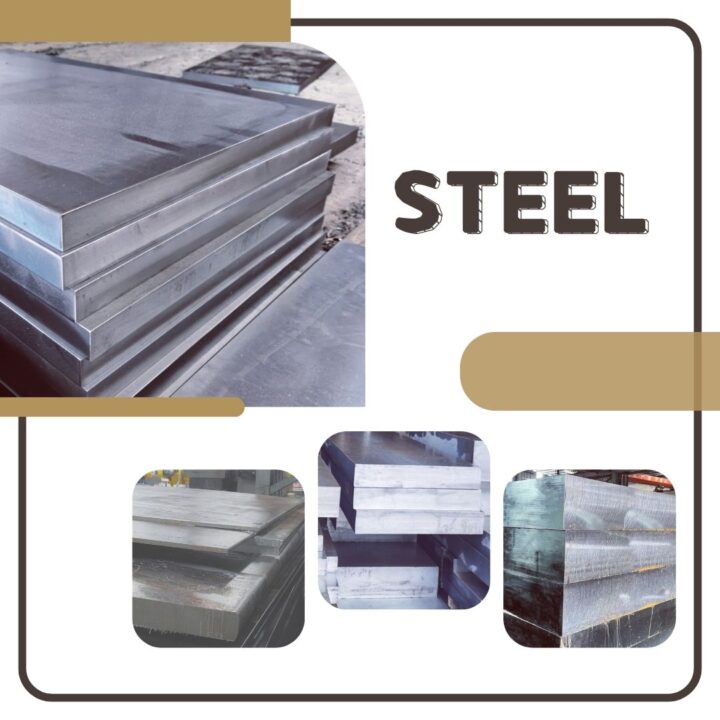
For buyers sourcing 41Cr4 steel plate, stock dimensions and processing options should be checked alongside mechanical properties. A supplier may list a broad thickness range, but the availability of a particular size, quantity, and delivery condition still needs confirmation. Likewise, the fact that a plate can be cut to size does not automatically establish that the cut product will meet a specific tensile-strength requirement.
Confirm the exact dimensions and condition
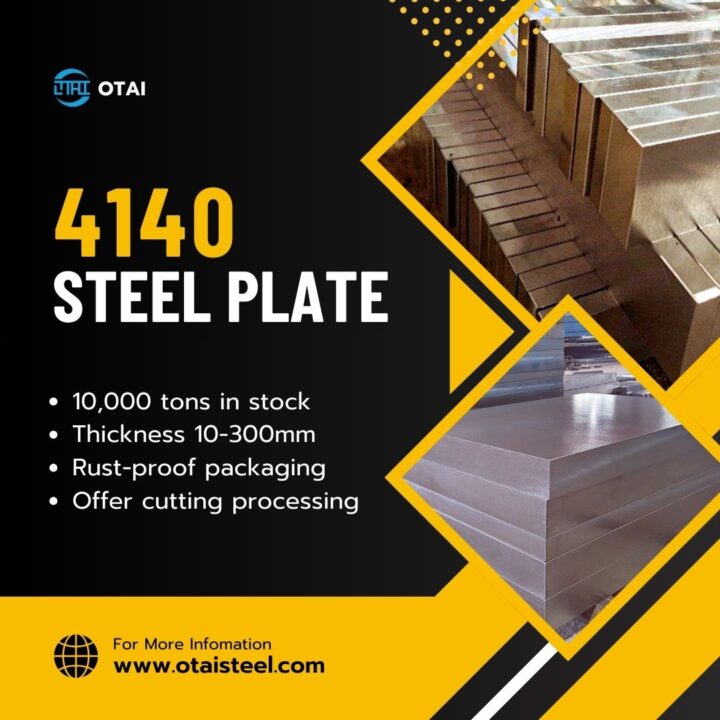
Otai Special Steel’s stated current stock range for 41Cr4 / 5140 steel plate is 4–300 mm thickness. Buyers should confirm the exact grade, size, quantity, and condition available for their order. This range is a stock reference and does not guarantee that every thickness and delivery condition combination is immediately available.
When requesting a quotation, include thickness, width, length, quantity, cutting requirements, and the specified standard. If the application requires +QT mechanical properties, state that condition explicitly and ask the supplier to confirm the relevant property requirements for the requested plate thickness. Do not assume that every plate in the general stock range is already quenched and tempered.
Specify cutting and tolerance requirements
If the supplier will cut plate into smaller pieces, clarify whether the quoted dimensions are saw-cut or finished dimensions. Include required tolerances and machining allowance where relevant. These details help the supplier plan cutting and help the buyer estimate the amount of usable material received.
For precision components, also consider whether subsequent machining or heat treatment may affect final dimensions. Agree on the material condition and the point at which final mechanical properties must be verified. This reduces the risk of confusing incoming stock requirements with finished-component requirements.
Review quality and delivery arrangements
Before placing the order, confirm the certificate scope, material identification, packaging method, and any additional inspection. If the steel will be exported, also clarify shipping terms, destination, and the documents required by the receiving company or customs broker.
A complete quotation should make the scope of supply clear. By comparing technical specifications and commercial terms together, purchasing teams can assess the true value of an offer rather than selecting a supplier based on nominal price alone.
📝 What Buyers Should Include in a 41Cr4 RFQ
A clear request for quotation (RFQ) helps the supplier confirm the right material and reduces avoidable questions during order processing. Instead of asking only for “41Cr4 steel,” specify the technical and commercial details that determine whether the material meets the project requirements.
Essential information for the inquiry
| RFQ item | What to provide | Why it matters |
|---|---|---|
| Grade and standard | 41Cr4 / 1.7035 and applicable standard or edition | Defines the material requirements |
| Product form | Steel plate or other required product form | Determines the relevant product and test provisions |
| Dimensions and quantity | Thickness, width, length, number of pieces, and total weight | Supports stock checks and accurate pricing |
| Delivery condition | Annealed, +QT, or another agreed condition | Affects mechanical properties and processing |
| Mechanical requirements | Tensile strength, yield strength, elongation, hardness, and impact requirements where applicable | Enables direct compliance review |
| Inspection documents | MTC, traceability, ultrasonic testing, or third-party inspection as required | Clarifies quality evidence and extra costs |
| Delivery requirements | Cutting tolerance, packaging, destination, and shipping terms | Improves cost and delivery planning |
Ask for confirmation rather than assumptions
Once the supplier responds, compare the quotation with your drawing and specification. Check that the grade, delivery condition, dimensions, and mechanical-property requirements match. If the quotation offers an alternative grade or condition, ask for the technical difference in writing and obtain approval before proceeding.
For repeat purchases, keep the approved specification and inspection requirements consistent across purchase orders. When the design or delivery condition changes, document the revision. This gives both the buyer and supplier a clear reference for material selection, inspection, and delivery.
🏢 Company Advantages
- Extensive inventory: More than 10,000 tons of stock across the company’s steel supply range. Confirm the specific 41Cr4 grade, dimensions, condition, and quantity before ordering.
- 41Cr4 / 5140 plate range: Current stated plate thickness range of 4–300 mm, subject to confirmation of exact stock and delivery condition.
- Cutting capacity: 20 saw-cutting machines support customer-specified cutting requirements.
- Processing services: CNC machining, grinding, and customized dimensions and tolerances can be discussed according to project needs.
- Quality support: Material documentation, quality testing, ultrasonic testing, and third-party inspection support can be discussed according to the agreed specification.
- Export experience: Supplying international customers since 1999, with exports to more than 54 countries.
- Packaging support: Strapping, bundling, anti-rust protection, and wooden-box packaging can be arranged according to product and shipping requirements.
- One-stop service: Cutting, processing coordination, packaging, and export support can help simplify industrial procurement.
For a quotation, provide the required 41Cr4 dimensions, delivery condition, tensile-strength range, quantity, documentation requirements, and destination. Otai Special Steel can then check the relevant supply options and confirm the services available for your project.
❓ Frequently Asked Questions
1. What is the tensile strength of 41Cr4 steel?
For 41Cr4 in the quenched-and-tempered condition under the EN 10083-3:2006 reference table, tensile strength is 1,000–1,200 MPa for flat products up to 8 mm thick, 900–1,100 MPa for thicknesses over 8 mm to 20 mm, and 800–950 MPa for thicknesses over 20 mm to 60 mm. The applicable standard, product form, and delivery condition must be checked for the actual order.
2. Does 41Cr4 tensile strength depend on heat treatment?
Yes. Annealed or untreated 41Cr4 may have different tensile strength from quenched-and-tempered material. Buyers should identify the required delivery condition and verify the relevant properties against the applicable specification and material test documentation.
3. Why does the tensile strength of 41Cr4 change with plate thickness?
Section size affects heat transfer during quenching and can influence the final microstructure and mechanical properties. Standards therefore specify different property ranges for defined dimensional groups. Do not apply values for thin plate automatically to thicker products.
4. Is 41Cr4 the same as 5140 steel?
41Cr4 and 5140 are commonly treated as related chromium alloy steel grades, but they are not automatically interchangeable for every specification. Compare the governing standards, chemical composition limits, delivery condition, and mechanical-property requirements before approving a substitution.
5. Which documents should I request when buying 41Cr4 steel?
Request the agreed material test certificate with traceability to the supplied material and the relevant chemical and mechanical test results. Depending on the application, you may also need hardness testing, ultrasonic testing, or third-party inspection. State these requirements in the RFQ and confirm them in the quotation.