 4140 Steel Specs: Chemical Composition and Mechanical Properties
📑 Table of Contents
🔍 1. What Are 4140 Steel Specs?
⚙️ 2. 4140 Steel Chemical Composition
📊 3. 4140 Steel Mechanical Properties
🔥 4. 4140 Steel Heat Treatment Specifications
📏 5. 4140 Steel Plate Specifications and Sizes
⚖️ 6. 4140 Steel Equivalent Grades
🏭 7. Applications Based on 4140 Steel Specs
📦 8. Otai Special Steel Advantages
🔍 1. What Are 4140 Steel?
When engineers search for 4140 steel specs, they usually need detailed information about this popular chromium-molybdenum alloy steel, including chemical composition, mechanical properties, hardness, heat treatment conditions and available sizes.
AISI 4140 steel is one of the most widely used alloy steels in mechanical engineering. It provides an excellent combination of strength, toughness, fatigue resistance and wear resistance.
The main reason for its popularity is the balanced alloy design. Chromium improves hardenability and wear resistance, while molybdenum increases strength and toughness at elevated temperatures.
Unlike simple carbon steels, 4140 alloy steel can achieve high mechanical performance after proper heat treatment. This makes it suitable for demanding applications such as shafts, gears, bolts, molds and heavy machinery components.
The following sections explain the most important 4140 steel specifications used by manufacturers and engineers worldwide.
Basic Information of 4140 Steel
| Property | Description |
|---|---|
| Steel Grade | AISI 4140 |
| Steel Type | Chromium-molybdenum alloy steel |
| Standard | ASTM A29 / AISI / SAE |
| Material Number | 1.7225 |
| EN Equivalent | 42CrMo4 |
| Carbon Level | Medium carbon alloy steel |
| Main Features | High strength, toughness and fatigue resistance |
Why Is 4140 Steel Widely Used?
The popularity of 4140 steel comes from its balanced performance. It can provide:
- High tensile strength after heat treatment.
- Excellent impact resistance.
- Good fatigue strength.
- Good machinability in annealed condition.
- Reliable wear resistance.
These characteristics make 4140 a preferred material for components that must withstand high mechanical stress.
⚙️ 2. 4140 Steel Chemical Composition
The chemical composition is one of the most important parts of 4140 steel specs. The alloy elements determine strength, hardenability and heat treatment response.
The main alloying elements in 4140 steel are chromium and molybdenum. These elements give the steel better performance compared with ordinary carbon steels.
4140 Steel Chemical Composition
| Element | Content (%) | Function |
|---|---|---|
| Carbon (C) | 0.38–0.43 | Improves hardness and strength |
| Silicon (Si) | 0.15–0.35 | Deoxidation and strength improvement |
| Manganese (Mn) | 0.75–1.00 | Improves hardenability |
| Phosphorus (P) | ≤0.035 | Controlled for toughness |
| Sulfur (S) | ≤0.040 | Improves machinability |
| Chromium (Cr) | 0.80–1.10 | Improves wear resistance and hardenability |
| Molybdenum (Mo) | 0.15–0.25 | Improves toughness and high-temperature strength |
Role of Main Alloy Elements
| Alloy Element | Effect on 4140 Steel |
|---|---|
| Chromium | Increases hardenability and corrosion resistance |
| Molybdenum | Improves toughness and reduces brittleness |
| Carbon | Provides strength and hardness |
| Manganese | Improves strength and heat treatment response |
The carefully balanced 4140 steel chemical composition allows manufacturers to achieve different mechanical properties through processes such as quenching and tempering.
📊 3. 4140 Steel Mechanical Properties
Mechanical properties are one of the most important parts of 4140 steel specs. Engineers choose 4140 alloy steel because it offers a strong combination of tensile strength, yield strength, hardness and toughness.
The final mechanical performance depends on the heat treatment condition. Quenched and tempered 4140 steel provides much higher strength compared with annealed material.
4140 Steel Mechanical Properties (Typical Values)
| Property | Annealed Condition | Quenched & Tempered Condition |
|---|---|---|
| Tensile Strength | Approx. 655 MPa | 900–1100 MPa |
| Yield Strength | Approx. 415 MPa | 650–950 MPa |
| Elongation | 20%+ | 10–15% |
| Reduction of Area | 50%+ | 40–55% |
| Impact Toughness | Good | Excellent |
| Hardness | 197–229 HB | 28–36 HRC (typical) |
4140 Steel Hardness Specifications
Hardness is an important factor when selecting alloy steel for wear-resistant applications. The hardness of 4140 depends on the supply condition and heat treatment process.
| Condition | Typical Hardness |
|---|---|
| Annealed 4140 Steel | 197–229 HB |
| Normalized 4140 Steel | 217–241 HB |
| Quenched and Tempered | 28–36 HRC |
| Surface Hardened | 50–60 HRC possible |
Why Are 4140 Mechanical Properties Important?
The balanced mechanical performance of 4140 steel allows it to work under demanding conditions.
- High strength: Suitable for heavily loaded components.
- Good toughness: Reduces risk of sudden failure.
- Fatigue resistance: Improves service life under repeated stress.
- Wear resistance: Supports long-term industrial operation.
Because of these advantages, 4140 steel is widely used in automotive, oil and gas, machinery and tooling industries.
🔥 4. 4140 Steel Heat Treatment Specifications
Heat treatment plays a key role in achieving the required 4140 alloy steel mechanical properties.
Due to the chromium and molybdenum alloying elements, 4140 responds very well to quenching and tempering processes.
Typical Heat Treatment Process of 4140 Steel
| Process | Temperature | Purpose |
|---|---|---|
| Annealing | Approx. 800–850°C | Improve machinability and reduce hardness |
| Normalizing | Approx. 870–900°C | Refine grain structure |
| Hardening | Approx. 830–860°C | Create martensitic structure |
| Tempering | Approx. 540–680°C | Adjust strength and toughness |
Effect of Heat Treatment on 4140 Steel Properties
| Heat Treatment | Property Change |
|---|---|
| Annealing | Lower hardness, better machinability |
| Quenching | Higher hardness and strength |
| Tempering | Improved toughness and reduced brittleness |
| Surface Hardening | Improved wear resistance |
Why Does 4140 Respond Well to Heat Treatment?
The chromium and molybdenum contained in 4140 improve hardenability. This allows thicker sections to achieve better mechanical properties after heat treatment.
Compared with ordinary carbon steel, 4140 maintains better strength and toughness after hardening.
This is why ASTM 4140 steel properties are widely recognized in heavy-duty engineering applications.
📏 5. 4140 Steel Plate Specifications and Sizes
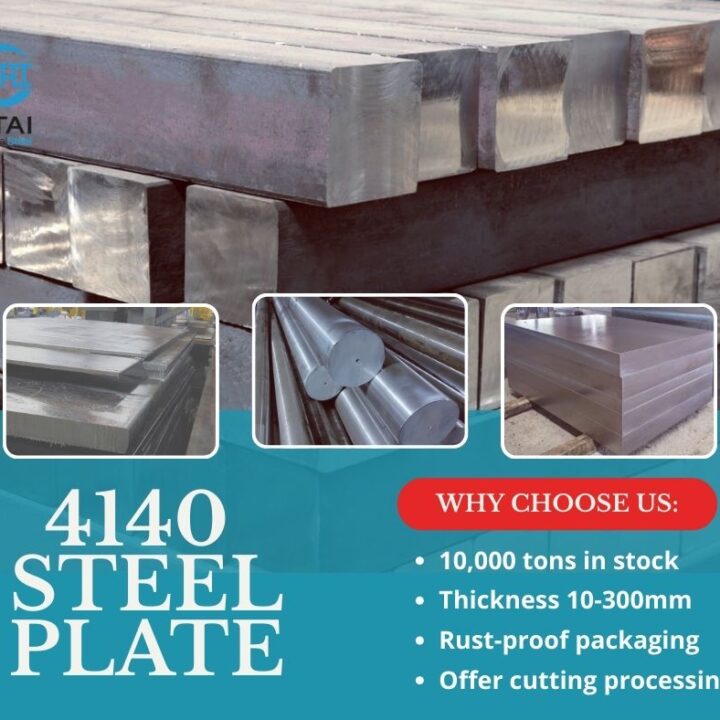
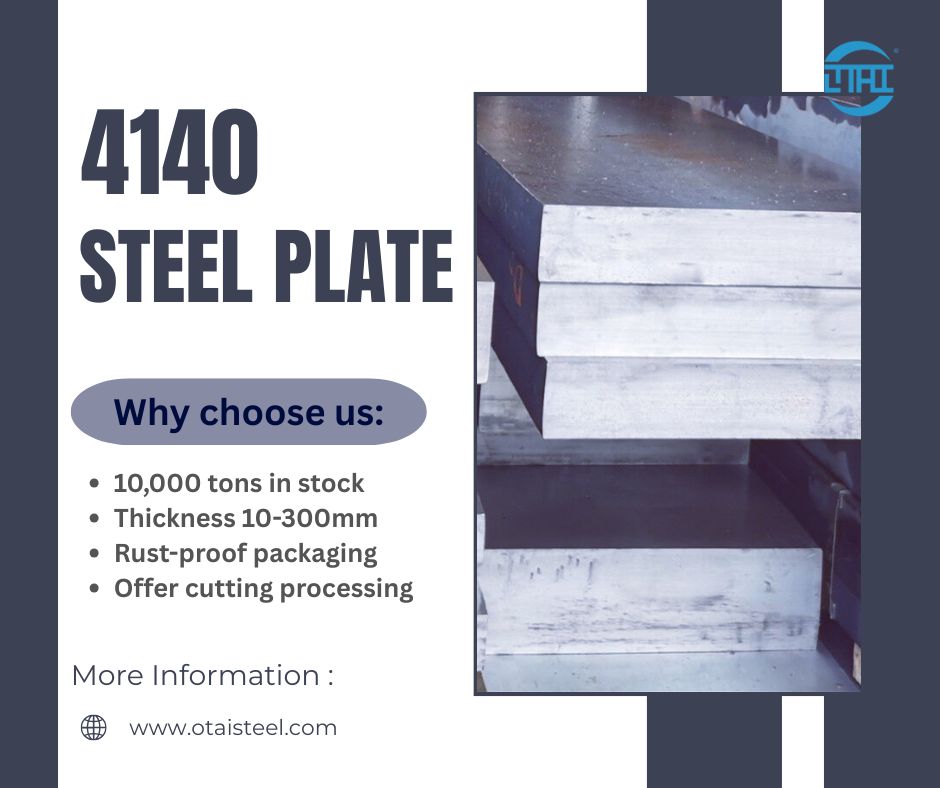
Besides chemical composition and mechanical properties, size availability is another important part of 4140 steel plate specifications.
4140 steel plates are supplied in different thicknesses, widths and lengths according to customer requirements.
Typical 4140 Steel Plate Specifications
| Item | Typical Range |
|---|---|
| Thickness | 6–300 mm |
| Width | 1000–2500 mm |
| Length | 2000–6000 mm |
| Supply Condition | Hot rolled, annealed, Q&T |
| Surface | Black surface, machined, polished |
4140 Steel Processing Options
| Service | Description |
|---|---|
| Cutting | Cutting according to customer drawings |
| Heat Treatment | Annealing, quenching and tempering support |
| Machining | Milling and surface processing available |
| Testing | Ultrasonic testing and third-party inspection |
Selecting the correct size and condition is important because 4140 steel performance depends not only on chemistry but also on processing history.
⚖️ 6. 4140 Steel Equivalent Grades
When purchasing alloy steel internationally, customers often compare different standards. Understanding the equivalent grades is an important part of 4140 steel specs because different countries use different designation systems.
Although equivalent grades have similar chemical compositions, they may not be completely identical. The final performance depends on manufacturing standards, heat treatment condition and quality requirements.
4140 Steel Equivalent Grade Comparison
| Standard | Equivalent Grade | Country / System |
|---|---|---|
| AISI / SAE | 4140 | United States |
| ASTM | A29 4140 | United States |
| EN | 42CrMo4 | Europe |
| DIN | 1.7225 | Germany |
| GB | 42CrMo | China |
| JIS | SCM440 | Japan |
4140 vs 42CrMo4
AISI 4140 and EN 42CrMo4 are the most commonly compared grades. Both are chromium-molybdenum alloy steels with similar applications.
| Property | 4140 | 42CrMo4 |
|---|---|---|
| Steel Type | Cr-Mo alloy steel | Cr-Mo alloy steel |
| Carbon Content | 0.38–0.43% | 0.38–0.45% |
| Strength Level | High | High |
| Main Applications | Shafts, gears, machinery parts | Automotive and engineering components |
For most engineering applications, 4140 and 42CrMo4 can replace each other after confirming the required specifications and testing standards.
🏭 7. Applications Based on 4140 Steel
The excellent combination of strength, toughness and fatigue resistance makes 4140 steel suitable for many industries.
The balanced AISI 4140 steel specs allow this material to perform well in components exposed to high mechanical stress, impact loads and repeated operation.
Common Applications of 4140 Alloy Steel
| Industry | Components | Why 4140 Is Used |
|---|---|---|
| Automotive | Drive shafts, axles, gears | High strength and fatigue resistance |
| Oil & Gas | Drilling tools, couplings, shafts | Excellent toughness under stress |
| Machinery Manufacturing | Machine frames, bolts, rollers | Good wear resistance and strength |
| Mold Industry | Mold bases and structural parts | Good machining and polishing ability |
| Heavy Equipment | Heavy-duty components | Reliable load-bearing performance |
Why Engineers Choose 4140 Steel?
- High strength-to-weight ratio: Suitable for demanding mechanical parts.
- Excellent toughness: Reduces failure risk under impact loading.
- Good machinability: Easy to process before final heat treatment.
- Heat treatment flexibility: Can achieve different hardness levels.
- Wide availability: Available in various plate and bar sizes.
Because of these advantages, 4140 remains one of the most commonly selected alloy steels in global manufacturing.
📦 8. Otai Special Steel Advantages for Steel Supply
For customers searching for reliable 4140 steel plate specifications, material availability and quality control are essential factors.
Otai Special Steel specializes in supplying 4140 alloy steel plates and other special steels for international customers in machinery, automotive and industrial manufacturing industries.
Why Choose Otai Special Steel?
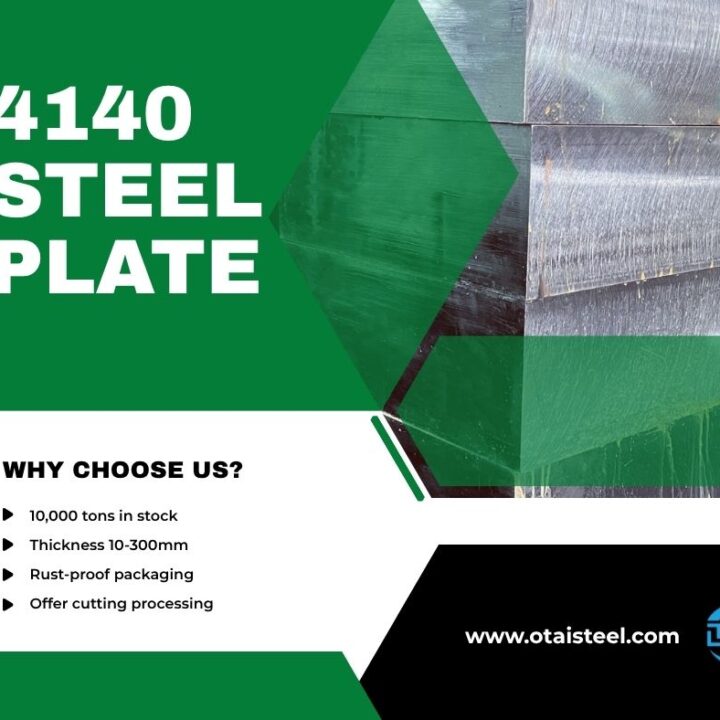
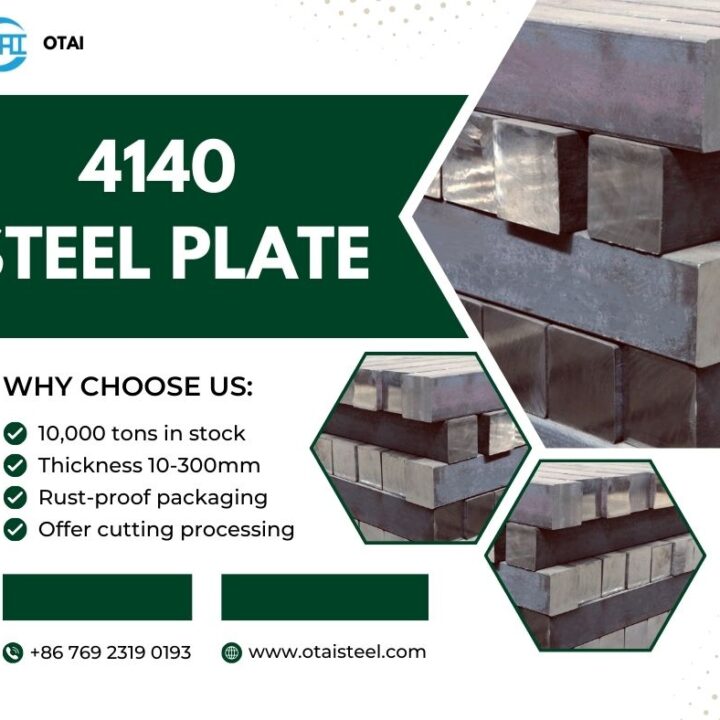
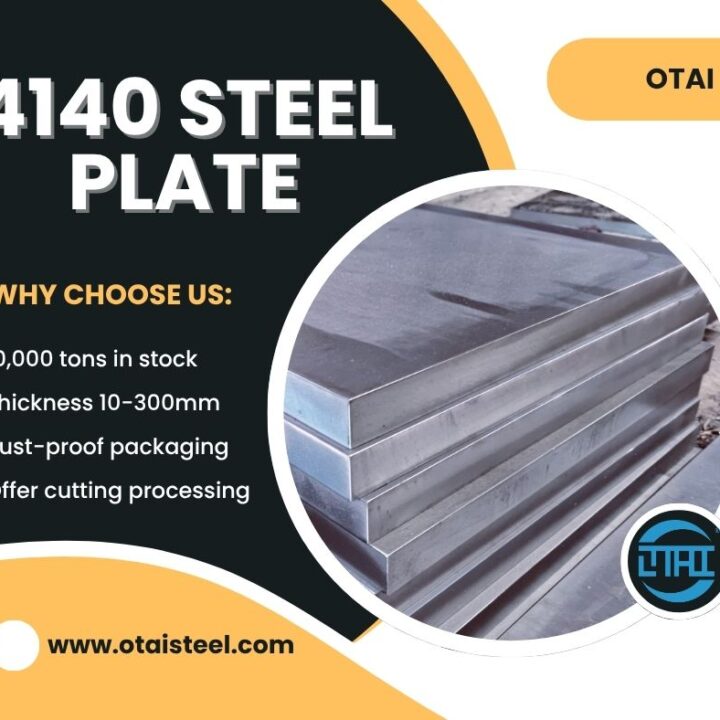
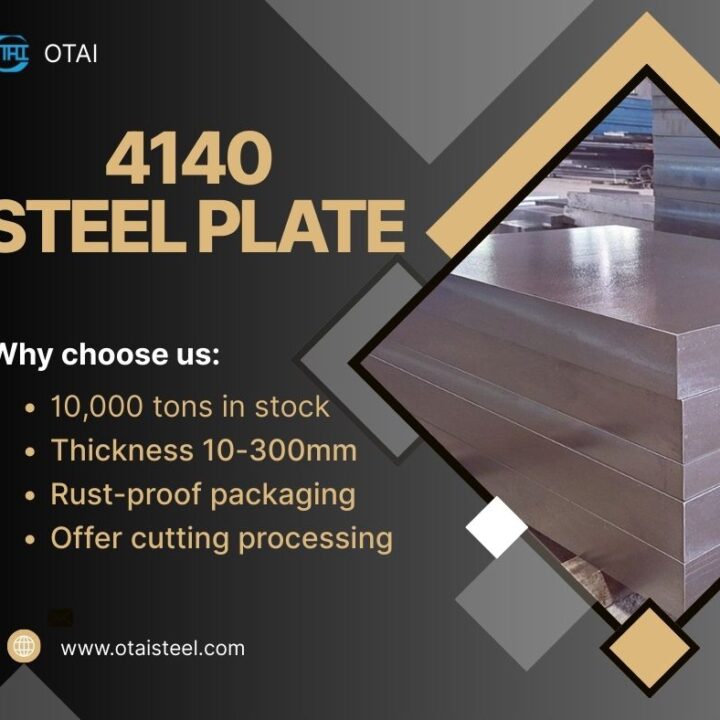
- Large inventory: Otai maintains around 10,000 tons of steel inventory, including different sizes of 4140 steel plates to support urgent production requirements.
- Wide size availability: Various thicknesses and dimensions of 4140 alloy steel are available for different machining applications.
- Processing services: Cutting, machining and customized processing services are available according to customer requirements.
- Heat treatment support: Professional heat treatment solutions help customers achieve required mechanical properties.
- Quality assurance: Ultrasonic testing and third-party inspection can be provided for critical projects.
- Export experience: Otai supplies special steel products to global customers with strict technical requirements.
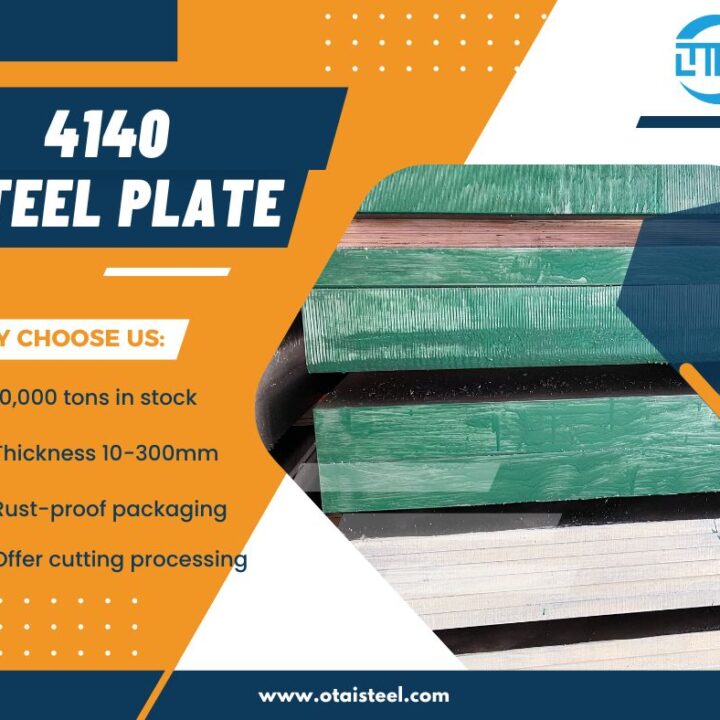
- Professional packaging: Anti-rust protection, steel strapping and wooden box packaging ensure safe transportation.
With professional knowledge of alloy steel materials, Otai helps customers select suitable 4140 steel grades, sizes and conditions according to application requirements.
❓ FAQ
1. What are the main 4140 steel specs?
The main 4140 steel specs include chemical composition, mechanical properties, hardness, heat treatment conditions and available sizes. 4140 is a chromium-molybdenum alloy steel with high strength and toughness.
2. What is the chemical composition of 4140 steel?
4140 steel mainly contains carbon, chromium and molybdenum. Typical composition includes 0.38–0.43% carbon, 0.80–1.10% chromium and 0.15–0.25% molybdenum.
3. What are the mechanical properties of 4140 alloy steel?
After quenching and tempering, 4140 steel can achieve high tensile strength, good toughness and excellent fatigue resistance. Typical tensile strength is around 900–1100 MPa.
4. Is 4140 steel the same as 42CrMo4?
4140 and 42CrMo4 are similar chromium-molybdenum alloy steels and are often considered equivalent grades, but specifications should be confirmed before replacement.
5. Does Otai supply 4140 steel plates?
Yes. Otai supplies 4140 alloy steel plates with different sizes available in stock, supported by cutting service, heat treatment, ultrasonic testing and third-party inspection.