41Cr4 Chemical Composition: Elements, Standards and What Buyers Should Check
📑 Table of Contents
- 🔍 1. Why 41Cr4 Chemical Composition Matters to Buyers
- 🧪 2. 41Cr4 Chemical Composition Under EN Standards
- ⚙️ 3. Carbon and Chromium: The Main Alloying Elements
- 🔬 4. Silicon, Manganese, Phosphorus and Sulfur
- 📋 5. Standard Range, Typical Analysis and MTC Chemistry
- 🌍 6. 41Cr4 Composition Compared with Related Grades
- 🔥 7. How Chemical Composition Affects 41Cr4 Performance
- 📦 8. What Buyers Should Specify When Purchasing 41Cr4
- 🏭 9. Otai 41Cr4 Stock and Supply Support
- ❓ FAQ About 41Cr4 Chemical Composition
🔍 1. Why 41Cr4 Chemical Composition Matters to Buyers
When engineers and purchasing teams evaluate 41Cr4 steel, the grade name provides only the starting point. The chemical composition helps determine how the material responds to heat treatment, how much hardness it can develop, and how it performs in demanding mechanical applications.
41Cr4, also identified by material number 1.7035, belongs to the medium-carbon chromium alloy steel family. Manufacturers commonly use it for shafts, gears, bolts, pins, axles and other components that need a useful combination of strength and toughness.
For procurement teams, chemistry also provides an important quality-control reference. The applicable standard defines the permitted chemical limits, while the Material Test Certificate shows the actual heat analysis of the supplied steel.
Why the grade designation alone is not enough
A purchase request that says only “41Cr4” leaves several technical points open. The supplier still needs to know the applicable standard, product form, dimensions, delivery condition and inspection requirements.
For example, one customer may need annealed 41Cr4 for machining before its own heat treatment. Another project may require quenched-and-tempered material with a defined hardness range. Both requests use the same grade name, but the purchasing specifications differ.
The same principle applies to chemical composition. A standard range describes the acceptable limits. It does not mean that every production heat will contain exactly the same percentage of each element.
What the chemistry tells you
Carbon and chromium have a particularly strong influence on the hardening response of 41Cr4. Manganese and silicon also contribute to the steel’s overall performance, while phosphorus and sulfur remain controlled elements within the applicable specification.
Therefore, buyers should connect chemical requirements with the complete material specification. A practical purchase description should cover grade, standard, chemistry, delivery condition, dimensions, mechanical requirements and inspection documents.
For a broader product overview, you can also review Otai’s 41Cr4 / 1.7035 steel product page.
🧪 2. 41Cr4 Chemical Composition Under EN Standards
Under the commonly referenced EN 10083-3:2006 specification, 41Cr4 contains carbon, silicon, manganese, phosphorus, sulfur and chromium within defined limits. The material number for the grade is 1.7035.
The table below presents the reference composition for 41Cr4 under EN 10083-3:2006. Buyers should always identify the exact product standard in the purchase specification because other standards and product categories can apply different limits.
Reference chemical composition
| Element | 41Cr4, EN 10083-3:2006 | Main Role in the Steel |
|---|---|---|
| Carbon (C) | 0.38–0.45% | Strength and hardening response |
| Silicon (Si) | ≤ 0.40% | Strength and steelmaking effects |
| Manganese (Mn) | 0.60–0.90% | Strength and hardenability |
| Phosphorus (P) | ≤ 0.025% | Controlled residual element |
| Sulfur (S) | ≤ 0.035% | Controlled residual element |
| Chromium (Cr) | 0.90–1.20% | Hardenability and heat-treatment response |
These numbers represent a standard, not one universal chemistry
The figures above describe the composition limits for the cited EN specification. They do not represent one fixed chemical formula for every 41Cr4 product sold worldwide.
Different standards can apply different limits to the same grade designation or related material number. Product form can also affect which technical standard governs the purchase.
For that reason, buyers should write the required standard directly into the RFQ. A clear specification prevents a supplier from interpreting the grade according to a different standard.
Why the standard matters in international purchasing
International buyers often compare 41Cr4 with 5140, SCr440 and 40Cr. Such comparisons can help expand sourcing options, but chemistry tables from different standards do not automatically establish interchangeability.
If the engineering drawing specifies 41Cr4 under an EN standard, the supplier should first confirm compliance with that specification. A comparable grade should enter the discussion only when the customer permits substitution.
⚙️ 3. Carbon and Chromium: The Main Alloying Elements
Carbon and chromium give 41Cr4 much of its characteristic heat-treatment response. Their combined effect makes the grade suitable for many components that need higher strength than ordinary low-carbon structural steel can provide.
Carbon and hardness potential
EN 10083-3:2006 specifies approximately 0.38–0.45% carbon for 41Cr4. This medium carbon level gives the steel useful hardening potential and supports higher strength after suitable heat treatment.
The actual hardness does not depend on carbon alone. Section size, austenitizing conditions, cooling rate and tempering parameters also influence the final microstructure and mechanical properties.
For procurement, this means that buyers should not specify a hardness value without also identifying the required delivery condition. Annealed 41Cr4 and quenched-and-tempered 41Cr4 can show very different hardness levels even though both carry the same grade designation.
Chromium and hardenability
Chromium ranges from approximately 0.90–1.20% under the cited EN specification. This alloying addition improves hardenability and supports the material’s response to quenching and tempering.
The chromium content also contributes to wear-related performance in appropriately heat-treated components. However, 41Cr4 remains an alloy structural steel rather than a stainless steel.
That distinction matters during material selection. The approximately 1% chromium level does not provide the corrosion resistance associated with stainless grades containing much higher chromium levels.
What the MTC should show
When reviewing an MTC, compare the actual carbon and chromium results with the limits in the specified standard. The certificate should identify the heat or cast so that the chemistry remains traceable to the supplied material.
A value near the middle of the permitted range can represent a perfectly compliant heat. Buyers should judge the result against the specification rather than against an arbitrary “ideal” midpoint.
🔬 4. Silicon, Manganese, Phosphorus and Sulfur
Carbon and chromium attract most of the attention in 41Cr4 discussions, but the other specified elements also matter. Buyers should review the complete chemistry instead of focusing on only two alloying elements.
Silicon contributes to strength
EN 10083-3:2006 limits silicon to 0.40% for 41Cr4. Steelmakers use silicon in the production process, and the element also contributes to strength.
The silicon value can therefore help buyers verify whether the supplied heat meets the selected specification. It should not, however, serve as a standalone indicator of material quality.
Manganese supports hardenability
The standard specifies manganese at 0.60–0.90%. Manganese contributes to strength and hardenability and works together with chromium during heat treatment.
When the customer plans to quench and temper a large section, the combined alloy chemistry becomes especially relevant. The heat-treatment shop needs to consider the material’s actual chemistry along with section size and process parameters.
Phosphorus and sulfur require control
The cited EN 10083-3:2006 specification limits phosphorus to 0.025% maximum and sulfur to 0.035% maximum. These elements do not serve as the principal alloying additions in 41Cr4.
Controlled residual elements still matter because they form part of the standard’s chemical requirements. A complete MTC review should therefore include every element listed by the applicable specification.
| Element | Reference Limit | What Buyers Should Consider |
|---|---|---|
| Si | ≤ 0.40% | Check against the applicable standard |
| Mn | 0.60–0.90% | Consider its contribution to hardenability |
| P | ≤ 0.025% | Verify the maximum permitted value |
| S | ≤ 0.035% | Check the actual heat analysis |
A reliable steel supplier should provide the relevant certificate for the actual material rather than asking the buyer to rely on a generic online chemistry table.
📋 5. Standard Range, Typical Analysis and MTC Chemistry
Buyers often encounter three different types of chemical data when researching 41Cr4: standard-specified composition, mill Typical Analysis and actual MTC chemistry. These terms describe different information, so procurement teams should not use them interchangeably.
Standard-specified composition
The material standard establishes the permitted range or maximum limit for each specified element. For example, EN 10083-3:2006 gives 41Cr4 a carbon range of 0.38–0.45% and a chromium range of 0.90–1.20%.
The standard answers one fundamental question: Does the material meet the specified chemical requirement?
That makes the standard the correct starting point for a purchase specification.
Mill Typical Analysis
A steel mill may publish a Typical Analysis to show the chemistry it normally achieves for a particular grade. Such data can help engineers compare materials and understand a supplier’s normal production practice.
However, a Typical Analysis does not represent every production heat. Actual values can move within the permitted specification range while the material remains compliant.
Therefore, buyers should treat Typical Analysis as technical reference data rather than as the contractual chemistry for a specific shipment.
Actual MTC chemistry
The Material Test Certificate provides the actual chemical analysis for the supplied heat. This document gives the buyer the most direct evidence for the material delivered under a specific order.
For quality-controlled projects, the purchasing team should match the heat number on the MTC with the material identification and shipment documentation.
| Data Type | Purpose | Procurement Use |
|---|---|---|
| Standard Range | Defines permitted chemistry | Use it in the material specification |
| Typical Analysis | Shows representative mill chemistry | Use it for technical reference |
| MTC Chemistry | Shows the actual heat analysis | Use it to verify delivered material |
Why this distinction prevents purchasing problems
Different websites can show slightly different 41Cr4 chemistry values because they may reference different standards or product specifications. Instead of asking which website has the “correct” chemistry, buyers should first identify the standard behind each table.
This approach becomes especially important when an international customer compares 41Cr4 with 5140, SCr440 or 40Cr. Similar chemistry does not automatically create contractual equivalence.
🌍 6. 41Cr4 Composition Compared with Related Grades
International procurement teams often compare 41Cr4 with 5140, SCr440 and 40Cr because these grades occupy similar positions among medium-carbon chromium alloy steels. Their compositions share several characteristics, but buyers should not treat them as automatically interchangeable.
Common comparison grades
| Grade | Common Standard | Typical Relationship to 41Cr4 | Buyer Action |
|---|---|---|---|
| 41Cr4 / 1.7035 | EN | Reference grade | Confirm the required EN specification |
| 5140 | ASTM / AISI / SAE | Commonly compared grade | Compare the complete specification |
| SCr440 | JIS G4053 | Commonly compared grade | Check JIS chemistry and properties |
| 40Cr | GB/T 3077 | Commonly compared grade | Confirm GB/T requirements |
Why similar chemistry does not guarantee interchangeability
Two grades can show similar carbon and chromium levels while following different standards. Their permitted phosphorus, sulfur, silicon or manganese levels may also differ.
Mechanical requirements can vary as well. Product form, section size, heat-treatment condition and testing requirements can change the final purchasing specification.
For that reason, a supplier should not replace 41Cr4 with another grade unless the customer or engineer approves the substitution.
41Cr4 and 5140
41Cr4 and 5140 often appear together in international comparison tables. The two grades share a similar alloy concept, but their specified chemical ranges differ. For example, commonly referenced ASTM 5140 data use a lower chromium range than EN 41Cr4.
If a project allows either grade, compare the actual standard, chemistry, mechanical properties and heat-treatment requirements before making the final selection.
🔥 7. How Chemical Composition Affects 41Cr4 Performance
Chemical composition establishes the material’s potential, but the production and heat-treatment process determines the final properties. Buyers should therefore connect the chemistry with the intended manufacturing route.
Heat-treatment response
41Cr4 can develop useful strength and hardness through suitable quenching and tempering. Carbon provides the necessary hardening potential, while chromium and manganese support hardenability.
Otai’s product information lists annealing around 850°C and hardening around 880–920°C followed by oil quenching for its 1.7035 material. These temperatures serve as product-page processing references; the final heat-treatment cycle should match the customer’s section size, equipment, standard and required properties.
Section size can significantly influence the final result. A large component does not cool at the same rate as a small bar, so the heat-treatment shop must consider the complete geometry and process.
Machining condition
The delivery condition also affects machining performance. Annealed 41Cr4 generally provides a more suitable starting condition for customers who plan to machine the material before their own hardening operation.
On the other hand, quenched-and-tempered material can provide defined mechanical properties directly from the supplier. The buyer should therefore decide whether the supplier or the customer’s own facility will perform the final heat treatment.
Surface hardening
Manufacturers can also use 41Cr4 for surface-hardening processes such as induction hardening. The final surface hardness and hardened depth depend on the selected process and component geometry.
When a drawing specifies hardness, clarify whether the requirement applies to the surface, core or complete cross-section. Clear wording helps the steel supplier, heat-treatment company and end user work from the same specification.
📦 8. What Buyers Should Specify When Purchasing 41Cr4
A complete RFQ helps a supplier check stock, confirm compliance and prepare the correct documentation. For 41Cr4, buyers should provide more information than the grade name alone.
Grade and standard
State 41Cr4 / 1.7035 and identify the applicable standard. If the engineering drawing specifies EN 10083-3 or another particular product standard, include that requirement directly in the inquiry.
Product form and dimensions
Tell the supplier whether you need plate, round bar, flat bar, forged material or another form. Include thickness or diameter, width, length, quantity and dimensional tolerances.
These details allow the supplier to compare your requirement with actual stock rather than giving you a general availability statement.
Delivery condition
Specify whether you need annealed, normalized, quenched-and-tempered or another defined condition. The correct condition depends on the manufacturing route and the properties required by the finished component.
Inspection and documentation
List the quality documents required for the project. Depending on the application, the buyer may request an MTC, ultrasonic testing, third-party inspection, dimensional inspection or additional testing.
| RFQ Item | Information to Provide | Why It Matters |
|---|---|---|
| Grade | 41Cr4 / 1.7035 | Identifies the required material |
| Standard | EN or customer specification | Defines chemistry and technical requirements |
| Form | Plate, bar, flat bar or forging | Determines the applicable supply route |
| Dimensions | Thickness/diameter, width and length | Allows an accurate stock check |
| Condition | Annealed, QT or other condition | Affects machining and final properties |
| Quantity | Weight and number of pieces | Supports stock allocation and production planning |
| Inspection | MTC, UT or third-party inspection | Ensures the shipment meets project requirements |
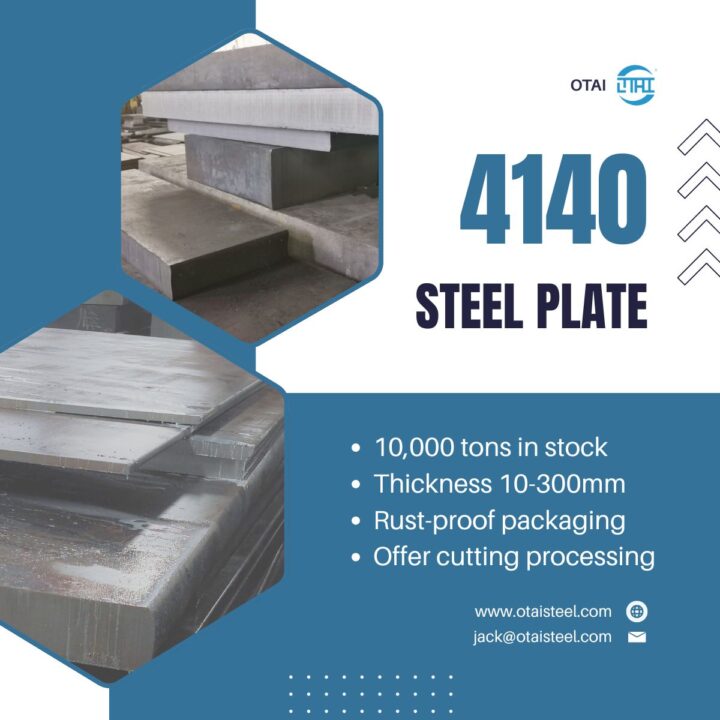
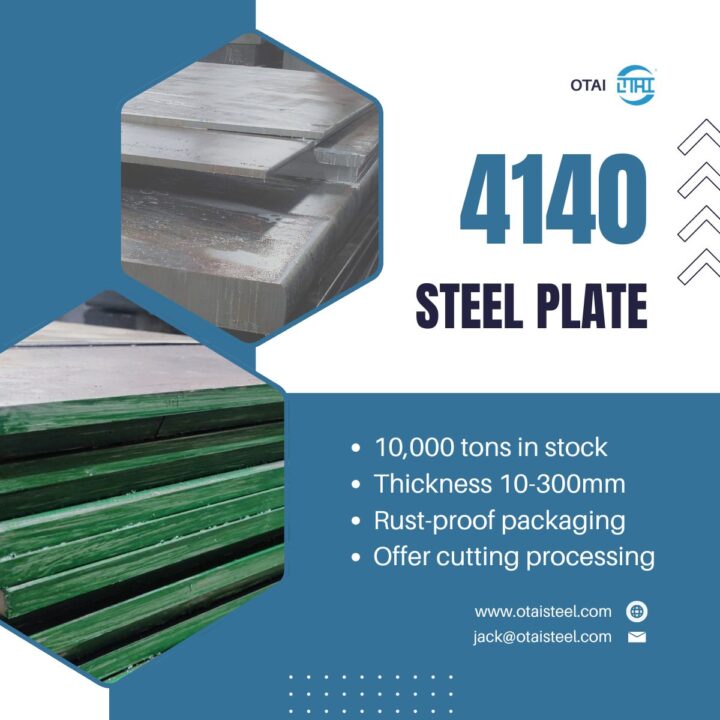
Current 41Cr4 plate stock
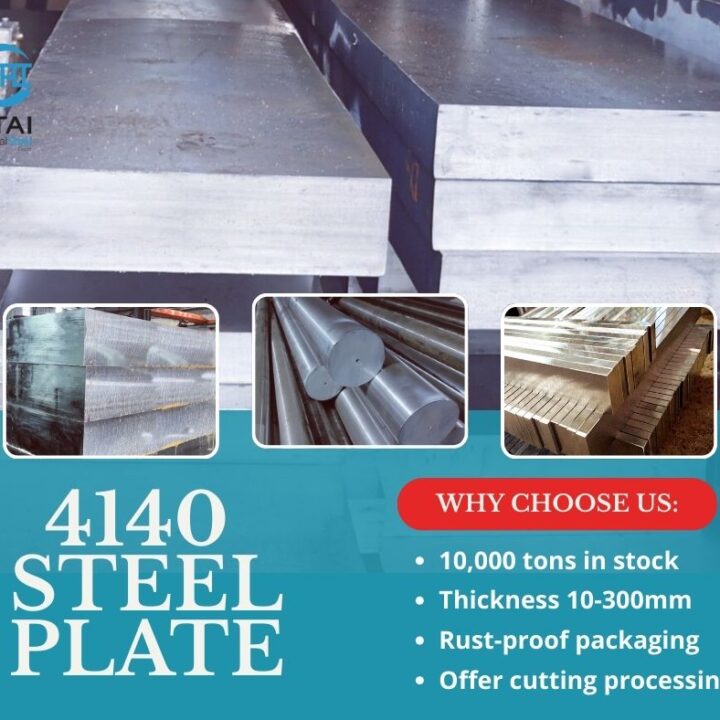
Otai currently has 41Cr4 steel plate in 4–300 mm thickness according to the current inventory information.
This current inventory range represents the stock information provided for the product and should not be confused with older general supply ranges published on a product page. Stock changes with sales and replenishment, so buyers should confirm the exact thickness, width, length, quantity and delivery condition for each order.
For buyers who need cut pieces, the RFQ should also state the required finished dimensions. That information allows the supplier to evaluate cutting requirements and reduce unnecessary material preparation at the customer’s facility.
🏭 9. Otai 41Cr4 Stock and Supply Support
- Current 41Cr4 plate stock: 4–300 mm thickness according to current inventory information.
- 10,000+ tons of steel stock across Otai’s alloy steel and tool steel supply range.
- 20 saw cutting machines for cutting material to customer requirements.
- Custom cutting and processing, including CNC and grinding services where required.
- Quality documentation support for MTC, ultrasonic testing and third-party inspection requirements.
- International export experience since 1999, with customers in more than 54 countries.
- Export packaging including steel strapping, wooden cases and anti-rust protection.
- One-stop supply service covering material sourcing, cutting, processing and shipment coordination.
For a 41Cr4 purchasing project, a supplier should do more than quote a grade and price. The supplier should also help the buyer confirm dimensions, delivery condition, documentation and processing requirements.
When requesting a quotation from Otai, provide the 41Cr4 grade, applicable standard, product form, dimensions, quantity, delivery condition and inspection requirements. If the project requires special cutting, machining, heat treatment or inspection, include those details in the initial inquiry.
❓ FAQ About 41Cr4 Chemical Composition
1. What is the chemical composition of 41Cr4?
Under the commonly referenced EN 10083-3:2006 specification, 41Cr4 contains approximately 0.38–0.45% carbon, up to 0.40% silicon, 0.60–0.90% manganese, up to 0.025% phosphorus, up to 0.035% sulfur and 0.90–1.20% chromium.
2. What is the carbon content of 41Cr4?
EN 10083-3:2006 specifies carbon at approximately 0.38–0.45% for 41Cr4. The actual heat analysis can fall at different points within that range, so buyers should use the MTC to check the chemistry of the supplied material.
3. What is the chromium content of 41Cr4?
The cited EN specification gives a chromium range of approximately 0.90–1.20%. Chromium contributes to hardenability and helps 41Cr4 respond to quenching and tempering.
4. Is 41Cr4 the same as 5140?
41Cr4 and 5140 are commonly compared because they share a similar medium-carbon chromium alloy concept. However, their standards specify different chemical limits. Buyers should compare the complete specification before accepting one grade as a substitute for the other.
5. What 41Cr4 plate thickness does Otai currently stock?
Otai currently has 41Cr4 steel plate in 4–300 mm thickness according to the current inventory information. Exact dimensions, quantity, delivery condition and availability should be confirmed for each inquiry.